What Performance Rating measures
In backgammon, winning a single game does not prove you played well, and losing one does not prove you made a mistake. A lucky sequence of doubles can carry a beginner across the line against a master. To evaluate how well someone actually played, modern backgammon relies on Performance Rating, commonly abbreviated as PR.
Performance Rating measures the average equity lost across all unforced decisions in a match, scaled into an accessible number. The concept was developed alongside computer backgammon engines, which calculate the mathematical equity of every possible legal move. When you make the optimal move according to the neural network, your equity loss is 0.0. When you make a suboptimal play, you forfeit a fraction of a point in equity.
The standard formula translates this accumulated error rate into PR:
$$\text{PR} = (\text{Total Equity Loss} / \text{Unforced Decisions}) \times 500$$
Every turn where you have a genuine choice counts as an unforced decision. Turns where you are on the bar with no legal entry, or where only one legal checker play exists, are excluded so that forced dice rolls do not dilute the measurement. If you play thirty unforced moves in a game and surrender a total of 0.60 in equity, your average equity loss per move is 0.020. Multiplying that average by 500 yields a PR of 10.0.
In tournament analysis, mistakes are categorized by their severity [1]. An error losing between 0.020 and 0.040 in equity is considered an inaccuracy. Any mistake that surrenders 0.080 equity or more is classified as a blunder. Because the multiplier is 500, a single blunder costing 0.08 equity adds 40 PR points to that individual decision. Eliminating blunders is therefore the fastest way to improve your score. Understanding what PR means in backgammon allows you to track genuine progress, separating technical skill from the vagaries of dice rolls.
The competitive benchmark for Performance Rating was codified by the Backgammon Masters Awarding Body (BMAB), which was established in 2014 [2]. The BMAB organizes clocked tournament matches and awards international master titles based on recorded PR rather than tournament podium finishes alone. Under BMAB standards, an Advanced Master must maintain a PR of 8.50 or lower, a Master must achieve 6.50 or lower, a Grandmaster must play at 4.00 or lower, and a Super Grandmaster must achieve 2.50 or lower [3].
Skill tiers and what your rating says
Performance Rating operates like a handicap in golf: a lower number reflects superior accuracy [4]. Because human beings are not computers, nobody plays a complete tournament with a PR of 0.0. Even the strongest grandmasters make small technical errors in complex positions.
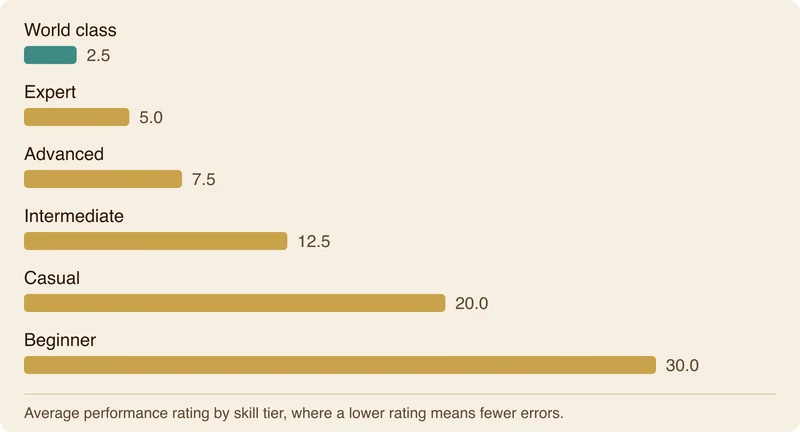
The world-class tier spans ratings from 0.0 to 3.5, averaging roughly 2.5. Players in this echelon rarely make blunders and consistently find the correct positional balances in complex prime-versus-prime struggles. The expert tier covers the range from 3.5 to 6.0, where players execute standard checker play cleanly but occasionally misjudge delicate cube timing or deep anchor positions.
Intermediate and advanced club players generally score between 6.0 and 16.0. An advanced competitor typically scores between 6.0 and 9.0, averaging 7.5. Dedicated club players and intermediate online competitors sit between 9.0 and 16.0, with an average around 12.5. In this band, players know basic opening theory and general tactical guidelines, but frequently give away equity by mismanaging race leads, mistiming cube actions, or leaving careless blots.
Casual and social players usually record a PR between 16.0 and 24.0, with an average around 20.0. Beginners who have recently learned the rules often score 24.0 or higher, frequently averaging around 30.0. At this level, players regularly make multiple blunders per game, such as hitting opposing checkers when it damages their own board structure, or running checkers forward when they are far behind in the race.
Five habits that bring your PR down
Dropping your Performance Rating does not require memorizing thousands of positions. Most double-digit ratings are inflated by five recurring mistakes that can be corrected with disciplined habits.
1. Hesitating on doubling decisions
The doubling cube generates some of the largest equity swings in backgammon. Many advancing players focus entirely on checker movements and treat the cube as an afterthought, leading to massive equity loss.
The most common cube error is waiting too long to double. When you hold an advantageous position with active threats to build a full prime or attack an opponent on the bar, you must often double before rolling. If you wait until your position becomes completely overwhelming, you have lost your market: your opponent will correctly drop your double, depriving you of the chance to play on for a gammon or win twice the stakes. Conversely, accepting doubles in lost positions surrenders immediate equity. Practicing disciplined cube evaluation brings immediate drops in overall error ratings.
2. Abandoning anchors when trailing in the race
When you are trailing in the pip count, your primary defensive asset is a high anchor in your opponent’s home board, such as on their 20-point. An anchor provides a safe landing spot, prevents your opponent from closing their board, and keeps contact alive so you can strike if they leave a blot.
A frequent blunder occurs when players roll a large number and instinctively run their back checkers forward into the outfield, even though they are behind in the race. In a pure race with no contact, a player leading by 10% or more in pips has a commanding advantage [5]. If you break your anchor while trailing, you convert a position with fighting chances into a straightforward running race that you are mathematically favored to lose. Keep your anchor until you are forced off it or until the race equalizes.
3. Hitting reflexively instead of priming
Many players operate under the assumption that hitting an opponent’s checker is always the right play. While sending a checker to the bar gains pips, hitting reflexively often damages your own positional structure.
Before hitting an opponent’s blot, evaluate whether the move advances your strategic game plan. If hitting leaves two loose blots in your own outfield or breaks up your existing blockade, the play may carry a steep equity penalty. Building a solid six-point prime that traps opposing checkers behind a wall is often far stronger than picking up a single checker. Reviewing basic backgammon strategy helps you recognize when constructing a home-board point is superior to an aggressive hit.
4. Leaving loose blots against strong home boards
Risk management in backgammon is directly tied to the strength of your opponent’s home board. Early in the game, when your opponent has only two points established in their home board, leaving a loose blot in the outfield carries modest risk because entering from the bar is easy if you are hit.
The error arises when players continue to play loosely after their opponent has closed four or five home-board points. If you are hit when facing a strong home board, the probability of dancing on the bar increases dramatically, frequently costing multiple turns and risking a gammon loss. When the opposing home board is strong, safety becomes paramount. Slotting points or leaving loose checkers in hazardous zones against a four-point board is a consistent source of blunders.
5. Careless checker distribution during bearoffs
Reaching the bearoff stage with all 15 checkers in your home board feels like the finish line, but improper checker distribution causes unnecessary losses. A common mistake is piling checkers onto low points—such as the 1-point and 2-point—while leaving the higher points bare.
Deeply stacked checkers waste pips and create awkward distribution. More dangerously, if your opponent still holds an anchor in your home board, stripping your higher points forces you to leave direct shots on subsequent turns. Proper bearoff technique requires smoothing your distribution across all home-board points, keeping spare checkers on the higher points so you can bear off smoothly without leaving vulnerable blots. Following the rules of backgammon for legal movement and maintaining checker balance will protect your lead.
How Boardgammon measures your PR
When you play online or review completed matches on Boardgammon, our server analyzes every move using neural network engines, including gnubg and wildbg [1].
Boardgammon separates checker play from doubling cube decisions on your match-analysis sheet. Because cube errors carry large equity penalties that can dwarf subtle checker maneuvers, reporting them apart gives an accurate picture of your technical movement. You can see your exact checker PR, your total blunders, and your cube decisions evaluated independently.
Furthermore, post-match analysis separates your decisions from the luck of the dice. If you rolled poorly while your opponent caught repeated doubles, your equity loss reflects only the quality of the choices you made with the numbers you received. To understand how dice are generated and verified independently on our platform, read our analysis on the fairness of online backgammon dice.
Reviewing your mistakes after each session is the most reliable path toward master-level play. You can test your decision-making and watch your rating improve against human players or computer engines whenever you play backgammon online.
Frequently asked questions about PR
Does a lower PR guarantee that I will win?
A lower PR does not guarantee winning a single game or a short match. Backgammon contains inherent variance, and an opponent who plays with a higher error rate can still win if the dice fall decisively in their favor. Over dozens of games, however, the player with the lower PR wins the vast majority of matches.
Can a human player achieve a PR of 0.0?
In a very short game with straightforward rolls, a player can occasionally record a PR of 0.0 by making the engine’s top choice on every turn. Over a multi-game match, however, positions become too complex for flawless human play, and even elite grandmasters finish with ratings between 0.0 and 3.5.
Sources
- Boardgammon. The server-authoritative match analysis and error evaluation code in server/internal/matchanalysis/.
- Backgammon Masters Awarding Body (BMAB). “About BMAB.” Explains the performance rating system for backgammon matches.
- Backgammon Masters Awarding Body (BMAB). “Titles and Standards.” Defines the PR thresholds for Super Grandmaster, Grandmaster, Master, and Advanced master titles.
- Boardgammon. “Backgammon skill levels and PR.”
- Boardgammon. “Backgammon strategy and concepts.”
- Boardgammon. “Backgammon rules.”
Found a mistake or an odd phrase? Tell us