Why backgammon has exactly 15 opening rolls
Every backgammon game begins with a roll-off. Each player casts a single die into their right-hand table, and the player who rolls the higher number takes the opening turn. If both dice show the same number, the roll is tied, the dice are picked up, and both players roll again until the numbers differ.
Because tied rolls are immediately re-rolled, the opening turn can never be played with doubles. Out of the 36 possible outcomes of two six-sided dice, the six doubles (1-1, 2-2, 3-3, 4-4, 5-5, and 6-6) are completely ruled out on move one [1]. That leaves exactly 30 unequal outcomes. Since dice order does not change the numbers available to the player—rolling a 3 and a 1 gives the exact same checker choices as rolling a 1 and a 3—those 30 outcomes group into exactly 15 unique pairs.
Memorizing the best move for each of the 15 opening rolls is widely regarded as the highest-return hour of study in backgammon. Unlike chess, where deep opening repertoires branch into thousands of variations before move five, backgammon begins from the identical starting position in every standard game. These 15 positions are the only board layouts you are guaranteed to encounter every single time you sit down to play.
Understanding how to play them correctly establishes early board control, keeps your back checkers mobile, and prevents avoidable equity leaks that degrade your overall performance rating (PR).
The rapid explosion of possibilities
The starting position in backgammon is deceptive in its simplicity. With only 15 possible initial rolls, players might expect opening theory to remain narrow for several turns. Yet backgammon branches with astonishing speed.
On the second turn of the game, doubles become legal. The second player faces 21 distinct dice combinations (the 15 unequal pairs plus the six doubles) [1]. When combined with multiple candidate moves for each roll, the number of distinct game paths multiplies exponentially. By the third turn of the match, the decision tree expands to about 25,000 distinct board possibilities [1].
This explosive branching means that standard book openings cannot be memorized beyond the first few plies. The opening roll is your only opportunity to execute a purely prepared move free from the complicating tactical noise of prior hits, anchors, and scattered blots. Making a fundamentally sound opening play ensures that when that branching explosion arrives, your army is balanced between offense and defense.
The four point-makers
Four opening rolls allow you to create a secure point on the board immediately, using two checkers to occupy a previously open point without leaving an exposed blot anywhere on the playing surface. In backgammon strategy, point-making rolls are prized because they simultaneously improve your board strength and deny valuable landing squares to your opponent.
1. Roll 3-1: Making the 5-point (8/5 6/5)
The roll of 3-1 is universally acknowledged as the single finest opening roll in backgammon [2]. The correct play is 8/5 6/5, bringing one checker from the 8-point and one from the 6-point to secure the 5-point in your home board.
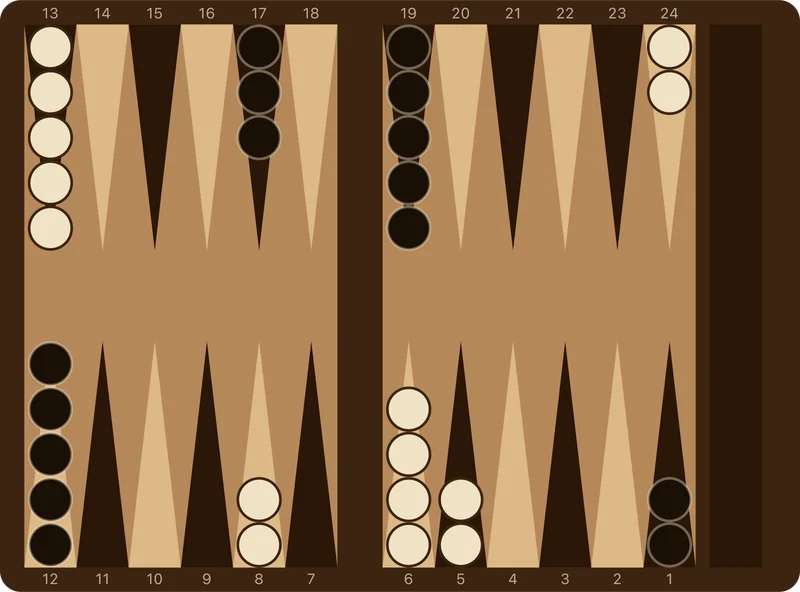
The 5-point is known throughout backgammon culture as the “golden point.” Securing it gives you an advanced anchor in your home board, extends your prime toward the bar-point, and severely hampers your opponent’s ability to enter from the roof if they are hit later in the game. In rollout evaluations by modern neural network engines, playing 8/5 6/5 gains roughly 0.23 in equity over the second-best candidate move [2]. In a game where small tactical advantages are measured in thousandths of a point of equity, a 0.23 margin on move one is a massive head start.
2. Roll 4-2: Making the 4-point (8/4 6/4)
The roll of 4-2 plays 8/4 6/4, claiming the 4-point in your home board. While slightly less commanding than the golden 5-point, securing the 4-point establishes a two-point home board from the first turn. It creates a solid foundation for future priming structures and leaves no loose blots for your opponent to target on their opening reply.
3. Roll 6-1: Making the bar-point (13/7 8/7)
With 6-1, the standard move is 13/7 8/7, constructing the 7-point, commonly called the bar-point. The bar-point sits directly outside your home board. Making this point creates a barrier that blocks your opponent’s back checkers from escaping with a direct roll of 6. It also serves as a crucial staging post for checkers circulating around the outfield into your inner quadrant.
4. Roll 5-3: Making the 3-point (8/3 6/3)
The roll of 5-3 is played 8/3 6/3, securing the 3-point deep inside your home board. Although modern strategy prefers building points higher up in the home board (the 5-point and 4-point) before making deep points, 5-3 still constructs an unassailable home point with zero risk. It provides an immediate asset that strengthens your board in any future hitting battle.
The pure runner: 6-5 (Lover’s Leap)
Only one opening roll allows you to run a back checker completely to safety on turn one. That roll is 6-5.
In classic backgammon lore dating back centuries, 6-5 is known as the “Lover’s Leap” [1]. The move is 24/13, taking one of your two back checkers on the 24-point and advancing it 11 pips across the board to land directly on your midpoint.
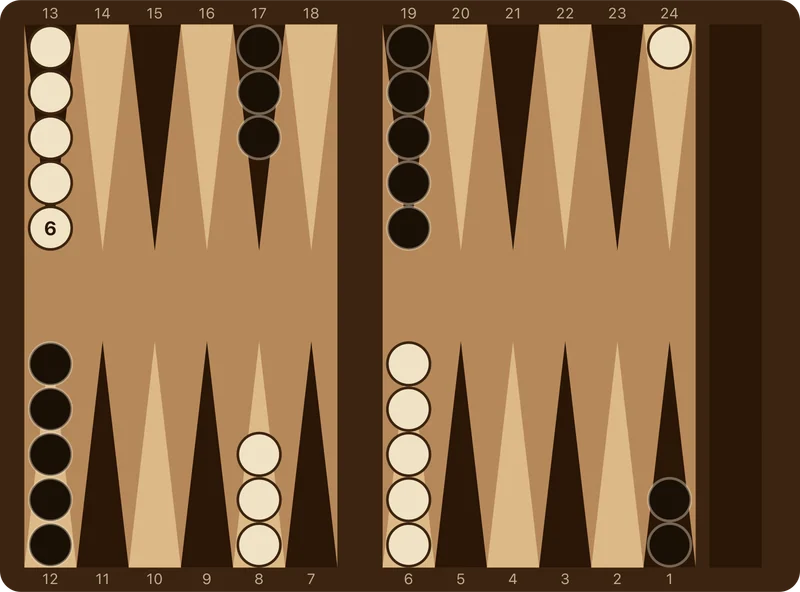
Lover’s Leap is unique among opening moves. It does not build an inner-board point, nor does it stage builders in your outfield. Instead, it solves half of your back-checker problem in a single bound. The checker travels from deep in enemy territory to join your five-checker stack on the 13-point without being exposed to any direct or indirect shots. It immediately reduces your pip count, putting you ahead in the race, which matters later when bearing off without losing, and leaves only a single straggler on the 24-point for your opponent to attack.
The split-and-build rolls
When the dice do not allow you to make a point or execute the Lover’s Leap, you must navigate rolls that cannot accomplish both safety and progress simultaneously. These are the split-and-build rolls: 5-4, 6-3, 6-2, 5-1, 4-1, and 2-1.
A split-and-build move divides your resources between two vital strategic objectives:
- Splitting the back checkers: Advancing one checker from your 24-point into the opponent’s home board (to the 23-point, 21-point, or 20-point) or into their outfield (the 18-point).
- Bringing down a builder: Moving a checker from your midpoint on the 13-point into your outfield (points 8, 9, 10, or 11).
The strategic logic of splitting
Leaving two checkers bundled together on the 24-point leaves you passive. An opponent who rolls a point-maker can quickly build a multi-point prime in front of you, trapping your checkers behind a wall. By splitting one checker forward, you contest key landing squares.
If you split to the opponent’s 20-point (with a 4 on a roll of 5-4) or to the 18-point (with a 6 on 6-3 or 6-2), you threaten to make an advanced anchor on your next turn. An advanced anchor provides permanent security, preventing your opponent from closing out their home board and offering an escape hatch if you are forced into a defensive holding game.
Splitting to the 23-point (a minor split using a 1 on rolls like 5-1, 4-1, or 2-1) is more subtle. It gives your back checker greater reach across the board while keeping it relatively deep. If your opponent hits the blot on the 23-point, they must use valuable pips to do so, often at the cost of breaking up their own outfield distribution.
The power of outfield builders
Meanwhile, the second part of the roll brings a builder down from your heavy stack of five checkers on the 13-point. Placing a builder on the 8-point, 9-point, 10-point, or 11-point diversifies your good rolls for turn two. Instead of needing one specific die combination to make your 5-point or 4-point, having active builders spread across the outfield gives you multiple intersecting numbers that can hit opposing blots or construct new defensive points on your subsequent turn according to backgammon strategy.
The standard modern consensus plays for the split-and-build rolls are:
- 5-4: 24/20 13/8 (advances to the valuable 20-point while adding a builder to the 8-point).
- 6-3: 24/18 13/10 (splits to the opponent’s bar-point while placing a builder on the 10-point).
- 6-2: 24/18 13/11 (splits to the 18-point while placing a builder on the 11-point).
- 5-1: 24/23 13/8 (minor split to 23, builder to 8).
- 4-1: 24/23 13/9 (minor split to 23, builder to 9).
- 2-1: 24/23 13/11 (minor split to 23, builder to 11).
The two-down builders: 5-2 and 3-2
Two opening rolls offer an alternative philosophy: instead of splitting a back checker, you bring two checkers down from the midpoint into your outfield. These are the “two-down” rolls.
On 5-2, the traditional play was 13/8 13/11, bringing two builders down into the outfield. This leaves two exposed blots, but both sit far out of direct hitting range of the opponent’s starting checkers on the 24-point. Modern computer rollouts have demonstrated that 24/22 13/8 (splitting the back checkers to the 22-point) is an equally viable alternative, but bringing two down remains a respected, aggressive way to fight for board supremacy.
On 3-2, the consensus rollout play is 13/11 13/10, pulling two checkers off the midpoint and distributing them cleanly across points 10 and 11. Together with your spare checkers on the 8-point and 6-point, you now command an array of five builders aimed directly at your inner board. Over 25 of the 36 possible rolls on your second turn will allow you to make a key home point. An alternative play, 24/21 13/11, splits to the 21-point while bringing down one builder, trading offensive board-building power for defensive anchor preparation.
The flexible choice rolls: 6-4 and 4-3
Two opening rolls present such balanced strategic merits across different styles that modern computer rollouts rate multiple candidate plays in a virtual tie.
The famous 6-4 three-way tie
For decades, backgammon theorists argued passionately over the correct play for 6-4. Some advocated running the back checker out into the outfield with 24/14. Others favored the classical split-and-build move, 24/18 13/9. Meanwhile, old-school traditionalists dismissed making the deep 2-point with 8/2 6/2 as crude and inefficient.
When self-trained neural network engines analyzed millions of rollout iterations, they produced an unexpected verdict: all three plays are effectively equal [2]. In modern rollout consensus, running 24/14, splitting and building with 24/18 13/9, and making the 2-point with 8/2 6/2 all finish within approximately 0.004 equity of each other [2].
This discovery liberated tournament players. If you prefer a quiet, structural game with zero blots, making the 2-point with 8/2 6/2 is fully justified. If you want to challenge for an advanced outfield anchor, 24/18 13/9 is ideal. If you want to break contact and race, 24/14 is equally sound.
The variations on 4-3
A similar flexibility applies to 4-3. You can bring two builders down with 13/10 13/9, maximizing offensive development. Alternatively, you can play 24/21 13/9 (splitting to the 21-point) or 24/20 13/10 (splitting to the 20-point). Rollout margins between these options are microscopic, allowing players to tailor their opening choice to their preferred match strategy.
How neural networks changed opening theory
Before the advent of computer analysis in the 1990s, opening theory was guided by expert consensus and published books [1]. By the early 1980s, top human players had settled on rigid guidelines for almost every roll [1]. Many of those guidelines turned out to be flawed.
The most dramatic shift occurred in the treatment of “slotting.” In pre-bot backgammon, slotting the 5-point on opening rolls like 5-1 (played 13/8 6/5) and 4-1 (played 13/9 6/5) was standard practice among aggressive masters. The rationale was that the 5-point is so valuable that leaving a direct blot on it was worth the risk. If the blot survived, you were almost guaranteed to cover it on your next turn and secure the golden point.
When neural networks like TD-Gammon and JellyFish conducted extensive rollouts playing positions out hundreds of thousands of times, they proved that slotting on move one is a blunder [1]. When your opponent rolls a direct hit (any roll containing a 1, plus combinations that total 4 or 3), the loss of equity from having a checker sent to the bar far outweighs the potential reward of securing the point. Modern opening theory has completely abandoned slotting on 5-1 and 4-1 in favor of split-and-build plays.
Computer rollouts also rehabilitated plays that human experts had mocked, including making the 2-point on 6-4 and splitting to the 22-point on 5-2. Today, opening choices are grounded in objective mathematical equity rather than stylistic dogma.
Summary table of the 15 opening rolls
The following reference table outlines the modern rollout consensus for all 15 backgammon opening rolls in money play, listing the preferred play alongside recognized close alternatives:
| Roll | Preferred Play | Strategic Type | Close Alternatives |
|---|---|---|---|
| 3-1 | 8/5 6/5 | Point-maker | None (decisive best play) |
| 4-2 | 8/4 6/4 | Point-maker | None |
| 6-1 | 13/7 8/7 | Point-maker | None |
| 5-3 | 8/3 6/3 | Point-maker | None |
| 6-5 | 24/13 | Pure runner | None (Lover’s Leap) |
| 5-4 | 24/20 13/8 | Split and build | 13/9 13/8 (two down) |
| 6-4 | 24/18 13/9 | Flexible choice | 8/2 6/2 (make 2-pt) · 24/14 (run) |
| 6-3 | 24/18 13/10 | Split and build | 24/15 (run) |
| 6-2 | 24/18 13/11 | Split and build | None |
| 5-2 | 24/22 13/8 | Split and build | 13/8 13/11 (two down) |
| 5-1 | 24/23 13/8 | Split and build | None (slotting 6/5 is inferior) |
| 4-1 | 24/23 13/9 | Split and build | None (slotting 6/5 is inferior) |
| 3-2 | 24/21 13/11 | Split and build | 13/11 13/10 (two down) |
| 4-3 | 13/10 13/9 | Two down | 24/21 13/9 · 24/20 13/10 |
| 2-1 | 24/23 13/11 | Split and build | 13/11 6/5 (slotting) |
Looking ahead: Opening replies and match context
Executing the correct opening roll is only the first step. On the very next roll, your opponent must choose an opening reply.
While there are only 15 opening moves, there are over 600 possible opening replies on move two once all possible second-roll dice combinations and candidate plays are taken into account [1]. First systematically catalogued by Joe Dwek in 1976 [3], opening replies require evaluating whether to hit an opponent’s split checker, make a new point of your own, or split in response.
Furthermore, match score alters opening decisions. In money play, maximizing average point equity with gammon potential is paramount. But in tournament match play, specific score situations dictate different priorities. At “gammon-go” (where winning a gammon gives you the match, but losing one costs nothing extra), aggressive openings with higher volatility become optimal. Conversely, at “gammon-save,” conservative plays that minimize blot exposure take precedence.
Reviewing your opening moves with an engine after each game is the fastest path to refining your intuition. By mastering all 15 opening rolls, you ensure that every match begins on sound strategic footing, setting up favorable positions for middlegame bearing off and endgame cube decisions in accordance with the rules of backgammon and structured backgammon lessons.
Questions people ask
Why are there no doubles on the opening roll?
The opening move in backgammon is decided by a roll-off where each player throws one die. If the dice tie, the roll is void and both players roll again until they show different numbers. The player who rolls higher plays the combined numbers on both dice. Because the numbers must differ for someone to win the roll-off, the opening move can never be played with doubles.
What is the single best opening roll in backgammon?
The best opening roll is 3-1, played 8/5 6/5. This move secures the 5-point (the golden point) in your home board without leaving an exposed blot. It gains approximately 0.23 in equity over any alternative play, giving you an immediate structural advantage in both offense and defense.
What is Lover’s Leap in backgammon?
Lover’s Leap is the traditional name for the opening roll of 6-5 played 24/13. It advances one of your two back checkers from the opponent’s 1-point (the 24-point) directly across the board to the safety of your midpoint on the 13-point. It is the only opening roll that allows a checker to escape the opponent’s home board safely on move one.
Is it ever correct to slot the 5-point on the opening move?
In modern backgammon theory, slotting the 5-point on move one (such as playing 13/8 6/5 on a roll of 5-1) is considered a tactical error. Extensive computer rollouts demonstrate that the risk of being hit on the exposed 5-point blot far outweighs the reward of making the point on the next turn. Split-and-build plays like 24/23 13/8 are consistently superior.
Sources
- Wikipedia. “Backgammon opening theory.” Overview of the 15 opening moves, computer rollouts, and branching factor.
- Boardgammon. “Backgammon Opening Rolls — Best Play for All 15.”
- Joe Dwek. Backgammon for Profit. 1976.
- Boardgammon. “Backgammon Strategy Guide.”
- Boardgammon. “Backgammon Rules: Starting the game, checker movement, and bearing off.”
Found a mistake or an odd phrase? Tell us