Why do backgammon programs keep getting accused of cheating?
The suspicion that the dice are rigged is not new. In September 1991 a player wrote to the backgammon newsgroup about a program called Gammontool: “I always felt it cheated, but I have access to the source code and it has no bias to the side rolling.”[1] In 1997 Gerry Tesauro, the author of the program TD-Gammon, wrote that people were “suspicious not only of TD-Gammon, but basically all programs that are good enough” to win a lot of games[2]. The manual of the program GNU Backgammon has a section headed “I think the bot is cheating. It always gets good dice.”[3]
So the feeling is common, and it settles nothing. A program can be honest and still feel crooked. A program can also be crooked, and unless it shows its work you cannot tell which.
We run a backgammon server and have an interest in the answer. So here are two kinds of evidence, and what each is worth. One is our own count of rolls from online games played here, which you have to take on our word. The other is the record that lets you recompute a single roll yourself; the box on our provably fair dice page opens it for a game you have played.
How often should doubles come in a row?
More often than it feels. Two dice can land 36 ways and six of those are doubles, so one roll in six is a double. A double also moves you twice as far, because you play the number four times (the rules of backgammon explain how).
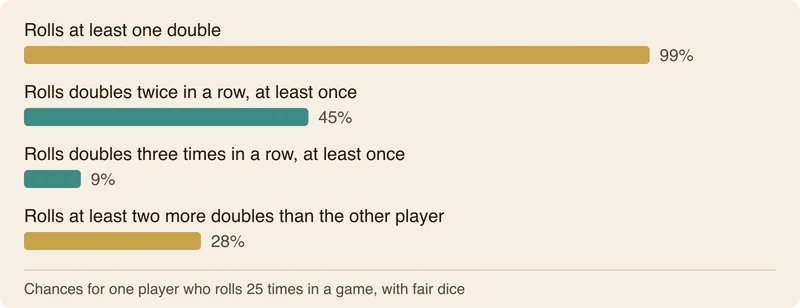
Take a game in which each player rolls 25 times. With fair dice:
- Your opponent rolls about four doubles on average.
- The chance that they roll doubles twice in a row at least once is about 45%.
- The chance that they roll doubles three times in a row is about 9%, roughly one game in 12.
- The chance that they roll at least two more doubles than you is about 28%.
The same numbers hold for you. Play 20 such games and the chance that some opponent rolls three doubles in a row against you is about 84%. Every regular player has that story.
These chances are exact, not estimates: we added up every way 25 rolls can fall[4].
Why do fair dice feel unfair?
Because people expect chance to be tidier than it is. A 1991 paper that summed up the research on how people judge random series put it this way: people “see clumps or streaks in truly random series and expect more alternation, or shorter runs, than are there.”[5]
In a study published in 1985, researchers showed 100 basketball fans six rows of hits and misses and asked them to label each one as chance, streaky or alternating. One row switched between hit and miss about as often as a tossed coin would. Only 32% of the fans called that row chance, and 62% called it streak shooting[6]. The rows they picked as the best examples of chance switched far more often than a coin does.
That study was about basketball shots, not dice. Its main conclusion, that players do not really get hot, was challenged by a 2018 reanalysis, which found that it reverses once a bias in the measure is corrected[7]. So we use only its smaller finding, about how people read a row of results.
Chance also seems to owe you something. Daniel Kahneman and Amos Tversky put it in one line in 1972: “People view chance as unpredictable but essentially fair.”[8] They meant that people expect even a short run of coin tosses to come out about even. Dice have no memory, though. After three bad rolls you are not due a good one.
Bad events also have more impact than good events of the same kind, a 2001 review of psychology research concluded[9]. One study it describes had people bet on sports games. A week later they spent more time talking about the games they had lost than about those they had won. The review does not mention backgammon or dice, so what follows is our reading and not a finding: the double that beat you gets more of your attention than the double that saved you.
What did 438,679 of our rolls look like?
Now for our own dice. We counted every roll on record from every online game a person played in, from May 18 to October 10, 2026, and read the record on October 11. That came to 438,679 rolls, or 877,358 dice[10].
Start with doubles. Fair dice give a double on 16.67% of rolls. Ours gave 73,179 doubles, which is 16.68%. The six doubles were not equally common, as the chart shows.
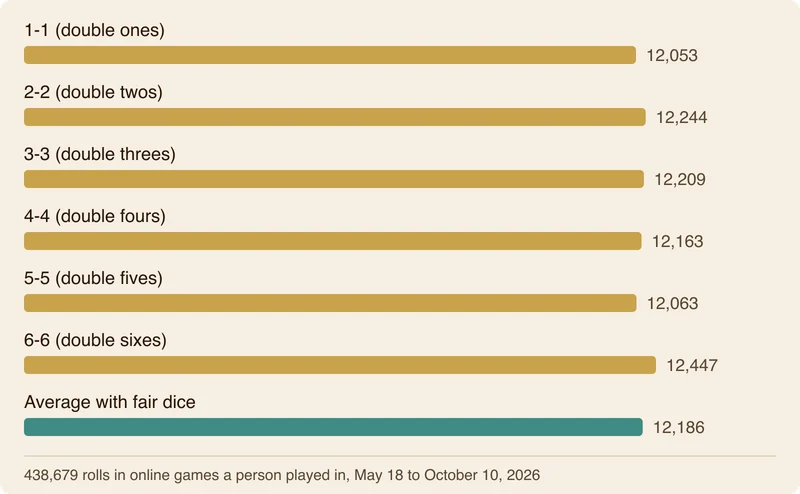
Now every outcome. If you tell the two dice apart, a roll can land 36 ways, and fair dice give each way the same chance: about 12,186 times in a count this size. Here are all 36, so that you can run the test yourself. Rows are the first die and columns the second.
| First die | 1 | 2 | 3 | 4 | 5 | 6 |
|---|---|---|---|---|---|---|
| 1 | 12,053 | 12,005 | 12,222 | 12,134 | 12,225 | 12,188 |
| 2 | 12,049 | 12,244 | 12,386 | 12,165 | 12,256 | 12,299 |
| 3 | 12,193 | 12,311 | 12,209 | 11,973 | 12,178 | 12,082 |
| 4 | 12,242 | 12,303 | 12,207 | 12,163 | 12,161 | 12,127 |
| 5 | 12,268 | 12,053 | 12,008 | 12,015 | 12,063 | 12,389 |
| 6 | 12,179 | 12,311 | 12,301 | 11,993 | 12,277 | 12,447 |
The rarest outcome came up 11,973 times. The most common was double sixes at 12,447, which is 2.1% more than fair dice would average.
Some spread is what chance produces. Is this one too wide? A standard test for that, the chi-square test, says it is not: fair dice would give a table at least this uneven about 19 times in 100. (For statisticians: 42.25 on 35 degrees of freedom, p = 0.19.) Some outcome has to come top, and with fair dice the top one is at least as far above average as our double sixes in about one count in four.
The six faces are less even. Each face should turn up on 16.67% of dice. Fours were lowest at 16.60% and sixes highest at 16.76%.
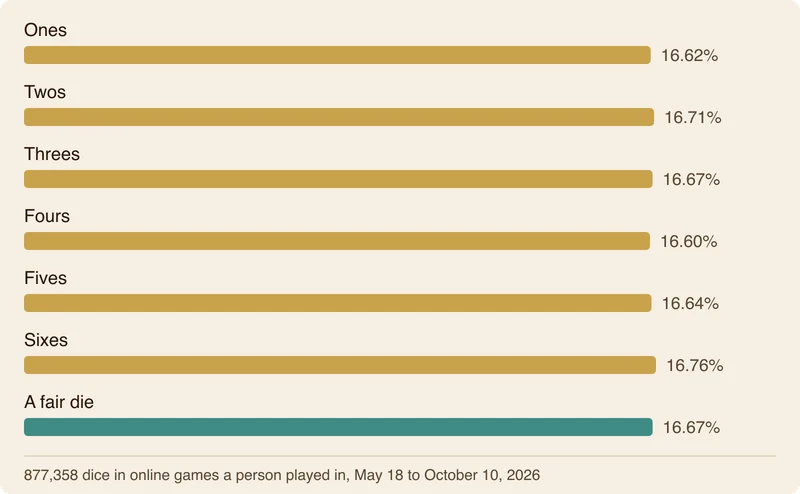
Does that mean the dice lean toward sixes? This count cannot say so. Tested as a set of six, a spread at least this wide turns up about 9 times in 100 with fair dice (9.62 on 5 degrees of freedom, p = 0.09). That is uncommon, and it is not rare.
Sixes look worse if you single them out. A face named before the count would stray this far from its share only about 2 times in 100. But nobody named sixes beforehand. Pick out, after the fact, whichever face strays farthest and it will always look more unusual than it is: with fair dice, that face is at least this far off about 11 times in 100. That is why the test takes all six together.
So the count does not show a lean toward sixes, and it does not rule one out. A bigger count would say more.
Counts like this have a history. In 1997 Stephen Turner of the Statistical Laboratory in Cambridge, England, reported on 10,593,121 rolls from the FIBS backgammon server. A smaller sample collected by someone else had shown more doubles than chance should give. His larger count had 16.651% doubles and, in his words, “no evidence of bias.”[11]
What can a count like this not prove?
A count can show whether the dice are skewed overall. It cannot show that no single roll was changed.
The table records how often each roll came up. It does not record when, or for whom. If every roll in it had been handed to the player who needed it most at that moment, the totals would be exactly the same. Nor can it tell you how often doubles followed doubles: it holds totals, not the order of the rolls. A count also checks only the patterns someone thought to look for. The 1997 analysis said as much: it did not “check for every possible bias in the data.”[11] And this count comes from us, the people who run the dice, so it asks for the trust you were trying not to give.
To rule out a changed roll, each roll has to be pinned down before anyone sees it.
How is a roll locked in before it is made?
In an online game on Boardgammon, every roll goes through four steps[12].
- The server picks a secret. It draws a fresh random number for this one roll and gives out only its fingerprint, a short code computed from the secret. In practice nobody can work backward from a fingerprint to its secret, or find a different secret with the same fingerprint[13].
- A second number is added. When you roll in a live game, the app on your device draws a random number of its own and sends it to the server.
- The two are mixed. The server puts both numbers through HMAC, a published method for making a fingerprint with a secret key[14]. Three labels go in with them: the game’s ID, the roll’s ID and a counter that goes up with each roll. The result is turned into two dice by a rule that gives every face exactly one chance in six; each game’s public record, described below, spells it out.
- The secret is shown. The server reveals its secret together with the roll. For a roll you make, your app checks that the secret matches the fingerprint it was given in step 1 and repeats the calculation with the numbers in the record. It does this in the background.
The order is the point. The server locks in its secret before your number exists, so at that moment it cannot know what you are about to roll. Once the roll is out it cannot swap the secret, because the fingerprint would stop matching. You cannot steer the dice either, because you never see the secret in time. And the server will not start a new roll until the one on the board has been played, so nobody rolls again after a roll they dislike.
The first of those, that the server cannot know your roll in advance, holds only when the second number comes from a player’s device. When the server makes a roll with no player’s device involved, it supplies the second number too. A correspondence game, where each player takes a turn when it suits them, is one case: the server rolls for the player whose turn it is. For those rolls the server has both numbers before the roll is made. The record shows that such a roll was not changed after it was written down. Nothing in it can show that the server did not know the roll in advance, or pick it. All we can offer for them is the count above, with the limits you have just read.
Only the two random numbers and the three labels go into the calculation. The position, the score and who the players are stay out of it, so nothing in it can help or hurt a player for being behind, for being ahead, for paying or for not paying.
How do you check a roll yourself?
When a live online game ends, the result screen has a link marked “Provably fair dice · Verify.” It opens a list of that game’s rolls with the game’s ID at the top.
Type that ID into the box on our provably fair dice page and it takes you to the game’s audit page, the public record[15]. That page has one line per roll, yours and your opponent’s alike. It uses the technical names: the fingerprint is the “commitment,” the secret is the “server seed,” the second number is “client entropy” and the counter is the “nonce.”
At the bottom is a short Python program, already filled in with the first roll of that game. If you have Python on your computer, paste the program in and run it; it needs nothing else. If you do not, anyone who programs can run it for you. It computes the fingerprint of the revealed secret and compares it with the one on the page, then it repeats the mixing step and compares the dice. If either comparison fails, it stops with an error. To check another roll, put that line’s values in.
A roll that passes was computed from the numbers on its line. Dice that do not follow from those numbers fail the check.
Does the computer cheat with the dice?
No, but here we can give you only a description, not a proof. When you choose a game against the computer, the dice are rolled on your own device. No server makes those rolls, so there is no secret, no fingerprint and no record to check, and the count above does not include them.
One random number generator in the app rolls for both sides. The computer is handed its roll after the roll is made, and then it chooses a move. It never chooses the dice.
You are right to weigh a description and a proof differently. If you want dice you can check, play backgammon online, where every roll leaves a record.
Questions people ask
Can my opponent see my dice in advance, or change them?
No. The server’s secret stays hidden until the roll is revealed, so no player can see a roll before it is made. The server works out every roll. A player’s app only adds its number and checks the result, and the server checks every move against the rules, so a tampered app can neither invent a roll nor play an illegal move.
Does the app give some players better dice?
The calculation has no input for it. What goes in is two random numbers and the labels of the game and the roll, and who you are is not among them. The limit is the one above: where the server supplies both numbers, nothing in the record can show that it did not know the roll in advance, or pick it.
What does “provably fair” mean?
That a roll can be checked, not that someone promises it is fair. Each roll is locked in before it is made and the server shows its secret afterward, so you or anyone else can recompute the dice from the record.
How do I know whether I lost to the dice or to my own play?
On the result screen of a live online game you played, press the button that starts with “View match analysis.” Once the analysis has finished, it shows each player’s luck in that game as a number, one for White and one for Black. It also gives a PR, short for performance rating: one grade for the moves both players made in that game[16]. A PR grades decisions, not results, so luck does not move it[17]. Our page on what PR means in backgammon explains how PR is measured, and our guide to performance rating walks through how players evaluate error rates across a match.
In games with no dice, such as chess, a loss comes entirely from tactical and strategic oversights—like walking into a back-rank mate in chess. In backgammon, separating the luck of the dice from the quality of each checker and cube decision is precisely what performance rating does.
Sources
- Hurley, J. (1991, September 24). “Computer cheats, was - Information on gammontool.” Post to the newsgroup rec.games.backgammon, kept in the Backgammon Galore forum archive as “Does Gammontool cheat?”
- Tesauro, G. (1997, February 13). “Re: TD-GAMMON with OS/2 WARP 4.” Post to the newsgroup rec.games.backgammon, kept in the Backgammon Galore forum archive as “Does TD-Gammon cheat?”
- GNU Backgammon Manual V0.16, section 12.4.7, “I think the bot is cheating. It always gets good dice.”
- Boardgammon. Our own exact calculations for two fair dice, made for this article on October 11, 2026: 36 equally likely outcomes, and the chance of each count and each run of doubles for a player who rolls 25 times.
- Bar-Hillel, M., & Wagenaar, W. A. (1991). The perception of randomness. Advances in Applied Mathematics, 12(4), 428–454.
- Gilovich, T., Vallone, R., & Tversky, A. (1985). The hot hand in basketball: On the misperception of random sequences. Cognitive Psychology, 17(3), 295–314.
- Miller, J. B., & Sanjurjo, A. (2018). Surprised by the hot hand fallacy? A truth in the law of small numbers. Econometrica, 86(6), 2019–2047.
- Kahneman, D., & Tversky, A. (1972). Subjective probability: A judgment of representativeness. Cognitive Psychology, 3(3), 430–454.
- Baumeister, R. F., Bratslavsky, E., Finkenauer, C., & Vohs, K. D. (2001). Bad is stronger than good. Review of General Psychology, 5(4), 323–370.
- Boardgammon. Our count of every dice roll on record from every online backgammon game a person played in, from May 18 to October 10, 2026: 438,679 rolls (877,358 dice). Read from the server’s dice record on October 11, 2026. All 36 counts are printed in this article.
- Turner, S. (1997, April 5). “Re: Randomness and FIBS dice (with 10 MILLION ROLLS!!).” Post to the newsgroup rec.games.backgammon, kept in the Backgammon Galore forum archive as “FIBS: Analysis of 10 million rolls.”
- Boardgammon. The code that makes and checks the dice on our server and in our app, and the audit page it produces for each online game, read on October 11, 2026. The code is not public; every audit page prints the full recipe.
- National Institute of Standards and Technology (2015, August). Secure Hash Standard (SHS). FIPS PUB 180-4.
- Krawczyk, H., Bellare, M., & Canetti, R. (1997, February). HMAC: Keyed-hashing for message authentication. RFC 2104.
- Boardgammon. “Provably fair dice.” Our page with the box that opens a game’s audit page.
- Boardgammon. The code of our app’s result screen and match-analysis sheet for an online game, read on October 11, 2026. The code is not public.
- Boardgammon. “Backgammon skill levels and PR.”
- Boardgammon. “Backgammon rules,” section 9, “Doubles.”
Found a mistake or an odd phrase? Tell us