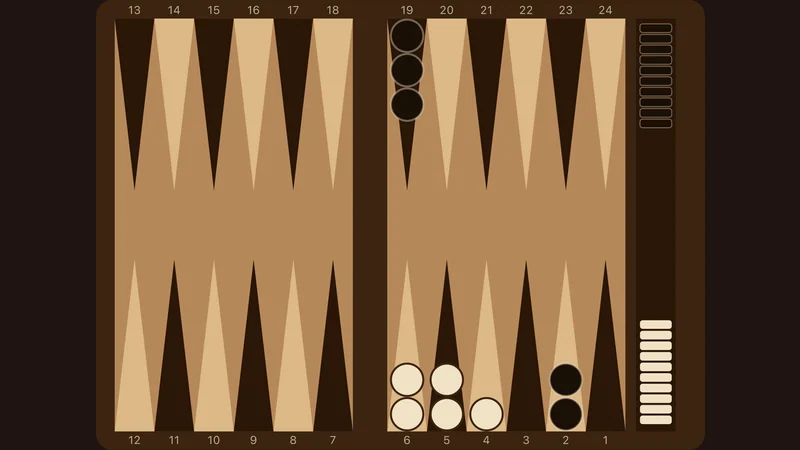
In every game of backgammon, a silent scoreboard runs beneath the surface of the checkers. While casual onlookers see pieces jumping across triangles and colliding on open points, experienced tournament competitors constantly track a single number: the pip count.
The pip count is the total number of points your remaining pieces must travel to clear the board. It determines whether you should run for home or build a defensive wall, whether your opponent is bluffing with the doubling cube, and whether that tempting hit in the outfield helps or harms your position.
Yet watching a tournament player calculate the count over a live board can feel bewildering. They do not point a finger from checker to checker multiplying fifteen separate stacks. Instead, within five to ten seconds of quiet observation, they know both counts down to the single pip. Learning how they do it is the fastest way to elevate your understanding of backgammon strategy.
What is a pip count in backgammon?
A “pip” has two meanings in backgammon. It refers to a single spot on the face of a die, and it refers to one of the 24 triangular points on the playing board.
Your pip count is the sum of the distances that all your checkers must move to reach your home board and bear off. A checker on your opponent’s 1-point sits on your 24-point; it requires 24 pips to travel all the way around the board to your home tray. A checker resting on your 6-point requires 6 pips to reach safety. Once a checker bears off the board, its pip value drops to zero.
Every standard game governed by the rules of backgammon starts with identical arrangements for both sides [1]:
- 2 checkers on the 24-point (2 × 24 = 48 pips)
- 5 checkers on the 13-point, also called the midpoint (5 × 13 = 65 pips)
- 3 checkers on the 8-point (3 × 8 = 24 pips)
- 5 checkers on the 6-point (5 × 6 = 30 pips)
When you sum these four groups—48 plus 65 plus 24 plus 30—the total starting pip count is exactly 167 pips for each player [2].
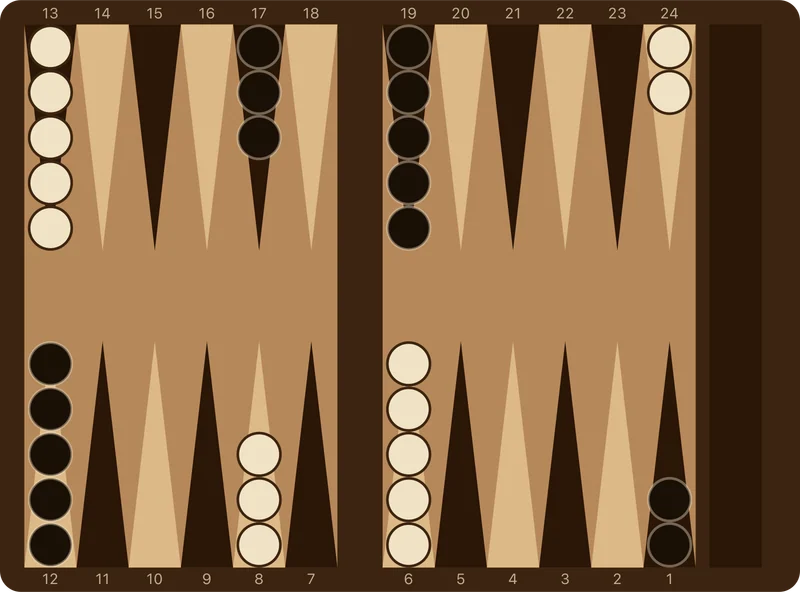
As pieces advance around the board, each roll shaves pips off that initial 167. When a checker is hit and sent to the bar, it must re-enter in the opponent’s home board, adding substantial distance back onto that player’s count. Tracking who leads in this race is fundamental to every tactical choice.
The mathematics of movement: dice averages and expectations
To evaluate whether a lead in the race is secure, you must understand how fast pips evaporate from the board.
A turn in backgammon uses two six-sided dice, creating 36 equally likely numerical outcomes. These 36 combinations split into two categories:
First, there are 30 non-doubles. The sum of the two faces on a non-double ranges from 3 (a roll of 2-1) to 11 (a roll of 6-5). Across all 30 non-double rolls, the total distance is 210 pips, so the average distance gained is exactly 7 pips [2].
Second, there are 6 doubles (1-1 through 6-6). Because the rules grant four moves of the rolled number for any double, their values range from 4 pips on double ones to 24 pips on double sixes. Across all 6 double rolls, the total distance is 84 pips, so the average yield is exactly 14 pips [2].
Combining both groups gives the overall expected value of a backgammon turn: adding 210 pips from non-doubles and 84 pips from doubles yields 294 pips across the 36 possible outcomes. Dividing 294 by 36 simplifies to 49 divided by 6, producing an average of 8.17 pips per roll [2].
This constant has an immediate practical application: the on-roll advantage. In a pure race where neither side can hit the other, having the dice in your hand is worth roughly half an average roll, or about 4 pips [2]. If you lead by 4 pips but your opponent is on roll, the race is effectively dead even. If you lead by 4 pips and hold the dice, your practical advantage feels twice as large.
Fast counting method 1: cluster counting
The biggest obstacle for newer players is arithmetic fatigue. Attempting to locate all fifteen pieces, multiply each point number by its stack height, and add fifteen results together takes too long and invites errors.
Master players bypass arithmetic by memorizing standard clusters. Instead of fifteen calculations, they see three or four familiar groups [2]:
- 5 checkers on the 13-point equal 65 pips.
- 5 checkers on the 6-point equal 30 pips.
- 3 checkers on the 8-point equal 24 pips.
- 2 checkers on the 24-point equal 48 pips.
When pieces shift during play, they look for standard 30-pip blocks:
- 5 checkers on the 6-point equal 30 pips.
- Two checkers on the 15-point equal 30 pips.
- Three checkers on the 10-point equal 30 pips.
Another powerful cluster shortcut relies on quadrant crossovers [3]. The 24 points of the board divide into four quadrants of 6 points each:
- Opponent’s home board
- Opponent’s outer board
- Your outer board
- Your home board
Every time a checker crosses from one quadrant into the next, it travels a baseline distance of 6 pips [3]. When comparing two positions, counting how many total quadrant crossovers remain gives an immediate estimate of the race before fine-tuning the exact points.
Fast counting method 2: symmetry cancellation
Often you do not need the total pip count of both players; you only need the difference between them. If you lead by several pips, it rarely matters whether both players are in high counts or low counts.
The fastest mental technique for finding the difference is symmetry cancellation, explored in depth by mathematician Danny Kleinman in 1981 [4].
In symmetry cancellation, you match identical opposing formations and remove them from your mental tally:
Imagine both players have two checkers on their respective 24-points. Those four pieces contribute 48 pips to White and 48 pips to Black. Their net contribution to the race difference is zero. You ignore them completely.
If you have five checkers on your 6-point and your opponent has five checkers on their 6-point, each stack equals 30 pips. They cancel out.
By pairing mirrored stacks across the board, you eliminate the majority of the 30 pieces on the table [4]. Typically, only four or five asymmetrical pieces remain. Calculating the difference between those few pieces takes five seconds rather than thirty.
Fast counting method 3: reference shift methods
When checkers do not match cleanly, tournament players use reference shifts. Instead of adding scattered checkers individually, they choose a landmark point—often the 6-point or the midpoint—and count deviations [3].
Suppose you have four checkers clustered around your 6-point:
- One on the 5-point (one pip less than 6)
- Two on the 6-point (exact match)
- One on the 7-point (one pip more than 6)
Rather than calculating 5 + 6 + 6 + 7 = 24, you treat all four checkers as being on the 6-point (4 × 6 = 24) and notice that the minus-one on the 5-point cancels the plus-one on the 7-point. The total is immediately 24.
This shift method allows you to slide messy, uneven formations into clean multiples in your mind. Once you practice recognizing symmetrical pairs and offset groups, pip counting transforms from slow arithmetic into quick pattern recognition.
What to do with the count: the fundamental law of racing
Knowing the count is only useful if it dictates your decisions. Backgammon strategy hinges on a central strategic rule formulated by Paul Magriel in his classic 1976 work [2]:
When ahead in the race, race. When behind in the race, preserve contact.
If your pip count is lower than your opponent’s, you hold a racing advantage. Your strategic goal is to simplify the position:
- Disengage back checkers and advance them toward home.
- Avoid leaving exposed blots that could be hit and sent back.
- Refuse to engage in priming battles where complications arise.
- Steer the game toward a pure running race.
Conversely, if you trail in the pip count, running into an open race is mathematically unpromising. When trailing in the count, your strategy must be the opposite:
- Maintain contact with the opponent’s forces.
- Establish defensive anchors in the opponent’s home board.
- Build a multi-point prime to trap their advancing checkers.
- Wait for them to roll awkward numbers that force them to leave a blot.
As explored in our guide to bearing off without losing, failing to recognize who leads the race is the primary cause of blunders that surrender won games.
Cube decisions in pure races: the 8–9–12 percentage rule
The most critical application of pip counting arrives when contact is broken and the game enters a pure running race. In a pure race, no pieces can be hit, and the player who bears off fifteen checkers first wins.
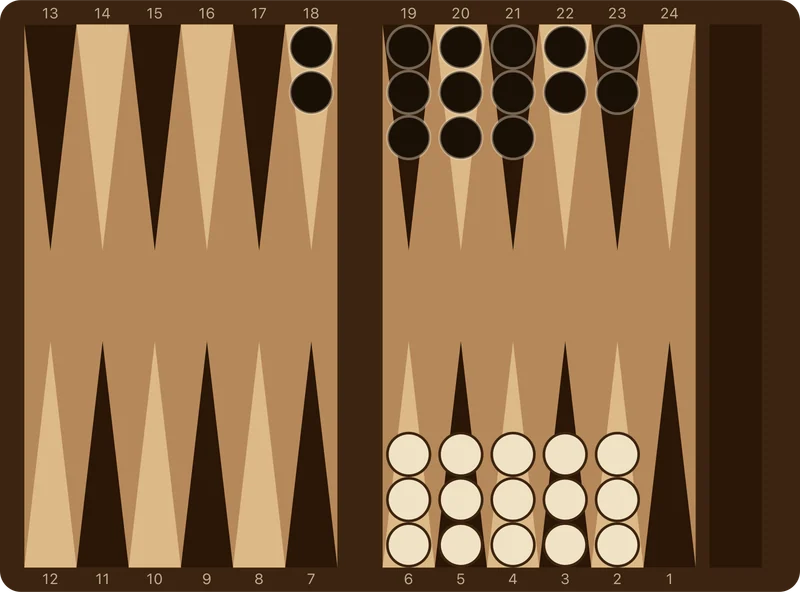
In 1996, backgammon theorist Jeff Ward published a systematic percentage formula for running games known as the 8–9–12 race rule [5]:
- Doubling threshold (8%): If you lead in the pip count by at least 8% of your opponent’s total count, you have a sound initial double from the center.
- Redoubling threshold (9%): If you already hold the cube and lead by at least 9% of the opponent’s count, you should redouble.
- Take or drop threshold (12%): If your opponent doubles you in a pure race, you may accept the cube (take) if you trail by 12% or less of your own count. If you trail by more than 12%, you should drop the cube and concede one point [5].
This percentage framework aligns directly with fundamental mathematical research on optimal backgammon doubling. In a landmark 1975 paper published in Operations Research, mathematicians Emmett Keeler and Joel Spencer proved that in doubling positions, a player should accept a cube whenever their probability of winning is at least 25% [6]. Because dropping concedes a guaranteed loss of one point, accepting is correct as long as you win at least one out of four games. The 12% trailing threshold in Ward’s formula captures that exact 25% boundary in pure running positions [5].
Advanced race formulas: Keith and Kleinman counts
While raw pip counts and the 8–9–12 rule work well for long races, short races near the bearoff stage introduce distortion known as checker wastage.
Wastage occurs when checkers are distributed inefficiently:
- Stacking six checkers on the 1-point wastes pips because high rolls cannot use their full values.
- Leaving empty gaps on key points forces rolls to jump over empty spaces.
- Having three checkers left on the 2-point means high rolls bear off only two checkers, discarding excess dice pips.
To solve this, advanced players use adjusted counts such as the Keith count and the Kleinman count [4].
Danny Kleinman’s formula, published in 1981, adjusts raw pip totals by comparing the difference in counts against the square root of their sum. By evaluating the lead relative to the spread of the remaining rolls, Kleinman developed formulas that predict win probabilities without requiring complete computer rollouts [4].
Reviewing your games with computer analysis, as explained in our guide on what PR means in backgammon, reveals that errors in race cube decisions are among the largest sources of lost equity. Practicing fast counts eliminates these costly blunders.
Questions people ask about pip counting
Can you win in backgammon if you are far behind in the pip count?
Yes. Being behind in the pip count only disadvantages you if the game becomes an open race. In contact games, a player trailing by a substantial margin can build a six-point prime or establish a back game with anchors in the opponent’s home board. If the leader is forced to leave a blot and gets hit, the pip deficit can vanish in a single turn.
How quickly can top backgammon players count the board?
In tournament settings with time controls, experienced players count the net pip difference in three to seven seconds using symmetry cancellation. A full count of both sides using cluster grouping usually takes between eight and fifteen seconds.
Does the opening roll change the pip count equally?
Yes. On the opening roll, the player who rolls the higher single die plays those two numbers. If White opens with 3-1, White moves checkers a total of 4 pips, reducing their count from 167 to 163, as detailed in our guide to backgammon opening rolls. Doubles cannot occur on the opening move.
How does bearing off affect the pip count?
When a checker is borne off the board into the tray, its distance to travel becomes zero. A checker on the 3-point borne off with a three removes 3 pips from your count. If borne off with a six, it still only removes 3 pips, because the excess pips of the roll are discarded as wastage.
Where can I practice pip counting?
The best way to develop speed is to pause positions during digital play or practice over an actual board. For structured guidance, explore our interactive backgammon lessons and test your calculation in real-time games on Boardgammon.
Sources
- Boardgammon. “Backgammon Rules: How to Play and Board Setup.”
- Magriel, P. (1976). Backgammon. Quadrangle/The New York Times Book Co.
- Boardgammon. “Pip Counting in Backgammon: Fast Methods & Formulas.”
- Kleinman, D. (1981). Vision Laughs at Counting: With Advice to the Doublecross and Other Diversions. Los Angeles.
- Ward, J. (1996). The Ward Count: A Systematic Method for Doubling in Running Games.
- Keeler, E. B., & Spencer, J. (1975). Optimal Doubling in Backgammon. Operations Research, 23(6), 1063–1071.
Found a mistake or an odd phrase? Tell us