In every game of backgammon, checker play determines who reaches the finish line first, but the doubling cube determines how much that victory is worth. Beginners often treat the doubling cube as an intimidating novelty or a reckless wager. For experienced tournament competitors, however, cube judgment is responsible for more points won or lost than almost any individual checker play.
Understanding when to double and when to accept an opponent’s double does not require memorizing dense mathematical tables. At its heart, cube decisions rest on simple principles of risk, reward, and probability. Once you learn how to identify the doubling window and calculate your breakeven threshold, the cube transforms from a source of anxiety into your most powerful strategic tool.
How the doubling cube works: rules, faces, and turns
The doubling cube looks like an oversized die, but it is never rolled during play. Instead, it serves as a physical marker that tracks the current point multiplier of the game. Its six faces display the powers of two: 2, 4, 8, 16, 32, and 64. At the start of a standard game, the cube sits centered along the side rail with the 64 face showing, which denotes that the contest is currently being played for 1 base point.
According to the rules of backgammon, a player may propose a double only at the start of their own turn, strictly before rolling the dice. You cannot roll, observe a favorable combination, and then decide to double. When the cube is in the middle of the board, either competitor has the right to initiate the first double.
When you offer a double, you place the cube on the board showing the 2 face and ask your opponent to make an immediate choice:
- Drop (or pass): The opponent refuses the double, immediately resigns the game, and concedes 1 point to you. The game ends on the spot.
- Take (or accept): The opponent accepts the double. The game continues with the stakes doubled to 2 points. Crucially, the opponent picks up the cube and places it on their side of the board. The opponent now owns the cube.
Cube ownership is a central element of backgammon strategy. The player who initiated the double cannot double again. Only the player who owns the cube holds the exclusive right to redouble the stakes to 4 points on a subsequent turn. If that redouble is accepted, ownership shifts back across the table, allowing a possible future redouble to 8, 16, 32, or 64 points.
The 25% take point: the math behind accepting a double
The most fundamental question in cube theory is deceptively simple: when your opponent offers a double, how good must your winning chances be to justify accepting?
Many new players assume they need at least a 50% chance of winning to accept. After all, why play a game you are likely to lose? The flaw in that reasoning becomes obvious once you compare the outcome of dropping against the outcome of taking.
When you drop, you lose 1 point with 100% certainty. Your expected outcome is exactly −1.
If you accept, you will sometimes lose 2 points, but you will also sometimes win 2 points. Suppose your probability of winning the game is $p$. In 1975, mathematicians Emmett Keeler and Joel Spencer published a foundational paper on optimal doubling in Operations Research, establishing the mathematical breakeven condition [1].
Your expected value when taking a 2-cube in a game without gammon possibilities is calculated as:
Take EV = 2p − 2(1 − p) = 4p − 2
To find the breakeven threshold where taking is equal to dropping, set the take value equal to the drop value:
4p − 2 = −1
4p = 1
p = 0.25
This simple formula demonstrates that your breakeven threshold—known throughout competitive backgammon as the take point—is exactly 25%.
To see why this holds true in practice, imagine playing the identical position four times:
- If you drop all four times, you lose 1 point each time, for a total loss of 4 points.
- If you accept all four times and win only one game (a 25% win rate), you lose three games at 2 points each (−6 points) and win one game at 2 points (+2 points). Your net result is −4 points.
Whenever your winning chances exceed 25%, taking loses fewer points over time than conceding. You do not need to expect to win the game; you only need to win often enough that fighting on is cheaper than surrendering. Detailed mathematical proofs and match equity calculations can be explored in our comprehensive guide to cube theory.
What is the doubling window?
Knowing your take point tells you when to accept, but how do you know when you should be the one to double?
Doubling is governed by what Paul Magriel famously termed the doubling window in his classic 1976 work [2]. The doubling window represents the range of winning probabilities where doubling is mathematically correct. It has two boundaries:
- The lower boundary (the initial double threshold): You should not double the moment you obtain a slight advantage, such as a 55% edge. When you double, you give up cube ownership, handing your opponent the powerful right to redouble you later. In ordinary money play, you generally need roughly 66% to 70% winning chances before your advantage is large enough to justify relinquishing cube ownership.
- The upper boundary (the drop point): If your winning chances rise past roughly 75%, your opponent should refuse the double and drop. If your advantage becomes completely overwhelming, you have missed your chance to double for a profit.
The space between roughly 66% and 75% winning chances is the sweet spot. Inside this window, you have a substantial advantage that warrants increasing the stakes, and your opponent has enough equity to make taking a reasonable decision.
Live cube ownership: why race take points drop to 21–22%
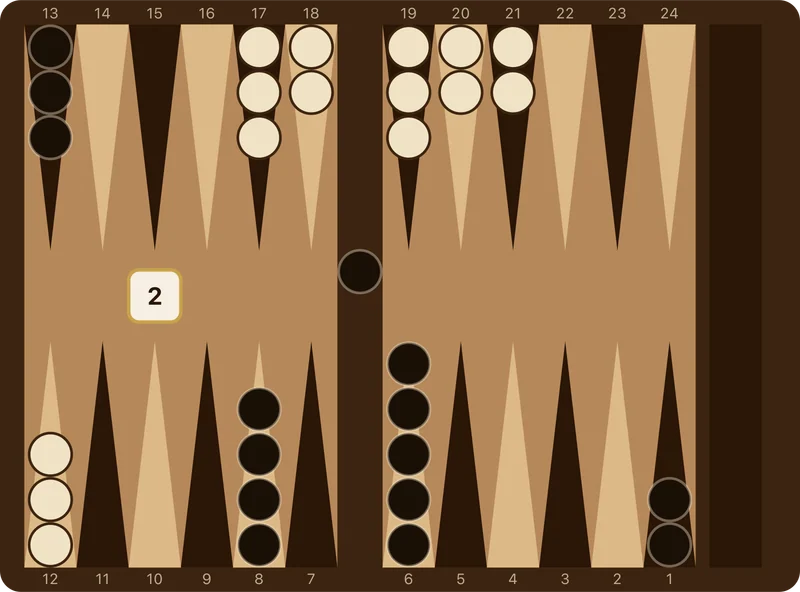
In real games, the 25% take point is an approximation based on a dead cube—a scenario where the cube can never be turned again. But backgammon is played with a live cube. When you accept an opponent’s double, you gain exclusive ownership of that cube, which gives you leverage that your opponent does not possess.
If the game takes a dramatic turn in your favor, you can redouble to 4 points. Your opponent cannot do the same. This ability to punish an opponent who stumbles is known as the value of cube ownership.
Because owning the cube allows you to win games at 4 points when you mount a comeback, your practical take point in uncontacted races drops from 25% down to approximately 21% to 22%. In pure running situations where checkers have bypassed each other and cannot be hit, knowing how to count pips in backgammon lets you measure your race percentage accurately. If you trail in the pip count but still retain roughly 21% to 22% winning chances, owning the live cube makes accepting the correct play.
Market loss: why you must double before your lead explodes
A common question among developing players is: if I am ahead and my position is improving, why should I double now? Why not wait another turn until my position is even stronger?
The answer lies in the concept of market loss. You double today because waiting might cause your lead to expand so much that your opponent will refuse a double on the next turn.
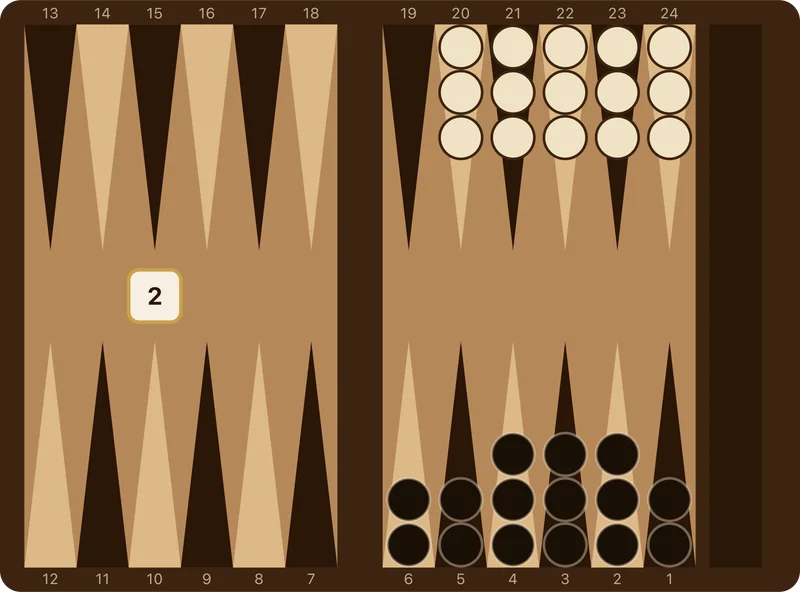
Consider a position where you have closed four points in your home board and your opponent has a checker trapped on the bar. You currently hold about a 70% chance of winning. If you double now, your opponent is in the doubling window and has a valid take. You play on at 2 points.
Out of the 36 possible outcomes with two six-sided dice, many combinations will allow you to make another key point or hit an exposed checker. If you roll one of those strong numbers, your winning chances jump from 70% to 85%.
If you did not double before rolling, you now turn the cube to 2. But your opponent looks at the wrecked board, realizes their winning chances are well below 25%, and drops. You win 1 point. Had you doubled on the previous turn, you would have won 2 points from the exact same game. By waiting for safety, you lost your market and surrendered 1 whole point of profit.
Whenever a large share of your next 36 dice rolls will push the game into an easy drop for your opponent, you must double immediately to lock in the 2-point stake.
When are you too good to double?
While fearing market loss encourages timely doubling, there is an important exception: positions that are too good to double.
A position is classified as too good to double when your gammon chances are so substantial that cashing 1 point by doubling is actually a mistake. Remember that a gammon victory pays double the stake. In an undoubled game, winning a gammon earns 2 points.
If you hold a powerful attacking blitz where your opponent has two checkers on the bar and no defensive anchors, you might have an 80% chance of winning the game and a 60% chance of winning a gammon. If you double, your opponent will instantly drop and concede 1 point. By doubling, you rob yourself of the opportunity to win 2 points (or 4 points on a doubled cube) with minimal risk.
When you have overwhelming control, virtually zero risk of losing the game, and strong gammon potential, do not touch the cube. Roll the dice and play for the gammon. If the opponent manages to anchor or enter and your gammon chances evaporate, you can still offer a routine cash double later.
How gammon threats change the doubling equation
Gammon possibilities alter the 25% take point for the defending player just as dramatically as they influence the attacker.
In positions where the doubler threatens a gammon, accepting a double exposes the trailer to losing 4 points rather than 2. When gammons enter the equation, the trailer’s losses compound rapidly. If you face a fierce home-board attack and accept a double, losing a gammon costs 4 points, while winning still earns only 2.
Because losing 4 points is devastating, the trailer’s required take point rises sharply. In heavy blitz or deep priming games where gammon risks are real, you may need 30% or even 35% winning chances to justify accepting a double. A position that looks like a comfortable take in a pure race becomes an automatic drop when checker contact threatens a gammon defeat.
Woolsey’s law: a practical test for tournament play
At the board, you will rarely have the luxury of running complex equity calculations. In 1993, American backgammon grandmaster Kit Woolsey proposed a simple, brilliant mental rule that every player can apply instantly [3]:
Put yourself in your opponent’s shoes. If you are not sure whether to take or drop, then it is definitely a double.
Woolsey’s law works because if a decision is agonizingly close for the defender, the position sits directly on the boundary of the doubling window. If dropping and taking are nearly equal in value, the doubler is guaranteed a massive strategic advantage. Doubling exerts maximum pressure: if the opponent takes, they must play a difficult defense for high stakes; if they drop, you collect an immediate point. If you find yourself debating whether you would accept if doubled, turn the cube.
Common doubling mistakes beginners make
Even talented checker players surrender vast equity through recurring cube errors. Avoiding these three common traps will immediately raise your competitive performance:
- Waiting for certainty: Novice players frequently wait until they are sure they are winning before offering the cube. By that time, the opponent is also sure they are losing and will drop without hesitation. You must double while the outcome is still somewhat in doubt.
- Ignoring gammon danger when taking: Players often look solely at whether they have checkers left on the board, ignoring whether they can avoid a gammon. If your opponent has an active blitz and you have no anchors, dropping for 1 point is often far wiser than taking and conceding 4 points.
- Double-blind rolling: Rolling out of habit before considering the cube is an illegal move that costs games. Develop the physical habit of checking the cube before your hand reaches for the dice cup on every single turn.
Mastering these decisions is a journey that connects opening structure to endgame precision. Reviewing standard opening rolls in backgammon helps you construct early positions that naturally expand into favorable doubling opportunities. You can practice recognizing these situations and analyzing decisions step by step when you learn backgammon step by step or test your skills when you play backgammon free in your browser.
Questions people ask about the doubling cube
What happens if both players want to double?
Only the player whose turn it is may double, and only before rolling the dice. Furthermore, once a double has been accepted, only the player who accepted the double owns the cube and possesses the right to redouble.
Can you double on the very first turn of the game?
No. On the first turn, both players roll a single die to determine who plays first and with what numbers. Because neither player has an established turn before that opening roll, doubling cannot take place until the opening roll has been resolved and the second player begins their turn.
Why does the doubling cube start on 64 instead of 1?
Physical cubes have six faces: 2, 4, 8, 16, 32, and 64. Rather than manufacturing a cube with a 1 face that would never be used once doubled, backgammon tradition uses the 64 face centered in the middle of the board to represent a starting value of 1.
When should you never double?
You should never double when you are behind in the game, when your lead is too small to justify surrendering cube ownership (below roughly 66% winning chances), or when your position is too good to double because you have virtually guaranteed gammon chances.
Sources
- Keeler, E. B., & Spencer, J. (1975). Optimal Doubling in Backgammon. Operations Research, 23(6), 1063–1071.
- Magriel, P. (1976). Backgammon. Quadrangle/The New York Times Book Co.
- Woolsey, K. (1993). Backgammon: Master Versus Amateur. Oakland.
- Boardgammon. “Doubling Cube Strategy — Take Points & Match Equity.”
- Boardgammon. “Backgammon Rules: How to Play and Board Setup.”
- Boardgammon. “Learn Backgammon Step by Step.”
Found a mistake or an odd phrase? Tell us