For centuries, players across parlor tables, park benches, and championship halls wondered whether checkers contained an inescapable mathematical secret. When two masters sit down across an 8x8 board of thirty-two dark squares, does the player who moves first possess a forced path to victory? Does an unavoidable disadvantage burden the second player? Or does the game, played without a single mistake from the first move to the last, balance on an exact knife-edge?
In 2007, a landmark paper published in the journal Science answered those questions definitively[1]. Led by computer scientist Jonathan Schaeffer at the University of Alberta, a research team announced that English draughts—known across North America simply as checkers—was officially solved. After an 18-year computational journey that commenced in 1989, their program, named Chinook, proved that perfect play by both players leads inexorably to a draw.
To understand why this achievement reverberated through the scientific world, and why it did not destroy the joy of playing checkers online, one must examine what game theory actually means by a solution. Solving a game does not mean that every casual match ends in a handshake. It means that the mystery of optimal play has yielded to rigorous mathematics.
What does it mean when a game is solved?
In everyday conversation, solving a puzzle means finding the trick that makes it trivial. In combinatorial game theory, however, the term carries a precise, formal definition established by computer scientist Victor Allis in 1994[2]. Allis separated game solutions into 3 distinct mathematical tiers, depending on how much information the proof provides:
- Ultra-weakly solved. A mathematical proof demonstrates whether the first player wins, the second player wins, or the game is drawn from the starting position, but without providing an algorithm or concrete sequence of moves to achieve that result. The classic example is the game of Hex, where mathematician John Nash proved via a strategy-stealing argument that the first player has a theoretical win, yet the proof does not show which moves actually win on large boards.
- Weakly solved. An algorithm or proof tree provides an explicit strategy that guarantees a win or a draw from the initial starting position against any possible moves by an opponent. The computer may not know the theoretical value of every bizarre, blunder-filled position that could arise from irrational play, but from the beginning of the match, it cannot be defeated. Checkers belongs to this category[1].
- Strongly solved. An algorithm computes the exact theoretical value—win, loss, or draw—and the optimal move for every single legally reachable position on the board, no matter how many mistakes preceded it. Connect Four became strongly solved in 1988 when James D. Allen and Victor Allis independently proved that the first player can force a win from any board state[2].
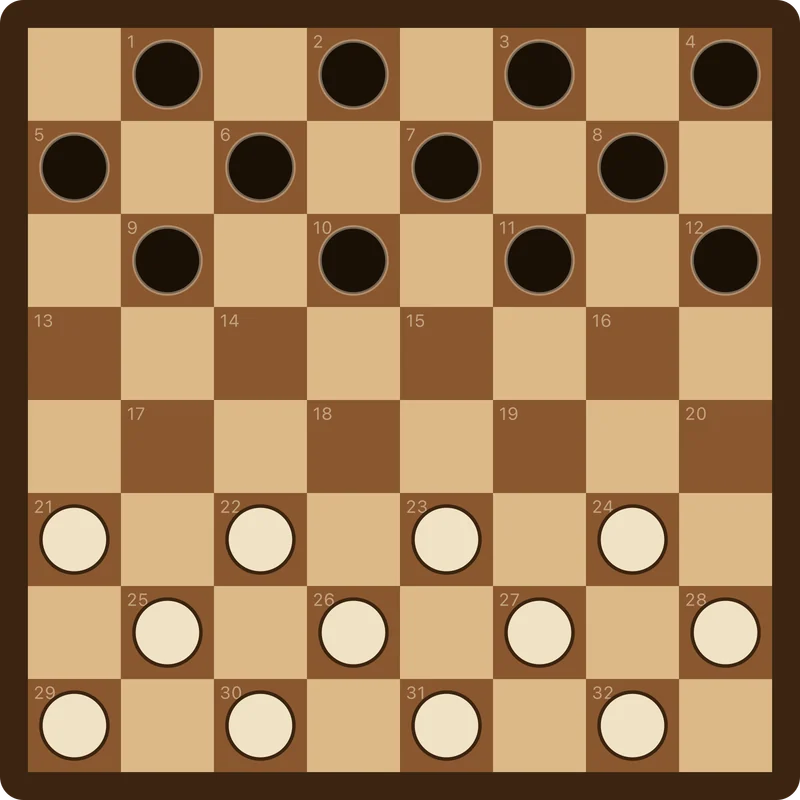
Checkers was weakly solved because computing every possible blunder state from scratch would require storing an impossible volume of data. Instead, Schaeffer’s team focused their calculations on proving the outcome from the official starting position. The board begins with 12 dark pieces facing 12 light pieces on thirty-two dark squares, making 24 pieces in total[3]. Proving that this balanced opening yields a draw required navigating a mathematical labyrinth of staggering proportions.
The 18-year journey of Chinook: how checkers was solved
The mathematical universe of checkers is far larger than casual players suspect. On a standard 8x8 board, the number of possible legal board arrangements is approximately 5 x 10^20 positions[1]. Written out in full, that is roughly five hundred billion billion positions. Examining every single position sequentially on a single computer would have taken millennia.
To conquer this astronomical state space, Schaeffer’s team divided the challenge into two complementary computational strategies: working backward from the endgame, and searching forward from the opening.
Calculating backward: the 39 trillion position database
The foundation of the proof was retrograde analysis. Rather than starting at move 1 and guessing where moves might lead, computer scientists began at the very end of the game, with just 1 or 2 pieces left on the board. A position with 1 dark king facing a lone light king is mathematically trivial: it is an immediate draw. A position with 2 kings trapping 1 king in a corner is a proven win.
By starting with empty boards and adding pieces one by one, Chinook computed the exact game-theoretic value of every possible configuration of pieces. If a position allows a player to jump into a proven winning state, that position is also marked as a win. If every legal move leads to an opponent’s winning state, the position is marked as a loss. If optimal moves preserve balance, it is recorded as a draw.
Between 1989 and 2007, Chinook calculated complete endgame tablebases for all positions containing 10 or fewer pieces[1]. This gargantuan database contains 39 trillion distinct positions. Once a match reaches 10 pieces or fewer, Chinook no longer calculates or guesses. It reads the absolute truth directly from memory.
Searching forward: bridging opening theory to the endgame
With the 10-piece endgame database completed, the remaining task was to build a bridge from the initial starting position of 24 pieces down to the 10-piece threshold[1].
To achieve this, the team deployed proof-number search algorithms combined with alpha-beta minimax search. The algorithm evaluated candidate moves, aggressively pursuing variations that led toward forced trades and simplified endgame databases, while cutting off branches where suboptimal moves were clearly refuted.
Over years of parallel computation running across hundreds of computer processors, the forward search pruned billions of unnecessary variations, eventually assembling a verified proof tree of tens of millions of critical positions. Every single branch from the opening position led either to an unbreakable defensive fortress or directly into a drawn state within the 39 trillion position database. In 2007, the proof was complete: checkers is mathematically drawn[1].
Man versus machine: the legendary Marion Tinsley
Long before checkers was formally solved by mathematics, one human player came astonishingly close to solving it through sheer intellect. Dr. Marion Tinsley, a professor of mathematics from Florida, is universally regarded as the greatest draughts player who ever lived.
Tinsley’s competitive record defies belief. Over an active tournament career spanning 45 years, Tinsley lost only 9 individual games out of thousands played[1]. He reigned as world champion across his multi-decade tournament career, stepping aside only when competitive motivation waned. To test Chinook against the ultimate standard of human perfection, Jonathan Schaeffer arranged a formal World Championship match against Tinsley in 1992.
The 1992 match was a historic confrontation between human intuition and machine calculation. Across thirty-nine grueling games, Tinsley demonstrated breathtaking positional mastery, defeating Chinook with 4 wins, 2 losses, and 33 draws[1]. It was the first time in history that a computer program had contested a world title against a reigning human world champion in any classic board game.
In 1994, a highly anticipated rematch took place. After 6 consecutive draws, Tinsley was forced to withdraw due to a sudden diagnosis of pancreatic cancer, passing away in 1995[1]. Chinook was subsequently awarded the Man-Machine World Championship. Schaeffer later noted that analyzing Tinsley’s games against Chinook showed that Tinsley’s moves matched the computer’s perfect endgame databases with near-flawless accuracy. Tinsley had internalized the mathematical geometry of checkers through intuition alone.
The complexity ladder: checkers versus chess
To understand the magnitude of solving checkers, it is helpful to place the game on the broader ladder of combinatorial games.
In 1950, mathematician Claude Shannon analyzed the computational complexity of chess in his foundational paper on computer programming[4]. Shannon estimated that chess features approximately 10^44 legal board positions and a game-tree complexity of roughly 10^120 possible games—a figure now celebrated as the Shannon Number[4].
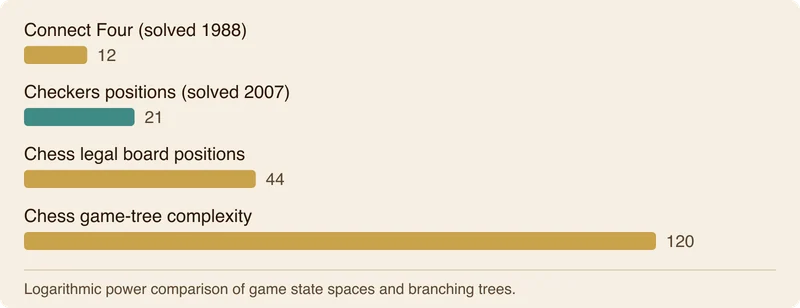
Consider how checkers compares to both simpler and more complex games:
- Connect Four: Strongly solved in 1988, Connect Four features trillions of positions[2]. It can be solved on a modern laptop in a matter of seconds.
- 8x8 Checkers: Weakly solved in 2007 with roughly 5 x 10^20 positions[1]. It required 18 years of distributed cluster computation and a 39 trillion position endgame database.
- Chess: Unsolved. With 10^44 positions and 10^120 branching paths[4], chess remains far beyond exhaustive computational proof. Modern chess endgame tablebases currently resolve positions with up to only 7 pieces, holding hundreds of trillions of positions. Expanding chess databases to 8 pieces requires petabytes of storage, while solving the full 32-piece game remains out of reach with classical computers.
- 10x10 International Draughts: Unsolved. Played on a hundred-square board with twenty pieces per side, International draughts possesses a state space estimated near 10^30 positions. Its flying kings and mandatory majority-capture rules expand the game tree far beyond the limits of current retrograde tablebases.
Why solving checkers did not ruin the game for humans
When the 2007 announcement made headlines worldwide, some commentators lamented that checkers was “dead.” If computers know that the game ends in a draw, why should anyone bother moving checkers across a board?
Such reactions misunderstand human play. A mathematical solution describes what happens when two omniscient entities make zero mistakes across forty or fifty moves. But human beings are not omniscient machines. No human player, not even a grandmaster, can memorize 39 trillion endgame positions or hold a proof tree of tens of millions of branching moves in their head.
Over the board, checkers remains a fierce psychological and tactical duel. The game is famous for its mandatory capture rule: if a jump is available, you must take it. This single rule creates spectacular tactical opportunities. Players regularly sacrifice pieces to lure enemy checkers onto vulnerable diagonals, execute multi-piece sweeping jumps, and spring devastating shot patterns.
Consider what happens in actual human games:
- Opening choices. While optimal moves draw, hundreds of opening variations contain sharp tactical traps. Straying by a single square on move 4 or move 6 can transform an equal position into a lost cause within two turns.
- Positional maneuvering. Controlling the center, anchoring the back rank, and managing the dog-hole require deep strategic understanding. Players who understand checkers strategy consistently outmaneuver opponents who rely on shallow tactical calculation.
- Endgame precision. In equal-piece endings, the game hinges on controlling the opposition—historically known as “the move.” A single misstep turns a win into a draw, or lets an opponent escape a single-corner trap into an invincible double-corner fortress, as detailed in our guide to checkers endgames.
Tournament organizations long ago introduced three-move opening restrictions (where the first three moves are drawn by ballot) specifically to bypass familiar opening lines and force players into complex, unexplored territory. Checkers has not died; rather, the mathematical proof demonstrated how remarkably balanced and profound the game truly is.
Whether you are studying the rules of checkers for the first time, exploring international checkers variants with long-range flying kings, or sitting down to play checkers online with friends, the board remains an open arena for human creativity. A computer may have mapped the destination, but the journey across the dark squares belongs entirely to the players.
Questions people ask
Is checkers completely solved for all possible moves?
No. Checkers is weakly solved, not strongly solved. The proof guarantees an optimal strategy from the standard opening position of twenty-four pieces on thirty-two dark squares, proving that perfect play yields a draw[1]. It also strongly solves all positions containing 10 or fewer pieces via its 39 trillion position database. However, it does not exhaustively map every irrational blunder that could occur with a dozen or more pieces on the board.
Can a human player beat Chinook today?
Against Chinook running with its full 10-piece database and opening book, a human player cannot win. Because the game is proven to be a draw, optimal play by the computer guarantees that it will never lose. If the human opponent plays perfectly, the game concludes in a draw; if the human makes even a subtle positional mistake, the computer capitalizes on the error and forces a win.
Does Black or White have an advantage in checkers?
In English draughts, Black moves first. While moving first grants Black the temporary initiative to control central squares, Schaeffer’s proof established that this first-move initiative is insufficient to force a win against accurate defense[1]. With flawless play from both sides, the initial advantage dissipates, and the game ends in an exact draw.
Is 10x10 International draughts also solved?
No. International draughts is played on a 10x10 board with forty checkers in total. Its search space of roughly 10^30 positions and dynamic long-range flying kings create a game tree vast enough to resist exhaustive retrograde calculation. While computer engines play International draughts at an elite grandmaster level, the variant has not been mathematically solved.
Where can I practice checkers against balanced opponents?
You can sharpen your tactical skills and test your endgame technique by enjoying a free game of draughts directly through Checkers Crown, where you can play checkers online against players of all skill levels.
Sources
- Schaeffer, J., Burch, N., Björnsson, Y., Kishimoto, A., Müller, M., Lake, R., Lu, P., & Sutphen, S. (2007). Checkers Is Solved. Science, 317(5844), 1518–1522.
- Allis, L. V. (1994). Searching for Solutions in Games and Artificial Intelligence. Ph.D. thesis, University of Limburg, Maastricht.
- Boardgammon. “Checkers Rules: How to Play, Movement, and Captures.”
- Shannon, C. E. (1950). Programming a Computer for Playing Chess. Philosophical Magazine, Ser. 7, 41(314), 256–275.
- Boardgammon. “Checkers Crown: Play Online Checkers and Regional Draughts Variants.”
- Boardgammon. “Play Checkers Online: Free Browser and Mobile Draughts.”
- Boardgammon. “Checkers Variants: The Kinds of Draughts Played Around the World.”
Found a mistake or an odd phrase? Tell us