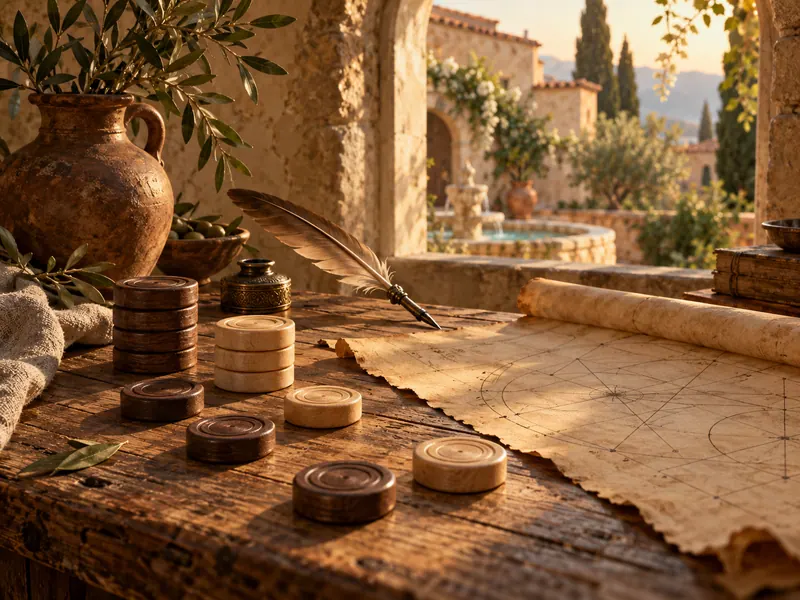
Few games in human history possess a lineage as widespread yet frequently misunderstood as checkers. Many casual players assume the game was invented as a simplified relative of chess, designed merely for children or informal parlor play. The historical evidence paints a very different picture. Checkers, traditionally called draughts throughout Britain and the Commonwealth, is an ancient discipline in its own right, born of the meeting of two distinct ludic traditions in the medieval Mediterranean and refined over eight centuries of intense tactical evolution.
Today, while millions enjoy checkers online across mobile apps and browser tables, the game has also achieved a unique milestone in computer science: in 2007, researchers demonstrated through mathematical computation that the game of checkers is solved, proving that perfect play from both sides yields a draw[1]. Understanding how a game of 12 simple wooden discs evolved from desert trade routes into a solved benchmark of artificial intelligence requires tracing the game back to its true ancestor: the ancient pastime of alquerque.
Where did checkers come from?
The earliest demonstrable ancestor of modern checkers is the game known in Arabic as al-qirq (القرق) and in medieval Spanish as alquerque[2]. While popular accounts often attempt to date checkers back to ancient Egyptian senet boards or Sumerian gaming tables unearthed in the Royal Cemetery of Ur, ludologists and board game historians make a strict distinction: senet and the Royal Game of Ur were linear race games guided by astragali or throwing sticks, entirely lacking the diagonal jump-and-capture mechanism that defines draughts.
Alquerque, by contrast, introduced the central tactical mechanic that every checkers player recognizes today: capturing an opposing piece by jumping over it to an adjacent vacant intersection. The earliest detailed surviving rules of alquerque appear in the celebrated thirteenth-century manuscript commissioned by King Alfonso X of Castile and León, the Libro de acedrex, dados e tablas (Book of Chess, Dice, and Tables), completed in Seville in 1283[2].
In Alfonso X’s manuscript, the game is cataloged as alquerque de doze (alquerque of 12). It was played not on the squares of a board, but upon a 5x5 grid of 25 intersecting lines and diagonals[2]. Each player commanded 12 pieces, which were set up occupying all points on their respective two home ranks, plus two points on the center rank, leaving only the central point vacant at the start of play. Pieces moved from point to adjacent point along the etched lines, and if an opposing piece occupied an adjacent point with an empty point immediately beyond it along the same line, the player was obliged to leap over it and capture it. Multiple captures in a single turn were permitted and encouraged.
Alquerque had been played across North Africa and the Near East for centuries before being introduced to Christian Europe via the Islamic Iberian Peninsula. The game was mentioned as early as the tenth century by Abu al-Faraj al-Isfahani in his monumental encyclopedic compendium Kitab al-Aghani (Book of Songs). Yet as engaging as alquerque was, its geometric density—twenty-four pieces crowded into 25 intersections—frequently led to locked positions and positional gridlock. To unlock greater strategic fluidity, medieval players took a decisive leap: they moved the game onto the squares of the chessboard.
How did checkers move to the chessboard?
During the twelfth century, in southern France or northern Spain, players made a quiet innovation that created the modern game of draughts[3]. The chessboard, consisting of an 8x8 grid of 64 alternating light and dark squares, was already an established fixture in European aristocratic households. By taking the 12 pieces and jumping mechanics of alquerque and transferring them exclusively onto the alternating dark squares of the 8x8 chessboard, medieval players revolutionized the pace and clarity of play[3].
On the chessboard, the 64 squares naturally split into two separate networks of thirty-two squares each. Confining movement to the diagonal grid of thirty-two dark squares resolved the congestion of alquerque: pieces now possessed open lanes of advancement, and the opposite edge of the board provided a natural objective.
This medieval merger also gave the game its enduring names across world languages. In Old French, the newly crowned piece that reached the far rank was originally called a fierge, derived from the Arabic firzan (the counselor or vizier, which in medieval European chess occupied the square beside the king). Over time, as the chess piece itself was transformed by European players into the queen, the crowned piece and the game itself became known as the dame. Hence, throughout continental Europe, checkers became jeu de dames in French, Dame in German, damas in Spanish and Portuguese, dama in Italian and Turkish, and дама in Russian.
In the British Isles, however, a different term took root. English speakers referred to the game as draughts, derived from the Middle English word draught (from the Old English dragan, meaning to drag or draw), referring directly to the physical action of drawing or moving the wooden counters across the board. In North America, the game was later named checkers, after the checkered pattern of alternating colored squares upon which it is contested.
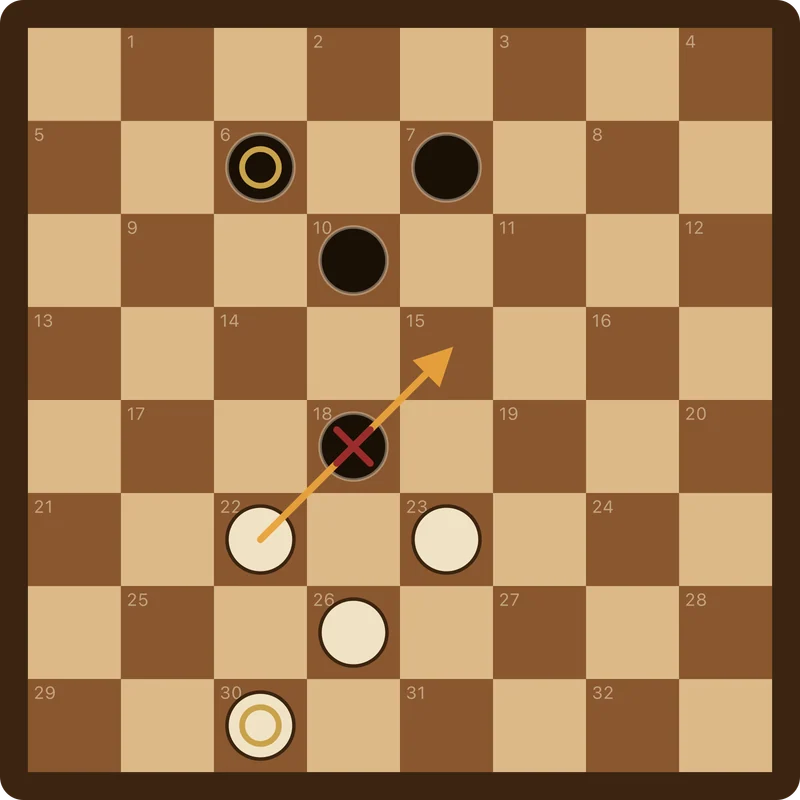
The diagram above illustrates how the fundamental jumping mechanic operates on the chessboard: an advancing piece leaps diagonally across an adjacent opposing piece to land on the vacant square beyond, removing the captured counter from play. This dynamic—stripping away material through compulsory diagonal leaps—forms the tactical backbone of the rules of checkers.
When did forced captures and kings become standard?
Early medieval draughts was played in two principal forms: with optional capture and with mandatory capture. In the early form, if a player noticed a jump, they could take it, but failing to jump carried no formal penalty. This permissive style made the game forgiving, but it also encouraged passive, defensive play that often ended in drawn stalemates.
By the sixteenth century, the game underwent a major competitive reform in Spain and France: capturing was made strictly mandatory. If a player overlooked a legal capture or elected to play another move instead, the opponent had the right to enact the rule of “huffing”—removing the offending piece from the board as a penalty before making their own move. The introduction of compulsory capture transformed draughts into a ferocious calculation game. Sacrifices became lethal tactical weapons: a skilled tactician could deliberately sacrifice one or two checkers to force an opponent’s piece into a compromised square, paving the way for a devastating multi-jump counterstrike.
The literature of checkers rapidly expanded. In 1547, the Spanish writer Antonio de Torquemada published El ingenio, ó juego de marro, de punta, ó damas in Valencia, recognized bibliographically as the earliest known printed book on the game of checkers[4]. Although copies of Torquemada’s original 1547 edition have not survived to the present day, later Renaissance treatises printed in Valencia established an exhaustive strategic framework for the game across Europe.
Two centuries later, in 1756, the English mathematics master William Payne published An Introduction to the Game of Draughts in London[5]. Payne’s book holds a celebrated place in literary history because its dedication to the Earl of Rochford was composed by the great essayist and lexicographer Dr. Samuel Johnson[5]. Defending the intellectual depth of board games against aristocratic condescension, Johnson famously wrote that the same degree of skill exerted in great matters is frequently displayed in little things, commending draughts as a rigorous test of foresight and mental discipline. Payne’s 1756 treatise codified the standard rules of English draughts and remained the definitive authority on the game for over a century.
How do checkers variants differ around the world?
While English draughts flourished in Britain, North America, Ireland, and South Africa, other countries developed their own distinct rule sets. Far from being a uniform monolithic game, checkers today represents a diverse global family of games. These checkers variants differ substantially in board dimensions, piece counts, capture obligations, and the movement powers of the crowned king.
The primary divide among world draughts games centers on three core rules:
- Can ordinary pieces (men) capture backward? In English draughts, ordinary pieces can move and capture only forward. In Russian shashki, Brazilian checkers, and International draughts, men move forward but are permitted to jump and capture both forward and backward[6].
- Does the king move one square or fly? In English draughts, a king moves and jumps only one square at a time along the diagonals. In Russian, Spanish, Brazilian, and International draughts, the king becomes a “flying king,” able to slide across any number of unoccupied diagonal squares and strike enemy pieces from a distance.
- Is there a majority capture rule? In English draughts, if multiple capture sequences are available, the player may choose whichever path they prefer. In International, Spanish, and Brazilian draughts, players are legally compelled to take the path that captures the greatest number of pieces.
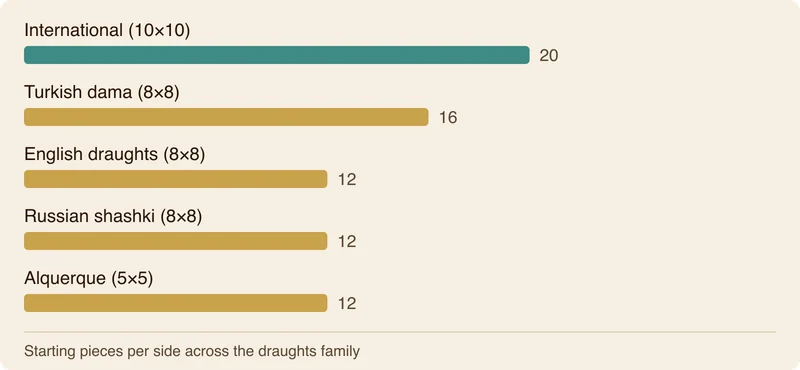
As the chart above illustrates, piece counts vary considerably across the family. Alquerque, English draughts, and Russian shashki feature 12 pieces per side on an 8x8 board, while Turkish dama features 16, and International draughts employs 20 checkers per side on a larger 10x10 grid with 100 squares[3].
English Draughts (American Checkers)
Played on an 8x8 board with 12 pieces per side, English draughts is the variant most familiar to players in the United States and the United Kingdom. Men move forward diagonally one square and capture forward only. Kings move and capture forward or backward, but only one step at a time. The game is concise, highly analytical, and features no flying kings.
International Draughts (Polish Draughts)
International draughts is played on an expansive 10x10 board with 20 pieces per side[3]. Despite being historically nicknamed jeu de dames à la polonaise, historical records indicate that the game was invented in Paris in the early eighteenth century, around 1723, possibly by an officer in the retinue of the Polish queen or the French Regent[3]. International draughts features backward capturing for men, long-range flying kings, and the strict majority capture rule. The 10x10 board provides vast open space, allowing complex multi-piece combination sacrifices known as the coup royal or coup Philippe.
Russian Shashki
Russian shashki (русские шашки) is played on a standard 8x8 board with 12 pieces each, but with a unique dynamic rhythm. Men can jump backwards as well as forwards. Kings are flying kings. Most distinctively, Russian shashki features the rule of in-flight promotion: if an advancing man touches the opponent’s king row during a multi-jump sequence and still has a legal capture available as a king, it crowns immediately and continues jumping across the board in the very same turn as a flying king.
Turkish Dama
Perhaps the most visually surprising variant in the family is Turkish dama (Türk daması), played across Turkey, Greece, and the Arab world. Turkish dama discards diagonal movement entirely: it is played on all 64 squares of an uncheckered 8x8 board. Each player commands 16 pieces arranged on the second and third ranks[6]. Men move one step forward or sideways, and capture orthogonally by jumping forward or sideways. Kings fly along open ranks and files like chess rooks, executing sweeping multi-piece orthogonal captures.
How Jonathan Schaeffer and Chinook solved checkers
For centuries, grandmasters of draughts debated whether the first player holds an inherent theoretical advantage. Unlike games involving dice—such as backgammon, where our study of provably fair dice rolls demonstrates the role of probability—checkers is a game of perfect information. There are no hidden cards, no simultaneous choices, and no random dice rolls. In theory, every position from the opening move to the endgame has an objective mathematical truth: it is either a win for White, a win for Black, or a draw.
Beginning in the late twentieth century, computer scientist Jonathan Schaeffer at the University of Alberta undertook an 18-year research effort to solve English draughts on the 8x8 board computationally[1]. The resulting program, named Chinook, combined deep alpha-beta search heuristics with an exhaustive endgame tablebase calculated backward from empty boards.
To measure Chinook’s strength, Schaeffer entered the program into human championship competition. The undisputed titan of checkers at the time was Dr. Marion Tinsley (1927–1995), a professor of mathematics from Florida who was world champion from 1955 to 1958 and from 1970 to 1992[1]. Tinsley’s competitive record was near-miraculous: across a career spanning 45 years, Tinsley lost only 9 individual tournament games out of thousands played[1].
In their first World Championship match in 1992, Tinsley defeated Chinook four wins to two, with thirty-three draws. When they met for a rematch in 1994, Tinsley resigned after six games due to ill health, having drawn all six, and passed away from cancer shortly thereafter[1]. Following the 1994 contest, Chinook achieved the title of World Man-Machine Champion.
Yet Schaeffer was not satisfied with merely defeating human opponents; he sought the mathematical solution of the game itself. Solving checkers required calculating through a total game-tree search space of roughly 5 x 10^20 possible board positions—five hundred billion billion positions[1]. Schaeffer’s team constructed complete endgame databases containing all positions with ten or fewer pieces on the board, representing trillions of distinct states.
In 2007, after 18 years of distributed computation across hundreds of computer processors, Schaeffer and his co-authors published their definitive findings in the journal Science in a paper titled “Checkers Is Solved.”[1] The paper demonstrated that 8x8 English draughts is weakly solved: from the starting position, if both players make perfect moves at every turn, the game will always terminate in a draw[1].
Why a solved game remains vibrant
When Science announced that checkers was solved, sensationalist headlines proclaimed that the game had been ruined. In reality, the computational proof confirmed what human grandmasters had intuitively known for more than a century: that careful play between equals inevitably leads to equality.
Crucially, checkers was solved weakly, not strongly. A strong solution provides an instant lookup table for every single one of the 5 x 10^20 legal positions[1]. A weak solution proves the outcome from the initial starting position and provides a winning or drawing response to any plausible counter-move. For a human player sitting at a wooden board, memorizing hundreds of billions of branches is impossible. One slight inaccuracy—moving a checker to the rim instead of securing the double corner, or mistiming a king-row breakthrough—instantly turns a theoretical draw into a decisive defeat.
In competitive tournaments, human organizers resolved the tendency toward draws long before computers entered the arena. As early as the late nineteenth century, masters introduced opening ballot systems—such as the “three-move restriction”—where the first three half-moves of a match are drawn randomly from a published deck of balanced opening lines. This forces players to navigate asymmetrical, razor-sharp positions where a single miscalculation proves fatal.
Much like chess players who study tactical themes to avoid blunders like a back-rank mate in chess, or backgammon players who track error rates through performance rating (PR), checkers masters understand that the beauty of draughts lies not in guessing the final result, but in the relentless logic of the journey. Whether played as English draughts on an eight-by-eight board, Russian shashki with flying kings, or International draughts on a ten-by-ten grid, the game born of medieval alquerque remains as captivating today as it was in 1283.
Questions people ask
Is checkers older than chess?
The mechanics of checkers—specifically the diagonal jumping capture—developed around the twelfth century, making modern draughts younger than chess, which had already assumed its recognizable form in sixth-century India (chaturanga) and seventh-century Persia (shatranj). However, the board game ancestor of checkers, alquerque, dates back well into antiquity and was described in tenth-century Arabic literature, existing contemporaneously with early chess.
What is the difference between draughts and checkers?
“Draughts” and “checkers” refer to the exact same game in English. “Draughts” is the historical British English term, derived from the medieval practice of drawing or dragging pieces across the board. “Checkers” is the American English term, named after the checkered pattern of 64 alternating light and dark squares. Internationally, “draughts” is commonly used to refer to the broader family of games, including the 10x10 International variant.
Does the player who moves first always win in checkers?
No. Jonathan Schaeffer’s 2007 proof demonstrated that neither player possesses a forced win from the starting array[1]. If both White and Black play the mathematically optimal move at every turn, 8x8 checkers always ends in a draw. While moving first offers a modest spatial initiative, it is insufficient to overcome accurate defensive play.
Which checkers variant should a beginner learn first?
Beginners should start with standard English draughts on an 8x8 board. Its straightforward movement rules—forward-only capturing for men and single-square kings—allow new players to master fundamental tactical concepts such as king-row defense, the opposition, and multi-jump traps. Once comfortable, exploring Russian shashki or International 10x10 draughts reveals the dramatic attacking possibilities created by flying kings and backward captures.
Sources
- Schaeffer, J., Burch, N., Björnsson, Y., Kishimoto, A., Müller, M., Lake, R., Lu, P., & Sutphen, S. (2007). Checkers Is Solved. Science, 317(5844), 1518–1522.
- Alfonso X of Castile. (1283). Libro de acedrex, dados e tablas (Libro de los juegos). Seville.
- Murray, H. J. R. (1952). A History of Board-Games Other Than Chess. Oxford University Press.
- Torquemada, A. de. (1547). El ingenio, ó juego de marro, de punta, ó damas. Valencia.
- Payne, W. (1756). An Introduction to the Game of Draughts. London.
- Boardgammon. “Checkers Rules: How to Play, Movement, and Captures.”
- Boardgammon. “Checkers Crown: Play Online Checkers and Regional Draughts Variants.”
Found a mistake or an odd phrase? Tell us