Across the global landscape of board games, few families appear as deceptively familiar as checkers. Most players grow up with English draughts: twelve round pieces per side, single diagonal steps across thirty-two dark squares, and kings that gain backward mobility upon reaching the far row. Yet if you travel across the Mediterranean basin, you quickly discover that this familiar starting point diverged into two radically distinct competitive traditions. In Italy, players sit down at a board where ordinary men cannot touch a king under any circumstances, and every capture sequence is governed by a meticulous four-tier priority code. Further east across the Aegean and Levant, players abandon diagonals entirely, deploying sixteen pieces across all sixty-four squares in orthogonal formations that resemble infantry marching forward and sideways.
These two games—Italian Dama (Dama Italiana) and Turkish Dama (Türk Daması)—represent two of the most intellectually compelling evolutions in draughts history. Where Western variants often focus on pawn sacrifice and king breakthroughs along open diagonals, Italian Dama creates intense procedural tension through strict piece status, while Turkish Dama delivers fluid, wide-open tactical battles with flying pieces that strike across empty ranks and files. Both styles have found an enthusiastic global audience in modern digital arenas such as Checkers Crown, where enthusiasts can explore the full spectrum of international rules. Understanding how these systems operate unlocks a deeper appreciation of board game geometry, tactical calculation, and strategic planning.
The Architecture of Italian Dama
At first glance, an Italian Dama setup might seem nearly identical to standard checkers, but a closer inspection reveals fundamental structural distinctions. The game is played on a standard sixty-four square board using thirty-two dark squares, but the board is rotated ninety degrees relative to the English convention. In Italian Dama, the board must be positioned so that the square in the bottom-right corner is a dark square for each player. Each participant commands twelve pieces arranged across the first three rows, leaving two central ranks open for the opening clashes.
+---+---+---+---+---+---+---+---+
|   | 1 |   | 2 |   | 3 |   | 4 |  Row 8 (Black Crown)
+---+---+---+---+---+---+---+---+
| 5 |   | 6 |   | 7 |   | 8 |   |  Row 7
+---+---+---+---+---+---+---+---+
|   | 9 |   |10 |   |11 |   |12 |  Row 6
+---+---+---+---+---+---+---+---+
|13 |   |14 |   |15 |   |16 |   |  Row 5 (Open Center)
+---+---+---+---+---+---+---+---+
|   |17 |   |18 |   |19 |   |20 |  Row 4 (Open Center)
+---+---+---+---+---+---+---+---+
|21 |   |22 |   |23 |   |24 |   |  Row 3
+---+---+---+---+---+---+---+---+
|   |25 |   |26 |   |27 |   |28 |  Row 2
+---+---+---+---+---+---+---+---+
|29 |   |30 |   |31 |   |32 |   |  Row 1 (White Crown)
+---+---+---+---+---+---+---+---+
Ordinary men (pedine) move one step forward diagonally. As detailed in our comprehensive guide to Italian Dama, a pedina cannot move backward and cannot capture backward. However, Italian Dama diverges dramatically once a piece reaches the eighth rank and crowns into a king (dama). The Italian dama does not possess the long-range “flying” movement seen in Russian shashki or International draughts; it moves exactly one step diagonally, forward or backward. Its immense power comes not from velocity, but from social rank and legal privilege.
The Aristocratic Principle: Absolute King Immunity
The most defining and famous rule of Italian Dama is king immunity. Under official regulations codified by the Federazione Italiana Dama (FID)[1], an ordinary man is strictly prohibited from capturing a king. In mathematical terms, zero ordinary men may jump an opposing dama. A dama can only be captured by another dama.
This single statutory prohibition alters the psychological landscape of the match:
- Invulnerable Blockades: A single crowned king can boldly step directly in front of an enemy cluster of ordinary men without fearing immediate capture. Unless the opponent has their own king nearby to counter, the dama commands the diagonal with absolute safety.
- Asymmetric Infiltration: When an endgame approaches with three men facing one king, standard English checkers allows the men to corner and trap the king through mutual sacrifice. In Italian Dama, those three men cannot execute a capture; they must cautiously shepherd the king into stalemate or coordinate their own promotions while avoiding capture.
- Pawn Sacrifices in Reverse: In standard draughts, players often sacrifice a man to draw a king onto an unfavorable square. In Italian Dama, offering a man to an opposing king is common, but you can never use a man to eliminate that king on the following ply.
The Four-Tier Capture Priority Cascade
Forced capture is the universal engine of checkers, ensuring games do not stall into passive hesitation. Yet when multiple jump paths present themselves on an Italian board, players cannot simply choose whichever path suits their tactical convenience. The official FID code enforces a rigorous four-stage hierarchy to settle all capture choices:
- Maximum Quantity: A player must always choose the capture path that takes the largest total number of opposing pieces. If one path takes two pieces and another takes three, the three-piece jump is mandatory.
- Highest-Ranking Capturing Piece: If two available capture paths yield an equal quantity of captured pieces, the player must execute the jump with the piece of higher rank. A dama must jump instead of a pedina.
- Highest-Quality Targets: If the choice is between two jumps made by pieces of equal status taking equal numbers of targets, the player must choose the line that captures the highest quality of opposing material—that is, the path capturing more kings.
- First Target Encountered: If equality still persists across quantity, capturing piece status, and target quality, the player must execute the sequence where a king is captured first along the jump sequence.
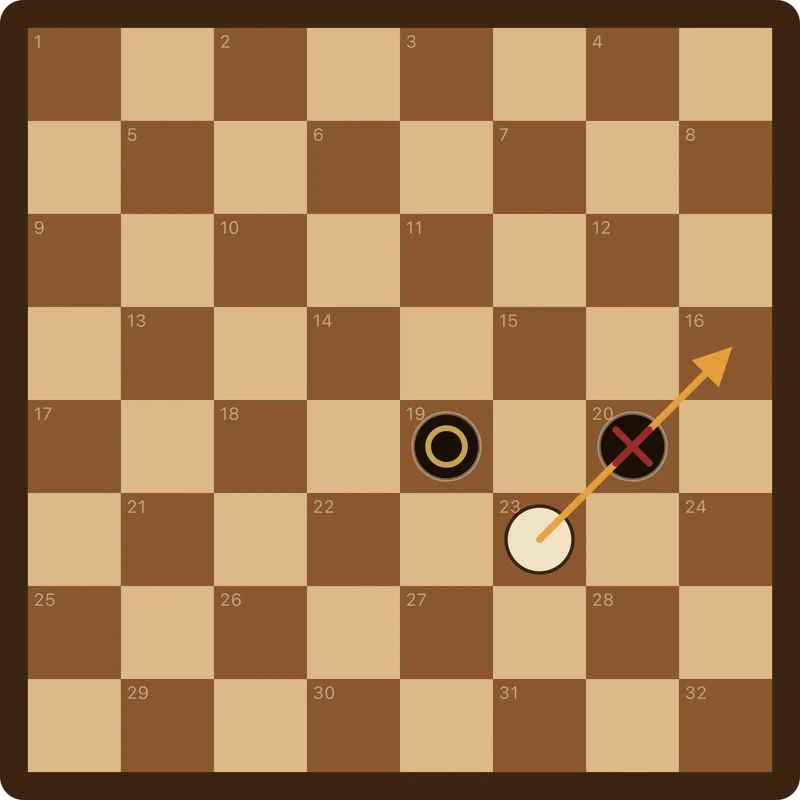
This procedural code turns Italian Dama into a game of strict discipline. Tactical masters deliberately set up deceptive positions where an opponent believes they have an attacking sequence, only to discover that the four-tier hierarchy forces their piece down an alternate, disastrous path.
Türk Daması: Checkers on an Orthogonal Grid
If Italian Dama sharpens the traditional board through procedural constraints, Turkish Dama (Türk Daması) dismantles the conventional paradigm by eliminating diagonal movement altogether. The game is played across all sixty-four squares of an eight-by-eight board, using the light and dark squares without distinction. You can explore these mechanics in depth in our dedicated overview of Turkish Dama.
Each side fields sixteen pieces—four more than the twelve pieces used in Western variants—for a total of thirty-two pieces in action. The starting layout creates an unmistakable formation:
+---+---+---+---+---+---+---+---+
| . | . | . | . | . | . | . | . |  Row 8 (Empty White Promotion Rank)
+---+---+---+---+---+---+---+---+
| B | B | B | B | B | B | B | B |  Row 7 (Black Men)
+---+---+---+---+---+---+---+---+
| B | B | B | B | B | B | B | B |  Row 6 (Black Men)
+---+---+---+---+---+---+---+---+
| . | . | . | . | . | . | . | . |  Row 5 (Open Neutral Zone)
+---+---+---+---+---+---+---+---+
| . | . | . | . | . | . | . | . |  Row 4 (Open Neutral Zone)
+---+---+---+---+---+---+---+---+
| W | W | W | W | W | W | W | W |  Row 3 (White Men)
+---+---+---+---+---+---+---+---+
| W | W | W | W | W | W | W | W |  Row 2 (White Men)
+---+---+---+---+---+---+---+---+
| . | . | . | . | . | . | . | . |  Row 1 (Empty Black Promotion Rank)
+---+---+---+---+---+---+---+---+
Notice that row one and row eight remain completely vacant at the beginning of the match. White occupies rows two and three, while black occupies rows six and seven. The absence of pieces on the baselines ensures that players cannot simply sit in a passive defensive shell on row one; advancement is built into the initial geometry.
Orthogonal Movement and Sideways Infiltration
In Turkish Dama, ordinary men move one step orthogonally in three directions: forward, left, or right. They cannot step backward under any circumstances. Captures follow the same orthogonal directions: a man leaps over an orthogonally adjacent opposing piece to an empty square immediately beyond, jumping forward, to the left, or to the right[2].
The ability to slide sideways gives Turkish Dama a tactical feel unlike any diagonal draughts variant:
- Phalanx Formations: Players construct solid horizontal walls of adjacent men. Because pieces can slide laterally to fill gaps, a well-coordinated defensive line can slide across rows to reinforce threatened sectors.
- Flank Overloads: Instead of being locked into rigid diagonal channels, a player can shift multiple pieces horizontally across rank three to overwhelm an isolated defender on the flank.
- The Lateral Jump: Because men capture sideways as well as forward, opposing pieces that stand shoulder to shoulder on a rank can become vulnerable to devastating horizontal clearance combinations.
Immediate Removal and the Flying King
Two additional rules elevate Turkish Dama into an exhilarating tactical sport:
First is the rule of immediate removal during multiple captures. In European draughts, jumped pieces remain physically on the board until the moving piece completes its entire multi-square sequence. In Turkish Dama, each captured piece is lifted off the board the moment it is jumped[3]. This clearing action can instantly open fresh orthogonal avenues of attack, allowing the capturing piece to continue hopping across squares that were obstructed just a moment earlier.
Second is the flying Dama. When a man reaches the opponent’s baseline (row eight for white, row one for black), it promotes to a Dama. The Turkish crowned Dama moves like a chess rook: it can glide any number of unoccupied squares forward, backward, left, or right across open ranks and files. When capturing, it can strike an enemy piece from any distance down an open rank or file, leap over it, and land on any vacant square beyond.
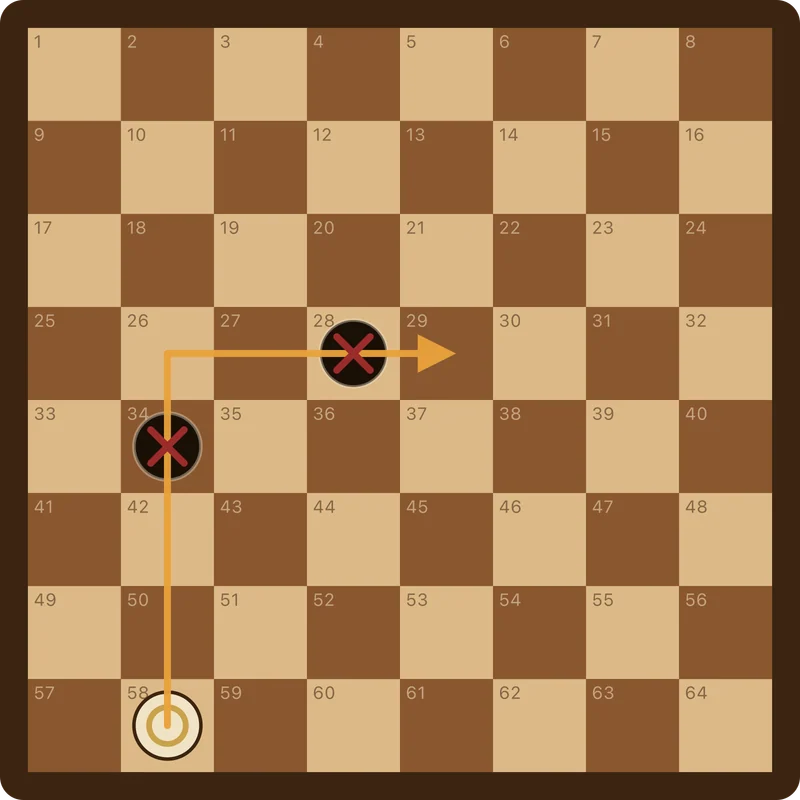
A single crowned Dama on an open board exercises terrifying authority. Because it can travel across entire rows and columns in all four directions, it can sweep through an opponent’s disorganized formation with surgical efficiency.
Structural and Geometric Comparison
Comparing these two games side by side reveals how minor adjustments to board rules alter game complexity:
| Feature | Italian Dama (Dama Italiana) | Turkish Dama (Türk Daması) |
|---|---|---|
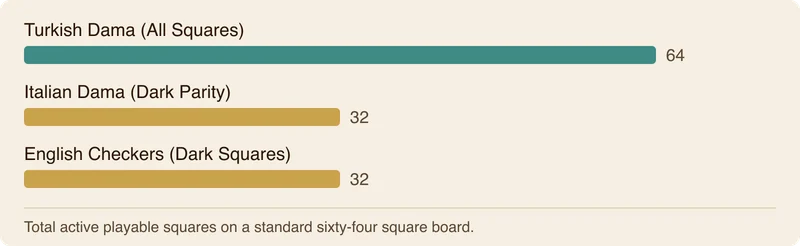
| Board Size | 8×8 (64 squares) | 8×8 (64 squares) |
| Active Squares | 32 dark squares (dark corner right) | All 64 squares (light and dark) |
| Pieces per Player | 12 pedine (24 total on board) | 16 men (32 total on board) |
| Man Movement | 1 step forward diagonally | 1 step forward, left, or right orthogonally |
| King Movement | 1 step diagonally (all 4 directions) | Flying rook: any distance orthogonally |
| King Immunity | Absolute (0 men may jump a king) | None (men can jump kings orthogonally) |
| Capture Priority | 4-tier cascade (quantity, status, quality, order) | Majority rule (maximum pieces captured) |
| Piece Removal | End of entire capture sequence | Immediate removal upon each jump |
To see how these rules fit into the broader global context of draughts, explore our comprehensive breakdown of global checkers variants and how they compare in difficulty.
In Italian Dama, the decision space is tightly constrained by the thirty-two playable squares and the strict priority cascade. Matches often turn on precise zugzwang maneuvers, tempo counting, and subtle positional pins. In Turkish Dama, the decision space expands dramatically: with all sixty-four squares active and three movement directions per man, the branching factor is substantially wider, requiring players to visualize long orthogonal rays across the entire matrix.
Cognitive Engagement: Two Different Mental Disciplines
Both games offer profound mental engagement, exercising analytical faculties in sharply contrasting ways:
- Hierarchical Condition Checking (Italian Dama): Every potential capture requires the brain to run a sequential validation checklist. You must evaluate candidate moves against the four FID priority criteria before determining the legal move. This practice exercises systematic decision-making and disciplined rule evaluation[4].
- Orthogonal Ray Projection (Turkish Dama): The presence of flying kings and lateral movement demands expansive visuospatial calculation. Players must scan horizontal rows and vertical columns across all eight files, anticipating immediate piece removals that open secondary capture trajectories.
- Endgame Precision: Endgames in both variants are highly theoretical. In Italian Dama, a single king must navigate opposing men that it can capture but that cannot capture it, while in Turkish Dama, endgames such as two Damas against one require meticulous coordination to build a cage and prevent infinite evasion.
Cultural Heritage and Mediterranean Legacy
The history of both games reflects centuries of regional passion. Italian Dama boasts deep historical roots in the Renaissance, with treatises documenting local rules across Italian city-states before the formal unification of rules under the Federazione Italiana Dama in 1924. Across Italy, local clubs (circoli damistici) continue to host weekly championships, celebrating the quiet elegance and exacting logic of their national pastime.
Turkish Dama emerged from the bustling coffeehouse culture of the Ottoman Empire, spreading throughout Turkey, Lebanon, Syria, Egypt, and Greece. To this day, players gather in traditional tea houses and open-air public squares to play lightning-fast matches accompanied by the sharp clack of wooden pieces striking the board. The World Turkish Dama Federation (WCDF) now organizes international championships, drawing master players from across the Mediterranean and Central Asia.
Practical Advice for Transitioning Players
If you are accustomed to standard English checkers and wish to explore these rich Mediterranean variants, consider these foundational guidelines:
For Italian Dama:
- Protect Your Crown: Because an opposing king cannot be taken by your men, allowing your opponent an early king promotion is often fatal. Defend your back rank with utmost vigilance.
- Weaponize the Priority Cascade: When calculating trades, look for positions where you can force your opponent into an undesirable jump by exploiting the requirement to capture with the higher-status piece or take the larger quantity.
- Advance in Linked Pairs: Because men cannot move backward, advance them in connected formations so they support each other’s flanks.
For Turkish Dama:
- Maintain Solid Ranks: Avoid advancing lone pieces into open territory where they can be jumped from the side. Keep your men connected horizontally in defensive walls.
- Guard the Empty Ranks: Because rows one and eight start empty, the first player to achieve a promotion can rapidly dismantle the opposing army. Create a clear highway for one promoted Dama while sealing off enemy infiltrators.
- Watch for Immediate Clearance: Always calculate whether jumping an enemy man will open a secondary horizontal lane behind it, turning an ordinary capture into a multi-piece sweep.
To deepen your foundational skills, explore our interactive Checkers Rules tutorial, read our guide to Checkers Strategy, learn about the game’s roots in our History of Checkers, compare game designs in Checkers Variants and Difficulty Levels, or jump into an interactive match on Play Checkers Online to experience Mediterranean draughts firsthand.
Sources
- Federazione Italiana Dama (FID). “Regolamento Tecnico del Gioco della Dama Italiana.” FID Codice Ufficiale delle Gare, Roma, 2021.
- Encyclopaedia Britannica. “Checkers: Board Game.” Britannica Online Encyclopedia.
- World Turkish Dama Federation (WCDF). “Official Rules and Laws of Turkish Draughts (Türk Daması).” WCDF Rulebook, 2019.
- Murray, H. J. R. (1952). “A History of Board-Games Other Than Chess.” Oxford University Press.
- Boardgammon. “Italian Dama: Rules, Board Rotation, and King Immunity.”
- Boardgammon. “Turkish Dama: Orthogonal Moves, Flying Kings, and Tactics.”
- Boardgammon. “Checkers Rules: How to Play, Movement, and Captures.”
- Boardgammon. “Checkers Crown: Play Online Checkers and Regional Draughts Variants.”
- Boardgammon. “Play Checkers Online: Free Browser and Mobile Draughts.”
Found a mistake or an odd phrase? Tell us