Ask someone who grew up in London, Chicago, or Sydney to describe a game of checkers, and they will describe twelve round discs per side sliding forward across thirty-two dark squares on an eight-by-eight grid. Ask someone from Amsterdam, Dakar, or Saint Petersburg, and they will describe twenty pieces per side navigating a sprawling ten-by-ten board where kings sweep across whole diagonals like rooks. Ask a player from Istanbul or Beirut, and they will point to an orthogonal battlefield where checkers move straight ahead and sideways without ever touching a diagonal line.
Checkers—known as draughts in Britain and Ireland—is not a monolith. Over eight centuries, regional traditions cultivated their own rules of engagement, transforming the basic jump-capture mechanic into distinct disciplines. Understanding these checkers variants requires looking beyond the shape of the board. The true difficulty of a draughts game lives in the tension between two separate dimensions: mechanical rule complexity (the procedural restrictions governing legal moves and capture choices) and combinatorial depth (the size of the state space, the branching factor of the game tree, and the horizon of foresight required to win).
Whether you are looking for a straightforward family contest, a high-velocity tactical duel, or a lifetime of grandmaster study, here is how the world’s major checkers traditions compare, ranked from accessible introductory games to formidable competitive systems[1].
What makes a checkers game difficult?
When evaluating how demanding a board game is, players often conflate two very different types of difficulty.
The first is rule friction. A game with high rule friction presents intricate procedural obstacles: asymmetric capture rights, strict precedence hierarchies when multiple jumps appear, or distinct piece immunities. A beginner sitting down to Italian dama, for example, must memorize that a regular checker is legally prohibited from jumping a king, and that a king must always capture another king rather than a regular man when given an equal choice. These procedural fences create immediate cognitive load on every turn, punishing players who fail to observe strict legal protocol.
The second dimension is combinatorial search space. A game can possess remarkably simple rules while confronting players with an overwhelming web of tactical possibilities. This is governed by two mathematical properties:
- The state space: the total number of distinct legal board positions that can arise during play.
- The branching factor: the average number of legal candidate moves available to a player on any given turn.
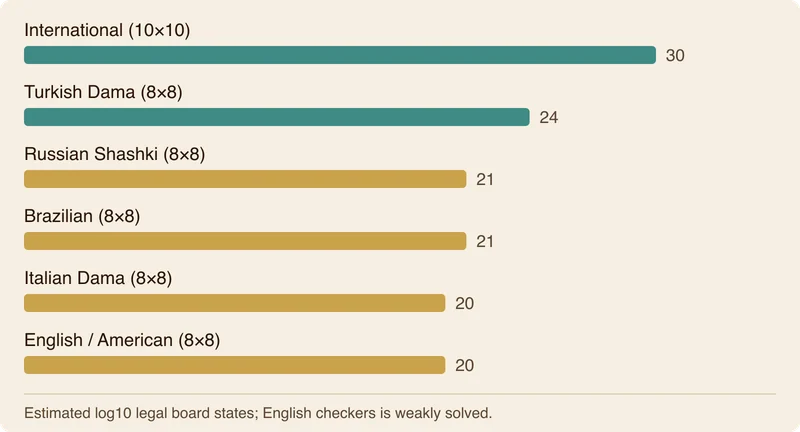
In English draughts on an eight-by-eight board, regular men only jump forward and kings step one square at a time. The rules can be explained to a child in two minutes. Yet the game tree encompasses roughly 5 × 10^20 legal positions, creating razor-sharp endgame subtleties where a single tempo determines victory or defeat. When the board expands to a ten-by-ten grid in International draughts, that state space surges to roughly 10^30 positions, requiring positional planning that rivals classical chess.
To see where each game sits, we can organize the family into five distinct tiers of difficulty.
Tier 1: English draughts (American checkers)
If you are beginning your journey into draughts, English draughts—known simply as checkers in North America—is the foundational entry point.
The configuration is straightforward: each player commands twelve pieces arranged on the first three rows of an eight-by-eight board, utilizing only the thirty-two dark squares. The movement rules are models of economy:
- Regular men move forward diagonally one square into an adjacent vacant dark square.
- Captures are mandatory: if an adjacent enemy piece has an unoccupied landing square directly behind it, you must leap over and capture it. However, regular men may only jump forward.
- Kings are crowned upon reaching the opposite baseline (the crownhead). Kings gain the ability to move and jump backward, but they remain strictly single-step pieces: a king steps or hops exactly one square at a time.
Because men cannot capture backward and kings cannot sweep across open lines, tactical traps in English draughts are relatively contained. There are no sudden long-range ambushes from across the board. If multiple capture sequences are legal, you are free to choose whichever path you prefer, regardless of how many pieces are captured.
Yet simple rules do not produce a trivial game. In 2007, a landmark computational research team led by Jonathan Schaeffer at the University of Alberta announced in the journal Science that English eight-by-eight draughts had been weakly solved[2]. After eighteen years of continuous computation analyzing a search space of 5 × 10^20 positions, their program Chinook proved that perfect play by both sides inevitably leads to a draw.
At human competitive levels, English draughts demands deep endgame memory and precision. Because pieces cannot retreat without crowning, every forward step is an irrevocable structural commitment. The game forgives minor inaccuracies in the opening, but punishes even the slightest hesitation once kings enter the double corners.
Tier 2: The high-velocity tactical step-up (Russian and Brazilian)
Once players grasp the baseline mechanics of checkers, moving to continental rules introduces an immediate jolt of kinetic energy. The two primary eight-by-eight continental variants are Russian shashki and Brazilian draughts.
Russian shashki
Played widely across Eastern Europe and Central Asia, Russian shashki retains the standard eight-by-eight board with twelve pieces per side, but transforms every piece on the board:
- Backward capture for men: While regular men must still walk forward when making quiet moves, they can capture both forward and backward. If an opponent steps behind your piece, your checker can snap backward to take it.
- Flying kings (dams): When a checker reaches the eighth rank, it becomes a flying king. Rather than crawling one square at a time, a flying king can glide across any number of unoccupied diagonal squares in a single stride, leaping over an enemy piece at any distance along an open diagonal and landing on any vacant square beyond it.
- In-flight crowning: In English checkers, if a man reaches the crownhead during a jumping turn, its turn terminates immediately so it can be crowned. In Russian shashki, if an advancing man touches the eighth row in the middle of a jumping sequence and can legally continue jumping, it crowns instantly mid-jump and continues capturing across the board with full flying-king privileges.
This mid-jump promotion rule produces breathtaking combinations. A player can sacrifice two checkers to steer an enemy piece onto a specific diagonal, jump an advancing checker into the back row, promote instantly, and ricochet across the board as a flying king to clear out the opponent’s entire back line in a single move.
Brazilian draughts
Brazilian draughts takes the complete rulebook of ten-by-ten International draughts and compresses it into the compact space of an eight-by-eight board. Like shashki, it features backward captures for regular men and long-range flying kings. However, Brazilian draughts enforces the strict majority-capture rule codified by the World Draughts Federation (FMJD):
Whenever you have a choice between different capture sequences, you must take the line that captures the greatest number of pieces[3].
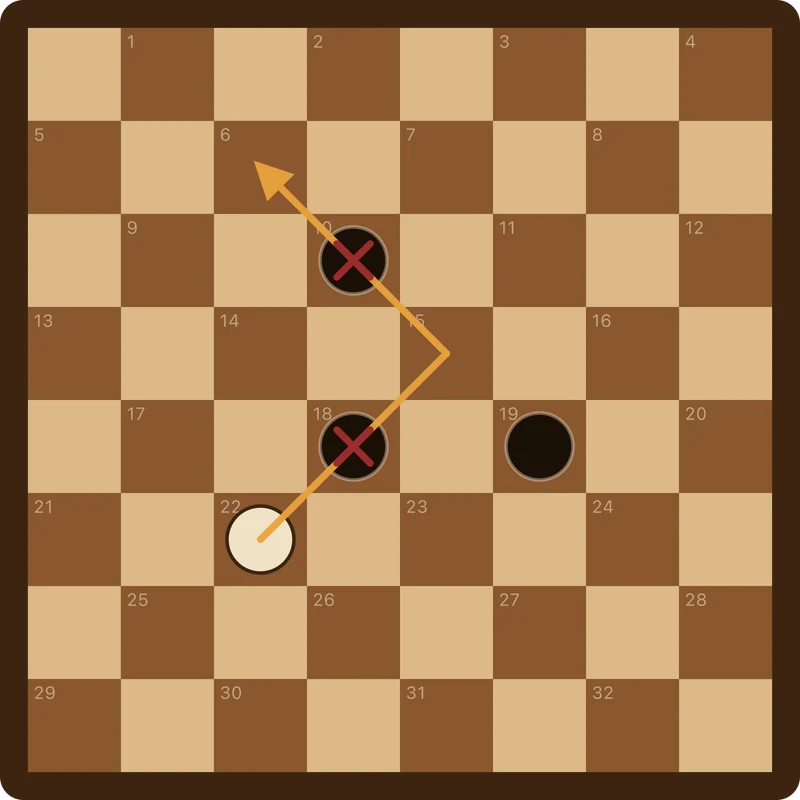
The majority-capture rule introduces sharp psychological and tactical calculation. In English checkers, you can dangle a piece as bait; in Brazilian draughts, you can force your opponent to take a path they hate simply by ensuring that line contains more checkers. Sacrificing three checkers to force the opponent into a specific square—even if taking a single checker would have saved their king—is a staple of competitive play. Because the board has only thirty-two active squares, these long-range combinations explode with intense spatial pressure.
Tier 3: Strict procedural discipline (Italian dama)
For players who appreciate rigid legal logic and meticulous tactical calculation, Italian dama offers a fascinating intellectual exercise.
At first glance, Italian dama resembles English checkers: twelve pieces per side on an eight-by-eight board, with regular men stepping and capturing forward only. But Italian dama incorporates two structural rules that transform the game into an entirely different puzzle:
- Board orientation: The board is turned ninety degrees relative to standard English setup, meaning the square at the bottom-right corner of each player is dark rather than light.
- King immunity: Regular men are legally prohibited from capturing kings. If an enemy king lands on a square adjacent to your regular man, your man cannot leap over it under any circumstance. A king can only be captured by another king.
On top of king immunity, Italian dama resolves multiple capture choices through a four-tiered hierarchy of legal obligations:
- Quantity first: You must capture the largest number of checkers possible.
- Quality of the actor: If two different capture paths yield the same number of pieces, you must capture with a king rather than a regular man.
- Quality of the target: If two capture paths of equal length using the same piece type are available, you must take the path that removes the greatest number of enemy kings.
- Order of encounter: If two paths remain tied, you must choose the path that captures an enemy king earliest in the jumping sequence.
This strict procedural protocol eliminates arbitrary choice. A player cannot casually pick a line of play; every jump sequence must be audited against the four-tier statute[4]. Defensively, advancing a king into enemy territory creates terrifying threats, because the opponent’s regular checkers are powerless to touch it unless they can coordinate a counter-promotion. Mastering Italian dama requires exceptional legal discipline and deep positional awareness.
Tier 4: The grandmaster standard (International 10×10 draughts)
If you are looking for the summit of strategic breadth in diagonal board games, International draughts stands in a league of its own.
Developed in eighteenth-century France and officially governed by the World Draughts Federation (Fédération Mondiale du Jeu de Dames), International draughts expands the battlefield from sixty-four squares to one hundred squares on a ten-by-ten grid. Each side commands twenty checkers stationed on fifty dark squares.
The rules incorporate the full suite of continental mechanics:
- Regular men move forward diagonally, but capture both forward and backward.
- Kings are flying, gliding over multiple empty squares along open diagonals.
- The majority-capture rule is mandatory: players must always choose the capture path that takes the largest number of checkers.
What elevates International draughts to grandmaster status is its immense search space. Combinatorial analysts estimate its state space at approximately 10^30 positions—roughly ten orders of magnitude larger than English draughts. With forty pieces filling fifty active squares, the opening phase resembles a complex military deployment.
In an eight-by-eight game, pieces collide after two or three turns; on a ten-by-ten board, players spend ten to fifteen moves constructing deep structural formations before the first pawn trade occurs. Master play revolves around classical strategic motifs:
- Center clamping: Occupying dominant central outposts to restrict the opponent’s flank mobility.
- The Dutch setup: Building a solid triangle of supporting checkers that resists tactical breakthrough.
- Combination shots: Named tactical themes such as the Coup Royal, Coup Philippe, and Coup de Talon, where four or five checkers are sacrificed across multiple turns to force an enemy piece into a cross-board sweep.
Because flying kings can strike across ten diagonal squares, a single king on a 10×10 board commands devastating reach. Endgames in International draughts are rich with zugzwang maneuvers, requiring fifteen to twenty moves of precise visualization to escort a passed checker to the promotion line.
Tier 5: The orthogonal paradigm shift (Turkish dama)
For centuries, European and American draughts players assumed that checkers was inherently a game of diagonal jumps. Turkish dama (also played throughout the Levant and Mediterranean under the name Dama) shatters that assumption completely.
Turkish dama is played on an eight-by-eight board, but it discards alternating colors entirely. All sixty-four squares are active. Each player commands sixteen checkers, arranged across the second and third rows for white and the sixth and seventh rows for black, leaving the first row, fourth row, and fifth row vacant at the start.
The movement mechanics represent a radical departure from all diagonal variants:
- Orthogonal walking: Checkers move one square forward or one square sideways (left or right). They can never move backward, and they never move diagonally.
- Orthogonal jumping: Captures occur by jumping horizontally or vertically over an adjacent enemy piece onto an empty square beyond. Jumps can be chained together in forward, left, and right directions in the same turn.
- Immediate piece removal: In diagonal draughts, captured pieces remain on the board until the entire multi-jump is finished. In Turkish dama, as soon as a checker leaps over an enemy piece, that captured piece is lifted off the board immediately. This often opens up new empty squares mid-turn, enabling the jumping checker to turn corners and continue capturing pieces that were previously blocked.
- The Dama (flying king): When a checker reaches the opposite eighth row, it promotes to a Dama. The Dama can glide any distance horizontally or vertically along open ranks and files, capturing enemy pieces at long range in all four directions.
The difficulty of Turkish dama is psychological as well as tactical. Because every square is playable and movement flows along ranks and files, diagonal sightlines become useless. A defensive wall of checkers that looks impregnable under European rules can be dismantled from the side in two turns. Endgames feature brutal blockades where a single Dama traps multiple enemy checkers against the board edge through suffocating zugzwang.
Summary: A comparative difficulty guide
To help you decide which game to study next, the following table summarizes the core parameters and relative difficulty of the major traditions:
| Variant | Board size | Pieces per side | Capture direction | King type | Majority capture | Difficulty tier |
|---|---|---|---|---|---|---|
| English / American | 8×8 (32 dark) | 12 | Men forward only | Single-step (1 square) | No (free choice) | Tier 1 (Accessible / Tactical) |
| Russian Shashki | 8×8 (32 dark) | 12 | Men forward & backward | Flying (long diagonal) | No (free choice) | Tier 2 (High volatility) |
| Brazilian | 8×8 (32 dark) | 12 | Men forward & backward | Flying (long diagonal) | Yes (maximum pieces) | Tier 2 (Tactical pressure) |
| Italian Dama | 8×8 (32 dark) | 12 | Men forward only | Single-step (men can’t take king) | Strict multi-tier hierarchy | Tier 3 (Strict procedural) |
| International | 10×10 (50 dark) | 20 | Men forward & backward | Flying (long diagonal) | Yes (maximum pieces) | Tier 4 (Grandmaster strategic) |
| Turkish Dama | 8×8 (64 squares) | 16 | Orthogonal (forward & sides) | Flying (orthogonal ranks/files) | Yes (maximum pieces) | Tier 5 (Unique spatial geometry) |
Where should a beginner start?
If you are exploring draughts beyond casual kitchen-table play, a structured path will build your tactical intuition without overwhelming you with rules.
Start with English draughts. Its forward-only captures and single-step kings teach you the vital core principles of the family: commanding the central squares, preserving your baseline king row, and calculating forced piece trades. Learning the endgame fundamentals of the double corner will give you a solid foundation that carries over to every other tradition. You can review these concepts in our breakdown of checkers strategy and trace how these games evolved in our article on the history of checkers.
Once you feel comfortable maneuvering on an eight-by-eight board, take the leap into Russian shashki or Brazilian draughts. Experiencing flying kings and backward captures for the first time will revolutionize your tactical awareness. You will quickly learn never to leave an unprotected checker sitting behind an enemy line, and you will begin spotting multi-piece combination sacrifices from several moves away.
When you crave deep positional mastery, step onto the ten-by-ten board of International draughts. The expanded space rewards patience, long-term pawn coordination, and comprehensive strategic foresight. And whenever you want to test whether your board vision depends too heavily on diagonal patterns, sit down to a game of Turkish dama to experience draughts reinvented from the ground up.
Every variant in this global family carries its own beauty, its own competitive literature, and its own tactical rhythm. When you are ready to test your foresight on the board, explore our interactive guides to the rules of checkers, compare the historical traditions in Checkers Crown, or sit down for a free game of checkers to put these principles into practice.
Sources
- Encyclopædia Britannica. (2024). Checkers | Rules, History, & Board.
- Schaeffer, J., Burch, N., Björnsson, Y., Kishimoto, A., Müller, M., Lake, R., Lu, P., & Sutphen, S. (2007). Checkers Is Solved. Science, 317(5844), 1518–1522.
- Fédération Mondiale du Jeu de Dames. (2021). Official Rules of International Draughts.
- Bell, R. C. (1979). Board and Table Games from Many Civilizations. Dover Publications.
- Boardgammon. Checkers Variants: Rules and Regional Traditions.
- Boardgammon. Checkers Rules: How to Play and Standard Laws.
- Checkers Crown. Free Online Checkers in Your Browser.
Found a mistake or an odd phrase? Tell us