When newcomers transition from casual money sessions to competitive tournaments, they quickly encounter an unfamiliar rhythm. In a money game, every individual point won or lost translates directly into agreed stakes, and the doubling cube can be turned whenever a player feels an edge. In competitive tournament matches, however, games are contested to a predetermined overall target score.
In this structured environment, every single point carries a fluctuating strategic weight depending on the current match score. As codified in the rules of backgammon, standard championship contests are governed by a critical regulation known worldwide as the Crawford rule[1].
The Crawford rule alters the character of the game at its most decisive moment. Understanding why this rule exists, what happens during the Crawford game, and how to execute post-Crawford doubling strategy separates casual rollers from accomplished tournament competitors.
What is the Crawford rule?
Every standard backgammon game begins with 15 checkers per side across 24 points[1]. Under the Crawford rule in match play, when either player reaches a score exactly 1 point away from winning the match, the doubling cube is completely prohibited for the entire next game[2].
This specific game is called the Crawford game. Throughout this single game, neither player may offer a double, and neither player may redouble. The doubling cube sits entirely dormant, remaining on 1 for the duration of the contest[2].
Championship matches are commonly played to odd point targets such as 5, 7, 9, 11, or 13 points, with match point occurring when a player reaches 4, 6, 8, 10, or 12 points respectively[3]. For example, in a 5-point match, if you build a lead of 4 to 2, you have reached 4 points and are exactly 1 point away from match victory[4]. The very next game is designated the Crawford game, and neither you nor your opponent can touch the doubling cube.
If the leader wins the Crawford game, they earn at least 1 point, reaching the target score of 5 points and winning the match outright[4]. If the trailing player wins the Crawford game, the match continues, but the Crawford rule expires for all subsequent games[4].
Why does the Crawford rule exist?
To understand why tournament backgammon requires this rule, you have to imagine what would happen without it. Consider a scenario where Player A leads Player B by a score of 4 to 2 in a 5-point match[4]. Player A needs only 1 point to close out the match, while Player B needs 3 points.
If there were no Crawford rule, look at what Player B would do on the opening turn of the next game. Without the Crawford rule, a player trailing 4 to 2 in a 5-point match would double immediately on move 1 at zero cost, since losing 1 or 2 points loses the match identically while winning scores 2 points to tie at 4 to 4[4].
Consider Player B’s calculation:
- If Player B does not double and loses a single game, Player A scores 1 point, reaching 5 points and winning the match.
- If Player B doubles to 2 and loses, Player A scores 2 points, reaching 6 points and winning the match. The extra point conceded makes zero practical difference, because losing the match by 1 point or 2 points is the exact same match loss.
- If Player B doubles to 2 and wins a single game, Player B receives 2 points instead of 1 point, instantly elevating their score from 2 to 4 and tying the match at 4 to 4!
In tournament theory, this zero-downside double is called a free double. Without a protective mechanism, the trailing player would double before the first roll in every single game where their opponent stood at match point. That automatic double would rob the leader of the cushion they earned across previous games, cutting their 2-point lead down to nothing.
The rule was introduced around 1970 by American champion and tournament director John R. Crawford, co-author of The Backgammon Book published in 1970[2]. Crawford recognized that allowing the trailing player an immediate, costless double penalized the player who had built a commanding match lead. By enforcing one undoubled game, the Crawford rule guarantees that the leader gets at least one fair chance to win their final 1 point at the base stake without being forced into an immediate high-stakes gamble.
How does the Crawford game change checker play?
Because the doubling cube cannot be used during the Crawford game, both contestants must adjust their backgammon strategy. In standard play, a player with a substantial positional edge can turn the cube to force a concession or cash the game. During the Crawford game, that exit door is bolted shut: you must play the game out to its natural conclusion on the board.
For the leader, the primary objective is straightforward: win the game by any margin. Bearing off all 15 checkers before the opponent clears their board secures the 1 point required to finish the match[1]. As a result, the leader frequently adopts prudent, risk-averse checker play. When faced with a choice between slotting an ambitious home point or making a quiet, safe consolidation, the leader routinely chooses safety.
For the trailer, the Crawford game is an uphill battle, but it is not hopeless. Because the leader cannot double them out, the trailer can contest positions far deeper into the endgame than would ever be possible in ordinary play. Even if the trailer falls behind in the race, they can maintain deep anchors, fish for late-game shots, and build counter-primes without fear of facing a lethal doubling cube.
Furthermore, victory margins remain fully active during the Crawford game. While the Jacoby rule in money play requires the doubling cube to be turned for gammons to score 2 points, match play strictly bars the Jacoby rule, meaning gammons always score 2 points even during the undoubled Crawford game[1]. If the trailing player manufactures an aggressive blitz and wins a gammon, they receive 2 full points, narrowing the deficit substantially.
Post-Crawford play: why the trailer doubles immediately
If the trailing player overcomes the odds and wins the Crawford game, the match moves into what tournament players call post-Crawford play.
Once the Crawford game has concluded, the Crawford rule expires for all subsequent games, giving the trailing player a free double that should typically be offered on move 1 or early in the game[4].
Why should the trailing player double right away? Because the fundamental math that John R. Crawford addressed in the Crawford game now returns with full force. In post-Crawford play, the leader still needs only 1 point to finish the match. Whether the leader wins 1 point or 2 points, they achieve victory. But the trailer still needs multiple points to catch up.
By doubling the cube to 2:
- The trailer risks nothing extra: a loss at 1 point or 2 points ends the match identically.
- The trailer gains everything: every win now awards at least 2 points, accelerating their comeback.
Because the leader has nothing to lose by accepting, the leader will take the cube with 100 percent certainty. In post-Crawford play, the leader needs only 1 point to win the match and should almost never double, because the trailer will automatically accept every double with 100 percent take frequency[5].
The only rare circumstance where a leader might consider turning the cube in post-Crawford play occurs when the leader has a massive gammon threat, and doubling denies the trailer any future redoubling leverage. In almost all standard situations, however, the leader leaves the cube alone, waiting for the trailer to trigger the inevitable double.
Double Match Point: when the cube sleeps permanently
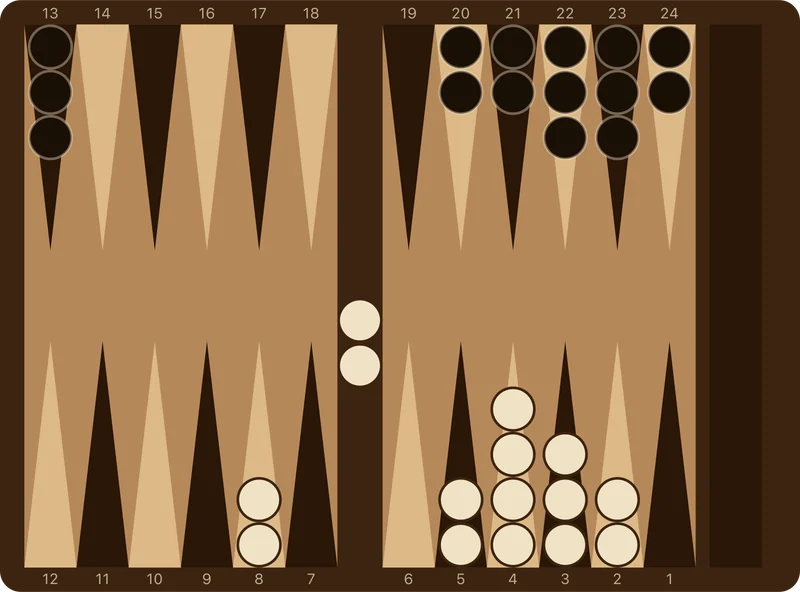
If the trailing player continues their comeback and ties the match, the contest reaches the most thrilling climax in backgammon: Double Match Point, commonly abbreviated as DMP.
When both players reach match point, such as 4 to 4 in a 5-point match, Double Match Point or DMP is reached where the cube is never turned and gammons count for 0 extra points[4].
At Double Match Point, all point calculations, cube considerations, and margin distinctions evaporate. Whoever wins the final game wins the entire match:
- Cube value is irrelevant: The doubling cube remains untouched. Offering a double makes no sense because both contestants need exactly 1 point; accepting or dropping is functionally meaningless.
- Gammons have zero value: Winning a single game, a gammon, or a backgammon makes no difference. A gammon awards 0 additional benefit because 1 point is already sufficient to claim the match trophy.
- Pure winning probability: Checker play shifts entirely to maximizing the pure probability of winning. Players do not take defensive precautions to prevent gammons, nor do they risk exposing extra blots to hunt for gammons. Every tactical decision is judged by one criterion: does this move maximize the chances of crossing the finish line first?
For deeper insights into how cube values interact with single-point thresholds, explore our guides on when to double in backgammon and the scoring dynamics of gammons and backgammons.
Asymmetric scores: gammon-go and gammon-save
Between the Crawford game and Double Match Point lies a fascinating realm of asymmetric match scores where the value of a gammon diverges completely for the two contestants.
In Norman Zadeh’s 1977 mathematical analysis of optimal doubling, match equity tables demonstrate that take points diverge drastically from the standard money play threshold of 25 percent depending on remaining score deficits[6]. These mathematical models reveal two vital strategic mindsets: gammon-go and gammon-save.
At specific scores like trailing 2 to 4 in a 5-point match, the trailer enters gammon-go where a 2-point gammon wins the match, while the leader enters gammon-save to avoid conceding 2 points[5]:
- Gammon-go (the trailer): The trailer trails 2 to 4 in a 5-point match. If the trailer wins a single game (1 point), the score becomes 3 to 4, leaving the trailer still behind. But if the trailer wins a gammon (2 points), their score jumps from 2 to 4, reaching 4 to 4 and instantly forcing DMP! Because winning a gammon provides massive equity while losing costs nothing extra, the trailer is in “gammon-go.” They should play with ferocious aggression, attacking blots, slotting home points, and sacrificing checkers to keep opposing runners trapped.
- Gammon-save (the leader): At the exact same score, the leader is in “gammon-save.” If the leader loses a single game, they still lead 4 to 3. But if the leader gets gammoned, their hard-earned lead vanishes into a 4 to 4 tie. The leader must treat gammon prevention as their highest tactical priority, breaking anchors early, avoiding unnecessary blots, and running checkers toward home safety.
To practice managing these volatile score situations in real time, you can play backgammon online and study how backgammon tournaments work across our competitive community.
Tournament match play versus casual money play
To synthesize these principles, it helps to review how tournament match play contrasts with casual money play:
| Feature | Money Play | Match Play |
|---|---|---|
| Objective | Accumulate net points | Reach target match score (e.g. 5, 7, 9, 11, or 13 points) |
| Jacoby Rule | Often active (gammons count only if cube turned) | Strictly barred (gammons always count 2 points) |
| Crawford Rule | Does not exist | Mandatory when either player reaches match point (1 point away) |
| Post-Crawford Doubling | Standard doubling window | Free double for trailer; leader almost never doubles |
| Gammon Values | Constant (2 points base) | Dynamic: 0 at DMP, super-valuable at gammon-go |
| Take Points | Static ~25% benchmark | Fluctuates from under 15% to over 35% based on score equity |
By respecting the structure of match play, you transform the doubling cube from a blunt betting tool into a sophisticated instrument of tournament strategy.
Questions people ask
Does the Crawford rule apply in 1-point matches?
No. In a 1-point match, both players begin the match exactly 1 point away from victory. That opening game is already Double Match Point (DMP). The doubling cube is never used in 1-point matches, so the Crawford rule does not apply.
Can you win a gammon during the Crawford game?
Yes. Although the doubling cube cannot be turned during the Crawford game, gammons and backgammons remain fully active. In match play, the Jacoby rule is strictly prohibited, meaning a gammon awards 2 points and a backgammon awards 3 points even when the doubling cube sits dormant at 1[1].
What happens if the trailer forgets to double in post-Crawford play?
If the trailer fails to double in post-Crawford play, they give up a massive mathematical advantage. The trailer holds a free double with zero downside risk. Forgetting to turn the cube leaves potential points on the table and forces the trailer to win more subsequent games than necessary to complete their comeback.
Why does the leader avoid doubling in post-Crawford games?
Because the trailer needs multiple points to win the match, the trailer will accept the leader’s double with 100 percent certainty[5]. Doubling does not pressure the trailer to drop, but it hands the trailer ownership of the cube. If the game subsequently swings in the trailer’s favor, the trailer could redouble to 4, putting the leader at risk of losing multiple points.
Who invented the Crawford rule?
The rule was created around 1970 by John R. Crawford, an American backgammon champion, author, and tournament director[2]. It was officially incorporated into tournament rulebooks to preserve equity and ensure that players who earn commanding match leads receive at least one undoubled game before facing the opponent’s free double.
Sources
- Encyclopaedia Britannica. “Backgammon: Rules, History, and Doubles.”
- Jacoby, O. & Crawford, J. R. (1970). The Backgammon Book. Viking Press, New York.
- Boardgammon. “How Backgammon Tournaments Work: Match Formats and Rules.”
- Magriel, P. (1976). Backgammon. Quadrangle/The New York Times Book Co., New York.
- Robertie, B. (2002). Modern Backgammon. The Game Grid, Inc., Arlington.
- Zadeh, N. (1977). Computation of optimal doubling strategies in backgammon. Operations Research, 25(1), 12–29.
- Boardgammon. “The Official Rules of Backgammon: Setup, Moves, and Doubling.”
- Boardgammon. “Doubling Cube Strategy and Take Points in Backgammon.”
Found a mistake or an odd phrase? Tell us