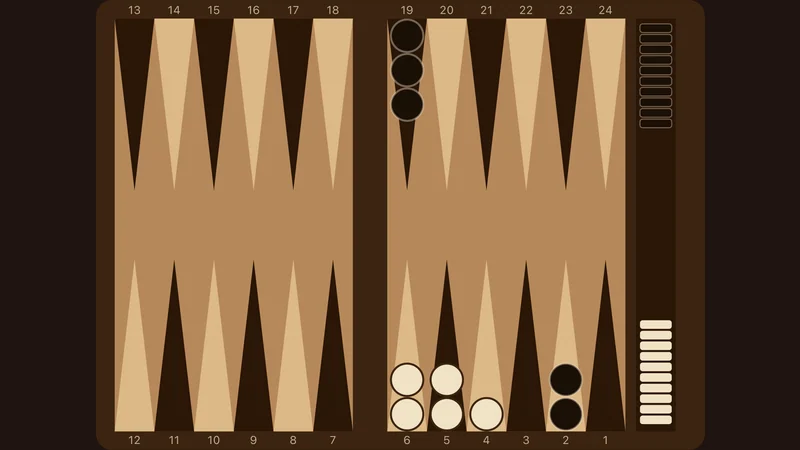
When newcomers sit down to learn backgammon, they usually focus entirely on crossing the board and bearing off their checkers first. Reaching the finish line ahead of your opponent is satisfying, but backgammon is rarely scored as a series of identical wins. The game measures not just whether you win, but how decisively you defeat your opponent.
A master player does not treat every game as a race for a single point. In tournament matches and traditional club sessions, the difference between an ordinary finish and a landslide determines match strategy, doubling decisions, and opening risks. The official codification in the rules of backgammon recognizes three tiers of victory: a single win, a gammon, and a backgammon[1].
Knowing when a game has evolved from a standard contest into a gammon hunt changes every checker move on the board. An attacker may choose to delay bearing off in order to hunt down remaining opposing pieces, while a defender must abandon long-term positional dreams to sprint for safety.
What is a single win, a gammon, and a backgammon?
Every backgammon match begins with 15 checkers per side[1]. The contest ends the moment one player bears off all 15 checkers from the board[1]. At that precise instant, the referee or scorekeeper looks at the position of the losing side’s pieces to determine the margin of victory:
- Single win (1 point): If the losing player has borne off at least 1 checker, the game concludes as a single win[1]. The winner earns 1 point, or the face value shown on the doubling cube[1].
- Gammon (2 points): If the winner bears off all 15 checkers while the loser has borne off 0 checkers, the winner scores a gammon[1]. A gammon pays 2 points, doubling the base stake of the game[1].
- Backgammon (3 points): A backgammon is a triple victory[1]. It occurs when the loser has borne off 0 checkers and still has at least 1 checker on the bar or trapped inside the winner’s home board on points 1 through 6[1]. A backgammon earns 3 points[1].
The distinction between a gammon and a backgammon is often misunderstood by casual players. Many assume that leaving any checker in the outer board constitutes a backgammon. That is incorrect. If the losing player has checkers on point 8 or point 12, but has cleared all checkers out of the winner’s home board (points 1 to 6) and has no checkers on the bar, the loss is recorded strictly as a gammon (2 points), not a backgammon[1]. To suffer a backgammon, at least 1 checker must remain on the bar or within points 1 through 6[1].
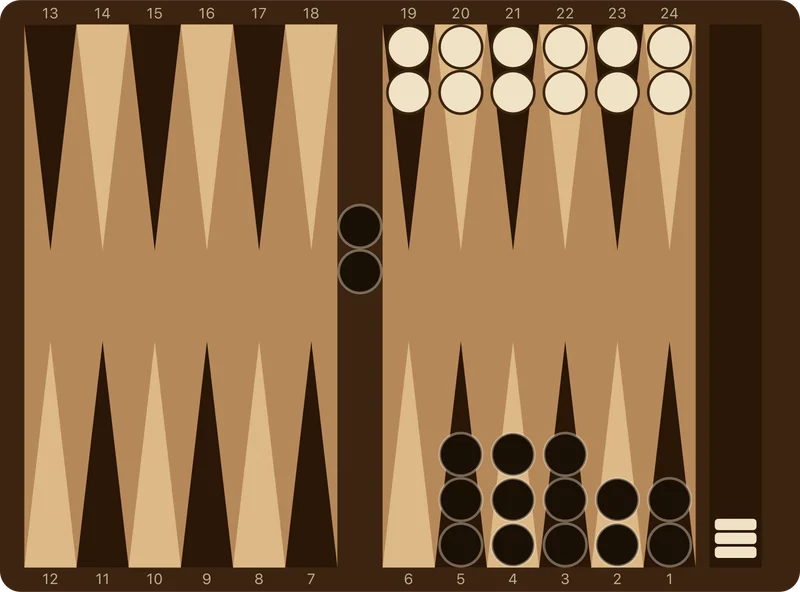
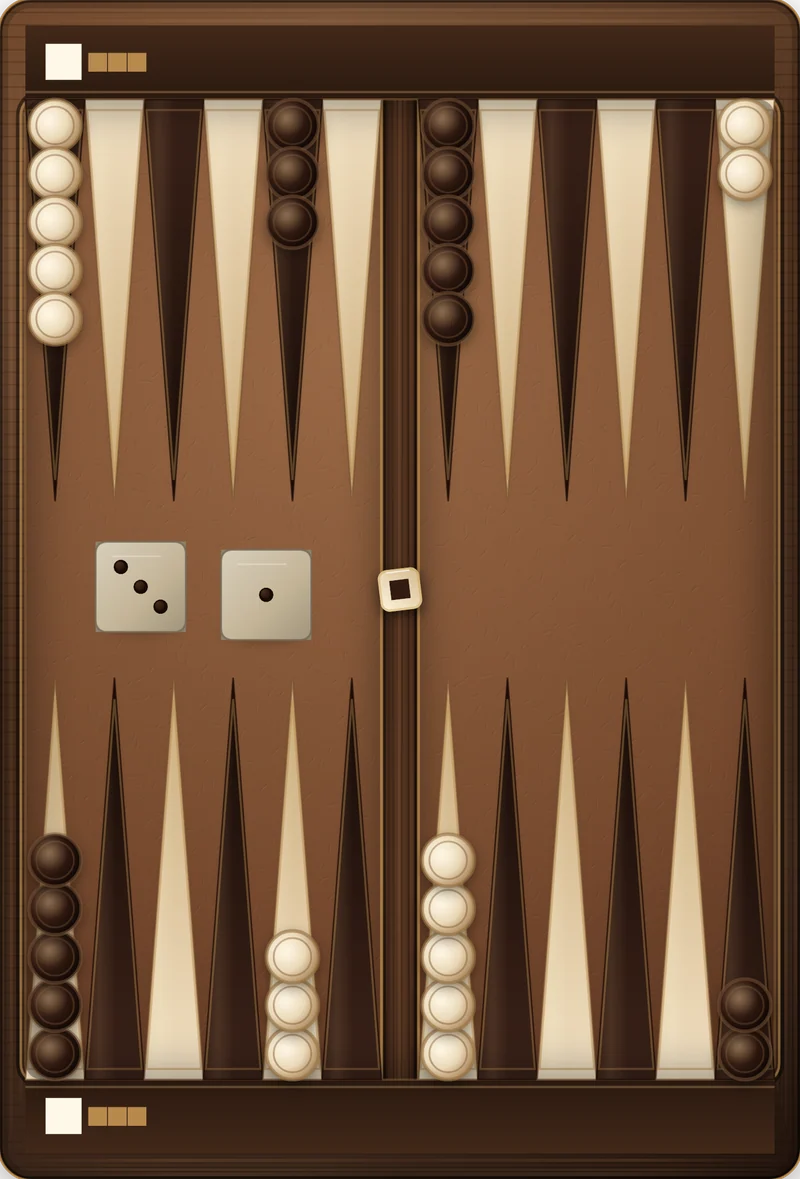
The board above illustrates an overwhelming gammon threat. White has established a closed home board by securing points 1 through 6 with 2 checkers on each point, while trapping 2 Black checkers on the bar. White has already borne off 3 checkers, whereas Black has borne off 0 checkers[1]. Because Black cannot re-enter until White opens a point, White is a heavy favorite to claim a gammon.
How the doubling cube multiplies gammons and backgammons
The point values described above represent the base stakes of the game. In modern backgammon, these values are multiplied directly by the doubling cube[1].
When a game is played with the doubling cube, any gammon or backgammon multiplies the final number displayed on the cube:
- If the cube sits on 2, a single win pays 2 points, a gammon pays 4 points, and a backgammon pays 6 points[1].
- If the cube has been redoubled to 4, a single win awards 4 points, a gammon awards 8 points, and a backgammon awards 12 points[1].
Because the doubling cube acts as a geometric multiplier, an unnoticed gammon threat can end a multi-point match in a single round. For players exploring competitive formats, studying when to double in backgammon provides the mathematical framework for assessing these volatility swings.
How common are gammons in competitive play?
Beginners often wonder whether gammons and backgammons are rare anomalies or standard occurrences. Across extensive database rollouts and championship match analyses, game outcomes follow a remarkably consistent distribution[2]:
- Approximately 68 percent of completed tournament games conclude as single wins[2].
- Roughly 30 percent of completed games result in a gammon[2].
- Approximately 2 percent of completed games finish as a backgammon[2].
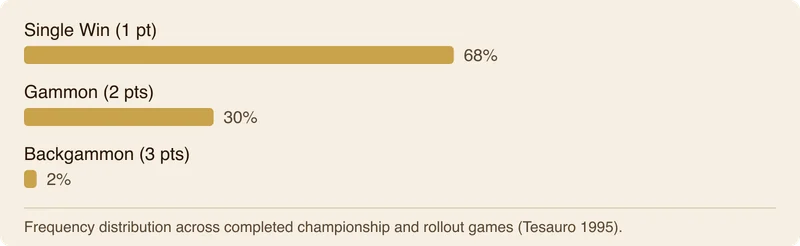
Because almost 1 in every 3 games concludes as a gammon, high-level backgammon is profoundly shaped by gammon probabilities[2]. In contrast, backgammons occur in only about 2 percent of games[2]. Backgammons are rare in championship play because losing defenders recognize the danger early and scramble their back checkers forward before the winner can clear 15 checkers, or because the losing side concedes or drops a double before a triple loss can materialize.
Money play vs match play: the Jacoby and Crawford rules
The rules governing gammons depend on whether you are playing a standalone money game or a structured tournament match.
The Jacoby rule in money play
In traditional money sessions (such as chouette play), games are played for monetary stakes per point rather than a target match score. In the early decades of the game, money games suffered from a pacing flaw: an attacker with a commanding lead would refuse to double, dragging out the game for dozens of rolls simply to milk a gammon.
To eliminate this stalling tactic, legendary player Oswald Jacoby introduced the rule that bears his name[3]. Under the Jacoby rule, gammons and backgammons count only as single wins (worth 1 point) unless the doubling cube has been offered and accepted[3].
If neither player has turned the doubling cube during the game, the winner receives only 1 point, even if the opponent has borne off 0 checkers[3]. The Jacoby rule forces attackers to double if they want the reward of a 2-point gammon, restoring rapid decision-making to money play.
Crucially, the Jacoby rule is strictly prohibited in tournament match play[3]. In match play, gammons and backgammons always award their full 2 points and 3 points, regardless of whether the doubling cube has been turned[3].
The Crawford rule in tournament matches
Tournament backgammon is contested to a set total of points, such as a 5-point match. When one player reaches 4 points in a 5-point match, they sit exactly 1 point away from overall victory[3].
Under tournament standards codified by John R. Crawford, reaching match point triggers the Crawford rule[3]. For the very next game (known as the Crawford game), the doubling cube is completely out of play: neither competitor may double[3].
Even though the doubling cube cannot be turned during the Crawford game, gammons remain fully active: winning by a gammon awards 2 points[3]. For the trailing player, scoring a gammon during the Crawford game is an extraordinary equalizer, bridging a multi-point deficit without needing cube action.
When to play for a gammon: “too good to double”
Recognizing when to shift your strategy from a safe win to an aggressive gammon hunt is one of the hallmarks of strategic maturity. In standard backgammon strategy, the decision revolves around an essential concept known as being “too good to double.”[4]
Suppose you have built a five-point or six-point prime and closed out 2 opposing checkers on the bar, as demonstrated in our earlier diagram. If you turn the doubling cube, your opponent will evaluate the hopeless position and immediately drop the cube, conceding 1 point[4].
If your probability of winning a gammon exceeds 60 percent, offering the cube is a serious tactical blunder[4]:
- If you double, you pocket exactly 1 point[4].
- If you do not double and play on, you have a 60 percent or higher chance of earning 2 points, generating an expected yield far greater than 1 point[4].
When an attacker is too good to double, their checker play changes:
- Do not rush to bear off: Instead of taking checkers off immediately, the attacker spreads spare checkers to control key outfield points and maintain prime containment[4].
- Hunt down stragglers: The attacker attacks any loose blots in the outer board to send a third or fourth checker back to the roof.
- Avoid voluntary blot exposure: While hunting, the attacker maintains home-board discipline to ensure the defender cannot hit an unexpected counter-shot. Reviewing priming games in backgammon illustrates how to roll a prime forward without fracturing your defenses.
Only when the defender manages to advance their pieces toward safety does the attacker cash the position by offering the doubling cube before their gammon equity evaporates.
How to save a gammon when trailing
When the dice betray you and an opponent establishes an insurmountable lead, your objective must undergo an immediate psychological transformation. You are no longer playing to win the game; you are fighting to save a gammon[4].
Saving a gammon saves 1 full point on the scoreboard[4]. In a competitive match, conceding 1 point instead of 2 points is just as valuable as winning a standard game.
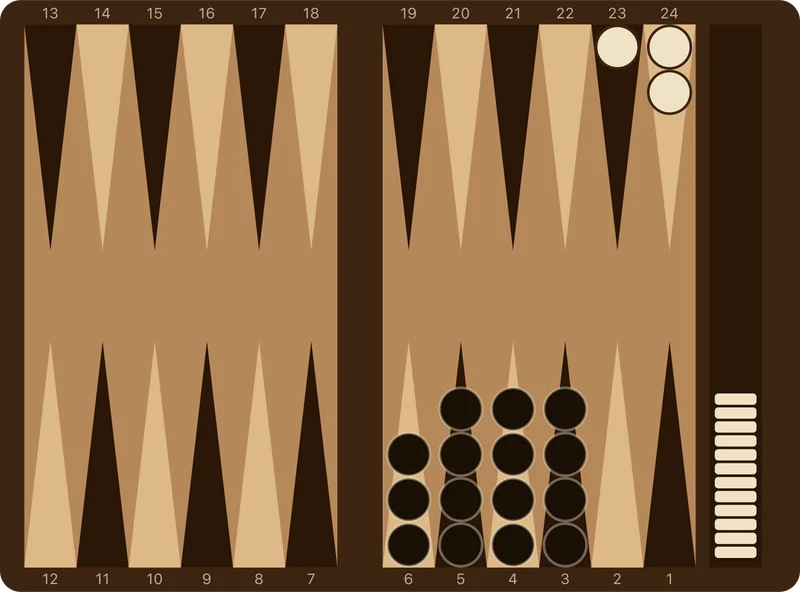
The diagram above captures the tension of saving a gammon. White has already borne off 12 checkers, leaving only 3 checkers on the low points of the board. Black has 0 checkers off, but has successfully brought all remaining pieces into the home sector on points 19 through 22. Black now rolls to bear off their very first checker. If Black removes a single checker before White bears off their final 3 pieces, Black saves the gammon and restricts White’s score to 1 point[4].
To maximize your chances of saving a gammon, follow these essential principles:
- Break deep anchors early: In a normal contest, maintaining an anchor on the opponent’s 1-point or 2-point can generate late counter-attacking shots. But when the attacker is bearing off and you hold no forward prime, staying on deep points is fatal[4]. You must abandon the anchor and sprint your checkers toward your home board[4].
- Accept direct shot risks: If crawling safely leaves you 2 rolls short of bearing off a checker, playing safe guarantees a gammon loss. You must take risks, leaving blots if it allows your checkers to cross the bar line faster.
- Calculate your crossover count: Count the number of crossovers your rear checkers need to enter your home quadrant. Every checker that requires 3 rolls to reach the home board must be prioritized over pieces already nearby.
- Prepare your bear-off geometry: Position your checkers so that any number on the dice allows an immediate bear-off on your first legal turn. Studying the mechanics of bearing off without losing highlights how checker distribution prevents wasted pips during urgent bear-offs.
Match score dynamics: DMP, gammon-go, and gammon-save
In tournament play, the value of a gammon fluctuates drastically depending on the match score:
- Double Match Point (DMP): When both players need only 1 point to win the match (such as a 4-4 score in a 5-point match), the gammon value drops to exactly 0[4]. Winning by 1 point wins the entire match; winning by 2 points provides 0 extra equity[4]. At DMP, players never risk safety to chase a gammon, and trailing defenders never sacrifice position to save one.
- Gammon-go: When a player trails by 2 points with their opponent at match point (for example, trailing 2-4 in a 5-point match), the trailing player is in “gammon-go.” Winning a gammon awards 2 points and ties the match, while losing costs the match regardless. Trailing players in gammon-go must play with relentless aggression to manufacture gammon opportunities.
- Gammon-save: Conversely, the leader at 4-2 in a 5-point match is in “gammon-save.” A single loss leaves the leader ahead 4-3, but losing a gammon surrenders 2 points and ties the contest at 4-4. The leader must play with heightened caution, guarding home points to prevent any catastrophe.
Understanding how match equity alters checker play is an essential component of analyzing your backgammon skill levels.
Questions people ask
How many points do you get for a gammon in backgammon?
A gammon awards 2 points in standard backgammon[1]. If the doubling cube is in play, the gammon doubles the value of the cube: for instance, a gammon with the cube on 2 awards 4 points, while a gammon on a 4-cube awards 8 points[1].
What is the exact difference between a gammon and a backgammon?
A gammon occurs when the winner bears off all 15 checkers while the loser has borne off 0 checkers[1]. A backgammon occurs when the loser has borne off 0 checkers and still has at least 1 checker on the bar or in the winner’s home board (points 1 to 6)[1]. A gammon pays 2 points, while a backgammon pays 3 points[1].
Does a gammon count if no one doubled in money play?
Under the Jacoby rule commonly used in money play, gammons and backgammons score only 1 point as a single win unless the doubling cube was offered and accepted[3]. However, in tournament match play, the Jacoby rule is barred, meaning gammons always award 2 points[3].
What does “too good to double” mean in backgammon?
Being “too good to double” describes a dominant position where the attacker has a high probability of winning a gammon (typically over 60 percent)[4]. Doubling would cause the opponent to drop the cube and concede 1 point, so the attacker plays on without doubling to play for the 2-point gammon[4].
How can a player save a gammon?
To save a gammon, a trailing player must bear off at least 1 checker before the opponent bears off all 15 checkers[4]. Trailing players should break deep anchors early, push rear checkers forward aggressively, and optimize checker distribution in their home board to bear off on the very first roll possible[4].
Whether you are seeking to punish an opponent’s passive opening or fighting with determination to salvage a match from behind, mastering gammons and backgammons elevates your game. Put these tactical principles into practice today when you learn to play backgammon or test your decisions in a live match when you play backgammon online.
Sources
- Encyclopaedia Britannica. “Backgammon: Rules, History, and Doubles.”
- Tesauro, G. (1995). Temporal difference learning and TD-Gammon. Communications of the ACM, 38(3), 58–68.
- Jacoby, O. & Crawford, J. R. (1970). The Backgammon Book. Viking Press, New York.
- Magriel, P. (1976). Backgammon. Quadrangle/The New York Times Book Co., New York.
- Boardgammon. “The Official Rules of Backgammon: Setup, Moves, and Doubling.”
Found a mistake or an odd phrase? Tell us