The seductive promise of the chessboard
For more than a century, school headmasters, ambitious parents, and civic leaders have repeated a familiar slogan: the notion that chess naturally builds superior intellect. The game has long enjoyed a glowing cultural reputation as the supreme gymnasium of the mind. Proponents argue that learning to calculate tactical combinations naturally fosters logical rigor, bolsters mathematical aptitude, and elevates academic performance across the curriculum.
Because chess masters display remarkable feats of concentration and memory, it is easy to assume that the game serves as an all-purpose cognitive booster. If a grandmaster can play twenty opponents simultaneously with their eyes closed, surely the game must build a formidable intellect that carries over into everyday reasoning.
Over the past three decades, educational authorities across dozens of countries invested substantial resources into classroom chess initiatives. Entire national programs were launched under the assumption that moving pawns and knights would produce measurable gains in standardized test scores.
Yet when cognitive psychologists and educational researchers subjected these beliefs to rigorous experimental testing, the romantic story unraveled. The reality uncovered by modern science is far more nuanced, fascinating, and honest.
The largest randomized trial: what the EEF discovered
Most early claims about the academic benefits of chess relied on anecdotal accounts or poorly controlled pilot studies. Typically, a group of enthusiastic students received chess lessons, took a test at the end of the semester, and scored higher than students who had received no special attention at all. Such experiments failed to control for the Hawthorne effect, where pupils show short-term improvement simply because they enjoy novel activities and extra attention from energetic mentors.
To settle the question with definitive rigor, the Education Endowment Foundation (EEF) funded the largest randomized controlled trial on chess instruction ever conducted [1]. Evaluated independently by researchers at the UCL Institute of Education, the trial examined 4,009 Year 5 pupils across 100 primary schools in England.
Half of the schools received thirty hours of structured weekly chess instruction delivered by trained tutors during normal school hours, while the control group continued with standard curriculum activities. At the end of the year, all students sat for standard national Key Stage 2 assessments in mathematics, reading, and science.
The results were unequivocal. The researchers found no evidence that a year of weekly chess lessons improved children’s academic attainment in mathematics, reading, or science. The measured effect size for mathematics was a negligible 0.01 standard deviations, a difference statistically indistinguishable from zero. Subgroup analyses revealed no hidden academic advantage for disadvantaged children either.
The authors concluded that while children enjoyed the lessons, treating chess as an academic silver bullet for school attainment is unsupported by empirical evidence. The researchers noted that teaching academic subjects directly produces outcomes that abstract board games cannot replicate.
The meta-analytic evidence and the myth of far transfer
The findings of the EEF trial did not stand alone. In 2016, cognitive scientists Giovanni Sala and Fernand Gobet published a comprehensive meta-analysis in Educational Research Review synthesizing 24 studies on chess training [2].
Sala and Gobet noticed a striking pattern in the published literature: the methodological rigor of a study was inversely proportional to its reported effect size. Studies lacking random assignment or relying on passive control groups reported moderate academic benefits. However, when researchers introduced active control groups—where the control pupils engaged in alternative stimulating pursuits such as drama, music, or computer games—the apparent academic advantage of chess disappeared.
The underlying psychological mechanism explains why. Cognitive science draws a fundamental distinction between near transfer and far transfer [2]:
- Near transfer occurs when practice in one task improves performance in closely related tasks that share identical structures. Practicing tactical combinations in chess improves your ability to solve similar tactical puzzles or spot combinations in chess online.
- Far transfer occurs when mastery of one specialized skill miraculously transfers to completely unrelated domains, such as geometry, economic forecasting, or foreign languages.
Decades of experimental research across educational psychology show that far transfer is exceedingly rare. Learning to recognize a pin or a knight fork trains your visual processing within the geometry of sixty-four squares, but it does not re-wire your brain into an all-purpose calculating engine.
How expert memory really works: the Chase and Simon experiments
If chess does not confer general intellectual superiority, why do skilled players possess such extraordinary memory at the board?
The answer emerged from landmark experiments conducted in 1973 by William Chase and Herbert Simon [3], who built upon the foundational 1965 research of Dutch psychologist Adriaan de Groot [4].
Chase and Simon presented chess masters and complete novices with positions on a board for just five seconds. The board was then removed, and the participants were asked to reconstruct the position from memory on an empty chessboard.
The experiment tested two distinct conditions:
- Structured game positions: Realistic middle-game layouts taken from published tournament matches.
- Random layouts: The exact same pieces placed entirely at random across the board, violating the structural rules and tactical harmony of real chess.
The results revealed the true nature of human expertise:
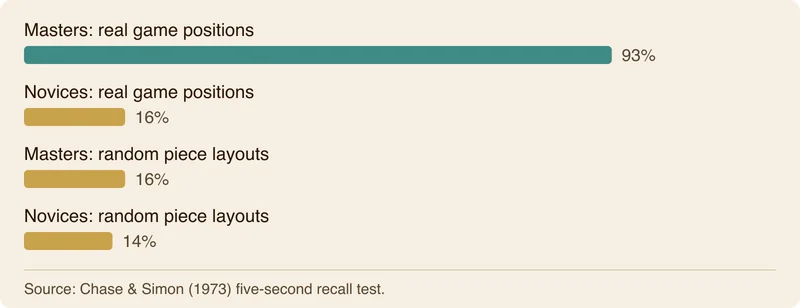
Chase and Simon (1973) 5-second recall:
- Masters on real game positions:  93% of pieces placed correctly
- Novices on real game positions:  16% of pieces placed correctly
- Masters on random piece layouts: 16% of pieces placed correctly
- Novices on random piece layouts: 14% of pieces placed correctly
On real game positions, masters reconstructed approximately 93% of the pieces correctly after a mere five-second glance, placing more than twenty pieces with effortless precision. Novices struggled, managing to place only about 16% of the pieces correctly (roughly four pieces).
However, when pieces were scattered at random, the masters’ supposed photographic memory vanished completely. On random configurations, the masters’ accuracy collapsed to 16%, virtually indistinguishable from the 14% achieved by novices [3].
Chase and Simon demonstrated that masters do not possess superior general visual memory. Instead, years of dedicated study allow experienced players to organize board information into meaningful clusters called chunks.
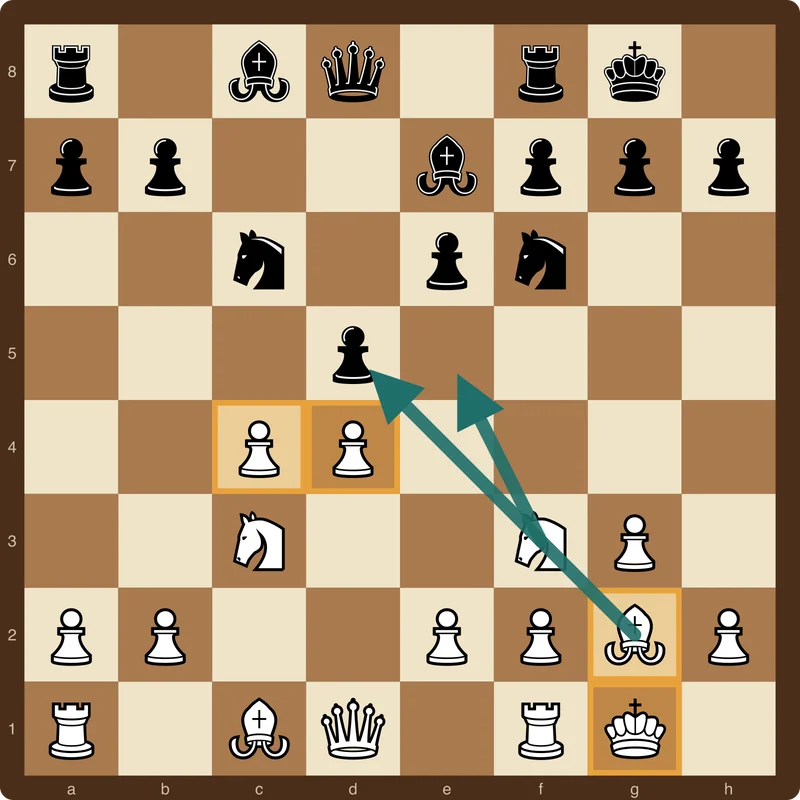
A novice looking at a chessboard sees thirty-two independent pieces scattered across individual squares. A master looking at the same board sees four or five familiar structural schemas: a fianchettoed king defense, an active pawn chain, or an outpost knight coordinated with a rook. Because human short-term memory can hold only a handful of discrete items at once, chunking enables masters to process complex positions in seconds. When the pieces are placed randomly, those learned schemas do not exist, and the expert’s working memory is reduced to the same basic biological limits as everyone else.
Do grandmasters calculate further ahead?
A related myth suggests that elite chess players win because they calculate twenty or thirty moves ahead, visualizing entire tree diagrams of possibilities like supercomputers.
When Adriaan de Groot investigated the thought processes of international grandmasters and club players in 1965 [4], he asked players to verbalize their thinking aloud while choosing moves in unfamiliar positions.
De Groot discovered that grandmasters did not calculate significantly deeper than ordinary club players. On average, both groups calculated variations between three and five plies deep, occasionally extending deeper only in forced tactical lines. Furthermore, grandmasters did not calculate vastly more moves; in fact, they often examined fewer total candidate moves than intermediate players.
The true difference lay in perceptual selectivity. Thanks to tens of thousands of hours of pattern exposure stored in long-term memory, a grandmaster’s intuition immediately identifies the two or three most promising candidate moves within fractions of a second. They do not waste energy calculating absurd moves. The club player, lacking that refined library of schemas, spends considerable mental energy calculating flawed branches before stumbling upon a reasonable plan.
Mastery in chess is not brute calculation power; it is rapid, domain-specific pattern recognition.
Intelligence versus deliberate practice: the Bilalić study
Does exceptional intelligence at least predict who becomes a strong chess player?
In 2007, cognitive psychologists Merim Bilalić, Peter McLeod, and Fernand Gobet examined 57 young chess players to untangle the relationship between raw intelligence and chess skill [5]. The researchers measured the children’s IQ using standardized tests and tracked their tournament performance alongside their total hours of dedicated practice.
The findings challenged popular assumptions:
- Among beginners with minimal training, intelligence accounted for some variance in early learning speed. Children with higher spatial aptitude grasped the basic mechanics more readily.
- However, among active players with substantial playing experience, IQ was no longer a reliable predictor of chess skill.
- The single overwhelming predictor of skill was the volume of deliberate practice—time spent studying positions, analyzing games, and solving tactical puzzles.
In fact, the researchers observed that highly dedicated young players with moderate IQ scores consistently outperformed peers with superior raw IQ who practiced less. Structured effort, repeated exposure to tactical themes, and systematic review completely overcame initial differences in cognitive aptitude [5].
What chess really trains: the authentic benefits
Dispelling the myth that chess raises IQ or turns children into math prodigies does not mean the game is devoid of intellectual value. On the contrary, chess provides rich psychological and developmental benefits, provided we appreciate what it actually exercises.
When you sit across the board in a serious contest, you are engaging with a demanding cognitive environment that cultivates specific, valuable executive habits [6]:
1. Visual-spatial working memory and chunk acquisition
Every game of chess challenges your visual working memory. You must project hypothetical moves forward, hold the transformed board layout in your mind’s eye, and evaluate whether a key defender has been deflected. Regular practice helps you transition from seeing isolated pieces to recognizing coordinated tactical motifs such as forks, pins, and skewers in chess. Solving daily chess puzzles directly exercises this pattern-matching circuitry.
2. Impulse control and calculation discipline
In casual life, impulsive reactions rarely carry immediate, unambiguous penalties. In chess, the touch-move rule enforces strict behavioral accountability: if you touch a piece, you must move it; once you release your fingers, the move cannot be undone.
This unforgiving feedback loop teaches impulse inhibition. Before executing a tempting move, an experienced player learns to pause, ask what their opponent threatens, and verify whether their own back rank is secure. Developing the habit of pausing before acting is one of the most transferable behavioral disciplines chess offers.
3. Emotional regulation and objective error analysis
Chess is an uncompromising game with zero hidden information and no element of luck. When you lose, you cannot blame the bounce of a ball, the roll of a die, or a referee’s whistle. The responsibility rests entirely on your own decisions.
Experiencing defeat and returning to the board to analyze where your plan went astray builds emotional resilience. Reviewing your mistakes after a game teaches you to separate your ego from objective evaluation, a mindset that benefits any serious intellectual pursuit.
4. Strategic planning under resource constraints
Selecting a coherent setup in your first chess opening requires balancing competing demands: piece activity, king safety, and control over central outposts. You learn that every move incurs an opportunity cost. Advancing a pawn gains territory but permanently weakens the squares left behind. Managing these trade-offs cultivates strategic patience.
How to structure your chess practice for real growth
If you want to enjoy the cognitive pleasures of chess and build genuine skill, relying on casual games alone will produce slow progress. To develop the rich pattern chunks identified by Chase and Simon, practice should be deliberate, active, and structured:
- Daily tactical pattern drills: Dedicate ten to fifteen minutes each day to solving tactical puzzles on chess puzzles. Repetition reinforces tactical chunks in long-term memory so that you spot opportunities effortlessly in live play.
- Master the fundamental opening guidelines: Avoid memorizing long opening variations. Focus on foundational opening principles—stake your claim in the center, develop knights and bishops promptly, and castle early—as taught in our comprehensive chess lessons.
- Play games with thoughtful time controls: Blitz and bullet games encourage shallow, impulsive guessing. To build calculation stamina and visual planning, play games where you have at least ten to fifteen minutes per side on play chess online.
- Analyze your blunders objectively: Never close a game immediately after a loss. Examine the critical turning points, identify the tactical motif you overlooked, and note the warning signs you missed.
Questions people ask about chess and the brain
Does chess raise your IQ?
No rigorous scientific trial has demonstrated that playing chess raises general intelligence or IQ scores. While children with high spatial aptitude may pick up chess faster initially, long-term studies show that deliberate practice hours, rather than IQ, determine playing strength [5].
Can chess improve a child’s school math grades?
The largest randomized controlled trial on chess in education, conducted by the Education Endowment Foundation with 4,009 pupils across 100 schools, found no evidence that thirty hours of chess lessons improved children’s math or reading attainment [1]. Cognitive skills learned at the board remain largely domain-specific.
Why do chess masters remember boards so well?
Chase and Simon’s landmark 1973 experiments proved that chess masters do not possess general photographic memory. Instead, they store tens of thousands of familiar pattern chunks in long-term memory [3]. When shown realistic game positions, masters recall 93% of the pieces; when shown random piece layouts, their recall collapses to 16%, virtually identical to beginners.
Is chess good for keeping the mind active?
Engaging with cognitively demanding activities such as chess provides stimulating mental exercise, encourages social interaction, and trains visual planning and impulse control. However, scientific consensus emphasizes that no single board game is a proven shield against cognitive decline. The primary reason to play chess is for the deep, enduring pleasure of the game itself.
Sources
- Jerrim, J., Macmillan, L., Micklewright, J., Sawtell, M., & Wiggins, M. (2016). Chess in Primary Schools: Evaluation Report and Executive Summary. Education Endowment Foundation.
- Sala, G., & Gobet, F. (2016). “Do the benefits of chess instruction transfer to academic and cognitive skills? A meta-analysis.” Educational Research Review, 18, 46–57.
- Chase, W. G., & Simon, H. A. (1973). “Perception in chess.” Cognitive Psychology, 4(1), 55–81.
- De Groot, A. D. (1965). Thought and Choice in Chess. The Hague: Mouton & Co.
- Bilalić, M., McLeod, P., & Gobet, F. (2007). “Does chess need intelligence? A study with young chess players.” Intelligence, 35(5), 457–470.
- Boardgammon. “Chess lessons: Learn to play chess from the first move.”
- Boardgammon. “Chess Moment: Play rated chess online.”
- Boardgammon. “Chess puzzles: Tactical puzzles with instant feedback.”
- Boardgammon. “Chess Moment: Play a rated game of chess.”
Found a mistake or an odd phrase? Tell us