Anyone who has spent an evening practicing against standard computer chess bots knows the peculiar frustration of the experience. You spend twenty moves building a solid pawn structure, maneuvering your knights to promising outposts, and defending against subtle threats. Then, without warning, the computer hands you its queen for a lowly pawn, or retreats an active rook into a passive corner for no discernible reason. Three moves later, it resumes calculating tactical combinations with superhuman precision.
The problem is not that traditional computer chess is too weak. The problem is that traditional engines calculate like machines rather than people. When developers attempt to make an engine suitable for casual or intermediate players, they almost always handicap it artificially. The engine evaluates millions of positions per second, calculates the mathematically optimal path, and then deliberately introduces random errors to depress its rating. This mechanical compromise satisfies mathematical rating formulas, but it fails completely as an imitation of human play.
In 2020, a team of artificial intelligence researchers set out to solve this fundamental mismatch. Instead of asking a computer how to win every game at all costs, they asked a radically different question: can a neural network learn to play chess the way humans actually play? The result was Maia Chess, an open-source engine trained directly on human decision-making. If you want to enjoy chess online without the jarring artificiality of standard bots, understanding how Maia works reveals why human-like play changes the entire character of the game.
The mechanical flaw of handicapped engines
To understand why Maia feels different, one must first look at how conventional chess engines operate. Programs such as Stockfish evaluate positions by combining deep tree searches with sophisticated positional scoring algorithms. They do not possess intuition, fear, fatigue, or aesthetic preferences. They compute tactical consequences across vast decision trees, searching dozens of moves into the future to establish whether a specific move leads to an objective advantage.
When developers create bots for club players or beginners, they typically apply one of two methods:
- Depth capping: Restricting how many moves ahead the engine is permitted to calculate.
- Noise injection: Forcing the engine to pick a second-rate or third-rate candidate move at regular intervals, or intentionally making catastrophic blunders.
Both methods produce deeply unnatural behavior. A human player rated 1200 or 1500 does not play like a grandmaster for fifteen moves and then randomly hang a full rook in one move because a random-number generator dictated an error. Real human players make mistakes because of cognitive blind spots, time pressure, complex board geometries, or tactical oversights. An intermediate player might fail to notice a knight fork on an obscure square or miscalculate an exchange in the center, but they rarely discard their pieces without tactical provocation.
Handicapped engines deprive the learner of genuine sparring. If you defeat a traditional bot because it arbitrarily surrendered its queen, you have learned nothing about exploiting real strategic weaknesses. Conversely, if the bot suddenly shifts into deep calculation mode and punishes an inaccuracy with an eight-move tactical sequence that no human at that rating would spot, you feel cheated.
Training a neural network on human games
The researchers behind Maia—Reid McIlroy-Young, Siddhartha Sen, Jon Kleinberg, and Ashton Anderson—recognized that bridging the gap between artificial intelligence and human behavior required an entirely different training philosophy [1].
Instead of utilizing reinforcement learning through self-play (the methodology pioneered by AlphaZero, where an algorithm plays millions of games against itself until it reaches superhuman perfection), the researchers trained Maia using supervised learning on real games played by human beings.
The training corpus was drawn from the public archives of Lichess. The researchers collected 12 million games per rating tier, partitioning games into distinct Elo brackets spanning from 1100 to 1900. Each model within the Maia suite was trained exclusively on games where both participants belonged to that specific skill tier.
The neural network was not tasked with discovering the objectively best move that maximizes the likelihood of winning. Instead, the network was trained on a single prediction objective: given a specific board position reached in a game between two human players of a targeted rating, predict the exact move the human made.
By training on 12 million games at each tier, Maia absorbed the genuine strategic priorities, common tactical blind spots, and positional instincts characteristic of human players at those ratings. A Maia model calibrated for intermediate players does not compute like a grandmaster and then roll a virtual die to decide whether to make an intentional mistake. It naturally evaluates candidate moves through the lens of human experience.
Move prediction accuracy: Maia versus Stockfish
The difference between optimizing for victory and optimizing for human mimicry becomes starkly evident when measuring move-matching accuracy. In their published research, the authors tested how frequently various engines correctly predicted the move actually selected by a human player in real games.
Standard engines scored poorly on this benchmark. Even at low search depths, Stockfish achieved a human move prediction accuracy of under 40 percent (typically around 38 percent). When Stockfish was allowed to search deeper, its move-matching accuracy declined further, because deeper search trees led the engine toward increasingly inhuman tactical subtleties that club players never perceive.
In contrast, Maia achieved move-prediction accuracy rates consistently above 50 percent across its targeted rating tiers. At intermediate rating brackets, Maia predicted the exact human move 52 to 54 percent of the time, and reached 48 percent even in beginner tiers around 1100 Elo.
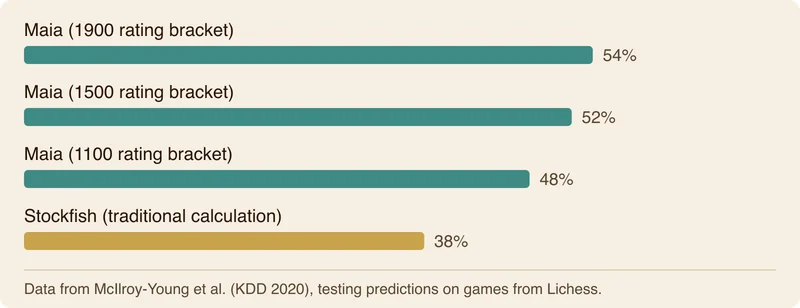
This accuracy advantage demonstrates that human chess decisions follow structured, predictable cognitive patterns. Humans rely on pattern recognition, piece activity, king safety, and familiar opening structures. Because Maia was trained on real decisions rather than abstract mathematical evaluations, its predictions align with the choices real people make at the board.
How human-like engines handle strategy and tactics
When you examine positions through a human-calibrated model—or put those strategic ideas to the test when you play chess online—the board dynamic feels immediately familiar. In the opening and early middlegame, Maia develops its forces along logical, harmonious lines.
Consider a classical opening structure such as the Italian Game. Rather than seeking obscure tactical counter-thrusts that require twenty plies of concrete calculation to justify, Maia naturally develops minor pieces, stakes a claim in the center, and castles its king into safety.
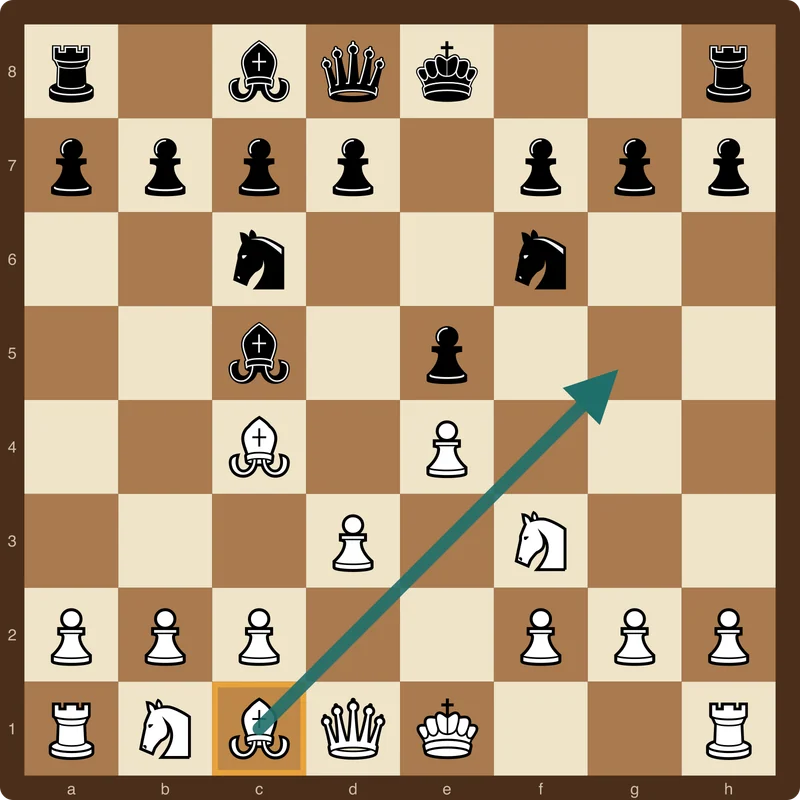
In this position, a human player instinctively develops the dark-squared bishop to pin the enemy knight on f6 or prepares central expansion. Maia selects candidate moves that reflect these intuitive plans. It does not play bizarre pawn thrusts on the wing unless the concrete demands of the position warrant them.
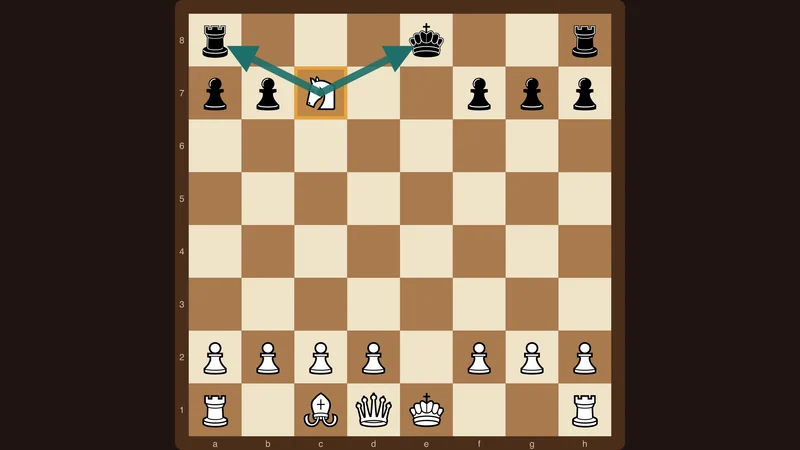
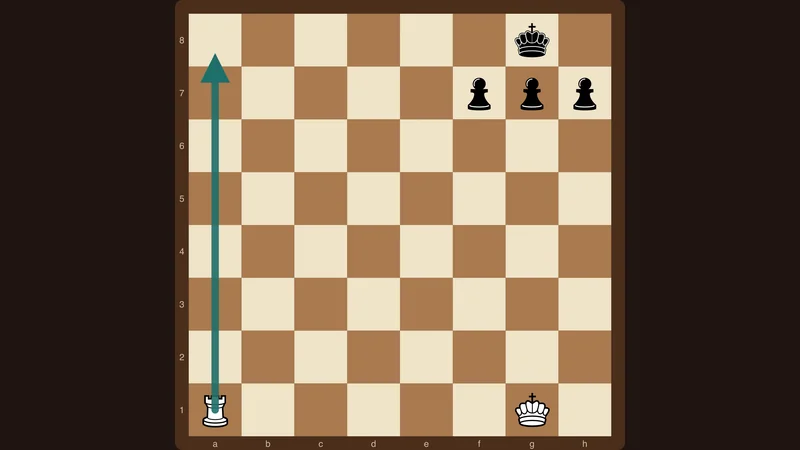
The most refreshing aspect of studying Maia’s games is how the model handles tactical tension. In human chess, players frequently fall victim to tactical themes such as forks, pins, and skewers in chess, or overlook vulnerable back ranks that lead to sudden back-rank checkmate traps. When Maia misses a tactical shot, it misses it for human reasons: the tactic was obscured by a crowded board, required an unintuitive quiet move, or occurred in a sharp position with multiple competing threats.
When Maia errs, the mistake makes sense. It might neglect a defensive retreat because it was preoccupied with creating counterplay on the opposite flank, or it might overestimate an attacking initiative. Analyzing these positions feels rewarding because victory stems from outplaying an opponent on strategy, spotting a real tactical oversight, or converting an endgame advantage—not from waiting for an artificial glitch.
From Maia-1 to Maia-2 and Maia-3
The original 2020 research proved that predicting human moves was possible, but the initial architecture had practical limitations. Each rating tier required a separate neural network model. Maia 1100, Maia 1500, and Maia 1900 were independent networks, incapable of smoothly modeling the continuous progression of a player whose skill evolves over time.
In 2024, the research team introduced Maia-2, presenting a unified transformer-based architecture for human-AI alignment in chess. Rather than training isolated models for discrete rating buckets, Maia-2 incorporates skill-aware attention mechanisms. This design allows a single, unified neural network to model the entire continuous spectrum of human play, dynamically adjusting its predictions based on target player ratings.
Building on these advances, the Computational Social Science Lab (CSSLab) at the University of Toronto released Maia-3 79M in 2025. This architecture features a 79-million-parameter transformer model trained specifically on large-scale human move datasets. Maia-3 captures nuanced positional play, complex endgame transitions, and subtle tactical defenses with greater fidelity, all while maintaining the core philosophy of authentic human prediction.
Maia-3 is distributed under the GNU Affero General Public License v3 (AGPL 3.0), ensuring that the research and weights remain open, verifiable, and accessible to the academic and chess communities.
What human-like engines teach us about chess improvement
The academic research behind Maia carries a profound lesson for anyone trying to improve at chess: preparing for real opponents requires understanding the moves people actually play, not just memorizing twenty-move computer refutations that never appear at the club level.
When improving players rely solely on superhuman evaluation bars, they often fall into the trap of memorizing abstract engine lines they do not understand. If an opponent deviates on move six with a natural-looking human inaccuracy, a player who only memorized the top Stockfish recommendation is left without a plan. Combining practical game experience with structured chess lessons bridges this gap by focusing on core strategic principles, piece coordination, and pattern recognition.
Studying how human-aligned models evaluate positions highlights three practical habits for everyday training:
- Prepare for probable replies, not just optimal ones: When building an opening repertoire, look at the moves players at your rating bracket most commonly choose, and learn the thematic plans that punish natural-looking mistakes.
- Focus on tactical clarity over obscure complications: Human mistakes cluster around crowded boards, pinned pieces, and undefended back ranks. Keeping your own pieces coordinated reduces the likelihood of falling into the exact tactical blind spots that neural networks identify in human games.
- Practice converting practical advantages: Rather than searching for a forced ten-move computer checkmate, simplifying into a clean endgame with an extra pawn or a superior minor piece is often the most reliable path to victory over the board.
Whether you are warming up before a tournament match, testing a new opening system, or practicing tactical vigilance in the middlegame, focusing on realistic human decision-making builds strategic intuition that translates directly to over-the-board success.
Questions people ask
Is Maia Chess stronger or weaker than Stockfish?
Maia is intentionally weaker than Stockfish in terms of absolute win rate. Stockfish is designed to achieve superhuman accuracy and will defeat Maia in competitive match play. Maia’s purpose is not to maximize wins, but to accurately predict and mirror how human beings play chess at specific rating tiers.
Can Maia Chess blunder like a beginner?
Yes. Because Maia was trained on games played by real humans across various rating brackets from 1100 upward, lower-rated Maia models exhibit the same tactical oversights, king safety lapses, and calculation errors that human players make at those levels.
Does Maia use opening books or endgame tablebases?
Unlike conventional engines that rely heavily on memorized opening books and precomputed endgame tablebases, Maia generates its moves directly through its trained neural network policy, reflecting how human players navigate openings and practical endgames based on learned experience.
Why do traditional chess bots make bizarre mistakes?
Traditional chess bots calculate thousands or millions of variations and then use artificial handicap algorithms to simulate lower ratings. These algorithms typically introduce random blunders or restrict search depth, creating an erratic oscillation between grandmaster calculation and nonsensical moves.
How does human-move prediction help everyday chess players?
By identifying the moves humans are most likely to play at a given rating—as well as the positions where human players most frequently blunder—human-aligned models help players study realistic opening responses and spot common tactical blind spots in their own decision-making.
Sources
- McIlroy-Young, R., Sen, S., Kleinberg, J., & Anderson, A. (2020). Aligning Superhuman AI with Human Behavior: Chess as a Model System. Proceedings of the 26th ACM SIGKDD International Conference on Knowledge Discovery & Data Mining, 1677–1687.
- Tang, Z., Jiao, D., McIlroy-Young, R., Kleinberg, J., Sen, S., & Anderson, A. (2024). Maia-2: A Unified Model for Human-AI Alignment in Chess. arXiv preprint arXiv:2409.20553.
- CSSLab, University of Toronto. (2025). Maia-3 79M: Transformer model trained on human chess moves.
- Boardgammon. “Chess Moment: Play rated chess online.”
- Boardgammon. “Chess lessons and fundamentals.”
- Boardgammon. “Chess Moment: Play chess online.”
Found a mistake or an odd phrase? Tell us