Why tactics decide most chess games
In chess, long-term strategy provides direction, but short-term tactics decide the winner. A player can spend twenty moves carefully building a positional grip, maneuvering minor pieces toward ideal outposts, and restricting enemy counterplay, only to watch the entire contest evaporate after walking into a tactical double attack.
At every level below master play, games rarely conclude with subtle pawn majorities converted through textbook endgame technique. They conclude because one player overlooks a tactical strike that wins a piece, fractures king safety, or delivers checkmate.
Among the tactical patterns documented in chess literature, three linear and geometric motifs appear more frequently than any others: the fork, the pin, and the skewer. These three tools form the foundation of tactical calculation. They exploit the inherent geometry of the board, the movement rules of each piece, and the vulnerability of undefended units [1].
Understanding how these three motifs function in practice transforms how you evaluate positions. Instead of scanning the board aimlessly for random moves, you begin to look for tactical preconditions: loose pieces without defenders, heavy pieces aligned along open lines, and kings trapped on restricted squares.
Whether you are studying chess lessons for the first time or seeking to climb rating ladders in competitive play, mastering forks, pins, and skewers is the fastest way to turn tactical awareness into consistent victories.
The fork: striking two targets at once
A fork occurs when a single piece attacks two or more enemy pieces at the same time [1]. Because a player can only make one move per turn under the rules of chess, defending against two simultaneous threats is often impossible. The opponent is forced to rescue one piece—usually the more valuable one—leaving the secondary target vulnerable to capture.
Every piece on the chessboard can execute a fork. Pawns frequently deliver painful forks by stepping forward into the center to attack two minor pieces. Bishops can fork two enemy rooks across intersecting diagonals. Rooks can fork an enemy king and an unguarded knight along a rank. Even the king can deliver a fork in simplified endgames by stepping between two separated enemy pawns.
Yet among all the pieces, the knight is universally regarded as the most dangerous and deceptive forking weapon.
Why the knight is the premier forking piece
The knight possesses two unique attributes that make its double attacks uniquely lethal:
First, the knight is the only piece on the board that leaps over other units. It cannot be blocked by intervening pieces or pawns. When a bishop or rook launches an attack along a line, an alert opponent can sometimes step a defender between the attacker and the target. A knight fork offers no such luxury; its jump reaches directly into the enemy camp.
Second, the knight attacks with non-reciprocal geometry. Because the knight moves in an L-shaped path, none of the pieces it attacks—with the sole exception of an enemy knight—can attack it back on the same turn. When a bishop attacks a rook, the rook can often slide along a file to counter-attack or pin the bishop. When a knight strikes a queen or rook, the target cannot capture the knight unless it happens to already defend the square the knight landed on.
As former world champion Emanuel Lasker explained in his 1925 Manual of Chess, the knight’s peculiar leap allows it to strike enemy pieces without being exposed to reciprocal attack from pieces whose movement is strictly linear [2].
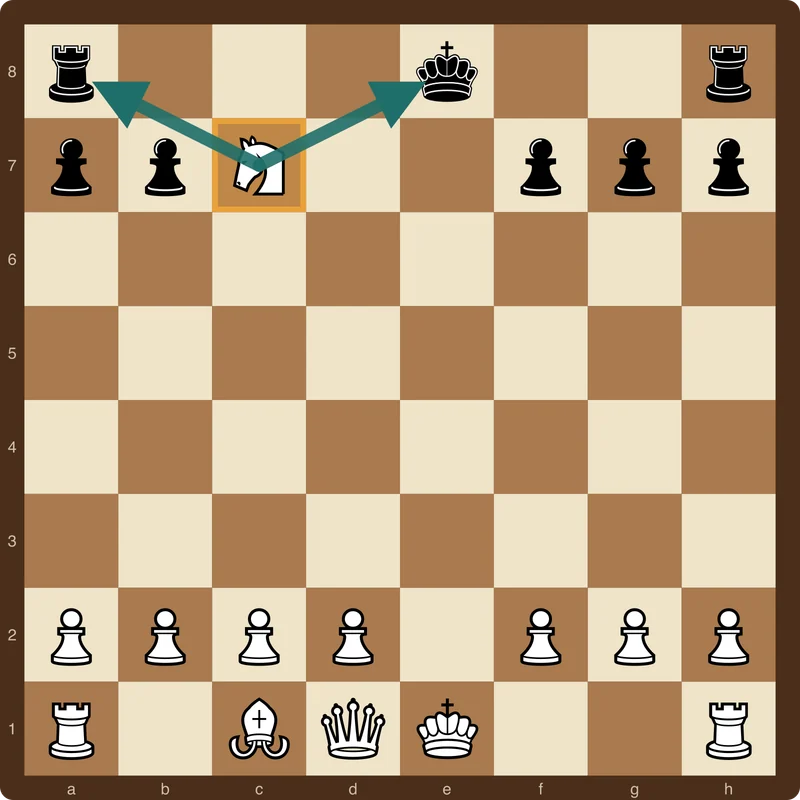
Consider the lead diagram below:
A white knight leaps to the c7-square, checking the black king on e8 while simultaneously attacking the undefended black rook in the corner on a8. Because Black is in check, the rules of chess compel the defending monarch to step out of danger. Black cannot capture the knight, block the check, or move the rook on a8. Once the black king retreats to safety, White captures the corner rook on the following turn, securing a decisive material advantage.
Royal forks—attacks that strike both the king and queen simultaneously—are the most catastrophic variation of this motif. When a knight lands on an outpost that forks the opposing king and queen, the game is effectively decided on the spot.
How to spot and create fork opportunities
Knight forks rarely occur by accident; they arise from specific positional patterns:
- Geometric alignment on matching colors: A knight always changes the color of the square it occupies with every move. Consequently, a knight can only fork two enemy pieces if both targets occupy squares of the identical color. If an enemy king stands on a dark square and an enemy rook stands on a light square, a single knight cannot attack both simultaneously on the next move. When you notice two valuable enemy pieces resting on squares of the same color, look immediately for intermediate jumping squares that connect them.
- Forced king deflections: Master players frequently engineer forks through sacrificial checks. By sacrificing a bishop or pawn to force the enemy king onto a specific square, they lure the monarch into the exact geometric alignment required for a knight fork.
- Overburdened defenders: When an enemy piece is tasked with defending multiple key squares in the center, removing or distracting that defender often clears the path for a decisive knight invasion.
The pin: freezing a piece in its tracks
If the fork is an explosive double attack, the pin is a weapon of tactical paralysis.
A pin occurs when a long-range piece attacks an enemy unit along a line, and that unit cannot move without exposing a more valuable piece—or the king itself—standing behind it on the same line [1].
Pins are executed exclusively by long-range linear pieces across the 64 squares of the 8x8 board: bishops along diagonals, rooks along ranks and files, and queens across both [2]. Short-range pieces like knights and pawns cannot create pins because their attacks do not extend through multiple squares along a single trajectory.
Absolute pins versus relative pins
Chess theory draws a fundamental distinction between two categories of pins:
- The absolute pin: An absolute pin occurs when the piece shielded behind the pinned unit is the king. Under the laws of chess, exposing your own king to check is an illegal move. Therefore, a piece caught in an absolute pin is completely paralyzed; it cannot legally step off the line of attack under any circumstances.
- The relative pin: A relative pin occurs when the shielded unit is not the king, but another valuable piece such as a queen or an unguarded rook. Moving the pinned piece is technically legal, but doing so permits the attacker to capture the higher-value piece behind it, usually resulting in ruinous material loss.
In the diagram below, White demonstrates an absolute pin:
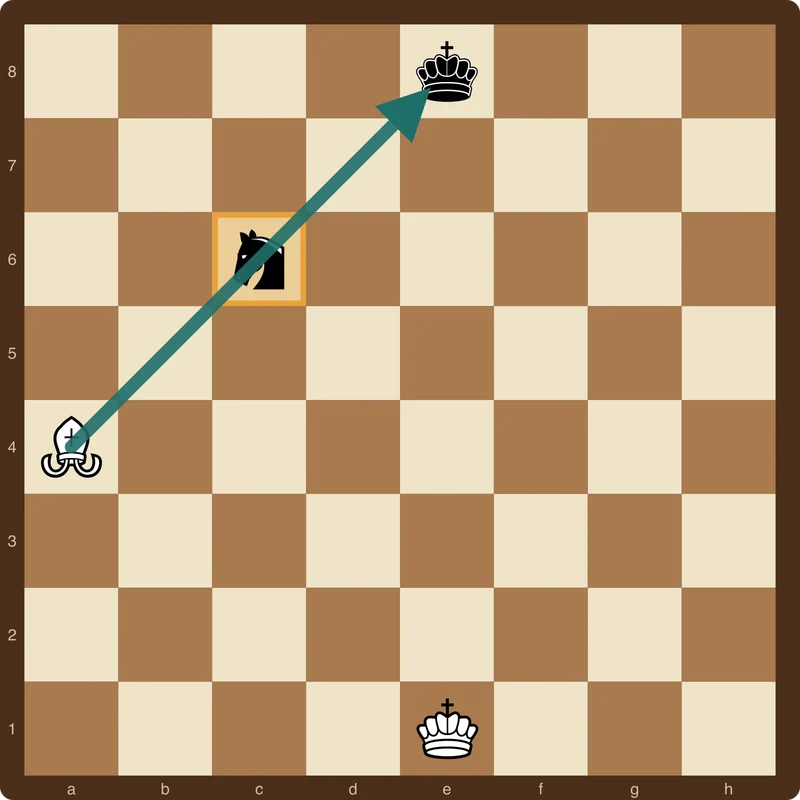
The white bishop on a4 attacks along the diagonal toward the black king on e8. Standing between the bishop and the king is the black knight on c6. Under the rules of the game, that black knight cannot move. It cannot leap to d4, take a pawn on e5, or retreat to b8, because doing so would instantly place the black king in check. The knight is completely immobilized.
Exploiting pinned pieces
A common mistake among beginners is capturing a pinned piece immediately. While taking the piece may yield an even trade, the true power of a pin lies in applying maximum pressure to the paralyzed defender.
A foundational principle of chess tactics states: attack the pinned piece with pawns and pieces of lesser value.
Because a pinned piece cannot run away, it becomes an easy target for slower-moving units. If an enemy knight is pinned to its king by your bishop, advancing a pawn to attack that knight wins the piece outright. The knight cannot flee, and trading a pawn for a minor piece represents a significant material gain.
Furthermore, a pinned piece cannot act as a reliable defender. If an enemy knight is pinned to the king, any square or friendly piece that knight appears to protect is actually undefended. Advanced players routinely look for pieces that seem guarded on the surface, only to realize the defending unit is pinned and unable to capture.
The skewer: the reverse pin
The skewer is the mirror image of the pin, sharing identical linear geometry but reversing the positions of the target pieces.
In a skewer, a long-range piece attacks an enemy piece along a rank, file, or diagonal. Unlike a pin, the piece of higher value stands directly in front, while the piece of lesser or equal value stands behind it on the same line [3].
When the attacker delivers the strike, the high-value piece in front is forced to move to avoid capture. As soon as that piece steps aside, the attack punches through to the rear piece, which is promptly captured. For this reason, chess writers frequently refer to the skewer as a “reverse pin” or an “x-ray attack.”
The mechanics of a linear skewer
As Dutch grandmaster and former world champion Max Euwe detailed in his 1964 work on chess tactics, a skewer relies on compelling the lead piece to vacate its post, uncovering an immediate strike against the secondary target stationed behind it [3].
In the diagram below, White executes a textbook rook skewer:
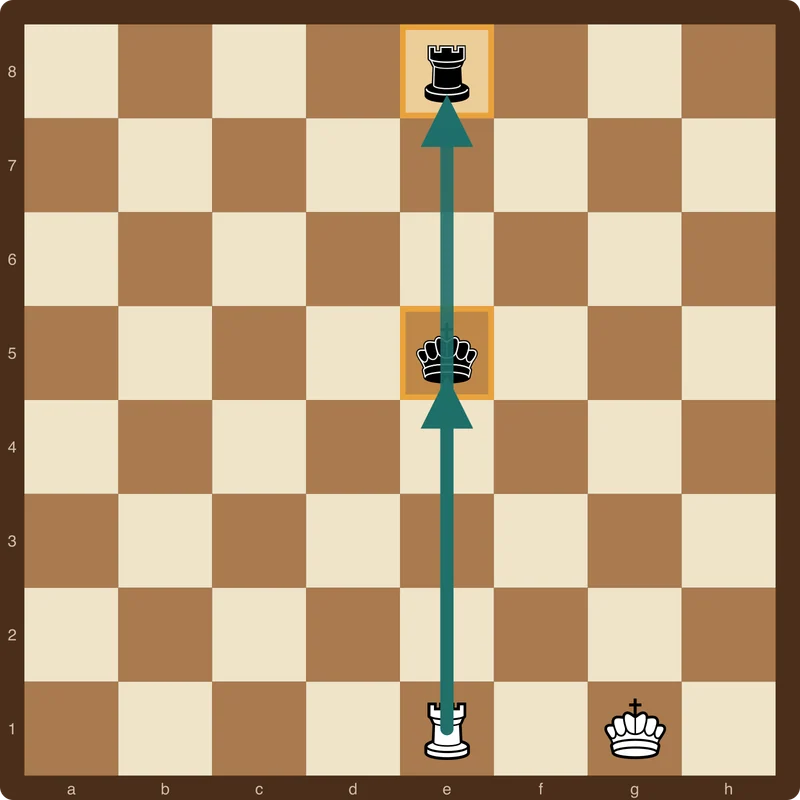
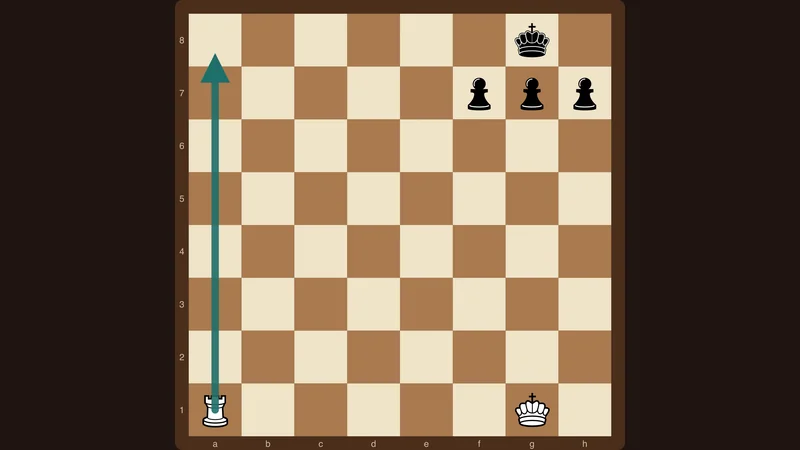
The white rook on e1 fires straight up the open e-file, checking the black king on e5. Standing directly behind the king on the identical file is an undefended black rook on e8.
Because Black’s king is in check, Black has no choice: the king must move off the e-file to an adjacent square such as d5 or f5. As soon as the king steps aside, the white rook slides up the file to capture the black rook on e8 (Rxe8). White converts an equal endgame into an easily winning rook advantage.
Pins versus skewers: understanding the differences
While both tactics rely on three pieces sharing a single straight line across the board, their execution and defensive dynamics differ substantially:
| Characteristic | The pin | The skewer |
|---|---|---|
| Target order | Less valuable piece in front, high-value piece behind | High-value piece in front, less valuable piece behind |
| Attacker’s goal | Paralyze the front piece and pile up attackers | Force the front piece to move and capture the rear piece |
| Typical front piece | Knight, bishop, or pawn | King or queen |
| Primary executioners | Bishops, rooks, queens | Bishops, rooks, queens |
| Board requirement | Aligned pieces along a rank, file, or diagonal | Aligned pieces along a rank, file, or diagonal |
Like pins, skewers can be absolute (when the front piece is the king and must move due to check) or relative (when the front piece is a queen that must move to avoid being traded for a lesser attacking piece).
Endgames featuring rooks and queens are especially rich in skewer motifs. In open boards with few pawns remaining, kings that wander onto the same rank or file as their own heavy pieces frequently fall victim to distant rook checks that win the game in two moves.
Spotting tactical preconditions: loose pieces and alignment
Tactical opportunities do not appear out of thin air; they are created by structural vulnerabilities in the opponent’s position. Grandmaster John Nunn coined the famous chess aphorism: “Loose pieces drop off.” A loose piece is any piece that is completely undefended by a friendly pawn or teammate.
Whenever you sit down to solve chess tactics puzzles or analyze your own games, train your eyes to scan for these three recurring tactical preconditions:
- Undefended units: Every undefended piece in the opponent’s camp is a potential target for a fork or skewer. When two undefended pieces share the board, almost any attacking piece can find a square that threatens both simultaneously.
- Linear piece alignments: Whenever two enemy pieces occupy the same diagonal, rank, or file, alert your brain to potential pins and skewers. Bishops hunt for diagonals containing kings and queens; rooks scan open ranks and files for heavy pieces sharing the same line.
- Restricted king mobility: When a king lacks flight squares, checks become far more dangerous. As we saw in our guide to back-rank mate in chess, a king boxed in by its own pawns can be eliminated by a single rook invasion on the back rank. Similarly, a restricted king is easily forced into skewer alignments or trapped in absolute pins.
Developing the habit of constantly questioning the safety of your own pieces is equally critical. Before executing any move, ask yourself: “Does this move leave any of my pieces undefended? Does it align my queen with my king along an open diagonal?”
Evaluating tactical blunders after your games—much like analyzing equity loss and performance rating in precision board games—reveals that the vast majority of lost contests stem directly from overlooked pins, forks, and loose pieces.
How to defend against tactical strikes
Recognizing when an opponent is preparing a tactical motif allows you to neutralize the threat before it lands. When faced with a potential fork, pin, or skewer, master players rely on four primary defensive techniques:
1. Interposition
When facing a pin or skewer from a distant bishop or rook, placing a friendly piece between the attacker and the front target breaks the line of attack. For example, if an enemy bishop pins your knight on f6 to your king on g8, sliding a bishop to e7 blocks the diagonal. The pin is dissolved, freeing your knight to move normally.
2. Counter-attacking with check or a greater threat
The best defense is often an active offense. If your opponent threatens a knight fork or places a rook on a pinning file, look for a forcing move—such as a check against their king or an attack against their queen—that forces an immediate response. If your counter-threat carries higher priority than their tactical idea, you gain the critical tempo needed to rescue your endangered pieces.
3. Creating escape squares (luft)
For skewers and back-rank threats along open files, providing your king with safe retreat squares prevents the forced moves that make skewers so devastating. Nudging an edge pawn forward gives the king room to maneuver without being corralled into linear alignments.
4. Overprotecting tactical anchors
If a piece must remain in a relative pin, ensure it is thoroughly reinforced by friendly pawns or pieces. A pinned knight that is defended twice can comfortably withstand an initial attack, buying you time to unpin your position on the following move by stepping your queen or king aside.
To put these defensive concepts into practice against live opponents, head over to Chess Moment and try playing a rated game of chess online. Testing your tactical vision against a variety of playing styles is the most reliable way to solidify these habits.
Questions people ask
Can a king execute a fork in chess?
Yes. While kings cannot deliver forks against defended pieces or move into squares attacked by the enemy, kings can and frequently do fork two undefended enemy pieces or pawns in simplified endgames. A king stepping between two disconnected enemy pawns can threaten both simultaneously, ensuring the capture of at least one.
What is the most common tactical mistake beginners make?
The single most common tactical error is failing to notice undefended pieces. Beginners frequently advance pieces onto active outposts without ensuring they have adequate retreat paths or reliable pawn support. These loose pieces quickly become targets for knight forks, double attacks, and tactical skewers.
How do master players calculate tactics so quickly?
Master players do not calculate every possible legal move on the board. Instead, they rely on pattern recognition. By studying thousands of tactical motifs in training, their eyes instantly recognize alignments, king vulnerabilities, and undefended pieces. Once a familiar motif is spotted, they calculate only the forcing moves—checks, captures, and direct threats—to confirm whether the combination succeeds.
What is the best way to improve tactical vision?
Daily puzzle practice focusing on fundamental themes—forks, pins, skewers, deflections, and back-rank checkmates—is the most effective method for building tactical intuition. Spending fifteen minutes each day solving structured tactical problems helps you spot geometric alignments automatically during live games.
Sources
- Wikipedia. “Chess tactic.” Overview of fundamental tactical patterns, double attacks, pins, and skewers.
- Lasker, E. (1925). Lasker's Manual of Chess. New York: E. P. Dutton.
- Euwe, M., & Kramer, H. (1964). The Middle Game: Book I: Static Features. London: G. Bell and Sons.
- Boardgammon. “Chess tactics and fundamentals.”
- Boardgammon. “Chess puzzles and tactical patterns.”
- Boardgammon. “Chess Moment: Play rated chess online.”
Found a mistake or an odd phrase? Tell us