Almost every chess player begins a puzzle session the same way: an intriguing position appears on screen, a tempting capture catches the eye, and fingers move a piece within two seconds. If the green checkmark lights up, a rush of satisfaction follows. If the red cross flashes, the player clicks through the solution, nods in brief recognition, and immediately jumps to the next puzzle.
Half an hour later, twenty puzzles have flown past, but very little real learning has taken place. Rapid guessing on a screen feels like playing chess, but it rarely improves how you navigate difficult positions over the board. To turn tactical exercises into enduring skill, you need to understand what puzzles actually train, how your mind interprets complex boards, and why modern training tools calibrate problems to your exact playing level.
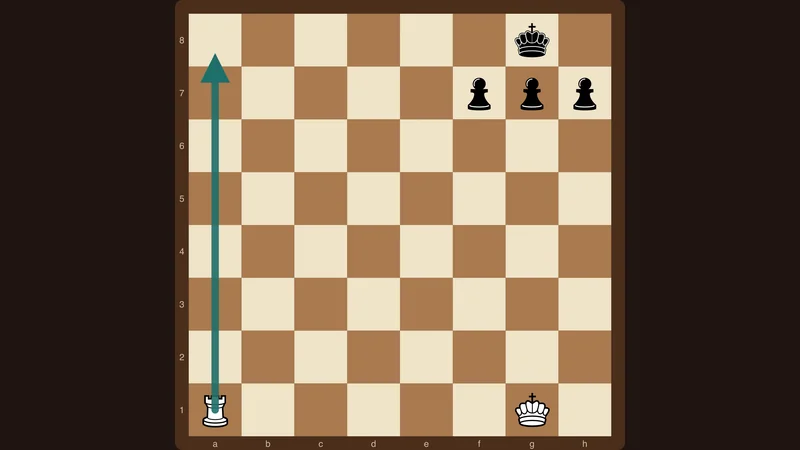
At its core, a chess tactic is a forced sequence of moves that secures a concrete advantage, such as winning material or delivering checkmate [1]. Whether executed through forks, pins, and skewers or a sudden back-rank mate, tactics decide the overwhelming majority of games below the master level. But seeing those combinations during live play requires far more than casual browsing; it demands deliberate practice structured around cognitive science.
The science of the chess chunk: why masters see more
When club players watch a grandmaster spot a winning four-move combination in seconds, they often assume the expert possesses superhuman calculation speed or the ability to envision twenty moves ahead. Cognitive psychologists have investigated this exact question for decades, and their findings overturned that romantic myth.
The pioneering Dutch psychologist and chess master Adriaan de Groot conducted landmark research in 1965 comparing the thought processes of world-class grandmasters with those of ordinary club players [2]. De Groot discovered that grandmasters do not calculate wider or deeper trees of moves than amateurs. In typical middle-game positions, grandmasters systematically examined between 2 and 4 candidate moves per position, reaching an average depth of three to five plies—virtually the same depth considered by skilled club players.
The real difference lay not in how deeply they calculated, but in what they perceived during their first glance at the board. Grandmasters immediately identified the critical squares, the vulnerable pieces, and the promising ideas, ignoring hundreds of irrelevant moves that weaker players spent minutes calculating.
Eight years later, in 1973, cognitive researchers William Chase and Herbert Simon illuminated the physiological mechanism behind this perceptual gift [3]. In their classic experiment, players of varying strengths were shown a chess position taken from a real game for exactly 5 seconds, after which the pieces were removed and the subjects were asked to reconstruct the position on an empty board.
The results were striking. After just 5 seconds, masters accurately reconstructed approximately 16 pieces, whereas beginners managed only about 4 pieces. The masters achieved this not by memorizing sixteen separate coordinates, but by recognizing structured groups of pieces—castled king defenses, pawn chains, rook batteries—which cognitive scientists call “chunks.” Chase and Simon estimated that a master possesses a mental catalog of roughly 50,000 of these familiar structural chunks stored in long-term memory.
Then came the crucial control test: Chase and Simon placed the same pieces randomly across the 64 squares of the board and repeated the 5-second test. Deprived of logical game structure, the grandmasters’ memory collapsed. On random boards, masters could recall only about 4 pieces—exactly the same count as complete novices.
This finding carries profound implications for your training. When you solve structured chess tactics puzzles, you are not developing a general photographic memory. You are systematically building and refining an internal library of chunks. Every time you solve a pin, a discovered attack, or an overloaded defender, your brain links those geometric relationships into a single retrievable concept.
How puzzle ratings work: the math of the fair match
If you have spent time solving puzzles on modern platforms, you have likely noticed that every puzzle carries its own numerical rating that shifts after you attempt it. This is not an arbitrary badge stamped on by an editor; it is the product of an elegant mathematical system designed to keep you training at the frontier of your ability.
In 1999, statistician Mark Glickman formalized dynamic paired comparison rating methods that treat the puzzle and the human solver as two competing opponents in a virtual match [4]. When you open a tactical puzzle, the software treats the exercise as a game:
- If you solve the puzzle correctly on the first attempt, you win the match: your rating increases, and the puzzle’s rating drops.
- If you enter a flawed move or give up, you lose the match: your rating drops, and the puzzle’s rating rises.
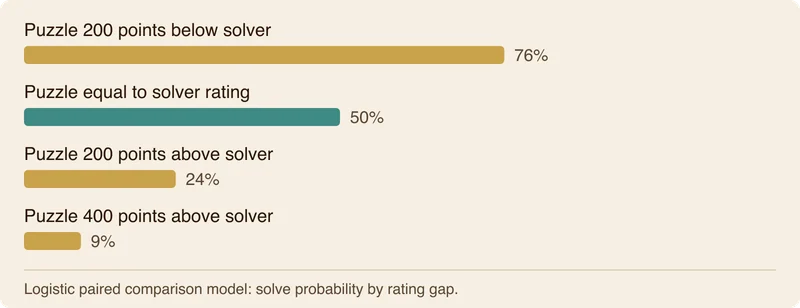
Because both players and puzzles share a common rating scale, the system can calculate an exact expected outcome for any matchup. When an adaptive rating system pairs you with a puzzle of your exact numerical rating, your expected probability of solving that puzzle correctly is precisely 50% [4].
If the system hands you a puzzle rated 200 points below your current tactical score, your expected solve rate climbs to 76%. If the problem is rated 200 points above you, your expected success rate falls to 24%. At a deficit of 400 points, expected success drops to just 9%.
Why is this fifty-percent balance so important for your improvement? The answer lies in educational psychology. In 1978, Lev Vygotsky formulated the concept of the “zone of proximal development”—the cognitive space between tasks a learner can already perform effortlessly and tasks that remain entirely beyond their reach [5].
If you only solve puzzles rated far below your level, you will solve nearly all of them effortlessly without forming new cognitive connections. Conversely, if you tackle puzzles rated far above your current ability, you will fail almost every attempt, leading to cognitive fatigue, frustration, and superficial guessing. An adaptive rating keeps you right in the zone of productive struggle, where each problem challenges your calculation without breaking your confidence.
The four habits of effective puzzle practice
Knowing that puzzles train chunks and that ratings calibrate challenge is only half the battle; how you engage with each position determines your rate of improvement. Top trainers and grandmasters recommend four core habits to replace mindless clicking with deliberate mastery.
1. Identify motifs before calculating moves
The most common beginner error is calculating concrete moves immediately upon seeing a position. Before calculating a single variation, take ten seconds to survey the board’s geometry. Ask yourself four diagnostic questions:
- Which enemy pieces are completely undefended?
- Which pieces are pinned, restricted, or aligned along the same file, rank, or diagonal?
- Is either king exposed or vulnerable to back-rank threats?
- What are the most forcing moves available: checks, captures, and direct threats?
By cataloging these tactical motifs first, you prime your subconscious to retrieve relevant chunks, narrowing your focus to the moves that matter most.
2. Kotov’s discipline: identify candidate moves first
In his classic 1971 work Think Like a Grandmaster, Soviet grandmaster Alexander Kotov observed that amateur players frequently waste mental energy jumping erratically between different lines of play [6]. A player calculates move A, gets distracted by a scary reply, switches to move B, finds move B unconvincing, and then plays move A on impulse without ever verifying it.
Kotov urged players to build a disciplined “tree of analysis.” First, compile a complete list of candidate moves—typically between 2 and 4 promising candidate moves [2]. Then, analyze each candidate systematically, one branch at a time, calculating until you reach a quiet, resolved position. Once you finish evaluating a line, trust your conclusion and move to the next candidate.
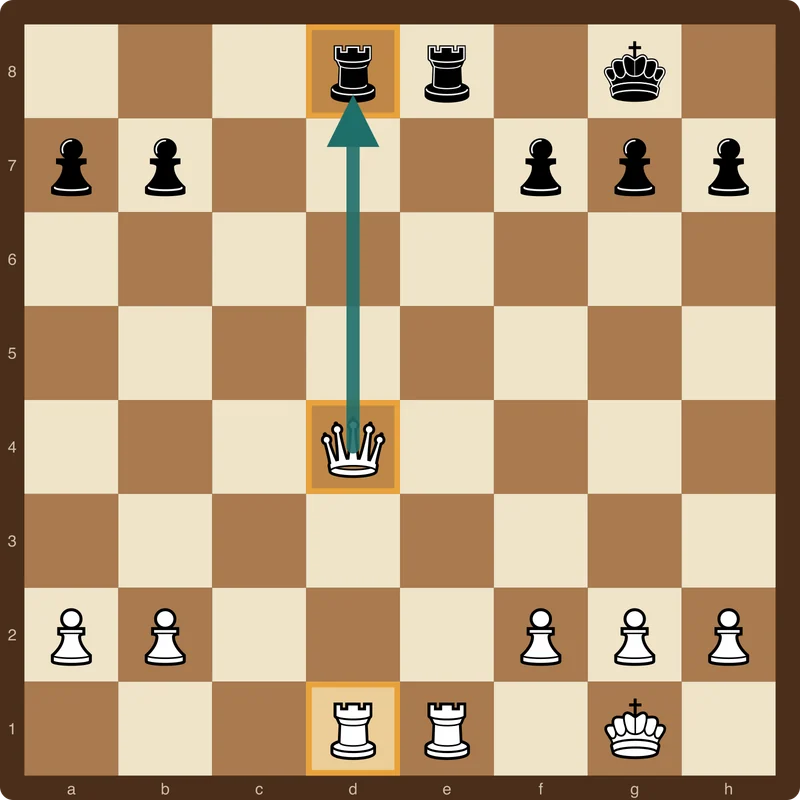
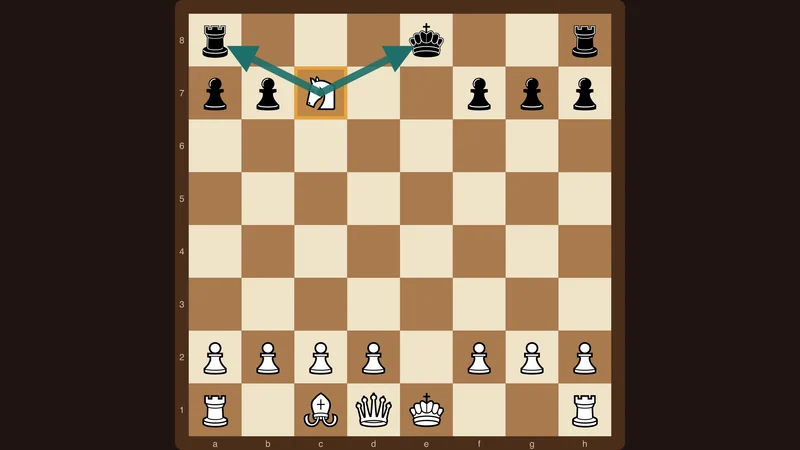
In the position above, White observes that Black’s rooks are tied to the defense of the eighth rank and the d8-square. Before moving, a disciplined solver identifies candidate moves such as 1.Qxd8 and 1.Rxe8+. Evaluating 1.Qxd8 reveals that Black must capture with 1...Rxd8 or 1...Rexd8, after which White delivers checkmate with 2.Rxd8#. The queen sacrifice deflects the defender from guarding the back rank.
3. Search relentlessly for your opponent’s defensive resource
More puzzles are failed due to overlooked counter-punches than incorrect attacking concepts. When you find an attractive tactical sequence, pause and ask: “What is my opponent’s strongest possible defense?”
Look specifically for:
- In-between moves (Zwischenzüge) that disrupt your attack with check.
- Counter-sacrifices that eliminate your key attacking piece.
- Defensive interpositions that block your line of attack.
If your combination still succeeds against the opponent’s stubbornest resource, you can play your move with complete conviction.
4. Leverage cyclical spaced repetition
In 2018, Swedish grandmaster Hans Tikkanen and Axel Smith introduced the “Woodpecker Method,” adapting the cognitive science of spaced repetition to tactical chess training [7]. Instead of solving thousands of different puzzles once and never seeing them again, they advocated selecting a curated set of several hundred puzzles and solving that exact same set repeatedly across shrinking time windows.
In round one, solving a large set might take four weeks. In round two, the same set is solved in two weeks; in round three, in one week; and in round four, in two days. This cyclical repetition forces your brain to compress slow, step-by-step calculation into instant, subconscious pattern recognition.
Untimed calculation versus tactical speed runs
Modern chess platforms offer both untimed puzzle sessions and rapid speed challenges where you solve as many problems as possible against a ticking clock. Both formats have their place, but they train entirely different cognitive skills.
| Training Mode | Primary Skill Developed | Ideal Solving Rhythm | When to Use |
|---|---|---|---|
| Rated untimed puzzles | Deep calculation, candidate selection, blunder prevention | 2 to 5 minutes per position; no moving until the full line is seen | Daily primary training; 15 to 30 puzzles per session |
| Speed runs and streaks | Instant chunk retrieval, basic tactical reflexes, tactical stamina | 3 to 10 seconds per puzzle; immediate pattern recognition | Warm-up before games; 5 to 10 minutes session |
| Thematic puzzle sets | Structural mastery of specific motifs (forks, pins, deflects) | Variable pace focusing on recurring piece arrangements | Targeted study when reviewing your tournament blunders |
For lasting improvement, untimed calculation should represent the vast majority of your puzzle practice. Speed runs are enjoyable and test quick pattern retrieval, but relying exclusively on them encourages guessing and superficial habituation.
What tactical training does and what it cannot do
Because tactical puzzles are engaging and easily quantified, many players fall into the trap of believing that puzzle solving is the only study they need. Cognitive science provides a clear reality check regarding what tactical practice accomplishes and where its limits lie.
Cognitive researchers Fernand Gobet and Herbert Simon demonstrated in 1996 that chess memory and skill rely on domain-specific perceptual templates rather than broad cognitive transfer [8]. Solving hundreds of tactical puzzles will sharpen your board visualization, increase your speed at spotting pins and forks, and reduce careless one-move oversights.
However, research has repeatedly shown that chess training does not produce generalized transfer to broad intelligence, school mathematics, or everyday decision-making [8]. Within the game of chess itself, tactical practice cannot substitute for positional understanding, pawn structure knowledge, or endgame technique.
A tactical combination only appears when a superior position allows it. If you navigate your first chess opening poorly or ruin your pawn structure, you will rarely reach positions where sparkling tactics exist for your side. Combine your puzzle workouts with balanced study: review your master games, explore opening ideas, and learn chess from the first move through structured lessons.
To test your tactical acuity against human opponents under real match conditions, take what you have practiced directly to the board and play a rated game of chess.
Practical rules for your daily routine
To build a consistent training habit that produces measurable gains in your over-the-board rating, adopt this straightforward daily framework:
- Target 15 to 30 focused puzzles per day: Completing 15 to 30 deliberate exercises with high accuracy yields far greater skill retention than speeding through many problems with careless guessing [7].
- Never move on a guess: Commit to never touching a piece until you have visualized the entire line through to the end of the combination, including your opponent’s best response.
- Analyze your failures immediately: When you get a puzzle wrong, resist the urge to glance at the answer and move on. Clear the board, identify why your candidate move failed, and find the defensive resource you overlooked.
- Track your tactical themes: If you notice consistent errors in rook endgames or knight forks, spend your next session working on those specific motifs.
By grounding your tactical study in the proven science of chunking, respecting the feedback of adaptive ratings, and applying disciplined candidate analysis, you transform chess puzzles from a passing pastime into the most powerful engine of your chess development.
Questions people ask
Why is my chess puzzle rating hundreds of points higher than my game rating?
In a puzzle, you are explicitly told that a winning tactic exists, and your opponent cannot make counter-threats outside the scripted variation. In a real game of chess online, nobody alerts you that a tactical opportunity has appeared. You must simultaneously manage time, defend against threats, evaluate positional weaknesses, and navigate quiet maneuvers.
How much time should I spend on a difficult puzzle before giving up?
For puzzles at or slightly above your rating, give yourself between three and five minutes of disciplined calculation. If you cannot find a forced sequence after five minutes, write down your best candidate move, play it, and carefully study the solution to identify which chunk or defensive resource you missed.
Can beginners benefit from tactical puzzles immediately?
Yes, beginners benefit enormously from tactical puzzles, provided they start with fundamental one-move and two-move motifs. Practicing basic checks, captures, and piece defenses builds the initial foundation of structural chunks that makes deeper calculation possible later on.
Sources
- Encyclopaedia Britannica. “Chess: Tactics and Combinations.” Britannica Online Encyclopedia.
- De Groot, A. D. (1965). “Thought and Choice in Chess.” The Hague: Mouton & Co.
- Chase, W. G., & Simon, H. A. (1973). “Perception in chess.” Cognitive Psychology, 4(1), 55–81.
- Glickman, M. E. (1999). “Parameter estimation in large dynamic paired comparison experiments.” Applied Statistics, 48(3), 377–394.
- Vygotsky, L. S. (1978). “Mind in Society: The Development of Higher Psychological Processes.” Cambridge, MA: Harvard University Press.
- Kotov, A. (1971). “Think Like a Grandmaster.” London: B. T. Batsford.
- Smith, A., & Tikkanen, H. (2018). “The Woodpecker Method.” Glasgow: Quality Chess.
- Gobet, F., & Simon, H. A. (1996). “Templates in chess memory: A mechanism for recalling several boards.” Cognitive Psychology, 31(1), 1–40.
Found a mistake or an odd phrase? Tell us