Every beginner learning chess online is taught a clean mathematical rule: a pawn is worth 1 point, a knight is worth 3, a bishop is worth 3, a rook is worth 5, and a queen is worth 9. This point scale is helpful when you are first learning the board because it prevents you from throwing away rooks for pawns. But the moment you advance beyond elementary tactics, you discover that the equal valuation of knights and bishops is an illusion.
Grandmasters spend entire tournaments debating whether to give up a bishop for a knight or fight tooth and nail to preserve the bishop pair. In some positions, a single bishop sweeps across the board like an unstoppable beam of light, rendering an opposing knight completely helpless. In other positions, that same bishop is reduced to a passive, miserable spectator—trapped behind its own locked pawns—while an enemy knight hops onto a glorious central square and decides the contest.
Understanding the eternal clash between knight and bishop is one of the foundational steps in positional mastery. Whether you are reviewing your games in Chess Moment or studying opening pawn structures, knowing which piece will dominate your middlegame allows you to choose favorable trades and steer toward winning endgames.
The geometry of the board: range versus flexibility
The fundamental difference between the knight and the bishop begins with how they move across the 64 squares of the chessboard.
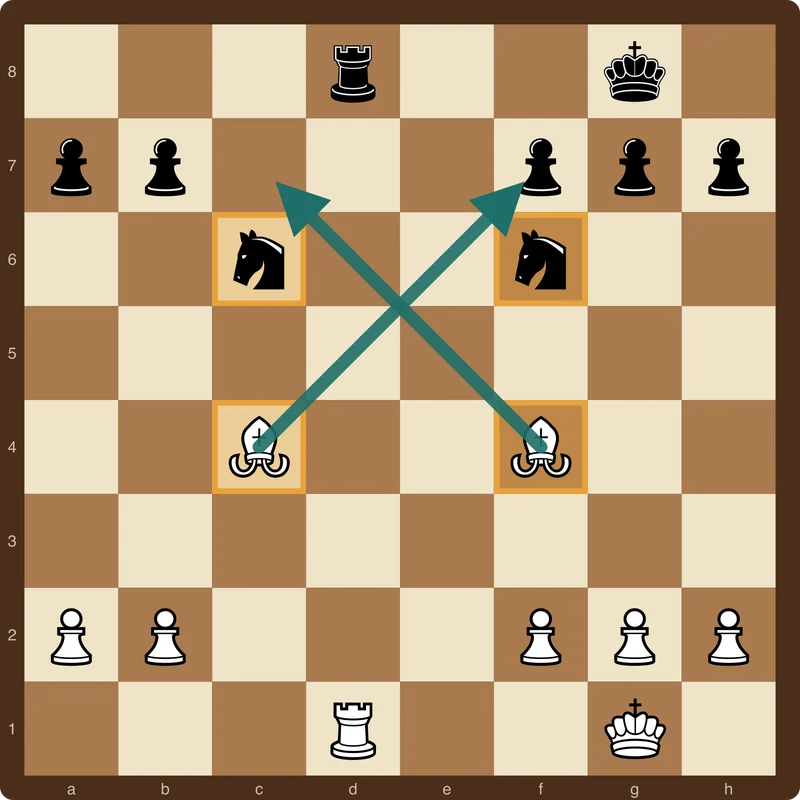
The bishop is a long-range projectile weapon. In a single move, an unimpeded bishop can travel from one corner of the board to the opposite corner—from c1 all the way to h6 or a3. This long-range capability gives the bishop tremendous speed. A bishop stationed on the kingside can defend a passed pawn on the queenside while simultaneously pinning an enemy piece in the center.
However, the bishop carries an inherent, incurable handicap: color blindness. A bishop that begins the game on a light square can only ever travel on light squares. Half of the board—all 32 dark squares—is permanently closed to it. If an enemy king or pawn chain sets up camp on the opposite color, that bishop can never touch them, challenge them, or drive them away.
The knight is the complete opposite. It is a short-range brawler. It moves slowly, requiring multiple turns to travel across the board. A knight on a1 needs three full moves just to reach the center on d4 or e4, and four moves to cross to the opposite flank on h8. If a sudden crisis breaks out on the opposite wing, a misplaced knight often arrives far too late to help.
Yet the knight possesses two unique superpowers that no other piece on the chessboard enjoys:
- The jump: The knight is the only piece that can leap over other friendly or enemy pieces. Obstacles on the board do not block its path; it simply hops over them.
- Total square access: With every single move, a knight changes the color of the square it stands on. A knight leaping from a light square lands on a dark square, and its next move lands back on a light square. Over the course of several moves, a knight can reach every single square of the 64 squares on the board. No corner or color complex is safe from a determined knight.
This geometrical contrast dictates how the two pieces interact with the surrounding pawn structure.
Open positions versus closed positions
The golden rule of minor pieces is straightforward: bishops love open positions, while knights love closed positions.
What makes a position open or closed? The answer lies in the central pawns.
When central pawns have been traded off—or when they remain mobile and fluid—the board opens up. There are few obstacles in the center to interrupt diagonal lines. In an open position, the bishop’s long-range reach becomes decisive. A bishop can exert pressure on multiple targets simultaneously from a safe distance, well out of reach of enemy pieces. Knights in open positions often struggle because the distance between active targets is wide, and knights lack the speed to jump back and forth across empty files.
Conversely, a closed position is characterized by locked central pawn chains that have ground to a halt. Examples occur frequently in the French Defense, the King’s Indian Defense, or closed lines of the Ruy Lopez, where pawns on d4 and e5 or d5 and e4 butt heads and cannot move forward.
In closed positions, locked pawns act as solid stone walls. Because bishops cannot leap over pawns, their diagonals are completely severed. A bishop trapped behind a wall of locked pawns becomes sluggish and ineffective.
For the knight, locked pawns are a welcome landscape. While the bishop stares helplessly at a stone barrier, the knight leaps right over it. Furthermore, locked pawn chains create permanent structural weaknesses—holes and unprotectable squares behind enemy lines—where knights can nestle safely.
The power of the bishop pair
When you have a single bishop, its color limitation is a constant positional liability. But what happens when you possess both of your bishops?
Together, the two bishops cover all 64 squares of the board. One sweeps the light diagonals while the other sweeps the dark diagonals. When coordinated harmoniously, the two bishops form an impenetrable cutting rake that controls large swaths of territory, preventing enemy pieces from finding secure squares.
The positional power of the “bishop pair” was first systematically formulated in 1889 by the first official World Chess Champion, Wilhelm Steinitz, in his foundational treatise The Modern Chess Instructor [1]. Steinitz demonstrated that having the two bishops against a bishop and knight—or against two knights—constitutes a permanent, tangible advantage in any position where the pawn structure can be opened. Steinitz argued that players should treat the preservation of both bishops as an enduring strategic asset.
In modern chess, computer databases have confirmed Steinitz’s classical insight with mathematical precision. In 1999, Grandmaster Larry Kaufman published landmark empirical research in Computer Chess Reports evaluating chess assets [2]. By analyzing a statistical database of over 300,000 master-level games and high-level engine evaluations, Kaufman quantified the true practical value of the minor pieces.
Kaufman established that while an isolated knight and an isolated bishop each hold a baseline value of approximately 3.25 pawns, possessing the bishop pair confers an empirical bonus of 0.50 pawn. This means that two bishops are statistically worth 7.0 pawns together, compared to just 6.5 pawns for two knights or for a knight and bishop combination.
That half-pawn premium explains why masters are often willing to accept doubled pawns or minor structural weaknesses if doing so secures the bishop pair for the rest of the game.
Good bishops versus bad bishops
Not all bishops are created equal. Even if you possess a bishop, its real strength depends on where your own pawns stand.
In 1925, the theorist Aron Nimzowitsch codified the concepts of piece restriction and the “bad bishop” in his masterwork Mein System [3].
A bad bishop is a bishop whose own central pawns are fixed and locked on squares of the same color as the bishop. For instance, if you have a light-squared bishop, and your central pawns are locked on c6, d5, and e6, your bishop’s natural diagonals are physically blocked by your own army.
A bad bishop suffers from three critical flaws:
- Its mobility is drastically curtailed, turning it into little more than a defensive, overgrown “tall pawn.”
- It cannot attack enemy targets because friendly pawns occupy the squares it needs to cross.
- It clashes with its own pawns for board space, making piece coordination awkward and congested.
Conversely, a good bishop is one whose own central pawns are fixed on squares of the opposite color. If your pawns are locked on dark squares, your light-squared bishop has free reign to glide between and beyond them. It can attack enemy squares while friendly pawns defend the opposite color complex.
When assessing whether to trade minor pieces, always evaluate the color complex of the fixed pawns:
- If your opponent has a bad bishop trapped behind their central pawns, avoid trading it! Keep that bad bishop alive on the board—it acts as an obstacle to their own pieces.
- If you have a bad bishop, look for opportunities to trade it off for an active enemy knight or an active enemy bishop, or sacrifice a pawn to blow open its diagonals.
The knight outpost: mastering the central anchor
If the bishop’s crowning glory is the open diagonal, the knight’s ultimate triumph is the central outpost.
Nimzowitsch defined an outpost—or Vorposten—as a square on an open or half-open file, usually located on the 5th or 6th rank, that cannot be attacked or driven away by opposing pawns, and is protected by a friendly pawn [3].
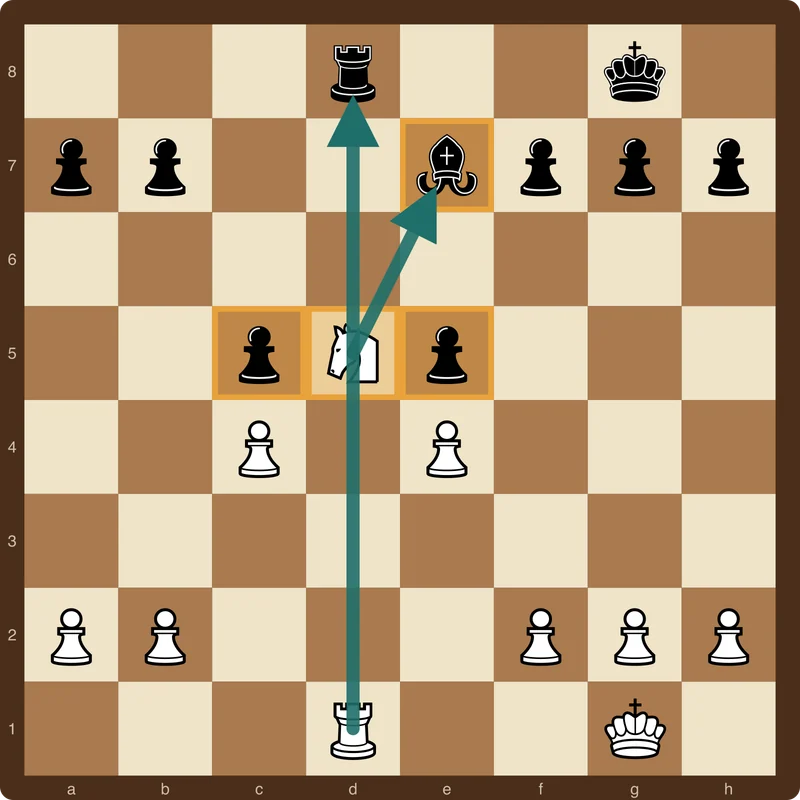
Consider the diagram above. White’s knight sits proudly on d5, securely anchored by the pawn on e4. Black’s c-pawn and e-pawn have advanced to c5 and e5, meaning Black has no pawns left on the c-file or e-file that can ever attack d5.
A knight established on such an outpost is often described as an “octopus” because its tentacles reach in every direction across the enemy camp. From d5, the knight attacks critical squares in Black’s territory, supports attacking lines, clamps down on counterplay, and creates tactical fork threats.
Meanwhile, look at Black’s light-squared bishop on e7. Black’s pawns on c5 and e5 are permanently fixed on light squares, directly suffocating the bishop’s diagonals. White’s knight completely dominates Black’s passive bad bishop. In this scenario, White’s knight is functionally worth far more than a bishop—it behaves like a rook.
When studying how to learn chess from the first move, look for holes in your opponent’s pawn structure. Whenever an opponent advances a pawn forward without proper care, they permanently surrender control over the squares that pawn used to guard. If you can plant a knight on that vacated square on the 5th or 6th rank, that knight can dominate the entire middlegame.
Endgames: who wins the race?
When the heavy pieces leave the board and the game transitions into an endgame, the battle between knight and bishop enters its purest form.
In his comprehensive study Secrets of Minor-Piece Endgames (1995), Grandmaster John Nunn analyzed thousands of positions using computer endgame tablebases to uncover the fundamental laws governing minor-piece endings [4].
Nunn’s research demonstrated two universal principles regarding pawn distribution:
1. Pawns on both wings favor the bishop
When pawns remain on both the kingside and the queenside, the bishop is overwhelmingly superior to the knight [4].
In a split-wing endgame, pawns advance on opposite edges of the board. The bishop can perform two vital duties at the same moment: from the kingside, it can usher its own passed pawn forward while simultaneously firing a long-range laser across the board to stop an enemy passed pawn on the queenside.
A knight in a split-wing race is hopelessly outclassed. Because it moves so slowly, a knight cannot be in two places at once. If it gallops over to the queenside to contain a passed pawn, the enemy king and bishop will feast on the undefended kingside pawns before the knight can return. Just as in fundamental rook endgames like the Lucena and Philidor positions, tempo and distance decide the outcome.
2. Pawns on one wing favor the knight
When all remaining pawns are concentrated on a single side of the board—such as three pawns versus three pawns on the kingside—the board is compressed [4].
In a compressed battlefield, the bishop’s long-range advantage is entirely neutralized; there are no distant targets across the board to attack. Here, the knight’s short range is no longer a drawback. More importantly, the knight can challenge and attack pawns on both light and dark squares, whereas the bishop can only ever defend or attack squares of one color. The knight can systematically pick away at pawn chains and hop into king outposts, making it the superior fighting piece.
The wrong-color rook pawn draw
Every chess player must know one classic endgame drawing trick: the wrong-color rook pawn [4].
If you enter an endgame with a king, a bishop, and a rook pawn (on the a-file or h-file) against a lone defending king, you cannot force a checkmate if two conditions are met:
- The promotion square in the corner is of the opposite color to your bishop.
- The defending king manages to reach that corner square.
Because your bishop cannot control or attack the opposite-colored corner square, it cannot dislodge the defending king. No matter how many moves you make, the defending king simply steps back and forth between the corner square and an adjacent square. Any attempt to crowd the king results in stalemate. In this rare instance, an extra bishop and pawn are completely worthless. A knight does not suffer from this specific corner-color curse.
Summary: Knight versus bishop comparison
To quickly evaluate the minor piece dynamic in any game, refer to this strategic breakdown:
| Feature | The Bishop | The Knight |
|---|---|---|
| Best pawn structure | Open positions with cleared centers and mobile pawns | Closed positions with locked, fixed central pawn chains |
| Pawn distribution | Highly dominant when pawns exist on both wings | Dominant when pawns are concentrated on one wing |
| Square coverage | Limited to 32 squares of its starting color | Visits all 64 squares across the board |
| Board speed | Fast: crosses the entire board in a single move | Slow: takes 3 to 4 moves to cross flanks |
| Cooperation | Superb in pairs (the bishop pair bonus is +0.50 pawn) | Independent; two knights do not create harmonious rakes |
| Outposts | Vulnerable to pawn kicks unless pawns are locked | Thrives on 5th and 6th rank outposts (Vorposten) |
| Vulnerability | Vulnerable to becoming a restricted “bad bishop” | Immune to color complexes; can hop over blockades |
When should you trade? A practical decision guide
When you face the choice of trading a knight for a bishop or vice versa, run through this practical checklist:
- Look at the center: Is the center open, or is it locked? If the center is blown open, keep your bishops. If the center is tightly locked with interlocking pawn chains, favor the knight.
- Count the wings: Are there pawns on both flanks of the board, or is the action restricted to one wing? If pawns are racing on both edges, preserve the bishop.
- Assess the bishop pair: Will trading your bishop give your opponent the uncontested bishop pair? Unless you receive concrete material or a crushing tactical attack, giving up your bishop and allowing your opponent two bishops concedes a long-term +0.50 pawn advantage.
- Identify outposts: Can your knight land on a secure central outpost on the 5th or 6th rank where no enemy pawn can hit it? If yes, that knight will likely outperform any opposing bishop.
- Inspect the pawn colors: Are your opponent’s pawns fixed on the same color as their bishop? If so, leave their bad bishop alone. If your own bishop is bad, seek to trade it off for an active enemy knight immediately.
- Watch for tactical targets: As we explored in our guide on loose pieces in chess, minor pieces left undefended on the board become targets for tactical forks and double attacks. Ensure your minor pieces always have secure anchors before initiating exchanges. You can practice recognizing these setups in chess puzzles or test your skills in a rated game of chess.
By mastering these fundamental principles, you will no longer look at knights and bishops as interchangeable 3-point pieces. You will recognize the dynamic terrain of the board, exploit every structural imbalance, and wield your minor pieces with grandmaster clarity.
Questions people ask
Why are knights and bishops both worth 3 points if bishops are often better?
The traditional 3-point value is a baseline generalization designed for beginners learning piece exchanges. While single knights and single bishops perform with comparable effectiveness on average, practical value varies widely depending on whether the board is open or closed. When paired together, two bishops earn an empirical bonus of approximately half a pawn (+0.50), making the pair worth 7.0 pawns in open positions.
Can a knight ever be worth more than a rook?
In material terms, a rook is worth 5 points and a knight is worth 3. However, in heavily closed positions where rooks have no open files to operate on, a knight securely entrenched on an advanced central outpost can be dramatically more influential and dangerous than a passive, boxed-in rook.
What is the difference between a bad bishop and a passive bishop?
A bad bishop is defined by the pawn structure: its own central pawns are fixed on squares of the same color as the bishop, inherently blocking its diagonals. A passive bishop may simply be placed on an ineffective square temporarily, but it can be reactivated if its diagonals remain clear. A bad bishop cannot be easily fixed unless the underlying pawn structure is liquidated.
How do you beat the bishop pair with two knights?
To combat the bishop pair using knights, your primary goal is to close the board. Keep pawns locked in the center, avoid opening files or diagonals, and establish solid pawn chains. Once the position is closed, maneuver your knights toward central outposts where they can leap over the blockaded pawns and exploit holes in the opponent’s territory.
Sources
- Steinitz, W. (1889). The Modern Chess Instructor. New York and London: G. P. Putnam’s Sons.
- Kaufman, L. (1999). The Evaluation of Assets in Chess. Computer Chess Reports.
- Nimzowitsch, A. (1925). Mein System (My System). Berlin: B. Kagan.
- Nunn, J. (1995). Secrets of Minor-Piece Endgames. London: B. T. Batsford Ltd.
Found a mistake or an odd phrase? Tell us