The viral myth of the 6000-calorie game
In October 2019, sports headlines around the world announced a startling claim: elite chess players were supposedly burning up to 6000 calories a day during tournaments without lifting more than a wooden piece [1]. The report cited estimates by neuroendocrinologist Robert Sapolsky, who noted that grandmasters experience breathing rates and physiological stress responses comparable to elite athletes during critical games. Commentators marveled at the idea that sitting in a chair and pondering combinations could burn more energy than running a double marathon.
The dramatic claim echoed a legendary episode from chess history: the 1984 World Chess Championship match in Moscow between Anatoly Karpov and Garry Kasparov [2]. That marathon struggle stretched across 48 games and 5 months before FIDE officials halted the contest without declaring a winner. By the time the match was abandoned, Karpov had lost 10 kilograms, amounting to 22 pounds of body weight. Photographs of the defending champion showed hollowed cheeks and visible physical strain.
For decades, casual players assumed that deep mental calculation literally consumes fat tissue at an astronomical rate. If Karpov shed 10 kilograms while calculating variations, and if the human brain is the hungriest organ in the body, could chess serve as an effortless calorie burner?
When exercise physiologists and metabolic researchers tested this hypothesis with clinical laboratory instruments, the sensational myth collapsed. Yet what scientists discovered about the heart, the nervous system, and the body during chess is even more fascinating.
What laboratory calorimetry actually measured
To determine how much energy a game of chess actually burns, sports physiologists cannot rely on casual estimates or heart-rate formulas designed for running. They must measure oxygen consumption and carbon dioxide production directly through indirect calorimetry.
In 2009, a research team led by Nicolas Troubat conducted the definitive physiological study of competitive chess players during tournament play [3]. The researchers fitted rated players with portable metabolic measurement carts and continuous electrocardiography monitors before, during, and after competitive matches.
The laboratory findings were unequivocal:
- The measured metabolic rate during tournament play ranged between 1.3 and 1.7 METs (Metabolic Equivalent of Task) [3].
- For an adult weighing 70 kilograms, this translates to an energy expenditure of approximately 105 to 125 calories per hour [3].
- In comparison, sitting quietly at rest burns roughly 70 to 75 calories per hour for that same 70-kilogram person [3].
- Over a grueling 4-hour tournament round, a player expends roughly 420 to 500 total calories [3].
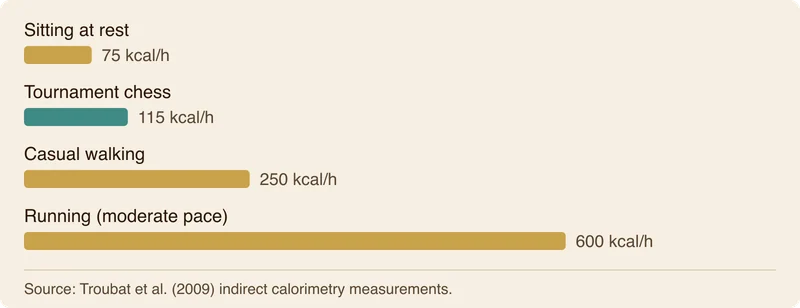
Energy expenditure breakdown (70 kg adult):
- Sitting quietly:     ~75 kcal/hour
- Tournament chess:    ~115 kcal/hour (105 to 125)
- Casual walking:      ~250 kcal/hour
- Moderate running:    ~600 kcal/hour
The difference between sitting idle and playing an intense game of chess online or in a tournament hall is only about 30 to 45 calories per hour [3]. Across a 4-hour game, the entire excess energy expended above resting baseline amounts to roughly 120 to 180 calories—equivalent to half an energy bar.
Over an entire 24-hour tournament day, including sleep, meals, light walking, and 4 hours of competitive play, an active grandmaster expends roughly 2000 to 2500 total calories [3]. That figure is completely standard for a healthy, sedentary adult. The claim of 6000 calories burned in a day is physically impossible: achieving such caloric expenditure would require cycling 100 miles or running continuously for 6 hours.
Why thinking hard does not burn extra fuel
Why doesn’t the brain burn thousands of calories when you calculate six moves ahead? The answer lies in the fundamental architecture of human cerebral metabolism.
In 2002, neuroimaging pioneer Marcus Raichle and David Gusnard published a landmark analysis of the brain’s energy budget in the Proceedings of the National Academy of Sciences [4]. Raichle demonstrated that the human brain is indeed metabolically expensive:
- The adult brain represents roughly 2% of total body mass (around 1.4 kilograms) [4].
- Yet it consumes roughly 20% of the entire body’s resting oxygen and energy budget [4].
- In baseline terms, the brain burns approximately 300 to 400 calories each day, consuming about 120 grams of glucose daily [4].
However, Raichle discovered that the brain’s energy consumption is remarkably constant. The vast majority of its energy powers intrinsic neural signaling—maintaining cellular membrane potentials, synaptic vesicles, and the subconscious “default mode network.”
When an individual engages in intense, focused cognitive work—such as solving complex tactical problems or calculating variations—the overall energy consumption of the brain increases by less than 1% to 5% above baseline resting levels [4]. The brain does not rev up its total fuel consumption like a car engine accelerating down a highway. Instead, it merely shifts localized blood flow and glucose from quiet cortical zones to the active visual, spatial, and executive areas.
Calculating a brilliant queen sacrifice burns practically the same amount of glucose as daydreaming about lunch.
If chess does not burn thousands of calories, why is it so exhausting?
Every tournament competitor knows that finishing a 4-hour match leaves the body thoroughly spent. If that exhaustion is not caused by burning thousands of calories, what produces it?
The answer comes from the autonomic nervous system and chronic psychological stress.
1. Sympathetic nervous system activation and heart rate spikes
In their 2009 investigation, Troubat and colleagues recorded significant cardiovascular responses during chess matches [3]:
- Baseline resting heart rates averaged 68 to 72 beats per minute [3].
- During tournament play, the players’ average heart rates rose to 86 to 90 beats per minute [3].
- During acute tactical crises, sudden blunders, and severe time trouble, heart rates spiked dramatically to 120 and 130 beats per minute [3].
When you face a dangerous counterattack or your clock ticks down under two minutes, your hypothalamus perceives an existential threat. It triggers the sympathetic “fight-or-flight” response, flooding the bloodstream with adrenaline and cortisol. Your heart beats faster, blood pressure climbs, and respiration quickens.
A heart beating at 120 beats per minute because of psychological stress feels just as taxing as a heart beating at 120 beats per minute from jogging. But because you are seated, your muscles cannot clear the circulating adrenaline through mechanical exertion.
2. The collapse of heart rate variability
In 2019, sports scientist Juan Pedro Fuentes-García and colleagues examined heart rate variability (HRV) among rated chess players [5]. HRV measures the millisecond variations between consecutive heartbeats, serving as a direct window into the balance between sympathetic stress and parasympathetic recovery.
Fuentes-García found that during competitive chess play, HRV drops substantially [5]. This reflects sustained sympathetic dominance and the suppression of the parasympathetic “rest-and-digest” system. Maintaining that state of autonomic vigilance for 4 or 5 hours produces profound systemic fatigue.
3. Isometric muscle tension
Watch any tournament room in hour 4: players sit frozen in posture, shoulders hunched, jaws clenched, necks rigid, and hands gripping the edge of the table. This sustained isometric contraction restricts local blood flow, accumulates lactic acid in postural muscles, and leads to tension headaches and back pain.
4. Why Karpov really lost 10 kilograms
Anatoly Karpov’s dramatic weight loss in 1984 was not caused by burning 6000 calories at the board [2]. It was caused by five continuous months of acute psychological stress, elevated cortisol, loss of appetite, and chronic sleep disruption. Under prolonged high stress, individuals frequently under-eat while nervous tension elevates basal metabolic expenditure, leading to genuine weight loss over weeks and months.
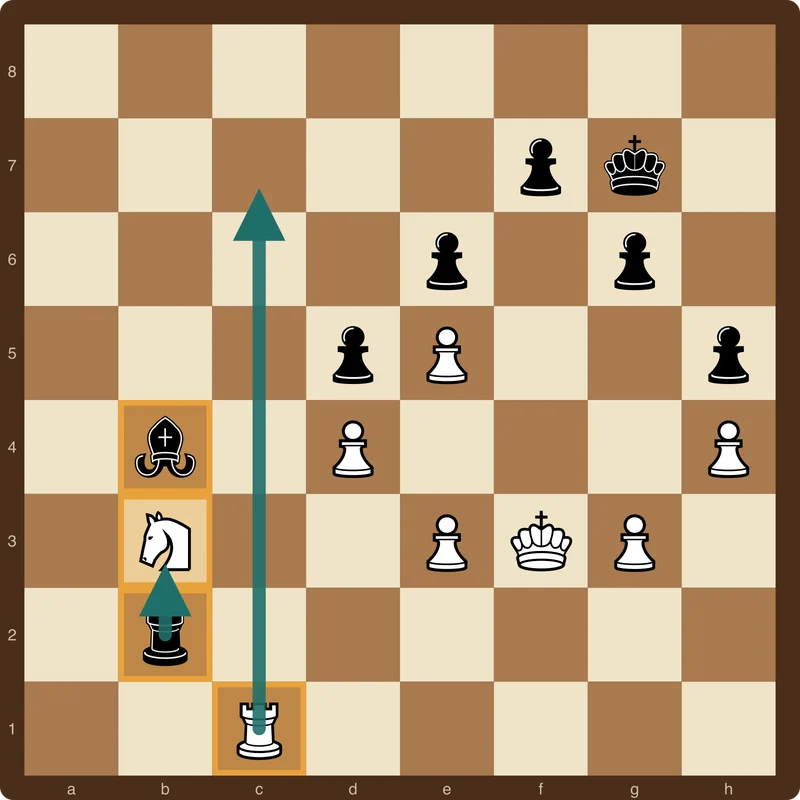
The blunder curve: why physical fitness wins chess games
The physiological strain of chess directly affects the quality of your moves.
In their 2019 study, Fuentes-García and co-authors compared high-rated and lower-rated players across extended tournament games [5]. They discovered a vital performance link: players with superior cardiovascular fitness showed significantly better autonomic regulation. Their heart rates recovered faster after tactical frights, their sympathetic stress remained lower, and they maintained higher calculation precision.
In classical chess, the blunder rate follows a distinct curve: errors multiply dramatically in hours 4 and 5 of a match [5]. As glycogen depletes and autonomic fatigue clouds working memory, players lose their tactical vigilance. They miss simple counter-punches, overlook loose pieces, and make fatal endgame miscalculations.
In our exploration of whether chess makes you smarter, we examined how grandmaster memory relies on structured chunking rather than raw computational power. Similarly, avoiding tactical blunders under physical fatigue connects directly to John Nunn’s observation that loose pieces drop off: when autonomic fatigue sets in during hours 4 and 5, tactical vigilance collapses first.
This explains why contemporary world champions treat aerobic fitness as a core competitive weapon [6]. Magnus Carlsen and Fabiano Caruana run, swim, and work with athletic trainers. Physical conditioning does not make a player smarter, but it provides the physiological stamina required to calculate accurately in hour 5 when an opponent’s brain is drowning in fatigue.
Practical habits for chess endurance
In classical tournament chess, time controls typically allocate ninety minutes for the first forty moves, followed by thirty minutes for the remainder of the game, with a thirty-second increment per move. Under these grueling conditions, a single match can easily extend past five hours of continuous mental labor. When a position reaches peak tactical tension, the player must hold multiple candidate moves in visual working memory while evaluating dynamic pawn structures and prospective king safety.
This intense visual-spatial processing is precisely why cognitive stamina degrades over time. Neurological fatigue does not shut down your thinking entirely; rather, it subtly erodes your calculation discipline. Instead of verifying three candidate replies, a tired player calculates only one, assuming the opponent will cooperate. Tactical oversights in the endgame rarely stem from a lack of strategic understanding; they occur because an exhausted brain seeks relief from the relentless friction of verification.
Whether you are competing in a weekend open tournament or enjoying a rated game of chess at home, applying basic sports science will protect your decision-making:
- Hydrate steadily: Even mild dehydration degrades concentration and raises heart rate. Keep water at your table and drink small sips regularly.
- Stand and move between moves: When your opponent is deep in thought, stand up, stretch your shoulders, and walk across the room. Physical movement clears muscular tension and resets sympathetic arousal.
- Engage in regular aerobic exercise: Running, brisk walking, or cycling three times a week builds cardiovascular resilience, lowering your baseline heart rate during tense positions.
- Train tactical recognition: Practicing structured positions through chess lessons and chess puzzles automates pattern recognition, reducing the cognitive effort required to calculate routine combinations.
Chess may not burn off a heavy dinner, but it demands genuine physical endurance. By respecting the real physiological demands of the game, you can keep your head clear when the decisive moment arrives.
Questions people ask
How many calories do you burn in a 1-hour chess game?
Clinical calorimetry measurements show that an average adult weighing 70 kilograms burns between 105 and 125 calories per hour while playing competitive chess [3]. This represents only about 30 to 45 calories more than sitting quietly at rest.
Can you lose weight just by playing chess?
No. Chess burns roughly the same calories as gentle desk work or reading. The weight loss observed in historical marathon matches, such as Karpov’s 10-kilogram drop in 1984, resulted from prolonged nervous tension, loss of appetite, and sleep disruption over five months, not from burning excess calories at the board [2].
Why does your heart beat so fast while playing chess?
Intense chess play stimulates the sympathetic nervous system, triggering a fight-or-flight stress response. During tactical complications or time pressure, adrenaline and cortisol flood the body, causing heart rate to spike from a resting 70 beats per minute to 120 or 130 beats per minute [3].
Does aerobic fitness help your chess rating?
Yes. Studies show that cardiovascular fitness helps players maintain lower sympathetic stress, recover faster between moves, and calculate more accurately during the fourth and fifth hours of long tournament games, when fatigue-induced blunders are most common [5].
Sources
- Kumar, A. (2019). “The extreme diet and workout regimens of chess grandmasters.” ESPN.
- Kasparov, G. (2007). How Life Imitates Chess: Making the Right Moves, from the Board to the Boardroom. New York: Bloomsbury.
- Troubat, N., Fargeas-Gluck, M. A., Tulppo, M., & Dugué, B. (2009). “The stress of chess players as a model to study the effects of psychological stimuli on physiological responses: an example of substrate oxidation and heart rate variability in man.” European Journal of Applied Physiology, 105(3), 343–349.
- Raichle, M. E., & Gusnard, D. A. (2002). “Appraising the brain’s energy budget.” Proceedings of the National Academy of Sciences (PNAS), 99(16), 10237–10239.
- Fuentes-García, J. P., Villafaina, S., Collado-Mateo, D., de la Vega, R., Olivares, P. R., & Clemente-Suárez, V. J. (2019). “Differences between high vs. low performance chess players in heart rate variability during chess problems.” Frontiers in Psychology, 10, 409.
- Boardgammon. “Chess lessons: Learn to play chess from the first move.”
- Boardgammon. “Chess Moment: Play rated chess online.”
- Boardgammon. “Chess puzzles: Tactical puzzles with instant feedback.”
- Boardgammon. “Chess Moment: Play a rated game of chess.”
Found a mistake or an odd phrase? Tell us