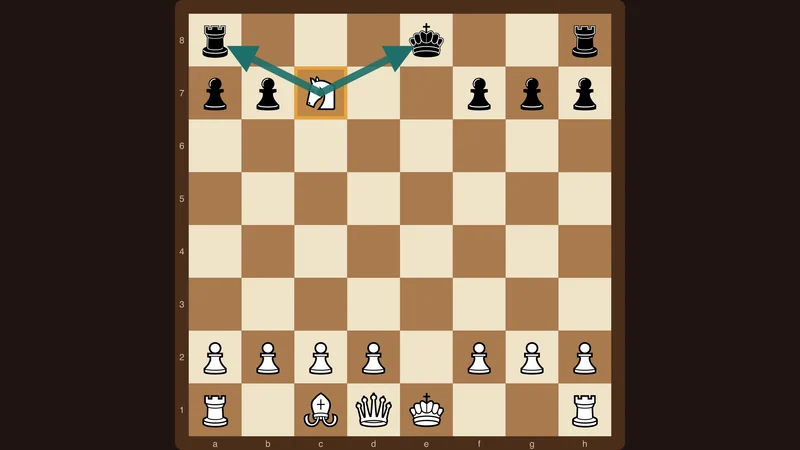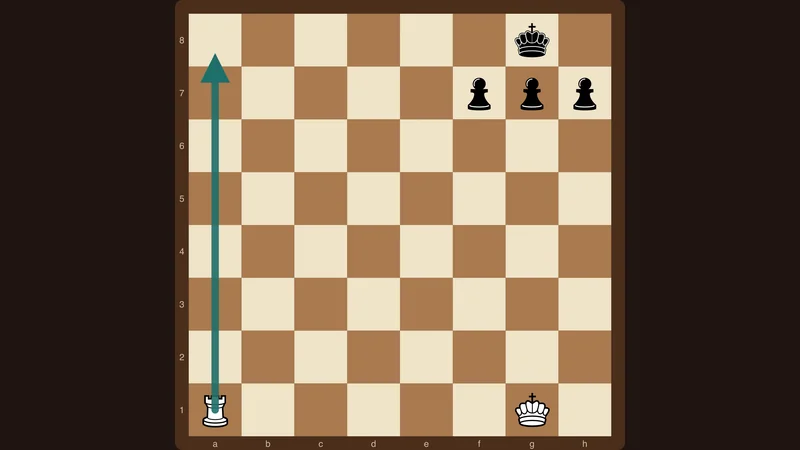
Every chess player remembers games that seemed completely peaceful until a sudden tactic shattered the position. One moment you are developing pieces and arranging pawns; the next moment, your opponent delivers a check or plays a queen maneuver, and an unprotected knight vanishes from the board. You wonder how a simple tactical shot materialized out of thin air.
The truth is that tactics almost never appear out of nowhere. Tactical blows—whether forks, pins, skewers, or discovered attacks—require targets. In practical chess, the most common target is a piece that has no friendly defender standing behind it. Chess players call this a loose piece [1].
When you begin working through structured chess lessons, one of the first strategic truths you discover is that pieces do not operate as isolated soldiers. They belong to an interconnected army. When a piece steps forward without a pawn or fellow piece guarding its square, it becomes a point of tactical vulnerability. Even if no enemy piece attacks it on this move, the stage is set for disaster on the next.
What is a loose piece in chess?
In standard chess terminology, a loose piece is any piece or pawn that has no friendly unit defending it [1]. If a black bishop stands on c5 and no black pawn on d6 or b6 guards it, and no friendly knight, rook, queen, or king can recapture on c5, that bishop is loose.
A piece can be loose even when it stands on an empty sector of the board where no opponent piece seems near. Beginners often assume that if an opponent piece is three squares away and looking in the opposite direction, their own piece is safe. But chess is a game of rapid geometric shifts. A queen can cross five squares in a single move. A knight can hop into a fork. A long-range rook can unmask along an open file.
Consider the physical reality of the chessboard. When your pieces are defended by pawns, an opponent cannot capture them without losing material of equal or greater value. A knight defended by a pawn on e4 demands a sacrifice to remove. But an undefended knight on e4 can be captured without any immediate material cost to the opponent, provided the opponent can orchestrate an attack that you cannot parry in time.
Recognizing loose pieces is the foundation of practical tactical vision. Before calculating five moves ahead, strong players scan the board for tactical geometry. They look for undefended pieces in their opponent’s camp to attack, and they look for undefended pieces in their own camp to protect or coordinate [2].
Loose vs. hanging: what is the technical difference?
While casual players often use the words interchangeably, chess literature maintains a clear technical distinction between a loose piece and a hanging piece [1]:
- A loose piece is undefended, but it is not under immediate enemy attack. It sits quietly on the board, seemingly comfortable, but structurally exposed.
- A hanging piece is undefended (or inadequately defended) and actively under attack by an enemy piece. In classic chess terminology, a hanging piece is described by the French term en prise, meaning it can be captured immediately for a material profit [1].
In other words, a hanging piece is an active fire that must be put out right now. A loose piece is a dry leaf waiting for a spark. Every hanging piece was usually a loose piece just one move earlier. When an opponent spots your loose piece and directs an attack toward it, that loose piece instantly becomes a hanging piece.
Understanding this progression transforms how you evaluate positions. If you only look for pieces that are currently hanging, you are reacting after the damage is already done. If you train your eyes to spot loose pieces, you identify dangers before your opponent can exploit them.
Why Grandmaster John Nunn coined LPDO: “Loose pieces drop off”
The most famous modern guideline regarding unprotected pieces comes from English Grandmaster John Nunn. In his 1998 classic manual Secrets of Practical Chess, Nunn formulated a memorable maxim that has become a staple of chess coaching worldwide: “Loose Pieces Drop Off,” commonly abbreviated as LPDO [3].
Nunn was not writing about abstract grandmaster aesthetics; he was addressing practical, competitive play. After analyzing thousands of games across all skill levels, Nunn pointed out that the overwhelming majority of tactical blunders do not come from intricate twenty-move combinations. Instead, players lose games because unguarded pieces simply “drop off” the board [3].
When a piece has no protection, any double threat, deflection, or clearance sacrifice becomes instantly lethal. In master games, players rarely hang a piece in one move to a direct capture. But grandmasters still lose pieces to LPDO when unexpected tactical sequences open up lines toward undefended units. If even world-class masters suffer from the perils of loose pieces, players in club games and online blitz are exponentially more vulnerable.
The beauty of Nunn’s LPDO rule lies in its practical simplicity. You do not need an advanced opening repertoire or an encyclopedic memory to apply it. You only need the discipline to ask a single question before you touch a piece: “Does this move leave anything loose, or does it punish something loose in my opponent’s position?”
How double attacks and forks punish multiple loose pieces
Why do loose pieces drop off with such relentless regularity? The primary tactical mechanism is the double attack, most commonly realized as a fork [3].
Under the rules of chess, a player can only make one move at a time. If you have a single loose piece on the board and your opponent attacks it with one piece, you can almost always defend it, retreat it, or counterattack. You have one problem, and you have one move to solve it.
The danger escalates dramatically when you have two loose pieces on the board at the same time [3]. When two friendly pieces stand unguarded, an enemy piece can move to a square that attacks both simultaneously. This is the classic double attack. Because you can only move one piece per turn, you can save one unit, but the second loose piece drops off into your opponent’s hands [3].
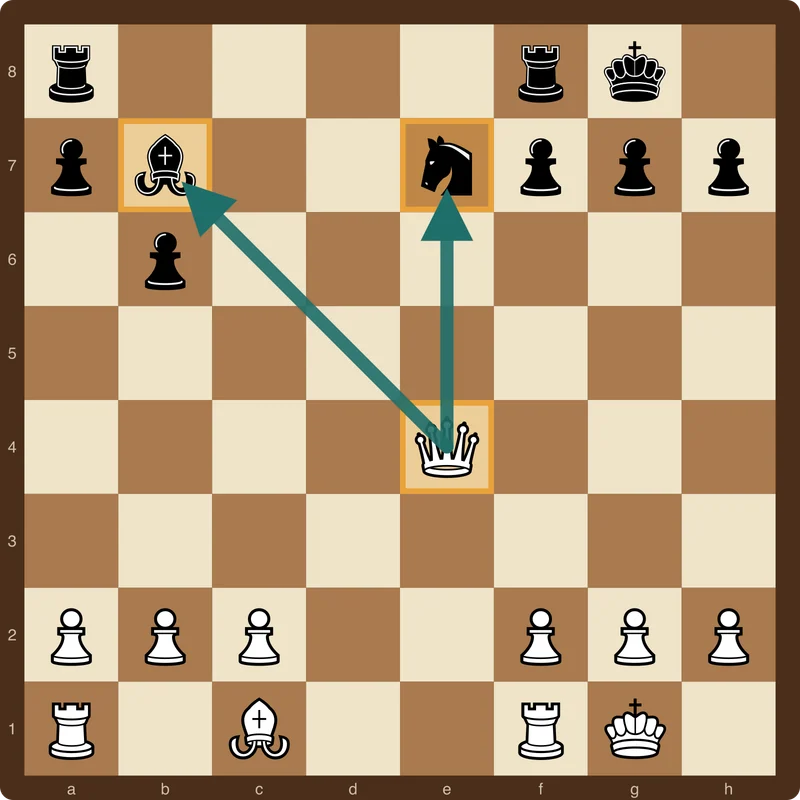
In the diagram above, look at how the queen exploits two loose minor pieces. Black has placed a bishop on b7 and a knight on e7. Neither piece is defended by a friendly pawn or rook. White spots the vulnerability and plays the central queen thrust Qe4.
Notice what happens:
- The white queen attacks the black bishop on b7 along the long diagonal.
- Simultaneously, the white queen attacks the black knight on e7 along the e-file.
- Black can defend one piece or move one piece away, but Black cannot protect both. One of Black’s minor pieces drops off on the next turn.
This scenario plays out in hundreds of thousands of amateur chess games every day. A player develops a bishop to a natural-looking square and hops a knight toward the center, feeling pleased with their active layout. But because neither piece is anchored into a solid chain of pawns or backed up by a rook, a single queen hop decides the game on the spot.
Forks by knights are equally deadly against loose pieces. Knights thrive on jumping over pawns and landing on central outposts. If your rooks or bishops sit on uncoordinated, unprotected squares, an enemy knight can leap into a fork, leaving you helpless to save both units. If you enjoy sharpening your tactical vision for these motifs, solving daily chess puzzles will help you spot these geometric alignments in seconds.
Discovered attacks: when moving with tempo unmasks a loose piece
A second tactical motif that regularly claims loose pieces is the discovered attack. In a discovered attack, one piece moves out of the way, unmasking an attack from a friendly rook, bishop, or queen standing behind it.
When the target of a discovered attack is well-defended, the tactic rarely wins material because the target piece simply exchanges itself or sits securely. But when the target is loose, a discovered attack becomes devastating.
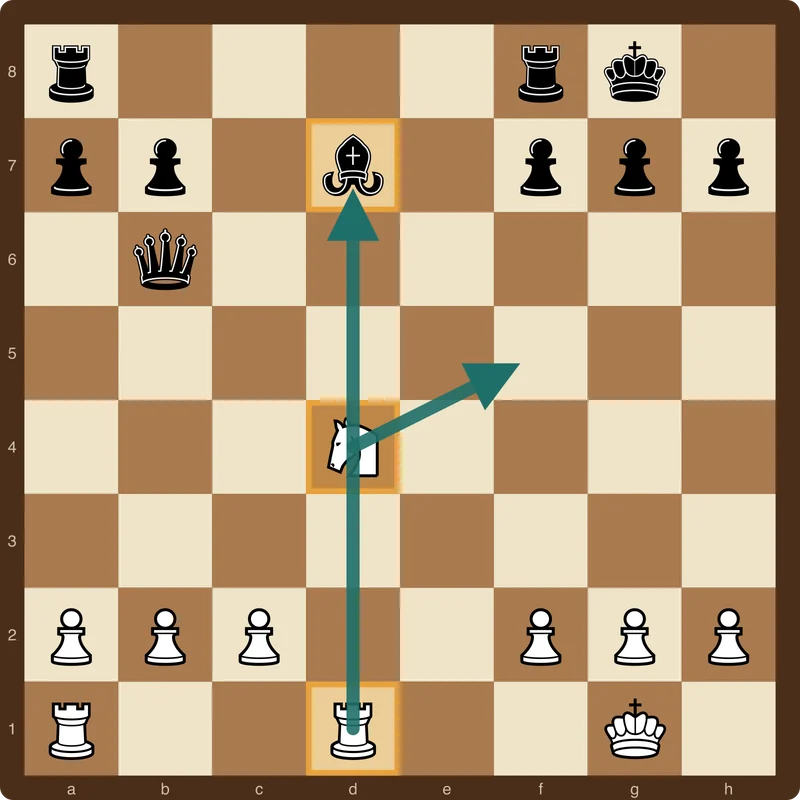
Look at the position shown in the second diagram. White has a rook positioned on the open d-file at d1. Standing directly in front of the rook is White’s knight on d4. Further up the d-file sits Black’s bishop on d7.
Notice the status of Black’s bishop: it has no pawn guarding it, and no friendly rook or knight defends it from behind. The bishop on d7 is completely loose.
White can now launch the discovered attack by moving the knight on d4 away with tempo:
- If White plays Nf5, the knight leaps into an aggressive attacking outpost.
- As the knight vacates the d4-square, the white rook on d1 suddenly has a clear line of sight directly to Black’s unprotected bishop on d7.
- Because Black must react to White’s active knight threats, Black has no time to save the undefended bishop, and the loose piece drops off.
The lesson here is profound: a piece that appears completely safe on move 15 can be captured on move 16 if an intervening piece leaves its square with check or a serious threat. Unprotected pieces invite your opponent to calculate aggressive discovered maneuvers that would otherwise be impossible.
To see how these concepts connect with classic tactical weapons, you can read our guide on forks, pins, and skewers in chess, which explores how alignment and geometry dictate piece survival.
José Raúl Capablanca on piece coordination and counting defenders
Long before John Nunn coined LPDO, the importance of keeping pieces coordinated and defended was a cornerstone of classical chess mastery. The third World Chess Champion, José Raúl Capablanca, was renowned for playing games of seemingly effortless clarity. He rarely suffered tactical surprises because his pieces were always harmoniously supported.
In his foundational 1921 treatise Chess Fundamentals, Capablanca devoted considerable attention to the mechanics of piece defense and pawn support [4]. Capablanca warned that leaving units unprotected creates structural liabilities that force your remaining pieces into passive, defensive roles.
Capablanca articulated a fundamental rule of piece calculation: every time a piece is exchanged or a pawn moves forward, the count of attackers and defenders changes completely [4]. As Capablanca wrote in 1921: “However, every time a piece is exchanged or a Pawn advanced the counting must begin afresh” [4].
Many players suffer from tactical blindness because they rely on an outdated mental snapshot of the board. They remember that their bishop on c5 was defended when it arrived on move 8. But on move 12, they pushed a pawn or traded a knight, inadvertently removing the piece that provided that defense. Suddenly, the bishop became loose, and two moves later it was gone.
Capablanca’s teaching emphasizes active vigilance:
- Pawn protection is superior to piece protection: A piece defended by a pawn is rock solid because an opponent cannot trade an equal piece without suffering a loss.
- Mutual defense prevents paralysis: When your minor pieces protect one another or lean on pawns, your heavier pieces—rooks and queens—are free to attack rather than babysit undefended pawns.
- Recount after every exchange: Never assume a square is safe simply because it was safe on the previous move.
When you play chess online, watching for these defensive shifts in your opponent’s layout gives you immediate targets to probe and exploit.
The two-step blunder check for club players under 1500
For club players, casual hobbyists, and anyone striving to break through the 1500 rating barrier, eliminating blunders is the single fastest way to gain rating points [2]. You do not need to memorize deep opening theory in the Sicilian or calculate endgame tablebases to win games at this level. You simply need to stop losing pieces to LPDO.
To put John Nunn’s maxim into daily practice, adopt this reliable two-step mental check before confirming any move on the board [2]:
Step 1: The Defensive Scan (Check Your Own Camp)
Before you play your intended candidate move, pause for three seconds and examine the consequences of that move on your existing pieces:
- “Does my move leave the piece I just touched unprotected on its destination square?”
- “Does moving this piece abandon another friendly piece that previously relied on its protection?”
- “Are all my pieces and pawns either guarded or completely safe from immediate enemy checks and forks?”
If your intended move leaves a piece loose, look for an alternative that maintains coordination, or calculate whether your opponent can punish that loose piece with an immediate double attack.
Step 2: The Offensive Scan (Check Your Opponent’s Camp)
As soon as your opponent completes their move, immediately scan their side of the board:
- “Did my opponent’s last move leave a piece or pawn undefended?”
- “Did their moving piece walk away from guarding another unit?”
- “Can I attack two of their loose pieces simultaneously with my queen, knight, or rook?”
By executing this two-step check on every single turn, you develop what masters call tactical radar [2]. Instead of wandering aimlessly across the board, your eyes immediately zero in on the exact squares where tactics are most likely to occur.
To see how solid defensive habits translate into late-game mastery, explore our breakdown of the two rook endgames every player needs or review our practical advice on how to practice chess with puzzles.
Questions people ask about loose pieces in chess
What does LPDO stand for in chess?
LPDO stands for “Loose Pieces Drop Off.” It is a popular chess rule of thumb coined by Grandmaster John Nunn in his 1998 book Secrets of Practical Chess [3]. It reminds players that pieces without friendly protection are inherently vulnerable to tactical double attacks and will frequently be captured.
Is an undefended piece always a mistake?
Not always, but it is always an inherent risk. In complex tactical positions, grandmasters sometimes deliberately leave a piece loose to set a trap, accelerate an attack on the enemy king, or create a tactical deflection. However, for players under 1500, uncoordinated loose pieces are almost always the product of inattention rather than deep calculation. As a general rule, keep your pieces defended unless you have calculated a concrete, forced sequence.
How do I stop hanging pieces in blitz chess?
In faster time controls, players hang pieces because they move impulsively on intuition rather than checking safety. The antidote is cultivating the habit of looking at piece defense as part of your natural move selection. Before playing any move in blitz, spend one split second verifying that your destination square is protected and that you are not unguarding a piece behind you.
What is the easiest way to exploit an opponent’s loose piece?
Look for double attacks. The most devastating tactical weapon against a loose piece is a move that threatens something major—such as delivering a check to the enemy king or attacking the enemy queen—while simultaneously creating a second line of attack toward the undefended piece. Because your opponent must resolve the primary threat to their king or queen, they cannot save the loose piece, and it drops off.
Sources
- Wikipedia. “Glossary of chess: Loose piece and hanging piece.”
- Boardgammon. “Chess lessons: Learn to play chess from the first move.”
- Nunn, J. (1998). Secrets of Practical Chess. London: Gambit Publications. ISBN: 978-1901983012.
- Capablanca, J. R. (1921). Chess Fundamentals. London: Harcourt, Brace and Company.
- Boardgammon. “Chess puzzles: Tactics puzzles and tactical motifs.”
- Boardgammon. “Chess Moment: Play rated chess online.”
Found a mistake or an odd phrase? Tell us