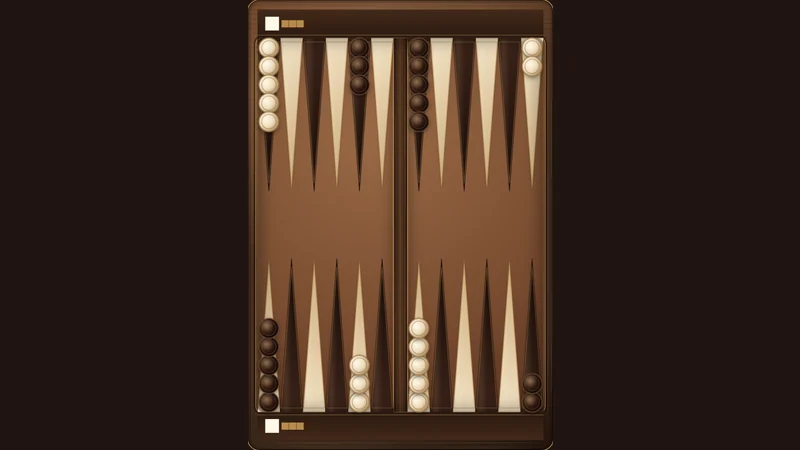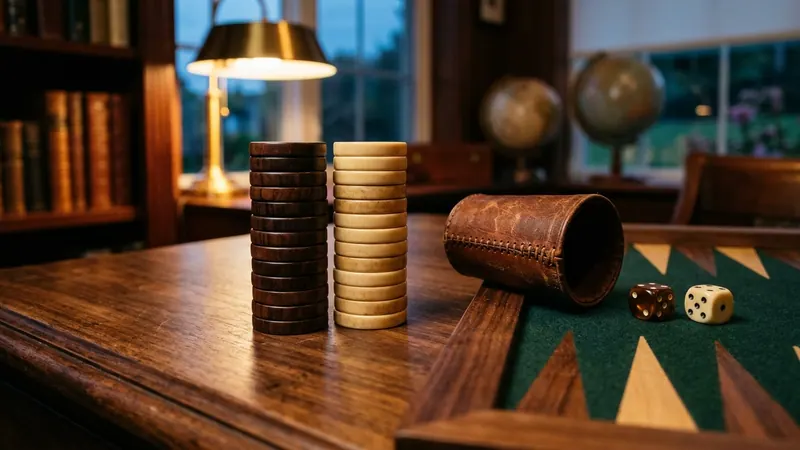
How divisions, brackets, and match lengths work
A tournament ballroom full of ticking clocks and wooden dice towers looks calm from the doorway, yet over-the-board competition puts real physiological strain on players: in a 2009 study of 20 male chess competitors, average heart rates rose from 75 to 86 beats per minute under sympathetic nervous activation without anyone leaving their chair[1]. That intensity can feel daunting to a first-timer, which is why organized backgammon tournaments do not seat a newcomer across from a world champion[2]. Entrants register by skill division, called a flight.
Nearly every weekend tournament offers three main flights: Championship (or Open), Intermediate, and Beginner or Novice[3]. Under U.S. Backgammon Federation (USBGF) and World Backgammon Federation (WBGF) rules, Tournament Directors may bar experienced players from lower divisions so Intermediate and Novice brackets stay fair for club players and first-timers[3]. Around the main singles events, schedules include Consulting Doubles (two partners sharing one side of the board), Speedgammon, Seniors, Women’s, and Team tournaments[2][3].
Three bracket formats prevent a cold hour of dice from ending a trip early:
- Single-elimination main bracket with consolation and Last Chance. Losing in the main knockout draw drops you automatically into a consolation flight—often progressive consolation, where players eliminated in later main rounds enter later consolation rounds, or double-elimination consolation—plus a final-day Last Chance bracket[2][3].
- Double-elimination brackets. Every entrant remains in contention until losing twice[3].
- Swiss formats. Used in clubs, national qualifiers, and online events, a Swiss tournament runs five to nine fixed rounds where nobody is eliminated and each round pairs players on matching win-loss records[3].
Every pairing is a match to a fixed point target. Novice brackets, club nights, and consolation flights usually play to 5, 7, or 9 points[3]. Regional tours, such as the 25 to 30 annual stops of the American Backgammon Tour, typically run 11 to 17 points, while the World Championship starts at 13 points in early rounds and reaches 21, 23, or 25 points in major finals[2]. As Peter Duersch, Marco Lambrecht, and Joerg Oechssler showed in a 2020 European Economic Review analysis of skill and chance across games, playing longer multi-game matches steadily compresses single-game dice luck so strategic skill determines who advances[4]. If you have wondered whether backgammon is luck or skill, match length is the organizer’s lever.
Tournament match play vs. money games and chouettes
Traditional coffeehouse games across the Mediterranean and Middle East typically omit clocks and doubling cubes: Greek tavli rotates three-game sets of Portes, Plakoto, and Fevga without a cube, while Persian takhteh-nard, Arabic tawlet al-zahr (mahbousa and tawlet 31), Israeli shesh-besh, and Russian long nardy play cube-free races[5]. Turkish clubs distinguish traditional geleneksel tavla from modern tavla, which adopts the clock, doubling cube, and baffle box (zar atma aparatı) alongside Russian short nardy (korotkie nardy)[5]. International tournaments everywhere standardize on Western 24-point match play: 15 checkers per side (30 total), 167 starting pips per player, and a doubling cube marked 2, 4, 8, 16, 32, 64[6].
Tournament match scoring centers on the Crawford rule. When either player first reaches 1 point away from the match target, the doubling cube is removed for one game: the Crawford game[6]. If the trailing player wins that game, all remaining games are Post-Crawford and the cube returns to play, allowing the trailer to double at the first legal turn[6]. Any cube already high enough to win the match for its holder on a single win is a dead cube and cannot be turned further.
Meanwhile, four common money-play rules are never used in tournament matches[6][3]:
- No Jacoby rule. Money sessions often score gammons and backgammons as 1 point unless the cube was turned; in tournament matches, gammons always score double and backgammons triple, even on an unturned cube or in the Crawford game.
- No beavers. A doubled player must take or pass; immediately redoubling to 4 while keeping the cube (a beaver) is forbidden.
- No raccoons. Because beavers are barred, the original doubler cannot immediately re-redouble a beaver to 8 while leaving the cube with the opponent (a raccoon).
- No automatic doubles. Tied opening rolls keep the stake at 1 and both players reroll.
After tournament rounds finish for the evening, money scoring returns in hotel lounges through the chouette[7]. Three or more players share one board: one Box plays alone against a Captain and consulting team, usually with individual doubling cubes for each team member and seats rotating after every game[7].
| Feature | Sanctioned tournament match | Money session or chouette |
|---|---|---|
| Players | 2 players (or 2-on-2 in Consulting Doubles) | 2 head-to-head, or 3+ in a chouette (1 Box vs. Captain and team) |
| Target | Fixed match target (commonly 5–25 points) | Open-ended session scored per point |
| Crawford rule | Mandatory for 1 game at 1-away | Never used |
| Jacoby rule | Never used; gammons always count full 2× | Common by prior agreement |
| Beavers, raccoons, automatic doubles | Prohibited | Permitted by prior agreement |
| Clock and shared dice | Standard (1 clock, 2 shared dice) | Rare; 4 dice (2 per player) |
How tournament clocks, table rules, and Legal Moves work
Under the WBGF and USBGF Tournament Rules effective January 2025—written with identical intent and interpretation—clocked matches give each player a match-long reserve bank plus a per-move delay[3]:
- Championship: 2 minutes of reserve per match point plus a 12-second delay per move (allowed range: 1.5 to 2.5 minutes per point and 12 seconds)[3]. At 2 minutes per point, each player starts with 10 minutes in a 5-point match, 14 minutes in 7 points, 18 minutes in 9 points, 22 minutes in 11 points, 26 minutes in 13 points, and 50 minutes in a 25-point final[3].
- Intermediate and Novice: 2 minutes per point plus a 15-second delay (allowed range: 2 to 3 minutes per point and 12 to 15 seconds)[3].
- Consulting Doubles: 3 minutes per point plus a 15-second delay (allowed range: 2.5 to 3.5 minutes per point and 15 to 18 seconds)[3].
Clocks run on either Simple Delay or Bronstein Delay (named after chess grandmaster David Bronstein), which are mathematically identical[3][8]. Simple Delay waits 12 seconds before starting your reserve clock; Bronstein Delay starts immediately and refunds up to 12 seconds spent when you hit the button[8]. On both settings, a 5-second play costs 0 seconds of reserve, a 30-second decision costs 18 seconds (30 minus 12), and fast moves never add time above your starting bank[3]. Reaching 0:00 loses the match unless you can already validly claim the game and match[3].
Five table procedures govern physical play[3]:
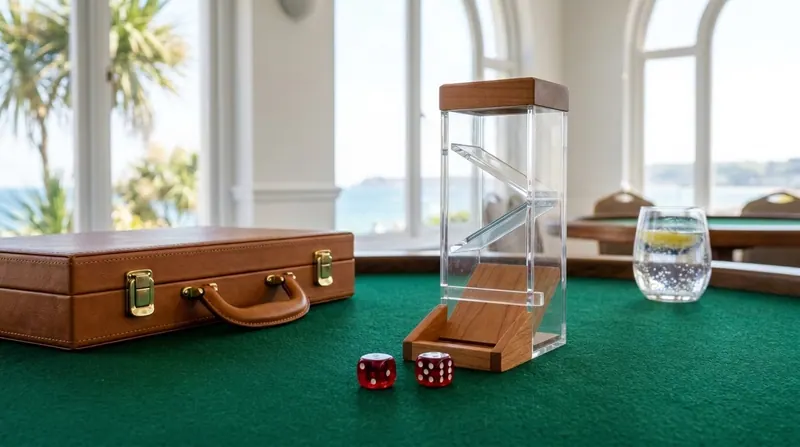
- Setup and shared dice. Checkers measure 37 to 50 millimeters (1.5 to 2.0 inches) across. In any clocked match, both players share two dice (mixed beforehand by rolling all four dice and alternating picks of one die each). The clock sits on the home-board side, and any baffle box sits on the non-home-board (outer-board) side.
- Valid rolls. With cups, shake vigorously at least twice up and down and roll onto the right-hand side of the bar; with a baffle box, drop both dice together cleanly. If either die is cocked, leans on a checker or rail, balances on an edge, lands on the wrong side, or wedges between checkers, both dice are rerolled.
- One-hand rule. Move checkers and press the clock with one and the same hand throughout the turn, keep borne-off checkers clear of the playing surface, and hit the clock even when closed out with no legal move.
- Fast grabs, premature rolls, and cube touch. Lifting the dice before your opponent presses the clock (a fast grab) lets your opponent pause the clock or forfeit your delay; rolling before their turn ends (a premature roll) lets them decide whether your roll stands or must be rerolled. When weighing when to double in backgammon, reaching toward the cube does not commit you, but touching the cube without first announcing an adjustment obligates you to double.
- Breaks, scorecards, and appeals. Each player receives 5-minute breaks between games equal to match length divided by 6, rounded down (none in 5-point matches, one in 7–11, two in 13–17, three in 19–23, and four in 25, plus 5 minutes between matches). Lateness costs 1 penalty point per 5 minutes, forfeiting above 50% of the match length. Both players keep written scorecards: a sole written scorecard governs, and if two written scorecards conflict, the trailing player’s scorecard prevails. Any Tournament Director ruling may be appealed to a Ruling Committee of three or five impartial players.
Unless Responsible Moves was announced before the event, Legal Moves is the default rule: both players must point out any illegal checker move and restore the position to be played legally if caught before the next valid roll[3]. Combined with the rule in the rules of backgammon that you must play both dice whenever possible (and must play the higher number if either die works alone, never both), Legal Moves creates a classic tournament trap[6].
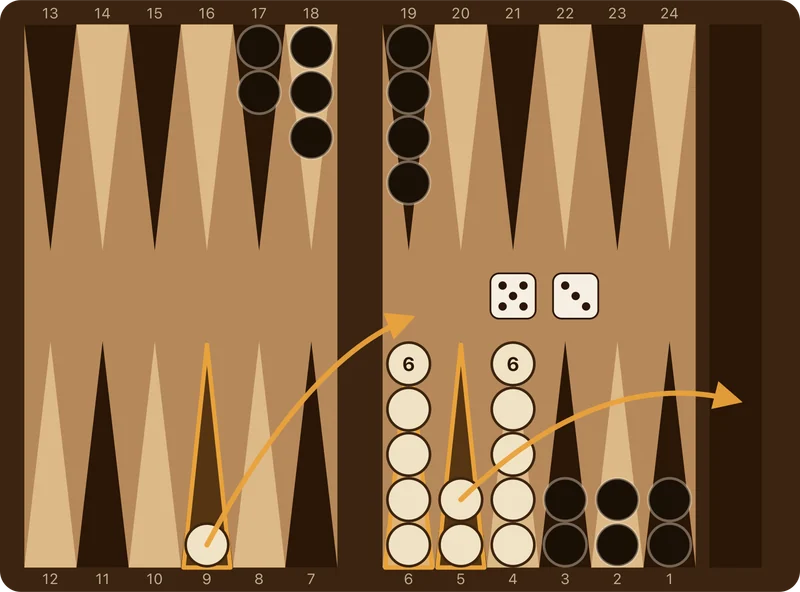
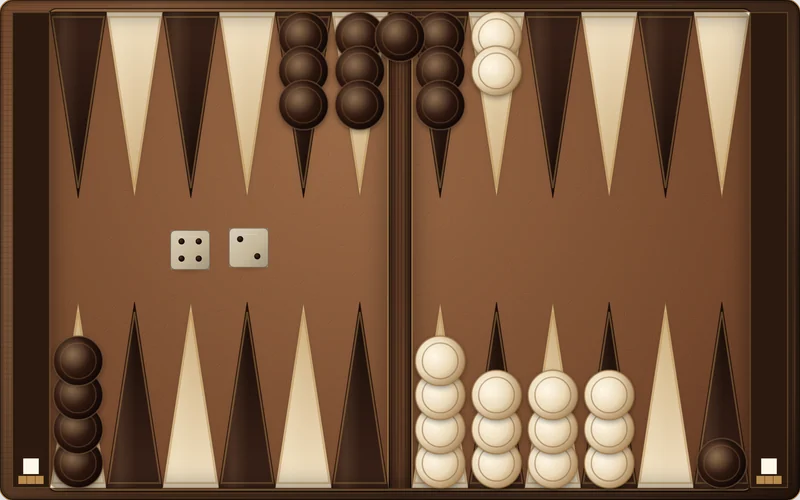
In the diagram above, White rolls 5-3[9]. White holds 15 checkers: 1 on the 9-point, 6 on the 6-point, 2 on the 5-point, and 6 on the 4-point. Black’s 15 checkers hold two-checker anchors on White’s 3-, 2-, and 1-points, plus 4 on the 19-point, 3 on the 18-point, and 2 on the 17-point. Playing the 5 first via 9/4 leaves zero blots and no legal 3s, since Black blocks points 3, 2, and 1 and over-bearing with a 3 is illegal while points 6, 5, and 4 are occupied.
Yet 9/4 is illegal[9]. Playing the 3 first via 9/6 brings White’s 15th checker into the home board and unlocks 5/off. Because 9/6, 5/off uses both dice, Legal Moves requires correcting 9/4 to 9/6, 5/off before Black rolls, even though bearing off from the 5-point leaves one blot that Black hits on 27 of 36 rolls (75.00%), missing only the nine rolls from 1, 5, and 6 (1-1, 1-5, 5-1, 1-6, 6-1, 5-5, 5-6, 6-5, 6-6, as 1-1 is blocked on point 4)[9].
How match equity changes checker and cube strategy
In money play, every point carries equal weight. In a fixed-target match, points beyond the target add nothing, so tournament players evaluate plays by match-winning probability (match equity), tracked by how many points each player still needs (“away”)[10]. The standard reference is the 2010 Rockwell–Kazaross Match Equity Table (MET), built by Neil Kazaross and David Rockwell from 38,880 computer rollouts per score (19,440 per side on roll) up to 15-away and extrapolated to 25-away[11].
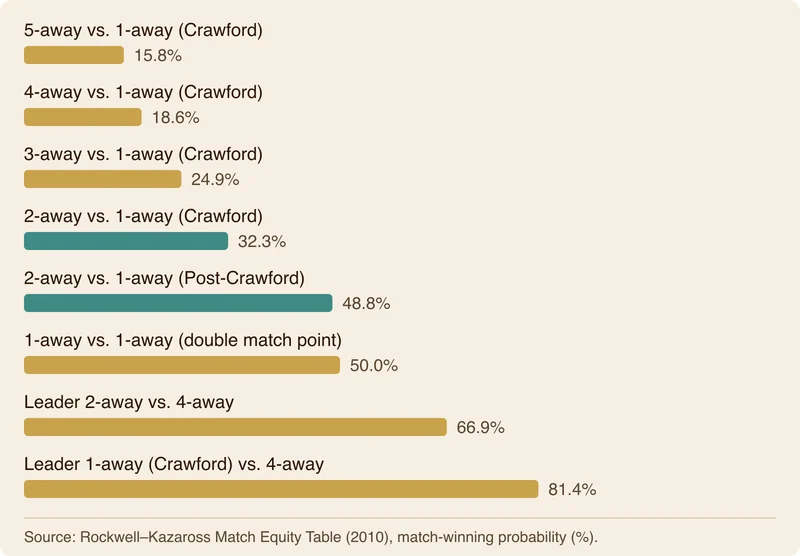
The chart illustrates how sharply match score reshapes backgammon strategy around the Crawford threshold[11]:
- Trailing a 1-away Crawford leader: the trailer holds 15.8% match equity at 5-away, 18.6% at 4-away, 24.9% at 3-away, and 32.3% at 2-away (leader 67.7%).
- The 16.5-point Post-Crawford leap: at 2-away vs. 1-away Post-Crawford, the trailer’s equity jumps 16.5 percentage points to 48.8%, nearly matching 50.0% at 1-away vs. 1-away (double match point, or DMP), because the trailer immediately doubles to 2 on their opening turn.
- Mid-match leads: leading 2-away vs. 3-away stands at 59.9% (vs. 40.1%), 2-away vs. 4-away (5–3 to 7) reaches 66.9% (vs. 33.1%), and 1-away (Crawford) vs. 4-away climbs to 81.4%.
At 2-away, 1-away Crawford—trailing 5–6 in a 7-point match or 9–10 in an 11-point match—gammon math becomes one-sided[9]. Because Black needs just 1 point, losing a gammon costs White no extra equity over a single loss (both end at 0%). Winning a single game ties the match at 50.0%, whereas winning a 2-point gammon wins the match outright (100.0%, a 50.0 percentage-point gain)[9].
In the Crawford position above, White trails 5–6 to 7 and rolls 4-2 with 2 checkers on the 20-point, 4 on the 6-point, 3 on the 5-point, 3 on the 4-point, and 3 on the 3-point (15 total), against Black’s 1 on the bar, 1 blot on the 1-point, 3 on the 19-point, 3 on the 18-point, 3 on the 17-point, and 4 on the 12-point (15 total)[9].
When weighing hitting or building points, quiet 6/2, 4/2 builds a five-point prime (6, 5, 4, 3, 2) but leaves Black’s 1-point checker safe and only one Black checker on the bar. At 2-away, 1-away Crawford, 5/1*, 3/1 is decisive: it also closes five home-board points (leaving only the 2-point open) while trapping two Black checkers on the bar[9]. Black enters both checkers on just 1 of 36 rolls (2-2, 2.78%), fans with zero entering on 25 of 36 rolls (69.44%), and enters one checker on 10 of 36 rolls (27.78%), stranding at least one checker on the bar on 35 of 36 rolls (97.22%) while White brings the 20-point checkers home for a match-winning closeout gammon[9].
From Obolensky’s 1964 Bahamas bracket to Monte Carlo and the world circuit
Modern tournament backgammon began in 1963, when St. Petersburg-born Prince Alexis Obolensky (1915–1986)—co-founder of the International Backgammon Association and Manhattan’s World Backgammon Club, inducted into the Backgammon Hall of Fame in 2018—devised the modern tournament bracket system[12]. In March 1964, Obolensky staged the first major international tournament in the Bahamas[12].

The inaugural World Backgammon Championship followed in Las Vegas in 1967, where Tim Holland won three titles (1967, 1968, and 1971; no tournament ran in 1969–1970)[13]. Oswald Jacoby, co-author with John R. Crawford of the 1970 classic The Backgammon Book[14], won in Las Vegas in 1972, and Carol Crawford became the first woman to capture the Open title in 1973 during that 1967–1974 Las Vegas run[13]. After dual championships ran from 1975 to 1978 in the Bahamas (won in 1978 by Paul Magriel, author of the 1976 book Backgammon[15]) and Europe, promoter Lewis Deyong unified the World Championship in Monte Carlo, Monaco in 1979, drawing 300 to 500 players from 30 or more countries each July[2][13]. Italy’s Luigi Villa won the 1979 crown and that same week played a historic exhibition match against Hans Berliner’s computer program BKG, losing 7–1[2][13].
Since unification, Monte Carlo’s Open champions have traced the game’s spread across four continents[13]. Early winners included Mexico’s Walter Coratella (1980), Lee Genud (1981), two-time American champion Bill Robertie (1983, 1987), Germany’s Michael Meyburg (1991, 1998), Frank Frigo (1994, 2023), Israel’s David Ben-Zion (1995), Sweden’s Jörgen Granstedt (1999, 2001, 2016, tying Holland’s three titles), Katie Scalamandre (2000), and Argentina’s Jorge Pan (2007)[13]. In the modern era, Japan’s Masayuki “Mochy” Mochizuki (2009, 2021), Takumitsu Suzuki (2011), and Akiko Yazawa (2014, 2018) joined champions Nevzat Doğan (2012), Vyacheslav Pryadkin (2013), Ali Cihangir Çetinel (2015), Didier Assaraf (2017), Eli Roymi (2019), and Timo Väätäinen (2025), before the United States’ Petko Kostadinov won the 2026 Open title while fellow American Martha Ghio captured the 2026 Women’s World Championship[13].
Beyond Monte Carlo, major international stops include Copenhagen’s Nordic Open (around 400 Easter entries), twice-yearly North Cyprus festivals, Japan’s JBL tour, the USBGF (founded in 2009) with its 25 to 30 American Backgammon Tour events, and WBIF online national-team competitions[2][13]. Since 2017, the WBGF has also staged rotating Individual and World Team Championships, stopping in Gibraltar (2018, won by Tobias Hellwag), Trier (2021, Stéphane Chenevière), Skopje (2023, David Klausa), Kamena Vourla (2025), and London (2026)[13].
What long tournament days do to the body and attention
Playing three or four long matches in a single day feels exhausting even though both players stay seated. Peer-reviewed studies of chess tournaments and sustained laboratory attention—conducted on chess competitors and visual tasks rather than backgammon players—explain why late-night rounds produce unforced blunders.
In their 2009 European Journal of Applied Physiology study (105(3), 343–349), Nicolas Troubat, Marie-Agnès Fargeas-Gluck, Mikko Tulppo, and Benoit Dugué monitored 20 male chess players during competitive play: heart rate rose from 75 to 86 beats per minute, the low-frequency to high-frequency (LF/HF) heart-rate-variability ratio climbed from 1.3 to 3.0 (sympathetic nervous activation without parasympathetic drop), and respiratory exchange ratio fell from above 0.89 to 0.75 as fuel use shifted from carbohydrate toward lipid oxidation[1]. In a 2024 field study (Applied Psychophysiology and Biofeedback, 49(2), 301–311), Marzieh Dovom and colleagues collected 10 salivary cortisol and mood samples from 14 female chess competitors across a 5-day, 9-round Swiss tournament (with rounds at 9:00 a.m. and 3:00 p.m.)[16]. Resting cortisol on days 1 to 4 ran above baseline measured one week earlier (p = 0.001), post-round cortisol rose on days 2 and 3 (p = 0.001), and winners showed higher cortisol than losers (p = 0.001)[16]. Heavy two-round days also brought higher mood disturbance (p = 0.001), anger (p = 0.009), and tension (p = 0.045) alongside lower vigor (p = 0.001)[16].
Cognitive fatigue erodes executive control over the same window. Maarten Boksem, Theo Meijman, and Monicque Lorist (2005, Cognitive Brain Research, 25(1), 107–116) recorded EEG across three uninterrupted hours of a visual-attention task and found rising theta and lower-alpha power alongside falling N1 and N2b event-related potentials: fatigue weakens goal-directed (top-down) attention and leaves tired players reacting on stimulus-driven (bottom-up) impulse[17]. At the board, that impulse is rushing an illegal 9/4 instead of pausing 10 seconds inside your delay, which is why experienced players step away from the table during their 5-minute breaks.
Keep both scientific limits plain. Troubat et al. (2009) and Dovom et al. (2024) studied chess players and Boksem et al. (2005) tested visual attention; seated sympathetic stress does not replace physical exercise or improve medical health[1]. Likewise, as Giovanni Sala and Fernand Gobet showed in 2017 (Current Directions in Psychological Science, 26(6), 515–520), board-game training builds game-specific decision skill at the board[18]. Board-game practice does not raise general IQ, improve school grades, or prevent dementia or cognitive decline[18].
To practice tournament match play before a live event, you can play backgammon online on Boardgammon in your browser or mobile apps across 11 interface languages[19]. We do not currently run live scheduled multi-round bracket tournaments, so practice happens in individual matches: you can set up 1-, 3-, 5-, 7-, or 11-point games against the computer, in pass-and-play, or in friend challenges, with the doubling cube on and (in multi-point matches) the Crawford rule enabled and Jacoby and beavers off by default[19]. Standard online games also lock in each roll on its own before it is made and show its secret with that roll (see whether online backgammon dice are rigged)[19].
Questions people ask
Can a beginner enter a live backgammon tournament?
Yes. Regional and major festivals run Novice or Beginner flights alongside Intermediate and Championship divisions, and WBGF and USBGF rules let Tournament Directors bar experienced players from lower flights[3]. Novice matches also use shorter targets and a 15-second delay rather than 12 seconds.
What happens if you lose your first tournament match?
One loss rarely ends your weekend. Knockout main events feed first-round losers into consolation or progressive consolation brackets, plus a final-day Last Chance flight and side events like Doubles and Speedgammon[2][3]. In five- to nine-round Swiss events, everyone plays every round.
Does every move drain your reserve time on a backgammon clock?
No. Championship clocks give a 12-second delay per move (15 seconds in lower flights and Doubles)[3]. Under both Simple and Bronstein Delay, finishing inside that window uses 0 seconds of reserve; only extra time—such as 18 seconds on a 30-second decision—reduces your bank.
How are illegal moves handled in a tournament?
Under the default WBGF and USBGF Legal Moves policy, both players must point out any illegal checker play and restore the position to be played legally if noticed before the opponent makes a valid roll[3]. Once the opponent rolls validly, an unnoticed illegal play stands.
Sources
- Troubat, N., Fargeas-Gluck, M.-A., Tulppo, M., & Dugué, B. (2009). “The stress of chess players as a model to study the effects of psychological stimuli on physiological responses: an example of substrate oxidation and heart rate variability in man.” European Journal of Applied Physiology, 105(3), 343–349.
- Boardgammon. “Backgammon Tournaments, Champions & the Hall of Fame.”
- U.S. Backgammon Federation & World Backgammon Federation (2025). U.S. Backgammon Federation Tournament Rules (Effective 1/2025; concise rendition of the WBGF Tournament Rules).
- Duersch, P., Lambrecht, M., & Oechssler, J. (2020). “Measuring skill and chance in games.” European Economic Review, 127, 103508.
- Boardgammon. “Backgammon Variants: Games in the Tables Family.”
- Boardgammon. “Backgammon Rules: Complete Guide to Setup, Movement, Cube & Tournament Etiquette.”
- Wikipedia contributors. “Backgammon chouette.” Wikipedia, The Free Encyclopedia.
- Wikipedia contributors. “Time control.” Wikipedia, The Free Encyclopedia.
- Boardgammon. “Exact 36-roll combinatorics and legal-move verification for 2-away/1-away Crawford gammon-go (5/1*, 3/1) and compulsory both-dice bear-off entry (9/6, 5/off).”
- Boardgammon. “Backgammon Strategy Guide.”
- Kazaross, N., & Rockwell, D. (2010). “The Rockwell-Kazaross Match Equity Table.” Backgammon Galore.
- Wikipedia contributors. “Alexis Obolensky.” Wikipedia, The Free Encyclopedia.
- Wikipedia contributors. “World Backgammon Championship.” Wikipedia, The Free Encyclopedia.
- Jacoby, O., & Crawford, J. R. (1970). The Backgammon Book. New York: Viking Press.
- Magriel, P. (1976). Backgammon. New York: Quadrangle / The New York Times Book Co.
- Dovom, M. M., Fatolahi, H., Nikbin, S., Noktehdan, S. F., Mohabbati, P., Bagheri, P., & Azarbayjani, M. A. (2024). “Effects of Official Chess Competition on Salivary Cortisol and Mood Swings in Adolescent Girls: A Win-Loss Approach.” Applied Psychophysiology and Biofeedback, 49(2), 301–311.
- Boksem, M. A. S., Meijman, T. F., & Lorist, M. M. (2005). “Effects of mental fatigue on attention: An ERP study.” Cognitive Brain Research, 25(1), 107–116.
- Sala, G., & Gobet, F. (2017). “Does Far Transfer Exist? Negative Evidence From Chess, Music, and Working Memory Training.” Current Directions in Psychological Science, 26(6), 515–520.
- Boardgammon. “Play Backgammon Online in Your Browser.”
Found a mistake or an odd phrase? Tell us