When a roll lets you either build a key point or hit an opposing blot, building the point wins more games whenever your home board is still weak. Two or more checkers on a point form a lasting asset: they shelter your builders, block enemy runners, and extend a prime. A loose hit into a home board with only one closed point buys almost nothing, because a checker on the bar re-enters on 35 of the 36 two-dice rolls (97.22%) and fires right back at the blot you left behind [1].
Hitting takes priority once your board can punish bar entry or the position demands immediate contact. Hit first when you already hold three to five closed home-board points, where your opponent’s chance of fanning on the bar climbs from 25% to 69.44%, or when you can hit and cover in one roll. Hitting also comes first when you trail in the pip count and need contact, or when sparing a blot lets your opponent make an anchor or key point [2]. Weighing lasting structure against a single turn of tempo sits at the heart of sound backgammon strategy.
Players have studied that choice for nearly three centuries. In his 1743 London manual A Short Treatise on the Game of Back-Gammon, Edmond Hoyle worked out the 36 outcomes of two dice and urged coffeehouse players to make the 5-point and the 7-point before chasing loose blots [3]. Modern tournament play turns Hoyle’s priorities into clear board checks you can count before touching a checker.
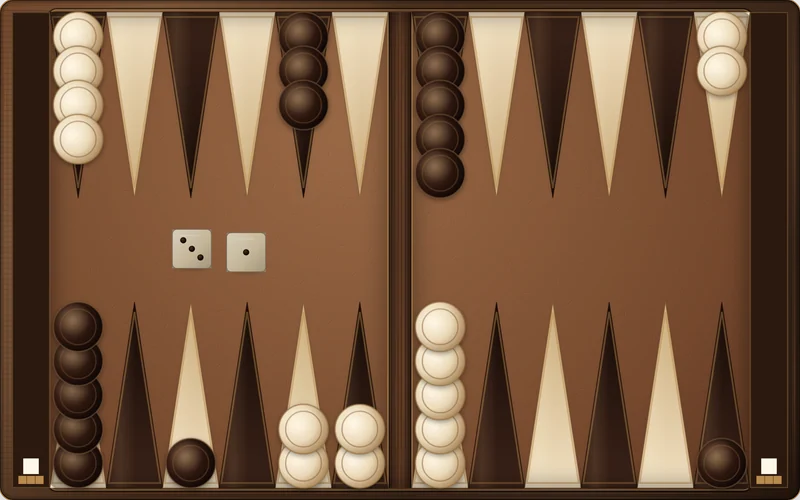
Why does building the 5-point beat a loose hit on roll 3-1?
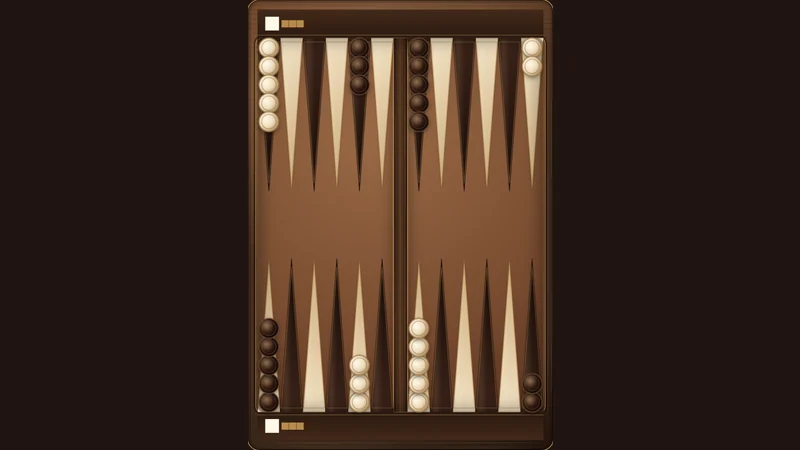
Set up the starting position to see the dilemma in action. Standard backgammon uses 15 checkers per side (30 total) across 24 points in four quadrants of six points each, starting from an equal pip count of 167 [1]. If you want a quick check on point numbering or bar entry, review the rules of backgammon first.
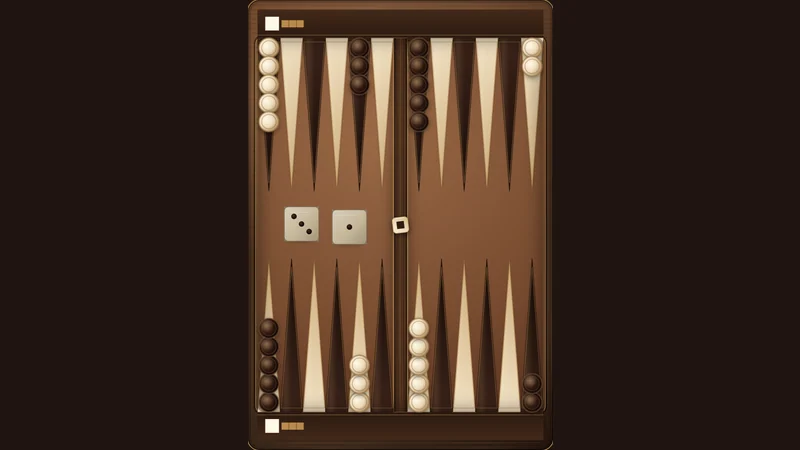
Suppose White opens with 6-1 and plays 13/7, 8/7 to make the 7-point, the bar-point play featured in how to play the opening rolls in backgammon. Black replies with 6-3 and runs one back checker 24/15 in Black’s numbering. From White’s side, that checker steps 1/4/10 through the open 4-point (because White’s 7-point blocks 1/7), leaving one Black blot on the 10-point and one back on the 1-point [2].
Now White rolls 3-1. Many players reach straight for Black’s blot on the 10-point, sitting three pips ahead of White’s 13-point stack. Compare the three candidates [2]:
- Build the golden point (
8/5, 6/5). White moves one checker from the 8-point and one from the 6-point to make the 5-point. That completes a three-point prime across the 7-point, 6-point, and 5-point with zero exposed blots. - Hit loose in the outfield (
13/10*/9). White hits on the 10-point and steps to the 9-point. Black loses only 10 pips and re-enters from the bar on 35 of 36 rolls (97.22%) against White’s lone closed 6-point. Meanwhile, White leaves the golden 5-point unmade, strips a builder from the 13-point, and exposes a blot on the 9-point to indirect return combinations from the bar and the 1-point. - Hit and slot (
13/10*, 6/5). White hits on the 10-point and drops a single blot onto the 5-point. Putting Black on the bar gives Black 11 rolls out of 36 (30.56%, every roll with a 5) to enter directly on White’s 5-point, handing White a 20-pip setback from the 5-point to the bar.
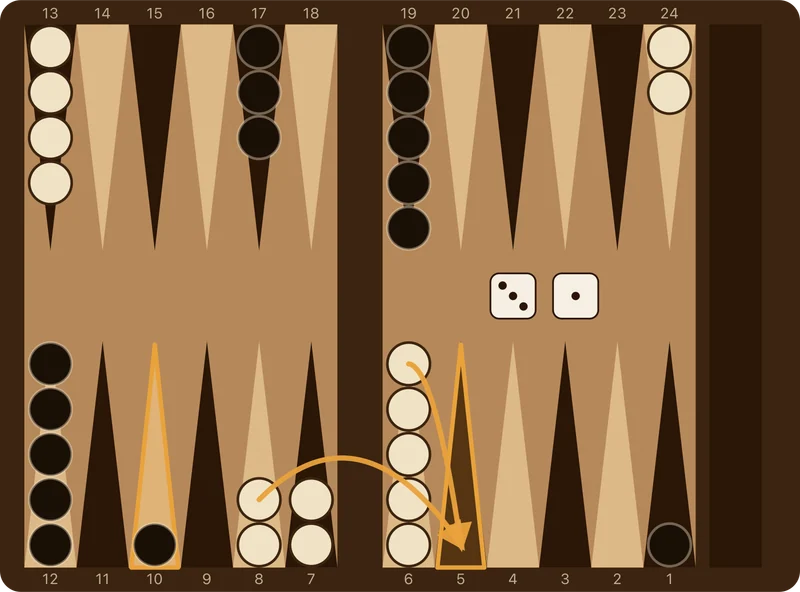
Playing 8/5, 6/5 wins by a wide margin. Black’s 10-point blot poses no inner-board threat, and sending it to the bar against a one-point board merely recycles an enemy checker back into your home quadrant, where Black would gladly anchor on your 5-point. Making the 5-point secures the best point on the board and traps Black’s remaining back checker on the 1-point behind a three-point prime.
What are the exact odds of getting hit at every distance?
Every slotting and hitting calculation starts with two six-sided dice. A roll produces 36 ordered outcomes (21 distinct rolls): 30 mixed rolls averaging seven pips (210 pips total) and six doubles played four times each (4, 8, 12, 16, 20, and 24 pips, or 84 pips total). Together those 36 outcomes move 294 pips, for an average roll of 8.17 pips [1].
Any single number from 1 to 6 appears on 11 of the 36 rolls (30.56%) and misses on 25 rolls (69.44%). Within six pips on an open board, your opponent hits with both single-die numbers and two-dice combinations [2]:
| Distance (pips) | Hitting rolls (out of 36) | Hit probability | How the dice reach the blot |
|---|---|---|---|
| 1 | 11 | 30.56% | Direct: 11 rolls with a 1 |
| 2 | 12 | 33.33% | Direct: 11 rolls with a 2, plus 1-1 |
| 3 | 14 | 38.89% | Direct: 11 rolls with a 3, plus 2-1, 1-2, 1-1 |
| 4 | 15 | 41.67% | Direct: 11 rolls with a 4, plus 3-1, 1-3, 2-2, 1-1 |
| 5 | 15 | 41.67% | Direct: 11 rolls with a 5, plus 4-1, 1-4, 3-2, 2-3 |
| 6 | 17 | 47.22% | Direct peak: 11 rolls with a 6, plus 5-1, 1-5, 4-2, 2-4, 3-3, 2-2 |
| 7 | 6 | 16.67% | Indirect: 6-1, 1-6, 5-2, 2-5, 4-3, 3-4 |
| 8 | 6 | 16.67% | Indirect: 6-2, 2-6, 5-3, 3-5, 4-4, 2-2 |
| 9 | 5 | 13.89% | Indirect: 6-3, 3-6, 5-4, 4-5, 3-3 |
| 10 | 3 | 8.33% | Indirect: 6-4, 4-6, 5-5 |
| 11 | 2 | 5.56% | Indirect: 6-5, 5-6 |
| 12 | 3 | 8.33% | Indirect doubles: 6-6, 4-4, 3-3 |
Beyond 12 pips, one checker can hit only with doubles: distances 15, 16, 18, 20, and 24 are each hit on one roll in 36 (2.78%), while distances 13, 14, 17, 19, 21, 22, and 23 carry 0% single-checker risk [2]. Notice that 12 pips (three rolls, 8.33%) is slightly more dangerous than 11 pips (two rolls, 5.56%) because 6-6, 4-4, and 3-3 all land on 12.
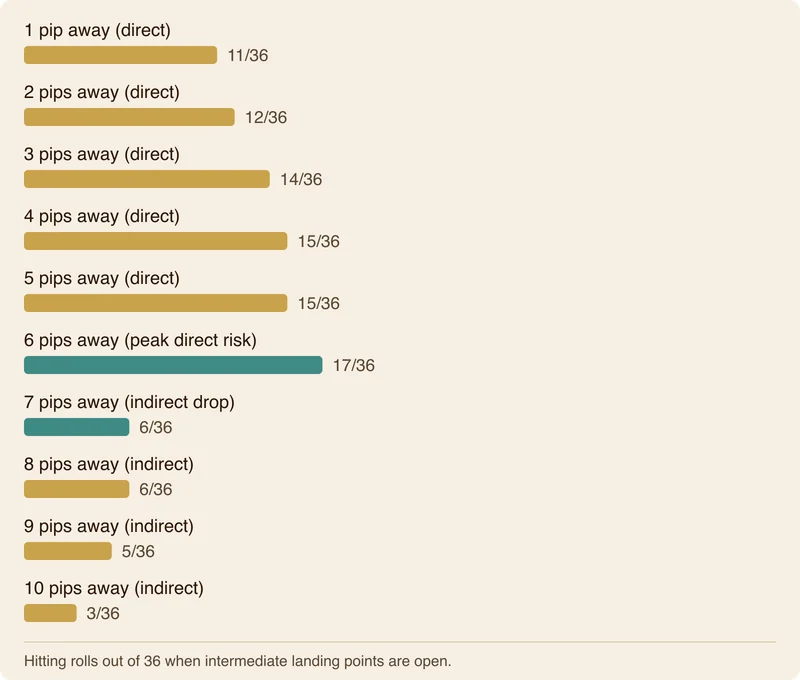
The steepest cliff on the board falls between six pips and seven pips. At six pips, an open blot is hit 17 times in 36 (47.22%, missing 19 times, or 52.78%). One pip farther out at seven pips, no single die can reach it, and risk drops by 11 rolls (30.56 percentage points) to six of 36 (16.67%) [2].
Over the board, three benchmarks anchor quick blot counting:
- Six or fewer hitting rolls (16.67% or less): Modest indirect exposure, acceptable for bringing builders into play when your opponent’s board is weak.
- 11 to 17 hitting rolls (30.56% to 47.22%): Direct shots that require clear compensation, such as slotting the 5-point early or escaping a back checker.
- 18 or more hitting rolls (50% or higher): Combined attackers hit your blot at least half the time; avoid this zone unless every safer move collapses your position [2].
How many closed home-board points make a hit hurt?
Shot odds measure your own exposure; bar entry odds measure how hard your hit punishes your opponent. A checker on the bar must enter on points 1–6, and missing entry on both dice is called fanning or dancing (see the backgammon glossary [4]). When k of your six home-board points are closed, a checker on the bar fans on k squared of the 36 rolls [1]:
| Closed points | Open points | Entering rolls (of 36) | Entry rate | Fanning rolls (of 36) | Fanning rate |
|---|---|---|---|---|---|
| 0 | 6 | 36 | 100% | 0 | 0% |
| 1 | 5 | 35 | 97.22% | 1 | 2.78% |
| 2 | 4 | 32 | 88.89% | 4 | 11.11% |
| 3 | 3 | 27 | 75% | 9 | 25% |
| 4 | 2 | 20 | 55.56% | 16 | 44.44% |
| 5 | 1 | 11 | 30.56% | 25 | 69.44% |
| 6 | 0 | 0 | 0% | 36 | 100% |
Against one or two closed points, an opponent on the bar enters 97.22% or 88.89% of the time. As Oswald Jacoby and John R. Crawford stressed in their 1970 classic The Backgammon Book, hitting loose into a one-point or two-point board rarely traps anyone; it puts another enemy checker behind your prime [5].
Once you close three home-board points, fanning reaches 25% (nine of 36 rolls). At four closed points it hits 44.44% (16 of 36), and at five closed points your opponent stays stranded on the bar 69.44% of the time (25 of 36) while you bring up spares for a six-point closeout [1]. That jump explains why strong players build three or four points first, often linking them into a wall as shown in building a priming game in backgammon, before switching to an all-out attack.
How did Edmond Hoyle and Paul Magriel turn style into board checks?
Club players often talk as if safe play and bold play were personality traits. Two landmark books replaced temperament with concrete board geometry.
In 1743, Edmond Hoyle published A Short Treatise on the Game of Back-Gammon for F. Cogan in Fleet Street, London [3]. After listing the 36 dice outcomes, including 25 to 11 odds against hitting at one pip (30.56%) and 19 to 17 against hitting at six pips (47.22%), Hoyle ranked point-building in strict order:
- First: Secure your own 5-point (Cinque Point) or your opponent’s 5-point (your 20-point anchor).
- Second: Secure your 7-point (Barr Point) so enemy back checkers cannot escape with 6-6.
- Third: Secure your 4-point (Quatre Point) inside your home board [3].
Two centuries later, Paul Magriel’s 1976 book Backgammon answered the next question in Chapter 16 (“Safe Play vs. Bold Play”): when should you risk blots to grab those points or hit loose? Magriel laid out six structural criteria [6].
Four board features favor bold play (slotting key points or hitting loose):
- A stronger home board than your opponent. Trading hits favors the side whose inner board causes more bar fans.
- An advanced anchor in your opponent’s home board. Holding the 20-point or 21-point keeps a permanent landing point open from the bar, prevents a closeout, and cuts gammon danger, a core principle of back games and holding games in backgammon.
- Blots inside your opponent’s home board. If your opponent hits you, their own inner-board blots sit exposed to return shots from the bar.
- Three or four of your own checkers back. With extra checkers trapped behind enemy lines, mutual contact and new anchors help you more than a quiet race [6].
Two board features demand safe play (making points cleanly and covering blots):
- A strong opposing home board (three to five closed points). Getting hit costs full turns on the bar and invites a gammon.
- Zero or one opposing checker left back. Once your opponent has escaped their back checkers, they can attack your blots freely without exposing rear stragglers [6].
When should you slot, blitz, duplicate, or hit for tempo?
Hitting and building frequently work together on the same turn. Jacoby and Crawford (1970) [5] and Bill Robertie in Modern Backgammon (2002) [7] detail five tactical tools that bridge the two plans:
- Hit and cover. Hitting an inner-board blot with one die and covering that checker with the second die puts your opponent on the bar and builds a closed point with zero blots left behind.
- Slotting. Dropping a lone checker onto an open 5-point or 4-point prepares to cover it next roll. Slot early when your opponent’s home board holds zero or one closed point and clean point-making rolls are unavailable; avoid slotting when your opponent sits on the bar or holds four closed home-board points [6].
- Tempo hits. Hitting an outfield blot can steal half a roll of initiative even with a modest home board, forcing your opponent to spend one die entering from the bar instead of covering a slotted point or completing a six-point prime that blocks every die from 1 to 6 [7].
- The blitz. With 10 to 12 checkers in the attack zone against a weak opposing board, hitting loose inside your home board launches a blitz aimed at closing four to six points and winning a 2-point gammon (or 3-point backgammon), as covered in when to play for gammons and backgammons [7].
- Duplication. When you must leave blots, place them so your opponent needs the same die number to hit each target or escape a back checker, cutting their effective good rolls [7].
Weigh the pip count and match score before choosing your line. When counting pips to judge the race shows you ahead, build points safely and clear contact; when you trail badly, hold high points and hunt for shots. Score shifts risk too: trailing 2 to 4 in a 5-point match raises the value of a 2-point gammon blitz, while defending a 1-point lead in the Crawford game (see how the Crawford rule changes match strategy) rewards solid point-building [7].
Why do human players fear constructive slots yet chase loose hits?
Even players who know the 36-roll table often play too timidly when ahead, refusing strong early slots, then swing to reckless loose hits right after getting set back. Behavioral economics sheds light on both impulses, provided we state plainly what each study tested and where its evidence stops.
In their 1979 Econometrica paper on prospect theory, Daniel Kahneman and Amos Tversky presented hypothetical monetary gambles to university participants, including samples of 72 and 95 respondents [8]. Offered a sure gain of 3,000 versus an 80% chance at 4,000 (expected value 3,200), 80% of 95 respondents took the sure 3,000. Offered a sure loss of 3,000 versus an 80% chance of losing 4,000, 92% gambled. As they wrote on page 279, losses loom larger than equivalent gains [8]. Their 1992 study with 25 Berkeley and Stanford graduate students (12 men and 13 women) estimated a median loss-aversion ratio of 2.25 and a sensitivity exponent of 0.88 [9].
Neither study tested backgammon players or board-game decisions; both measured hypothetical monetary lotteries in university settings, not move choices over a board. By analogy, though, the pattern fits over-the-board habits closely: slotting the 5-point when comfortable feels like risking an avoidable loss, whereas trailing after a hard hit tempts players to gamble on a low-equity loose hit into a four-point board.
Streaks distort blot math in a second way. In 2005, Rachel Croson and Jacqueline Sundali analyzed 18 hours of July 1998 security video from a Reno, Nevada casino covering 904 roulette spins and 139 players placing 24,131 bets, including 1,604 outside even-money wagers [10]. After streaks of five or more identical outcomes (p < 0.05), and on 85% of 41 outside bets after streaks of six or more (p < 0.01), bettors wagered against the streak (the gambler’s fallacy). Meanwhile, 80% of players (111 of 139) quit immediately after a loss versus 20% (28 of 139) after a win [10].
Casino roulette is a pure-chance game with a 5.26% house edge rather than a strategic board game, so roulette tape does not measure backgammon skill. It does show how stubbornly people expect independent random trials to self-correct. Two backgammon dice have no memory: an open blot six pips away faces a 17 in 36 (47.22%) shot on the next roll whether your opponent just missed five shots in a row or hit five in a row.
Does every game in the backgammon family allow hitting blots?
Hitting single checkers to the bar is what separates standard backgammon—known as Portes (one of the three games of Greek tavli), Russian korotkie nardy (short nardy), Turkish tavla, Hebrew and Arabic shesh-besh, and Persian takhteh-nard—from several close relatives [11]. Under standard rules, one checker is a vulnerable blot and two checkers make a point.
Across other games in the backgammon family, the balance shifts completely. In Greek Plakoto (and Arabic Mahbousa), landing on a lone enemy checker pins it on the point instead of sending it to the bar. In Greek Fevga and Russian dlinnye nardy (long nardy), hitting does not exist at all because even one checker blocks a point [11].
Only in standard backgammon does a single checker invite an instant trip to the bar while a pair forms a wall. Put Hoyle’s point order and Magriel’s six checks to the test on your next early 3-1 when you play backgammon free in your browser.
Sources
- Boardgammon. “Backgammon Rules: Board Setup, Movement, Hitting, and Bearing Off.”
- Boardgammon. “Backgammon Strategy: Game Plans, Opening Rolls, Cube Theory, and Pip Counting.”
- Hoyle, E. (1743). A Short Treatise on the Game of Back-Gammon. Printed for F. Cogan, Fleet-Street, London.
- Boardgammon. “Backgammon Glossary: Blots, Points, Primes, Anchors, and Tempo.”
- Jacoby, O. & Crawford, J. R. (1970). The Backgammon Book. Viking Press, New York.
- Magriel, P. (1976). Backgammon. Quadrangle / The New York Times Book Co., New York.
- Robertie, B. (2002). Modern Backgammon. The Game Grid, Inc., Arlington.
- Kahneman, D. & Tversky, A. (1979). “Prospect Theory: An Analysis of Decision under Risk.” Econometrica, 47(2), 263–291.
- Tversky, A. & Kahneman, D. (1992). “Advances in Prospect Theory: Cumulative Representation of Uncertainty.” Journal of Risk and Uncertainty, 5(4), 297–323.
- Croson, R. & Sundali, J. (2005). “The Gambler’s Fallacy and the Hot Hand: Empirical Data from Casinos.” Journal of Risk and Uncertainty, 30(3), 195–209.
- Boardgammon. “Backgammon Variants: Tavli, Plakoto, Fevga, Nardy, and Regional Rules.”
Found a mistake or an odd phrase? Tell us