
Every backgammon player knows the sting of watching an opponent roll consecutive double sixes to escape an airtight trap and snatch an impossible victory from the jaws of defeat. In those frustrating moments, it is easy to throw your hands up and dismiss backgammon as a glorified lottery where the dice dictate everything and careful planning counts for nothing.
Yet if backgammon were truly a contest of chance, the same grandmasters would not dominate international tournaments year after year, and mathematics professors would not dedicate careers to modeling its branching decisions. To understand the true nature of the game, one must separate the immediate outcome of a single roll from the cumulative power of hundreds of decisions.
Across the spectrum of competitive backgammon skill levels, the data reveals an inescapable truth: dice introduce short-term variance, but player skill commands the long run.
What modern science proves about skill and chance
The debate over chance versus skill in tabletop games is no longer a matter of opinion. In a landmark 2020 empirical study published in the European Economic Review, economists Peter Duersch, Marco Lambrecht, and Joerg Oechssler tackled this question directly [1]. Using large datasets of competitive games, the researchers developed an empirical rating model to measure the precise mathematical boundary where strategic skill overtakes stochastic randomness.
Their findings demonstrated that games sit on a continuous spectrum rather than in rigid categories. While pure chance games like roulette never reward player skill, backgammon occupies a unique position alongside poker and chess. Although a single turn incorporates random dice rolls, the strategic choices available to each player rapidly subordinate the element of chance over repeated trials [1].
The study confirmed what tournament competitors have observed for decades: luck provides the surface noise, but decision quality determines the trajectory of player ratings.
The legal precedent: State of Oregon v. Ted Barr
The question of whether backgammon is a game of skill was put on trial in an American courtroom. In February 1982, in the historic legal case State of Oregon v. Ted Barr, promoter Ted Barr was charged under state anti-gambling statutes for organizing a tournament with entry fees and cash prizes [2]. Under state law, gambling was defined as risking value on a contest of chance.
To defend the legitimacy of the game, the defense called 1978 World Backgammon Champion Paul Magriel to the witness stand as an expert witness [2]. Magriel, a former mathematics professor at the Newark College of Engineering, delivered two hours of rigorous testimony that dissected the mechanics of competitive play.
Magriel demonstrated to the court that when two six-sided dice are rolled, the outcome does not determine where the checkers must go. Instead, a player regularly confronts 30 or more legal move choices on any given turn [2]. Evaluating which move creates optimal board connectivity, minimizes blot vulnerability, and maximizes racing potential requires advanced probability calculation and deep spatial judgment.
Magriel famously testified that deciding where to move your checkers after the dice have been cast is the true essence of the game, and that chance is not a material factor in determining the outcome [2]. Impressed by the mathematical evidence, District Judge Stephen S. Walker officially ruled that backgammon is legally a game of skill rather than a game of chance, acquitting Barr and establishing an enduring legal precedent [2].
Why a single game feels like a coin toss
If backgammon is a game of skill, why can a total beginner occasionally beat a world champion?
The answer lies in the distinction between a single game and a match. In his classic 1976 textbook Backgammon, Paul Magriel mapped out the full probability distribution across all 36 possible outcomes of two six-sided dice [3]. In a single game played to 1 point, short-term dice variance is substantial. If an inexperienced player rolls several lucky doubles while an expert rolls awkward numbers, the novice can win a brief running race without making a single difficult choice.
However, treating backgammon as a 1-point game is like evaluating a tennis match on a single volley. In competitive tournaments, players do not play standalone games; they play matches to 7, 11, 15, or more points.
The mathematics of match length: how variance flattens out
The mathematical relationship between match length and win probability is governed by the Law of Large Numbers. In rating systems modeled on competitive play, an expert’s skill advantage does not remain static; it compounds with the square root of match length [4].
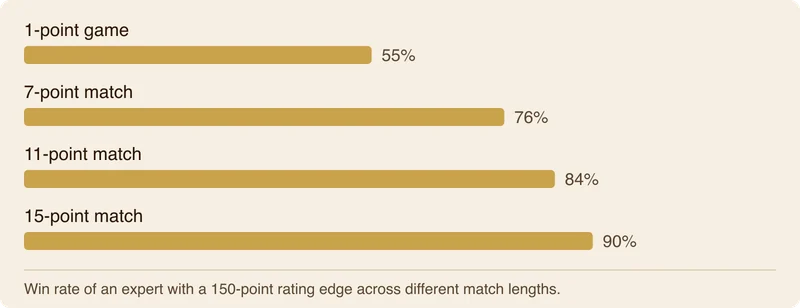
Consider an expert player who holds a 150-point rating advantage over a casual opponent [4]. If they sit down for a single 1-point game, the expert’s expected win rate is approximately 55 percent [4]. The beginner has a 45 percent chance of winning simply because favorable dice can carry a short race before positional mistakes take their toll.
Yet watch what happens when the match length is extended:
- In a 7-point match, the expert’s win probability climbs to 76 percent [4].
- In an 11-point match, the expert’s win rate reaches 84 percent [4].
- In a 15-point match, the expert’s expected win rate surges to 90 percent [4].
By the time two players engage in an extended 15-point contest, the cumulative volume of unforced decisions crushes the influence of random dice. The novice would need miraculous rolls across a dozen consecutive games to overcome the structural errors they commit on every turn. If you want to develop the fundamental habits that separate winners from losers, studying basic backgammon strategy and learning how to evaluate candidate moves is the first step toward consistency.
The doubling cube: how strategic leverage eliminates luck
No single invention has done more to elevate skill over luck than the doubling cube. Introduced in New York clubs during the 1920s, the doubling cube transformed backgammon from a casual race into an economic contest of calculated risk [3].
The doubling cube allows a player who has established a strategic advantage to raise the stakes of the game. Before rolling, a player who believes they hold superior equity can turn the cube to 2, forcing the opponent to make a crucial choice: accept the double and continue playing for double the points, or immediately concede the game and forfeit 1 point [3]. As detailed in our analysis of when to double in backgammon, mastering this choice separates casual players from tournament winners.
This mechanism eliminates the possibility of lucky reversals when one player holds an insurmountable lead. Instead of rolling out endless trivial turns where a freak sequence of rolls might spark an unearned comeback, the skilled player doubles out the opponent, pocketing the victory immediately.
Furthermore, cube decisions require precise mathematical calculation. In a standard running game, the mathematical threshold for accepting a double—known as the take point—is exactly 25 percent winning chances [3]. Why? Because if you drop the cube, you lose exactly 1 point every time. If you accept the double, you will win 2 points in 25 percent of games and lose 2 points in 75 percent of games, producing an identical net expectation of minus 1.0 point [3]. If your estimated winning chances exceed 25 percent, accepting the double is mathematically profitable; if they fall below 25 percent, dropping is mandatory. A casual player who relies on gut feeling will bleed points continuously against an opponent who knows the math.
Measuring pure decision quality: Performance Rating (PR)
Modern computer analysis has eliminated guesswork from skill measurement. In competitive backgammon, the universal standard for rating skill is Performance Rating (PR) [5].
Unlike traditional ratings that merely record whether you won or lost, Performance Rating evaluates how closely your moves align with optimal mathematical play. Every time a player faces an unforced decision, the analysis measures the exact equity lost compared to the best possible move. The formula sums the total equity lost across all unforced decisions, divides by the total number of unforced choices, and multiplies by 500 [5].
A lower PR represents superior play. Across competitive tournaments, PR establishes unambiguous tiers of skill [5]:
- World-Class Grandmasters: PR below 3.5 [5]
- Advanced Club Players: PR between 6.0 and 10.0 [5]
- Casual Beginners: PR between 15.0 and 25.0 [5]
A world-class player losing fewer than 3.5 points of equity per unforced decision will relentlessly grind down an opponent operating at a PR of 15.0 or 25.0. When games are reviewed through post-match analysis, the supposed bad luck that beginners complain about is almost always exposed as a succession of subtle tactical blunders.
Players who want to improve their tactical foundations can explore structured backgammon lessons that teach piece coordination, timing, and priming technique.
Volatility management: how masters control risk
One of the deepest strategic concepts in backgammon is volatility management. Casual players view the dice as an unpredictable master, but advanced players use checker positioning to dictate whether the game becomes wild or quiet [3].
When you hold a significant racing lead or a structural advantage, your primary goal is to minimize volatility. You do this by making safe points, securing backward anchors, avoiding loose blots, and steering the game toward a smooth, predictable bearoff where lucky hits are impossible [3].
Conversely, when you are trailing in the race or facing a superior prime, your strategic duty is to deliberately increase volatility. You split your back checkers, leave bold blots to bait attacks, and hit opposing checkers aggressively to create complex, tactical entanglements [3]. By multiplying the number of points in contact, the trailing player creates chaos that increases the probability of a decisive swing.
Knowing when to calm the waters and when to stir up a storm is pure strategic mastery. It has nothing to do with hoping for lucky rolls and everything to do with understanding risk distribution. In digital play, ensuring that dice generation is completely unbiased is critical, which is why modern players inspect systems backed by provably fair dice and evaluate whether online backgammon dice are rigged before committing to competitive ladder play.
The psychological trap: why we blame the dice
If the evidence proving backgammon is a game of skill is so overwhelming, why does the myth of luck persist?
The answer lies in human cognitive psychology. In 1975, psychologists Dale Miller and Michael Ross documented the pervasive phenomenon of self-serving attribution bias [6]. Their research showed that individuals systematically attribute favorable outcomes to internal attributes—such as skill, intelligence, and foresight—while blaming unfavorable outcomes on external forces like bad luck, chance, or unfair conditions [6].
Backgammon is the perfect breeding ground for this cognitive distortion:
- When you roll a 6-2 to hit an opponent’s blot from eleven pips away, your brain congratulates you on your bold, attacking vision.
- When your opponent rolls the exact same 6-2 to hit your checker from the roof, your brain screams that you were robbed by impossible dice.
Because the dice are visible on every turn, they provide a convenient psychological scapegoat. A player who made six minor positional errors in the opening, mishandled the midpoint, and failed to drop an obvious double will still leave the table convinced that they only lost because their opponent rolled a lucky double five on turn fourteen.
Overcoming this self-serving bias is the defining milestone of every serious player. The moment you stop cursing the dice and start analyzing your unforced equity errors, backgammon ceases to be a game of chance and becomes what it has always been: one of the deepest, most rewarding games of strategic skill in human history.
Questions people ask
Can a beginner beat a grandmaster in backgammon?
In a single 1-point game, a beginner has roughly a 45 percent chance of winning against a strong player if the dice deliver favorable doubles in an uncontacted race. However, over a standard 11-point or 15-point match, the grandmaster’s win probability climbs past 90 percent as thousands of micro-decisions eliminate short-term luck.
Why is backgammon considered a game of skill under the law?
In the 1982 court ruling State of Oregon v. Ted Barr, Judge Stephen S. Walker ruled that backgammon is predominantly a game of skill. Expert testimony by world champion Paul Magriel proved that players face 30 or more legal options on nearly every turn, and that choosing the optimal move governs the final outcome far more than the randomness of the dice.
What is the mathematical take point for the doubling cube?
In a standard money game or pure race, the mathematical take point is exactly 25 percent winning chances. Conceding surrenders 1 point, while accepting the double yields an identical expected loss of 1 point (winning 2 points in 25 percent of games and losing 2 points in 75 percent of games). If your winning probability exceeds 25 percent, accepting the double is mathematically profitable.
How does Performance Rating (PR) measure skill?
Performance Rating measures the average equity lost per unforced decision compared to computer-calculated optimal play, multiplied by 500. World-class grandmasters score below 3.5 PR, while casual beginners typically range between 15.0 and 25.0 PR.
Sources
- Duersch, P., Lambrecht, M., & Oechssler, J. (2020). Measuring skill and chance in games. European Economic Review, 127, 103472.
- District Court of Oregon for Multnomah County. (1982). State of Oregon v. Ted Barr, Case No. DA 216776-8103.
- Magriel, P. (1976). Backgammon. Quadrangle/The New York Times Book Co., New York.
- Schneider, A. (1995). “Backgammon FAQ: The FIBS Rating System and Match Length Formula.”
- Boardgammon. “Backgammon Skill Levels and Performance Rating.”
- Miller, D. T., & Ross, M. (1975). Self-serving biases in the attribution of causality: Fact or fiction? Psychological Bulletin, 82(2), 213–225.
- Boardgammon. “Learn Backgammon: Guides, Rules, and Strategy.”
- Boardgammon. “Provably Fair Dice in Online Backgammon.”
- Boardgammon. “Backgammon Strategy: Fundamentals and Advanced Play.”
Found a mistake or an odd phrase? Tell us