When bearing off begins
In backgammon, the game progresses through three distinct phases: the opening clash, the middlegame maneuvering for control, and the endgame bearoff. Bearing off is the final stage of the match where players remove their checkers from the board.
A player may begin bearing off only when all 15 of their checkers have successfully entered their home board, which comprises points 1 through 6 [1]. Before that condition is met, no checker can be lifted from the playing surface. If even a single checker remains in the outer board, or if an opposing hit sends a checker to the bar, bearing off halts immediately. You cannot resume taking checkers off until that stranded checker has re-entered and traveled all the way home according to the rules of backgammon.
Because bearing off is the ultimate objective, reaching your home board with a commanding lead often feels like victory. Yet many games are lost in the final turns. Knowing when to race and when to play defensively is the difference between closing out a match and suffering a painful late-game reversal.
The mechanics of removing checkers
Once your checkers reside entirely within points 1 through 6, your dice rolls determine which pieces can be taken off the board:
- Exact numbers: Rolling a number allows you to remove a checker from the corresponding point. A roll of 6 allows you to bear off a checker from your 6-point; a roll of 3 removes one from your 3-point.
- Moving forward instead of off: You are never forced to bear off a checker if an alternative legal move exists within your home board. If you roll a 2 and have a checker on your 5-point, you may choose to advance that checker to the 3-point instead of bearing off a checker from the 2-point.
- Higher numbers: If you roll a number higher than your highest occupied point, you must bear off a checker from the highest point where you still hold checkers [1]. For example, if your 6-point and 5-point are completely clear and you roll a 6, you must remove a checker from your 4-point.
Understanding these mechanics allows players to control their home board structure rather than letting random dice rolls dictate awkward placements.
Pure race bearoffs versus contact bearoffs
The strategic principles of bearing off depend entirely on whether opposing checkers remain in your path.
1. The pure race bearoff
When all opposing checkers have passed your army and contact is completely broken, the game becomes a pure race. Neither player can hit the other.
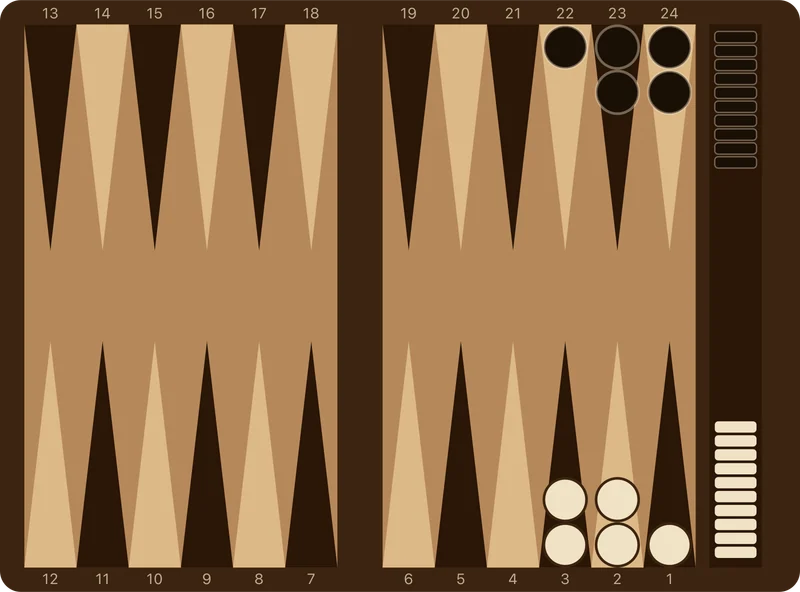
In a pure race bearoff, your sole priority is speed. You want to bear off as many checkers as possible with each roll. Wasting pips by unnecessarily shifting checkers forward when they could be removed costs crucial momentum. Calculating pip efficiency in races is a fundamental skill, closely tied to how players measure execution quality when tracking what PR means in backgammon.
2. The contact bearoff against an anchor
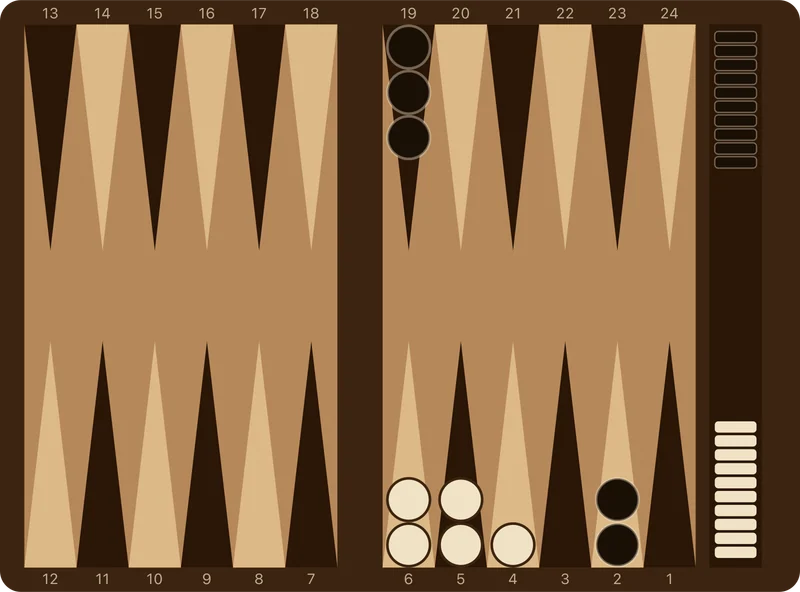
A contact bearoff occurs when your opponent maintains a defensive anchor—two or more checkers securing a point—inside your home board, typically on your 1-point or 2-point.
In this situation, speed takes a backseat to safety. If you leave a single exposed checker (a blot) anywhere within reach of the anchor, your opponent will attempt to hit it [2]. A hit sends your checker back to the roof, forcing it to enter on the opponent’s home board on the 24-point and journey across the entire board while your opponent methodically clears their own checkers.
Why home boards crunch and leave direct shots
Endgame losses against an anchor rarely happen by choice; they happen because a player’s home board “crunches.”
Crunching occurs when your checkers become stacked awkwardly on low points while your highest points remain occupied by stripped, vulnerable pairs. If you roll high numbers that force you to clear checkers from your 6-point or 5-point, you may be left with an isolated blot that cannot be protected.
The danger of leaving a blot within direct range of an anchor is severe. A direct shot left within six pips of an opposing checker can be hit with between 11 and 17 of the 36 possible dice rolls depending on the exact distance [3]. When an opponent rolls one of those winning numbers, the tables turn instantly.
Players who suffer such reversals often blame bad luck, which explains why fair dice feel rigged during emotional endgames. In reality, safe checker distribution before bearing off prevents most forced shots long before the fateful roll occurs.
Three rules for bearing off safely
To protect your lead against an opponent waiting on an anchor, follow three proven distribution principles:
1. Clear from the back first
Whenever possible, clear your highest points—the 6-point and 5-point—while you still have spare checkers on lower points. Spares on the 4-point and 3-point give you safe moves when you roll low numbers, ensuring you are not forced to dismantle your rear points at an inconvenient moment.
2. Smooth out heavy stacks
Avoid piling four or five checkers onto a single point while neighboring points hold only one or two pieces. Heavy stacks reduce your flexibility. Spreading checkers evenly across points 2, 3, and 4 provides multiple landing squares and eliminates awkward, forced moves.
3. Do not rush to take checkers off
Taking a checker off the board feels rewarding, but in a contact bearoff, safety always supersedes immediate removal. If bearing off a checker leaves an odd number of checkers on a rear point or strips a key defensive position, look for an alternative move that slots checkers safely into lower points. Preserving a secure structure ensures you can safely navigate subsequent turns.
Mastering endgame discipline
Much like chess players must guard against sudden tactical surprises such as a back-rank mate in chess, backgammon players must maintain tactical vigilance until the final checker leaves the tray.
Testing your endgame technique when you play backgammon online is the most effective way to internalize safe bearoff habits. Reviewing your matches alongside advanced backgammon strategy will help you spot vulnerable distributions before they crunch, ensuring your winning positions turn into victories.
Frequently asked questions
Can I bear off a checker while one of my checkers is on the bar?
No. You cannot bear off any checkers if you have a checker on the bar or outside your home board. You must first re-enter the checker into your opponent’s home board and move it completely into your own home board before any checkers can be removed.
Am I required to bear off a checker if I roll its exact number?
No. If you roll a number that corresponds to an occupied point, you may legally choose to move that checker forward within your home board instead of removing it, provided the destination square is a valid legal move.
What should I do if my opponent holds an anchor on my two point?
When an opponent holds the two point, prioritize clearing your six point and five point early while keeping spares on your four point and three point. Avoid stripping your highest points to single checkers until the anchor is evacuated or contact is broken.
Sources
- Wikipedia. “Backgammon.” Overview of bearing off rules and game phases.
- Boardgammon. “Backgammon endgame and bearoff strategy.”
- Our own calculations for dice outcomes and shot probabilities when bearing off against an anchor.
- Boardgammon. “Backgammon rules: movement, hitting, and bearing off.”
Found a mistake or an odd phrase? Tell us