Few games in human history have survived the rise and fall of civilizations with their core mechanics intact. When you sit down today to play backgammon online, you roll two dice and maneuver fifteen checkers around twenty-four narrow points, participating in a living tradition that connects modern computing with the courts of Byzantine emperors, Sasanian viziers, and Mesopotamian scribes.
The story of where backgammon comes from is not the creation of a single inventor or a solitary century. It is a long, documented evolution of track-based race games. Ancient societies across the Near East and Mediterranean experimented with dice and counters for thousands of years before the rules solidified into the tables games of medieval Europe and the tournament sport of our own era.
The ancient ancestors: Ur, Shahr-e Sukhteh, and early race games
The earliest known ancestors of table games originated more than 5,000 years ago in the fertile river valleys of the Near East. In the 1920s, British archaeologist Sir Leonard Woolley excavated the Royal Cemetery at Ur in southern Iraq, uncovering several exquisite boards dating from approximately 2600 to 2400 BCE [1]. Known today as the Royal Game of Ur, this contest was played on an inlaid wooden board of 20 squares, configured as a block of twelve squares joined by a narrow bridge of two squares to a smaller block of six squares. Players rolled tetrahedral 4-sided dice to race 7 markers per side down a central track. A cuneiform clay tablet written in Babylon in 177 BCE by the scribe Itti-Marduk-balāṭu confirmed that this 20-square contest remained popular for millennia as a wagering game.
Archaeological discoveries in southeastern Iran pushed our knowledge of ancient gaming boards further east. At the Bronze Age settlement of Shahr-e Sukhteh (the Burnt City), excavators uncovered a gaming board dating to circa 2600 to 2400 BCE [2]. Carved from ebony with 60 incised points winding like a coiled serpent, the board was discovered alongside 60 rounded checkers fashioned from agate, turquoise, and lapis lazuli, together with limestone dice.
These Bronze Age games established the foundational mechanics of backgammon: players cast numbered dice to race an equal contingent of stones along a designated path, attempting to enter, advance, and safely escort all their pieces off the board while blocking or capturing opposing markers along the way. Yet none of these earliest relics was an exact 24-point backgammon board. That specific geometry arose during classical antiquity under the Roman Empire.
From Rome to Byzantium: Ludus Duodecim Scriptorum and Emperor Zeno’s Tabula
During the Roman Republic and early Empire, citizens crowded taverns, public baths, and military camps to play Ludus Duodecim Scriptorum (the “Game of Twelve Markings”). Played on a stone or wooden table divided into three parallel rows of 12 points—yielding 36 points in total—the game was contested with 3 dice and 15 pieces per side [3]. Archaeological excavations from Roman Britain to North Africa have revealed dozens of these boards carved directly into marble steps and tavern floors.
By the first century CE, Roman players realized that the middle row of twelve points was largely redundant. They eliminated the central corridor, leaving two opposing rows of 12 points: the definitive 24-point layout that backgammon retains to this day. This refined contest was called Tabula (“Board” or “Table”) [3]. In Tabula, each player commanded 15 checkers, rolling 3 dice to move in opposing directions around the perimeter.
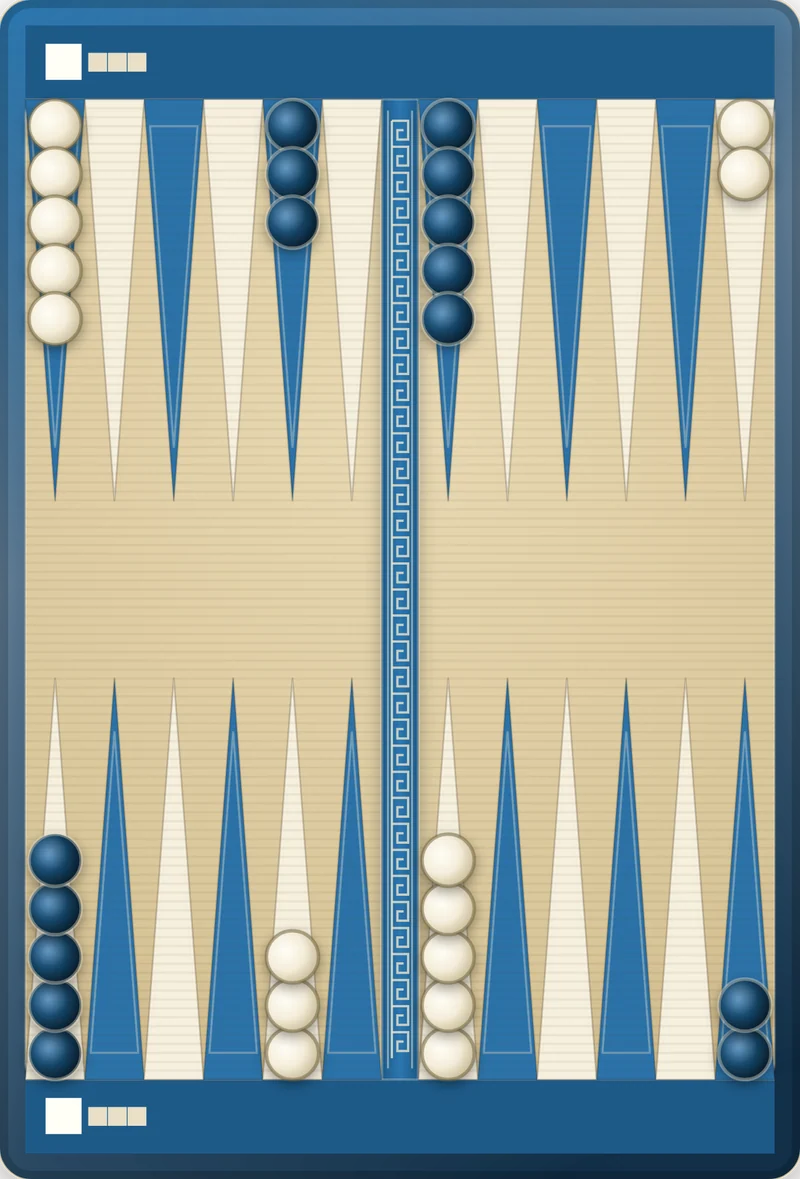
The strategic perils of Tabula were recorded for posterity by the Byzantine historian and poet Agathias Scholasticus. In an epigram preserved in the Greek Anthology, Agathias analyzed a disastrous position played by the Eastern Roman Emperor Zeno in approximately 480 CE [3]:
“Zeno, the kindly king, stood in a winning state, but threw from the dice-box a hateful cast…”
Zeno held a commanding cluster of checkers, but his opponent had established blockades across multiple points in the outer table. The Emperor rolled 2, 5, and 6 on his 3 dice. Because Roman rules strictly required a player to utilize every number rolled if a legal move existed, Zeno could not advance any piece to an empty point or leap over the enemy points. The dreadful cast forced the Emperor to break apart six protected pairs, leaving 7 isolated blots exposed across the board. His opponent pounced, hit the exposed stones, and swept the game. This 480 CE record provides the earliest documented analysis of checker vulnerability, blot exposure, and forced moves in board game literature [3].
Sasanian Persia: Nard, Bozorgmehr, and the cosmic board
While Roman legionaries rolled dice on stone tablets, an equally rich tradition blossomed across Sasanian Persia. The Persian game was known as Nēw-Ardashīr (“Noble is Ardashir”) or simply Nard [2].
The definitive historical account of Nard appears in the Middle Persian Pahlavi text Wizārishn ī Chatrang ud Nēw-Ardashīr (“The Explanation of Chess and the Invention of Nard”), composed around the 6th century CE [2]. According to this royal narrative, the King of India sent the game of chess (Chatrang) to the Persian court of Shahanshah Khosrow I Anushirvan as a diplomatic riddle, challenging the Persian sages to decipher its rules and pieces.
The wise Sasanian grand vizier Buzurgmihr (known in modern Persian as Bozorgmehr-e Bokhtagan) solved the secret of chess in 3 days. To demonstrate Persian intellectual parity, Buzurgmihr then invented the game of Nard and dispatched it to India with a counter-challenge.
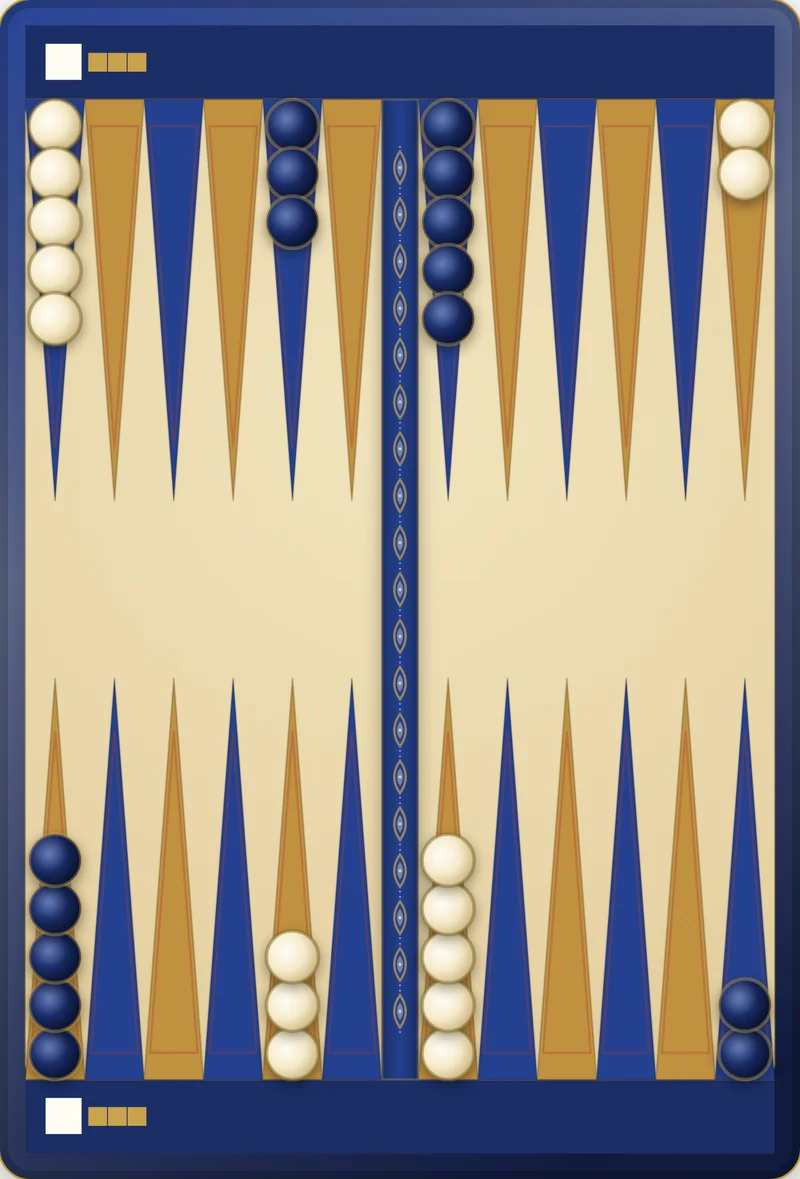
In Buzurgmihr’s formulation, Nard was designed as an elaborate cosmological model of human existence, time, and astronomy [2]:
- The board represented the terrestrial world, divided into four quadrants corresponding to the four seasons of the year and the four classical elements.
- The 24 points represented the 24 hours of the day and night (12 hours of light and 12 hours of darkness).
- The 30 checkers represented the 30 days of the Zoroastrian calendar month, with 15 white checkers symbolizing days of sunlight and 15 black checkers symbolizing nights of darkness.
- The two dice represented the celestial spheres and the turning of destiny (Bakht), while the movement of the checkers represented human will, choice, and wisdom navigating the constraints of fate.
While chess was viewed as a contest of pure human calculation and statecraft, Nard represented life itself: a player cannot choose the dice that fortune grants, but through foresight, prudence, and tactical skill, a master transforms difficult rolls into victory.
Medieval tables and Alfonso X’s Libro de los Juegos
Following the Islamic conquest of the Sasanian Empire in the seventh century, Nard was embraced enthusiastically across the caliphates of Baghdad, Damascus, and Cairo. Arab scholars wrote treatises on its mathematics and tactical opening lines, and Islamic trade routes carried the game across North Africa and into southern Europe.
In Christian Europe, the family of games was called tables in England, tablas in Spain, tavole in Italy, dames or tables in France, and Wurfzabel in German-speaking lands. Because of heavy wagering, medieval kings and church councils repeatedly attempted to ban dice games. King Louis IX of France issued ordinances against tables in the thirteenth century, yet European nobility and commoners continued playing in castles and inns alike.
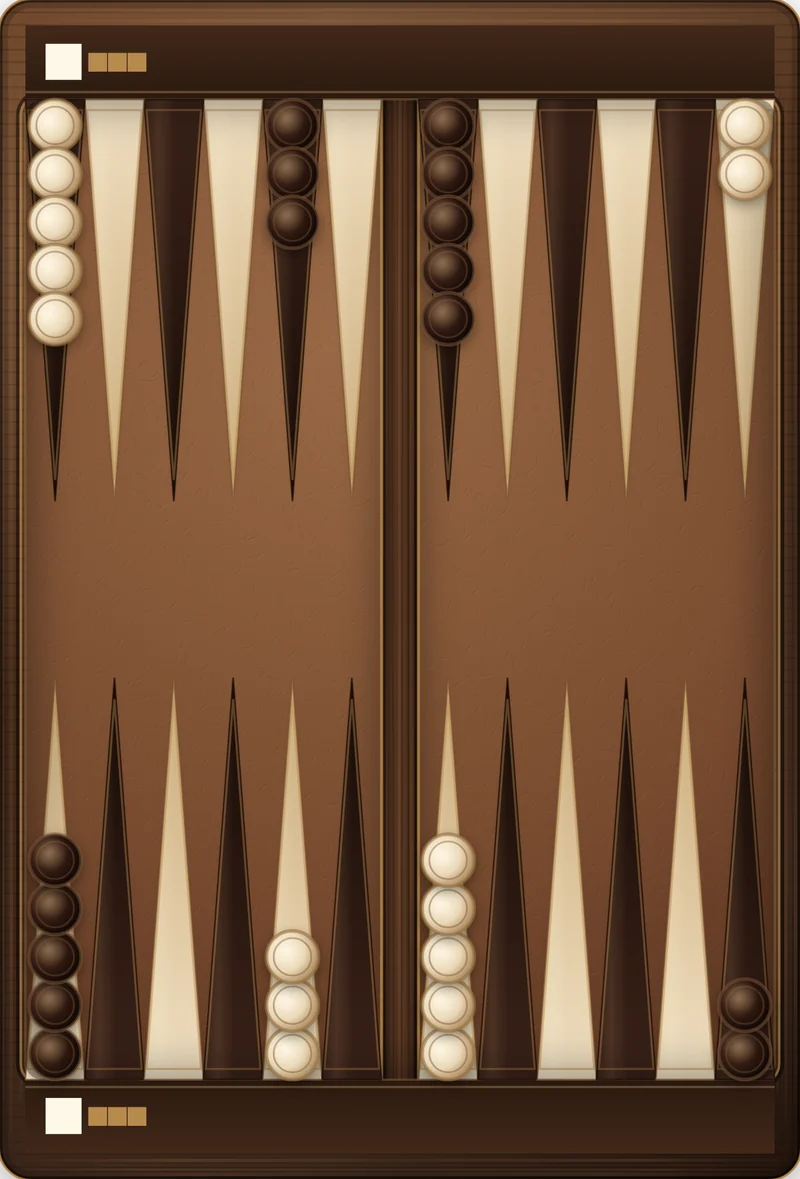
The supreme European record of this golden age is the Libro de acedrex, dados e tablas (“Book of Chess, Dice, and Tables”), commissioned by King Alfonso X of Castile and completed in Seville in 1283 [4]. Alfonso’s richly illuminated royal manuscript detailed 14 distinct table games, illustrating players in Iberian, Moorish, and Jewish attire competing across shared boards.
Among the 14 games documented in 1283 was todas tablas (“all tables”). The manuscript described an arrangement of 15 pieces per side set upon 24 points in the exact initial configuration used in standard backgammon today: two checkers on point 24, five on point 13, three on point 8, and five on point 6. For more than seven hundred years, this starting setup has endured as the universal opening array of the game.
Edmond Hoyle and the birth of modern backgammon
By the seventeenth century, the English name backgammon began appearing in print. While etymologists debate whether the term derived from Middle English bac (back) and gamen (game)—referring to checkers being sent back to the bar after being hit—or from Welsh bach (little) and cammaun (battle), the game became a staple of English coffee-houses and drawing rooms.
In 1743, the English mathematician and teacher Edmond Hoyle published A Short Treatise on the Game of Back-Gammon in London [5]. Hoyle was the first author to analyze the game through rigorous probability theory rather than superstition.
Hoyle recognized that a pair of six-sided dice produces 36 distinct combinations, yielding 21 unique rolls. In his 1743 treatise, Hoyle printed detailed mathematical tables calculating the exact odds of entering a checker from the bar and hitting enemy blots at distances ranging from 1 to 12 pips away [5]. Hoyle codified the official laws governing legal moves, touch-and-move rules, and bearing off. His treatise was so authoritative that it established standard play throughout the British Empire and North America, inspiring the enduring idiom “according to Hoyle.”
To understand how these fundamental rules govern play today, consult our complete guide to the rules of backgammon.
The twentieth century: the doubling cube and modern tournaments
For all its strategic elegance, backgammon at the turn of the twentieth century faced a competitive crisis. In long games where one side gained an insurmountable racing lead, the trailing player had little choice but to roll out a hopeless endgame, draining matches of tension and speed.
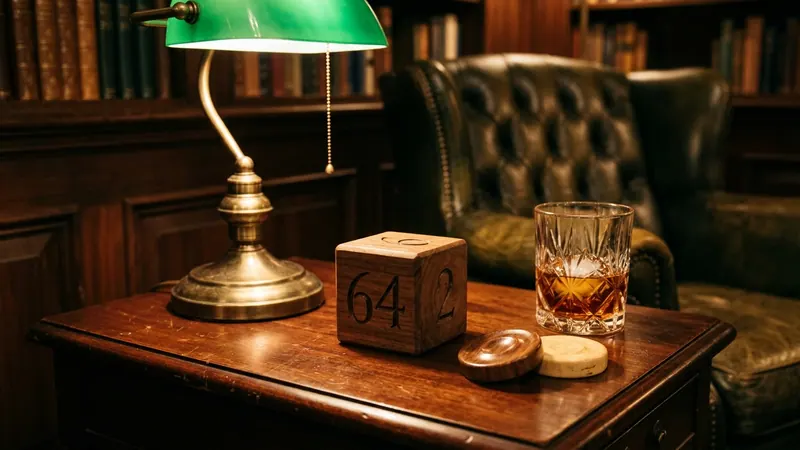
That dynamic changed in the 1920s in the private athletic and gaming clubs of New York City. An anonymous club member introduced a large six-sided die marked with the powers of two: 2, 4, 8, 16, 32, and 64. Our historical investigation into who invented the doubling cube examines how this simple innovation transformed backgammon. By permitting any player who believes they hold an advantage to double the stakes—forcing the opponent either to accept the double or immediately concede the game for 1 point—the cube injected ruthless mathematical game theory into every turn.
In 1931, the Backgammon Committee of the Racquet and Tennis Club of New York, in collaboration with prominent clubs in London and Paris, drafted the International Backgammon Rules, officially incorporating the doubling cube. In the late 1960s and 1970s, Prince Alexis Obolensky founded the World Backgammon Association, organizing international championships in the Bahamas and Monte Carlo that launched backgammon into a worldwide cultural craze.
The living branches of the backgammon family
While international tournament play standardized on the modern rules with the doubling cube, traditional table games never disappeared. Millions of players across the Mediterranean and Eastern Europe still play the ancestral forms of the game that predate the 1920s cube:
- In Greece, players contest tavli, playing a traditional three-game match comprising portes (standard tables), plakoto (where blots are pinned rather than hit), and fevga (a running game where points are blocked by single checkers).
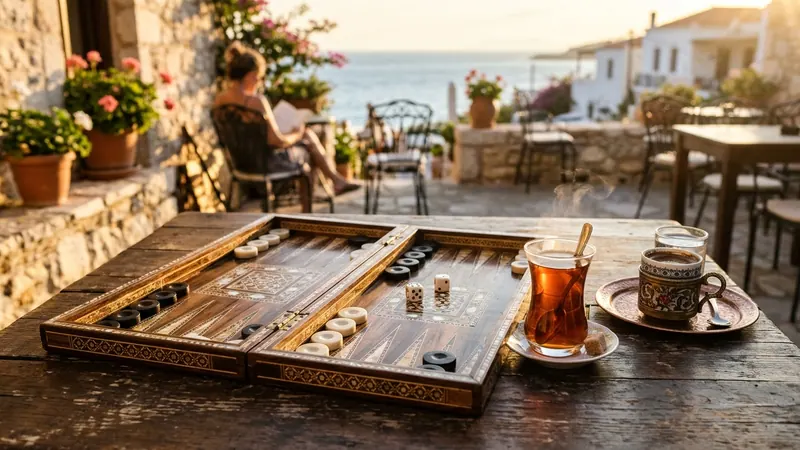
- In Turkey, tavla remains an integral social fixture of every café, celebrated for rapid rolling and strict prohibitions against the doubling cube.
- In Iran, takhte nard preserves ancient Persian table manners, emphasizing strategic blockades and prime construction.
- In Russia and the Caucasus, long nardy requires all 15 checkers to begin stacked on a single head point, forbidding hitting and rewarding fortress-like primes.
To explore how these fascinating regional traditions differ in movement, strategy, and table customs, read our detailed comparison of tavla, tavli, nardy, and shesh besh and explore our overview of worldwide backgammon variants.
Questions people ask
How old is the game of backgammon?
Ancestral race games with dice and pieces, such as the Royal Game of Ur and the boards found at Shahr-e Sukhteh, date back approximately 5,000 years to circa 2600–2400 BCE. The specific 24-point board with 15 checkers per side emerged in the Roman game of Tabula by the first century CE, giving backgammon in its recognizable form an age of roughly two thousand years.
Who invented backgammon?
No single person invented backgammon. It evolved organically across centuries through Mesopotamia, Rome, Sasanian Persia, and medieval Europe. Middle Persian tradition attributes the invention of the Persian variant Nard to the 6th-century vizier Buzurgmihr under King Khosrow I, while the modern doubling cube was introduced anonymously in New York clubs during the 1920s.
What is the difference between Nard and backgammon?
Nard is the historic Persian and Middle Eastern ancestor of backgammon. It was played on the same 24-point board with 30 checkers (15 per side) and two dice, but without a doubling cube. Today, variants like long nardy feature different starting layouts and capture rules, whereas modern tournament backgammon utilizes the doubling cube and standardized international rules codified in 1931.
Why does a backgammon board have twenty-four points?
The 24 points trace back to the Roman game of Tabula, which simplified the 36 points of the earlier Ludus Duodecim Scriptorum. In 6th-century Persia, the philosopher Buzurgmihr imbued the 24 points with astronomical symbolism, matching the 24 hours of the day and night divided across four six-point tables representing the seasons of the year.
Sources
- Finkel, I. L. (Ed.). (2007). Ancient Board Games in Perspective. British Museum Press, London.
- Daryaee, T. (2002). Mind, Body, and the Cosmos: Chess and Backgammon in Ancient Persia. Iranian Studies, Mazda Publishers, Costa Mesa.
- Austin, R. G. (1934). “Zeno's Game of τάβλη (A.P. ix. 482)”. The Journal of Hellenic Studies, 54(2), 202–205.
- Alfonso X of Castile. (1283). Libro de acedrex, dados e tablas (Libro de los juegos). Seville.
- Hoyle, E. (1743). A Short Treatise on the Game of Back-Gammon. F. Cogan, London.
- Murray, H. J. R. (1952). A History of Board-Games Other Than Chess. Oxford University Press, Oxford.
- Boardgammon. “The History of Backgammon: From Nard to the Modern Board.”
- Boardgammon. “Backgammon Rules: How to Play, Movement, and Bearing Off.”
- Boardgammon. “Backgammon Variants: Tavla, Tavli, Nardy, and Worldwide Table Games.”
- Boardgammon. “Play Backgammon Online Free.”
Found a mistake or an odd phrase? Tell us