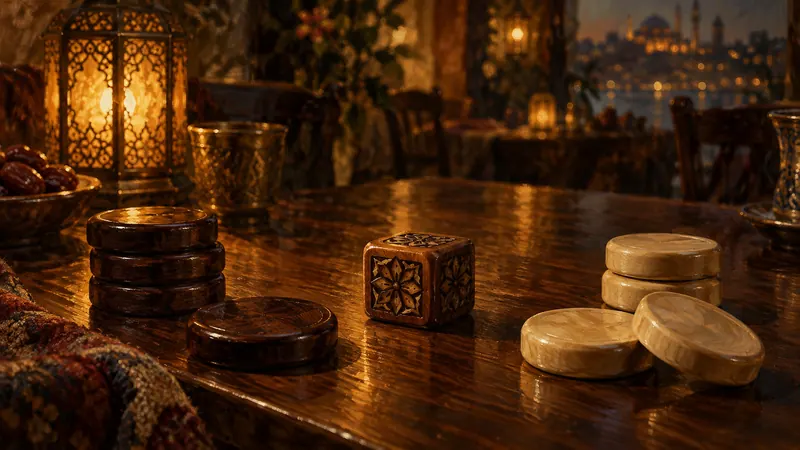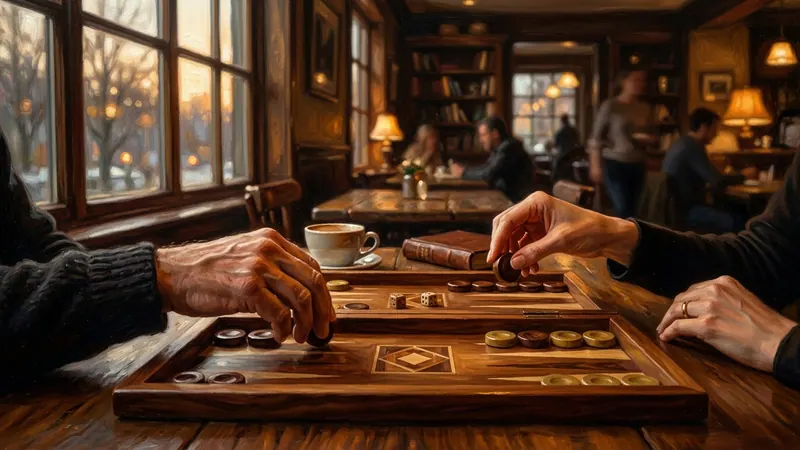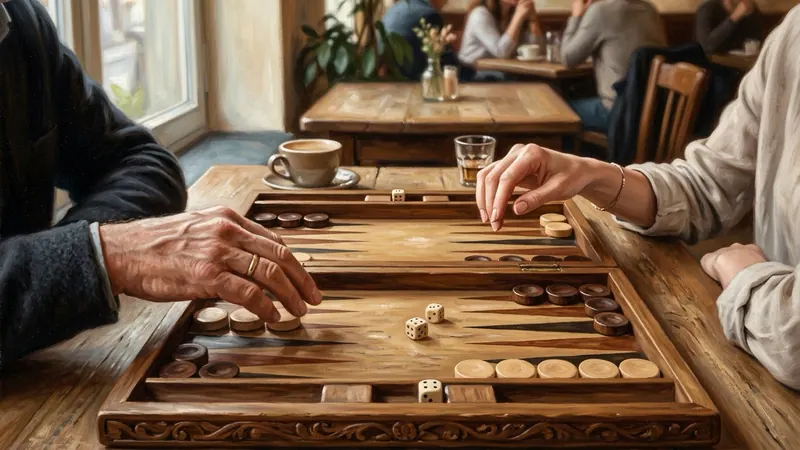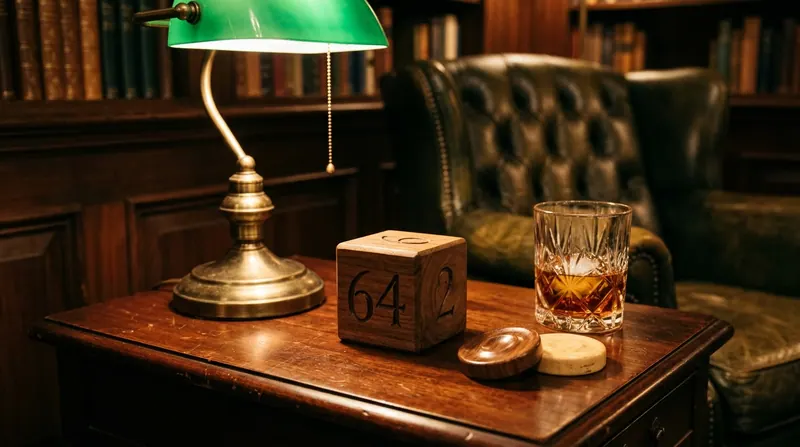
In every modern backgammon tournament, a large die marked with the numbers 2, 4, 8, 16, 32, and 64 sits beside the board. It is not rolled like ordinary dice. Instead, it is pushed across the felt by one player toward another to double the stake of the contest. For thousands of years, board games in the tables family were played as straight races without this device. Then, in a few feverish seasons during the mid-1920s, a six-sided block of wood appeared in Manhattan clubrooms and transformed the game forever.
Yet if you examine patent registries, copyright filings, or tournament rolls from that era, you will search in vain for the inventor’s name. No single creator stepped forward to claim legal ownership or royalties. In the history of backgammon, this anonymity is one of the most celebrated mysteries. When American champions Oswald Jacoby and John R. Crawford published their classic study in 1970, they acknowledged that the identity of the person who first proposed the cube had been lost to time, hailing that unknown player simply as an “unknown genius” [1].
Understanding who invented the doubling cube requires looking closely at the gaming culture of New York City during the roaring twenties, how backgammon had been played for centuries before, and why a simple wooden block rescued an ancient pastime from slow obsolescence.
Where did the doubling cube first appear?
The doubling cube originated around 1926 within the elite private athletic and social clubs of New York City [1]. Among these institutions, the Racquet and Tennis Club on Park Avenue was the acknowledged epicentre of competitive table games. Members also played at the Tuxedo Club, the Harvard Club, and the Yale Club, where wealthy sportsmen, stockbrokers, and visiting European aristocrats gathered daily for high-stakes games.
Before the cube arrived, backgammon had fallen out of popular fashion. In Victorian parlors and Edwardian clubs, it was widely regarded as an antiquated diversion. Games frequently settled into slow, one-sided grinds where one player held an overwhelming lead while the other had virtually zero chance of recovering. Because traditional etiquette required playing every single checker down to the final bear-off, games often dragged on long after the outcome was decided.
Around 1926, players in New York gaming rooms began experimenting with oral doubling to accelerate action and raise stakes [1]. Soon after, someone realized that keeping track of multiple doubles verbally or on scrap paper invited disputes. The solution was an oversized six-sided die carrying consecutive powers of two: 2, 4, 8, 16, 32, and 64 [2]. Placed in the center of the board, the cube served as both an accounting instrument and a psychological lever.
Why was backgammon dying before the cube?
To appreciate why the cube was hailed as a stroke of genius, one must examine how backgammon was played in the eighteenth and nineteenth centuries. The definitive historical English rulebook had long been Edmond Hoyle’s famous 1743 treatise, A Short Treatise on the Game of Back-Gammon [3].
Under Hoyle’s 1743 codification, matches were contested for fixed point values [3]. A regular victory was worth 1 point, a gammon was worth 2 points, and a backgammon earned triple points. There was no mechanism for a player in a hopeless position to surrender gracefully and move on to the next game. If your opponent trapped two of your checkers behind a deep prime early in the contest, you were forced to sit through twenty minutes of routine rolls, waiting for the inevitable bear-off to conclude.
This structural flaw made backgammon repetitive for skilled players. Unlike chess, which allowed polite resignations when a material deficit became insurmountable, pre-cube backgammon forced participants to endure boring endgames. By the early 1920s, card games like bridge had largely displaced backgammon in metropolitan clubs.
The doubling cube solved this defect completely. By granting either competitor the right to offer a double before rolling, the game created a voluntary exit ramp. The leader could say, in effect: “My position is strong enough that I am willing to play for 2 points; if you do not agree, you may concede 1 point right now.” For the defender, dropping a double conceded 1 point immediately, saving valuable time and cutting financial losses. For the doubler, it rewarded superior play without demanding tedious mechanical execution.
Who were the candidates behind the invention?
While Jacoby and Crawford confirmed in 1970 that no definitive documentation exists, club lore and contemporary periodicals from the late 1920s frequently mentioned a handful of figures [1].
The most prominent administrator connected to the cube was Walter L. Richard. A prominent sportsman and member of the Racquet and Tennis Club, Richard chaired the historic inter-club committee that codified modern rules. In 1931, Richard published Complete Backgammon, which contained The Official Rules of Backgammon prepared in collaboration with representatives from 25 leading American clubs [4]. While Richard did much to formalize and publicize the doubling cube, he never claimed to have invented it himself, attributing the initial idea to informal play among club members.
Another figure frequently cited in club memoirs was C. Whitewright Watson, an enthusiastic backgammon player at the Racquet and Tennis Club and the Tuxedo Club [1]. Contemporaries credited Watson with being among the earliest players to actively promote doubling rules in club matches, helping persuade fellow members to adopt physical cubes rather than informal wagers.
A more romantic legend attributed the concept to Grand Duke Dmitri Pavlovich of Russia, a cousin of Tsar Nicholas II who lived in exile in Paris and Manhattan during the 1920s [1]. Dmitri was a charismatic fixture in New York café society and an avid gambler who frequented the Park Avenue clubs. Although modern historians consider the Russian royal connection more apocryphal than proven, Dmitri’s enthusiastic embrace of doubling helped popularize the cube among high-society players in the United States and France.
Ultimately, historians agree that the doubling cube was likely a collaborative innovation born out of Wall Street gambling circles during the 1920s boom [1]. Stock traders and clubmen accustomed to fast financial markets applied the same logic of options and risk transfer to the backgammon board.
How does the doubling cube work on the board?
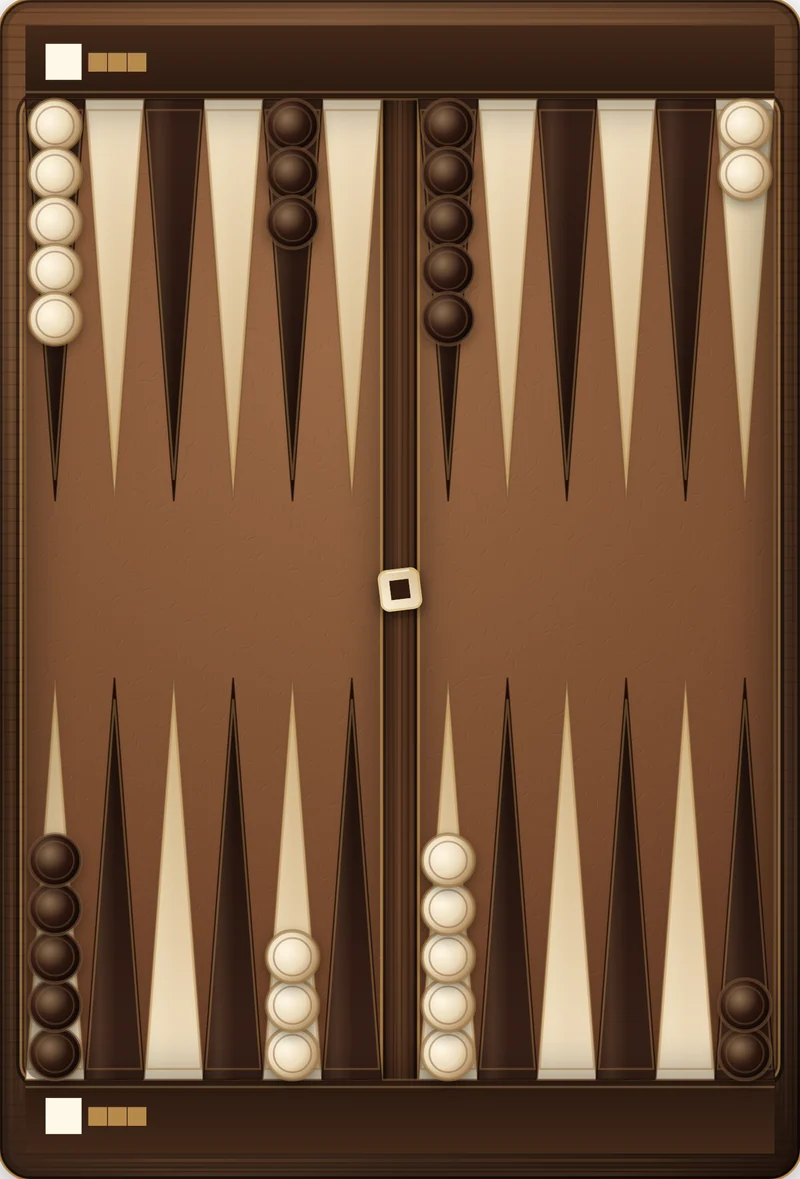
The physical cube features 6 faces displaying the numbers 2, 4, 8, 16, 32, and 64 [2]. It begins the game placed in the middle of the board or on the dividing bar with the 64 face turned upward, which signifies that the game is being played for its base value of 1 point [2].
Standard backgammon is played on a board with 24 narrow triangles called points, using 15 checkers per side and 2 dice [2]. At the start of a game, either player has the right to offer the first double. However, a double can only be proposed at the start of your own turn, strictly before rolling your 2 dice.
When you offer a double, you turn the cube to 2 and place it on your opponent’s side of the board. Your opponent must immediately make one of two choices:
- Drop (Pass): The opponent concedes the game on the spot, forfeiting 1 point to you. The game ends immediately, and a fresh game begins.
- Take (Accept): The opponent agrees to play on at twice the stakes. The cube now sits on the opponent’s side of the board showing 2.
Crucially, accepting a double grants that player exclusive ownership of the cube. The player who doubled first cannot double again. Only the player who accepted the cube holds the legal right to offer the next double—turning the cube to 4—if the momentum of the game swings in their favor. This redoubling power can theoretically continue to 8, 16, 32, and 64, although doubles beyond 4 or 8 are rare in serious competition.
For readers seeking to sharpen their practical cube decisions, our guide on when to double in backgammon explains how doubling windows function, while our tutorial on how to count pips in backgammon provides the racing arithmetic required for sound cube judgment. Our comprehensive guide on backgammon strategy and our detailed overview of doubling cube strategy walk through match equity tables and market calculations.
What is the mathematical take point?
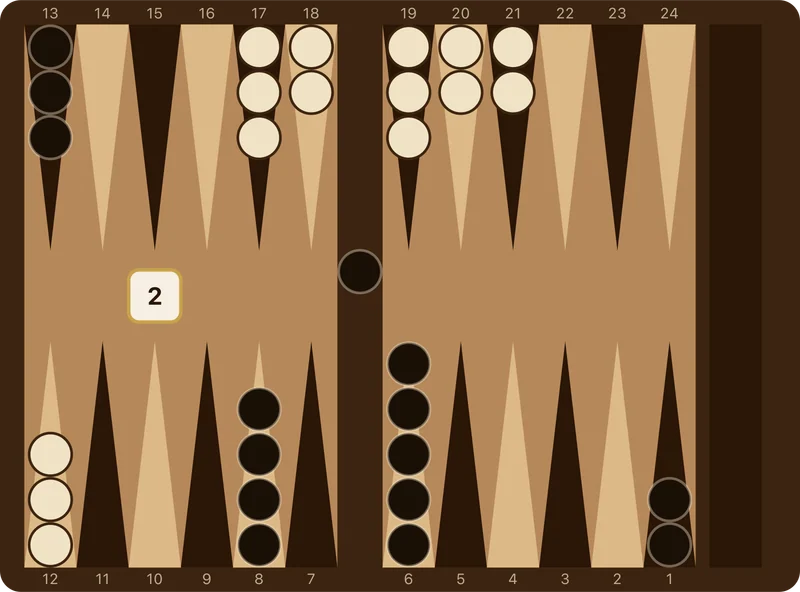
The invention of the cube converted backgammon from pure board mechanics into an applied equity market. In money games without gammon threats, the mathematical threshold for accepting a double is exactly 25% winning chances [5].
The arithmetic behind this benchmark is straightforward. If you drop a double, you lose exactly 1 point with complete certainty. Your expected value is:
$$\text{EV}(\text{drop}) = -1$$
If you accept the double, you are playing a 2-point game. If your probability of winning is $p$, your probability of losing is $1-p$. The expected value of taking is:
$$\text{EV}(\text{take}) = 2p - 2(1-p) = 4p - 2$$
To find the point where taking is equal to dropping, equate the two expected values:
$$4p - 2 = -1$$ $$4p = 1$$ $$p = \frac{1}{4} \quad (25%)$$
If your probability of winning is greater than 25%, taking loses less on average than the guaranteed loss of 1 point from dropping [5]. Even a small margin above 25% makes taking mathematically superior to yielding an entire point on the spot.
Master players double when their advantage enters the doubling window, acting before subsequent rolls cause market loss [5]. Market loss occurs when a commanding roll would push your winning chances so high that your opponent drops for 1 point, depriving you of winning 2 points on a taken cube.
How did the 1930 craze sweep the world?
Once the Racquet and Tennis Club adopted the doubling cube, backgammon experienced an unprecedented cultural explosion known as the 1930 craze [4]. Within months, the game spread from exclusive private clubs into fashionable department stores like Saks Fifth Avenue, which repeatedly sold out of wooden sets.
In 1931, the inter-club committee chaired by Walter L. Richard published The Official Rules of Backgammon, formally endorsed by 25 premier clubs across North America [4]. Tournaments drew hundreds of spectators in luxury Manhattan hotels. European resorts in Monte Carlo, Cannes, and London quickly followed suit, adopting the American rules and installing the doubling cube at their tables.
The cube transformed backgammon into the premier gambling game of the café society era. Celebrities, diplomats, and international chess champions were drawn to its mixture of strategic calculation, psychological nerve, and fast stakes.
What is the Crawford rule in match play?
As competitive tournament play developed, organizers realized that the doubling cube created an anomaly near the conclusion of multi-point matches.
If the leader reached match point minus 1—for instance, leading 4–2 in a match to 5 points—the trailing player had no disincentive to double on the opening roll of every subsequent game. Since the leader needed only 1 point to win the entire match, doubling the stake from 1 to 2 risked nothing extra for the trailer while providing free leverage.
To solve this distortion, tournament pioneer John R. Crawford formulated the Crawford rule [1]. Under the Crawford rule, when one player reaches match point minus 1, neither player may use the doubling cube for exactly 1 game (the Crawford game) [1]. If the trailer wins the Crawford game without the cube, the restriction is lifted for subsequent games. This rule restored competitive integrity to match play and remains universal in tournament regulations today.
Do all backgammon games use the doubling cube?
Although modern international tournaments rely universally on the doubling cube, traditional games across the Mediterranean, Middle East, and Eastern Europe never adopted it [6].
In Greece, the national game of tavli consists of three distinct games—portes, plakoto, and fevga—played in rotation on a standard board with 15 checkers and 24 points, but without any doubling cube [6]. In Turkish coffee houses, traditional tavla is played swiftly for single points and mars (gammons) without a cube. Similarly, Russian long nardy is played as a pure blockade race without doubling.
For millions of traditional players, the pure rhythm of rolling 2 dice and racing checkers without monetary leverage remains the authentic way to enjoy the game. Modern players who want to test their skills under standard international rules can play backgammon online for free against friends or computer opponents.
Questions people ask
When was the doubling cube invented?
The doubling cube was introduced around 1926 in private athletic clubs in New York City, most prominently the Racquet and Tennis Club [1]. It was officially codified in American tournament rules in 1931 by an inter-club committee representing 25 clubs [4].
Who actually invented the doubling cube?
The exact identity of the inventor was never patented or recorded in contemporary documents [1]. Historians Oswald Jacoby and John R. Crawford famously referred to the creator as an unknown genius [1]. Prominent figures associated with its early promotion included committee chairman Walter L. Richard, clubman C. Whitewright Watson, and Russian Grand Duke Dmitri Pavlovich.
What are the numbers on the doubling cube?
The six faces of the doubling cube display the first six powers of two: 2, 4, 8, 16, 32, and 64 [2]. The cube begins centered with the 64 face showing to represent an initial base value of 1 point.
How did backgammon work before the doubling cube was invented?
Under historical rules documented by Edmond Hoyle in 1743, backgammon was played for fixed stakes of 1 point, 2 points for a gammon, or triple points for a backgammon [3]. Players had no mechanism to double or concede, forcing both competitors to roll out one-sided, runaway games to the very end.
Sources
- Jacoby, O., & Crawford, J. R. (1970). The Backgammon Book. Viking Press, New York.
- Encyclopædia Britannica. “Backgammon.”
- Hoyle, E. (1743). A Short Treatise on the Game of Back-Gammon. F. Cogan, London.
- Richard, W. L. (1931). Complete Backgammon: With the 1931 Rules of the Racquet and Tennis Club. David McKay Co., Philadelphia.
- Boardgammon. “Doubling Cube Strategy — Take Points & Match Equity.”
- Boardgammon. “The History of Backgammon: From Nard to the Modern Board.”
- Boardgammon. “Play Backgammon Online Free.”
Found a mistake or an odd phrase? Tell us