Set down a standard 8×8 checkerboard in front of an American or British player and a Brazilian player, place 12 discs per side on the 32 dark squares, and both people see identical equipment. In the United States, Canada, Australia, and New Zealand, that grid belongs to English checkers (often called straight checkers in North America and draughts in Britain and Ireland). Dark moves first, uncrowned men step and jump strictly forward, and kings move one square at a time. In Brazil, the exact same 64 squares carry damas brasileiras (Brazilian checkers), which runs the 10×10 International draughts movement and capture rules on an 8×8 board.
Players explore checkers variants played around the world for sharper tactics on a board they already own, and often ask what controlled trials show about board games and executive functions. Verónica Estrada-Plana and colleagues’ 2026 systematic review and meta-analysis of 24 randomized controlled trials found targeted gains in two age groups alongside null pooled results on broader executive measures, confirming there is no clinical case for prescribing board games as cognitive therapy[1]. What Brazilian checkers delivers immediately is rule-switching friction. As cognitive psychologist Stephen Monsell showed in his 2003 review of task-switching studies, applying a new ruleset to identical (“bivalent”) visual stimuli creates measurable switch costs—slower decisions and carry-over errors that preparation reduces without eliminating[2]. Because the 8×8 board looks unchanged, English-checkers habits misfire on backward captures, forced majorities, and the crown row.
How do the five core rules of Brazilian checkers work?
Like the standard rules of checkers, Brazilian checkers uses the 32 dark squares of an 8×8 board with dark square a1 (square 29 in 1–32 notation) at White’s bottom-left corner and h8 (square 4) at the top right[3][4]. Each side starts with 12 men (24 pieces total) across the first three ranks, leaving two empty middle rows. Against the 100 squares, 50 dark squares, 20 men per side, and 40 total pieces of 10×10 International draughts, Brazil keeps the compact board while importing all five international mechanics[3]:
- White moves first. While Black opens with seven legal moves in English checkers, White opens in Brazilian checkers with seven legal third-rank moves (compared with nine White openings on the 10×10 board)[3].
- Men step forward, but capture forward and backward. On a quiet turn, an uncrowned man advances one dark square diagonally forward. On a capture, it jumps one adjacent enemy piece into the vacant square beyond either forward or backward, chaining jumps in any diagonal direction until none remain[3].
- Kings (damas) fly any distance. A crowned king slides any number of empty squares along an open diagonal forward or backward. When capturing, it leaps over an enemy piece from any distance and lands on any open square beyond it, unless a mandatory follow-up jump fixes the landing square[3].
- Mandatory majority-count capture (lei da maioria). Capturing is compulsory, and when multiple capture paths exist, you must pick the line removing the most enemy pieces[3]. Men and kings count equally as one piece each, so capturing two men overrides capturing a single king. Jumped pieces stay on the board as physical stoppers until the full turn finishes: you may cross an empty square twice, never jump the same enemy piece twice, and never reverse 180 degrees back over a piece[3].
- No crowning in passing. An uncrowned man that touches the crown row (
b8,d8,f8, orh8for White;a1,c1,e1, org1for Black) mid-capture does not crown if a backward man-jump continues the sequence; it promotes only if its turn finishes on that far rank[3].
| Rule | 8×8 English checkers | 8×8 Pool checkers (APCA) | 8×8 Russian checkers (shashki) | 8×8 Brazilian checkers (damas brasileiras) | 10×10 International draughts |
|---|---|---|---|---|---|
| Board & pieces | 64 squares (32 dark), 12 per side | 64 squares (32 dark), 12 per side | 64 squares (32 dark), 12 per side | 64 squares (32 dark), 12 per side | 100 squares (50 dark), 20 per side |
| First move | Black (7 openings) | White (7 openings) | White (7 openings) | White (7 openings) | White (9 openings) |
| Men capture backward | No | Yes | Yes | Yes | Yes |
| Flying kings | No (1 square) | Yes | Yes | Yes | Yes |
| Majority rule | No (free choice) | No (free choice) | No (free choice) | Yes (most pieces; king = man) | Yes (most pieces; king = man) |
| Crown row mid-jump | Crowns; turn ends | Crowns; turn ends | Crowns instantly; keeps jumping as king | Passes through uncrowned; crowns only if turn stops | Passes through uncrowned; crowns only if turn stops |
Compared with Russian checkers (shashki), the difference comes down to exactly two rules: Brazil mandates maximum-count captures and denies crowning in passing, whereas Russian shashki allows free capture choice and promotes mid-jump[5]. Those same fault lines explain many disputes covered in checkers rules that start arguments, because informal house rules frequently blend incompatible conventions across traditions.
Why does the majority rule forbid capturing a king?
The cleanest way to see lei da maioria in action is a position where material quality clashes directly with piece count.
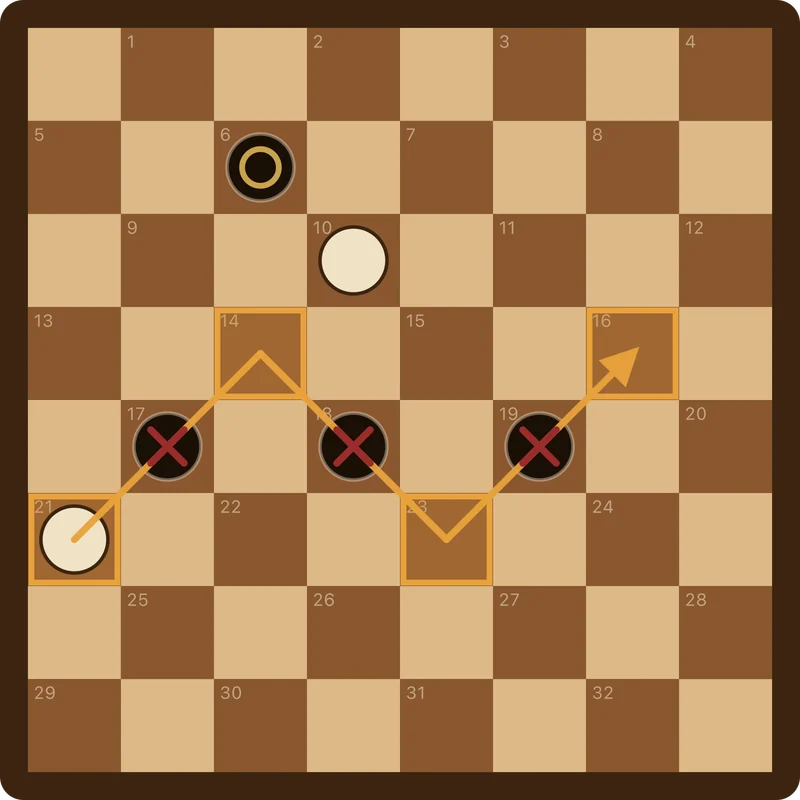
In this verified 8×8 position with White to move, White has two uncrowned men on d6 (square 10) and a3 (square 21), facing a Black king on c7 (square 6) and three Black men lined up across the fourth rank on b4 (square 17), d4 (square 18), and f4 (square 19)[6].
A player raised on English checkers immediately looks at d6:b8 (10x1), which removes Black’s king on c7 and crowns White on b8 (square 1). Under Brazilian rules, 10x1 is illegal[6]:
- Brazilian checkers (damas brasileiras): White has one legal move: the three-piece zigzag
a3:c5:e3:g5(21x14x23x16), jumping forward overb4toc5(square 14), backward overd4toe3(square 23), and forward overf4tog5(square 16). Because kings and men count equally as one piece each under the majority rule, capturing three men outranks capturing one king. - Russian shashki and Pool checkers: White has two legal moves. Both variants allow backward jumps by men, making
21x14x23x16legal, yet neither enforces a majority rule, so White chooses freely between21x14x23x16and10x1. - English checkers: White also has two legal moves, choosing between
10x1and the single forward jumpa3:c5(21x14), because English men cannot jump backward overd4.
Tactically, the majority rule hands both sides a forcing weapon. Feeding two or three expendable men into a capture chain forces an opponent away from a defensive post or a tempting king capture, opening lanes for counter-combinations across the board.
What happens when a man passes through the crown row mid-capture?
Promotion in passing is the second rule where online summaries routinely confuse Brazilian draughts with Russian shashki. In Brazilian checkers, touching the crown row mid-sequence never promotes a man if it must keep jumping backward[3].
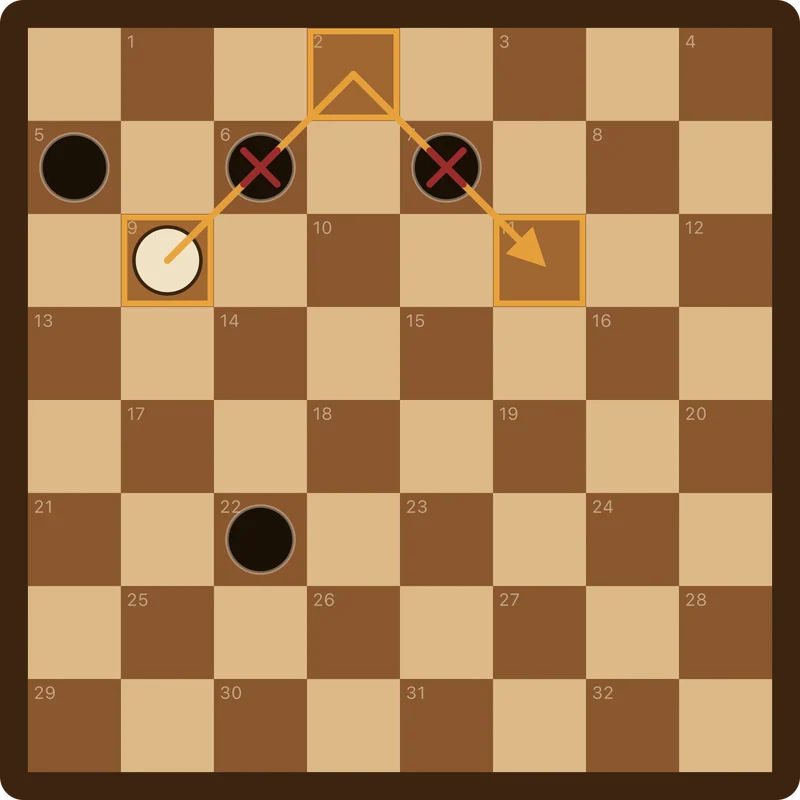
Set up this second verified 8×8 position with White to move: a lone White uncrowned man on b6 (square 9) against four Black men on a7 (square 5), c7 (square 6), e7 (square 7), and c3 (square 22)[6]. White’s b6 man must jump c7 onto d8 (square 2 on the eighth rank).
What follows divides the 8×8 family three ways[6]:
- Brazilian checkers (damas brasileiras): White has one legal move:
b6:d8:f6(9x2x11). On touchingd8, the man does not crown because a backward man-jump overe7tof6(square 11) is mandatory. It stops onf6still uncrowned (two captures, no kings), unable to cross emptye5andd4to reachc3. - Russian shashki: White crowns instantly on
d8into a flying king, unlocking four legal continuations, including three-piece sweepsb6:d8:f6:b2(9x2x11x25) andb6:d8:f6:a1(9x2x11x29) capturingc7,e7, andc3, plus two-piece king stops ong5(square 16) orh4(square 20). - English checkers and Pool checkers: White has one legal move:
b6:d8(9x2), capturing one piece, crowning ond8, and ending the turn immediately.
Defenders rely on this rule constantly. Leaving an enemy man a path to the back rank is safe whenever a forced backward follow-up drags that piece back off the eighth rank uncrowned.
How did Brazil build a championship tradition on 64 squares?
Brazil’s organized draughts scene grew out of Iberian print history and a decades-long campaign to win recognition as an official mind sport.

In their 2020 study in Revista Aedos, Tatiane Maria Barbosa de Oliveira and Paulo Vinícius de Souza Pinto trace Iberian draughts treatises back to Anton Torquemada’s 1547 Spanish manual (El ingenio ó juego marro de punto ó damas) and note that the first draughts book brought to Brazil arrived with the Portuguese Royal Family via Dom João VI: Juan Canalejas’s 1650 Spanish treatise Libro del Juego de las Damas[7].
Brazilian print publishing followed in the twentieth century. Geraldino Izidoro produced Ciência e Técnica do Jogo de Damas (1935–1940), and Rio de Janeiro published Brazil’s first local draughts book, the anonymous 40 golpes básicos, in 1940[7]. In 1954, former Soviet master Waldemar Bakumenko (the 1927 USSR draughts champion), now settled in São Paulo, founded a study circle that—alongside Izidoro’s work in Rio de Janeiro—sparked state federations across São Paulo, Rio de Janeiro, Rio Grande do Sul, Espírito Santo, and Minas Gerais[7].
National organization grew out of exclusion. After Confederação Brasileira de Desportos (CBD) president João Havelange (1916–2016) excluded Jogo de Damas because he did not consider it a sport, players met in Niterói in 1967 under first president Dr. Miolo Portugal to found the Confederação Brasileira de Jogo de Damas (CBJD). By its 2018 statute, CBJD listed 21 affiliated state federations[7]. In 1967, CBJD also held the first Brazilian Men’s 64-Square Championship, won by José Carlos Rabelo[7]. Following UNESCO’s 1978 charter, Article 217 of Brazil’s 1988 Constitution reinforced Jogo de Damas as an Esporte Intelectivo (mind sport). CBJD launched Brazil’s 100-square championship in 1971 (19 editions through 2016, led by José Maria Silva with nine titles), affiliated with the World Draughts Federation (FMJD) in 1975, and saw São Paulo include draughts in its regional games from 1992[7].
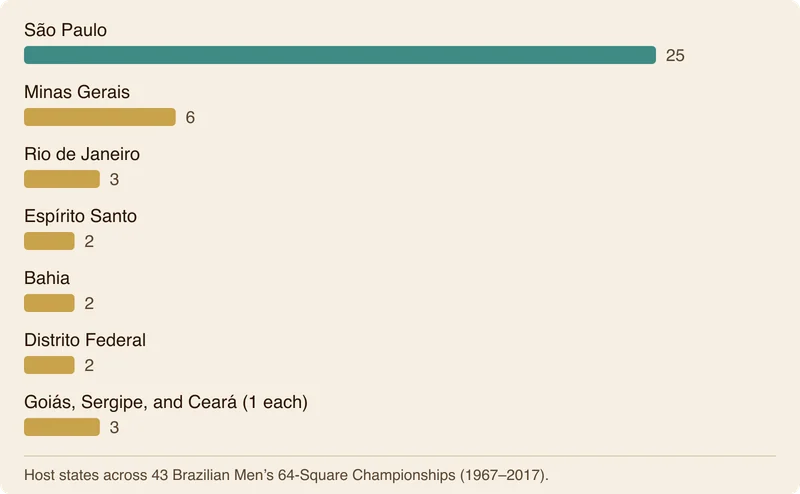
Across 43 Brazilian Men’s 64-Square Championships (1967–2017), São Paulo hosted 25 editions, Minas Gerais 6, Rio de Janeiro 3, Espírito Santo 2, Bahia 2, Distrito Federal 2, and Goiás, Sergipe, and Ceará 1 each (3 combined)[7]. Representing Pernambuco, Augusto Amilcar Mariano won a record eight national titles (1997, 1999, 2001, 2002, 2004, 2005, 2006, and 2013, including seven in the decade 1997–2006). Behind him sit three-time champions Ciro Gonçalves Barreto, Genaldo Gonzaga, and Lourival Mendes França (nine titles combined), followed by two-time winners Douglas Diniz, Lélio Marcos Luzes Sarcedo, and Jorge José de Carvalho Salomão[7]. Six Brazilian Women’s 64-Square Championships ran from 2005 to 2010, and the 2011 Women’s World Cup gathered competitors from 10 countries, with Ana Paula Araújo Brito and Tatiane Maria Barbosa de Oliveira representing Brazil[7].
Internationally, FMJD launched the World Draughts-64 Championship in 1985 in Galatina, Italy, under Brazilian rules, eight years before the first Russian-rules World Championship in 1993[8][9]. Aleksander Kandaurov took gold in 1985, Vladimir Vigman silver, and Brazil’s Douglas Diniz bronze[8]. Brazil later hosted World Draughts-64 championships in São Lourenço (1987 and 1989, both won by Alexander Schwarzman) and Águas de Lindóia (1993, where Lourival Mendes França shared first place with Schwarzman, Ion Dosca, and Iser Kuperman). Later Brazilian hosts included Belo Horizonte (1996, won by Schwarzman), São Caetano do Sul (1999, Ion Dosca), São Paulo (2002, Gavril Kolesov), and Recife (2008, Schwarzman). At Ubatuba in 2004, Yuri Anikeev won the classic title while Brazil’s Francisco Marcelo Araújo Oliveira captured rapid gold; when São Paulo hosted again in 2016, Alexander Georgiev took the classic title and Schwarzman won the rapid title[7][8]. National championships under Brazilian 8×8 rules also run in Poland (since 1991) and Lithuania (since 1993)[9].
What do randomized trials and game theory actually say about board games and the mind?
Two questions follow every 8×8 ruleset: has a computer solved it like English checkers, and what do randomized trials show about board games and executive functions?
Computationally, the gap is wide. In 2007, Jonathan Schaeffer and colleagues weakly solved 8×8 English checkers as a draw after 18 years (1989–2007) across roughly 5 × 10²⁰ positions (500 billion billion) using a 39-trillion-position 10-piece endgame database, a proof detailed in how checkers was solved[10]. That result covers only forward-only English rules; 8×8 Brazilian checkers, with backward captures, flying kings, and forced majority lines, still has no published starting-position proof[10][11].
In cognitive science, randomized trials paint a much more modest picture than popular slogans. In 2026, Verónica Estrada-Plana and colleagues published a systematic review and meta-analysis in Applied Psychology: Health and Well-Being that screened 5,288 records across four databases (1,103 in PsycINFO, 639 in PubMed/Medline, 2,063 in Scopus, and 1,483 in Web of Science). After removing duplicates, they retained 3,117 records plus eight snowball records, synthesized 24 randomized controlled trials (RCTs), and pooled 16 into quantitative meta-analyses[1]:
- Significant pooled effects: kindergarten children showed gains in visuospatial short-term memory (Hedges’ g = 0.26, p = 0.006, 95% CI [0.07, 0.45], Q(8) = 3.09, p = 0.929, I² = 0.00%), and older adults showed faster processing speed (g = −0.41, where negative latency scores favor the intervention, p = 0.033, 95% CI [−0.79, −0.03], Q(3) = 4.57, p = 0.21, I² = 27.71%, strengthened by longer multi-week programs at b = −0.10, p = 0.038). Qualitative synthesis also noted consistent verbal short-term memory gains in school-aged children[1].
- Non-significant pooled effects in older adults: pooled estimates did not reach statistical significance for cognitive flexibility (g = −0.27, p = 0.0921, 95% CI [−0.59, 0.04], I² = 22.96%, though shorter sessions outperformed fatiguing long ones at p = 0.025), visuospatial short-term memory (g = 0.53, p = 0.111, I² = 73.95%), verbal short-term memory (g = 0.51, p = 0.085, I² = 73.59%, with adaptive difficulty lifting effects by b = 0.55, p = 0.009), or verbal working memory (g = 0.19, p = 0.230, I² = 0.00%)[1].
- Non-significant pooled effects in children: pooled results were non-significant with high heterogeneity for visuospatial working memory (g = 0.08, p = 0.8943, I² = 97.57%), inhibitory control (g = −0.73, p = 0.223, I² = 98.16%), cognitive flexibility (g = −0.05, p = 0.8394, I² = 86.62%), and processing speed (g = −0.49, p = 0.302, I² = 90.47%), while fluid reasoning on Raven’s matrices improved equally in control and intervention groups[1].
- Clinical boundary: the authors concluded explicitly that current evidence is insufficient to prescribe board games as clinical cognitive interventions or claim broad executive-function enhancement[1].
Observational aging studies underscore the same distinction between correlation and causation. In a 2026 cross-sectional study in Dementia & Neuropsychologia, Dos Santos and colleagues assessed 50 community-dwelling older adults in Brazil over the preceding 12 months (after March 2020) using Addenbrooke’s Cognitive Examination and the CASP-19, DASS-21, and GDS scales. Higher engagement in active, intellectually stimulating leisure correlated with better cognitive scores (p = 0.021), whereas the link with lower depressive symptoms did not reach statistical significance (p = 0.060); physical activity correlated with lower anxiety (p = 0.013) and greater autonomy (p = 0.047)[12]. Because a cross-sectional snapshot cannot establish causation, it does not show clinical disease prevention[12].
Similarly, in France’s 20-year cohort of 3,675 dementia-free older adults (32.2% regular board-game players, 840 dementia cases), Jean-François Dartigues and colleagues (2013) observed an initial 15% lower dementia hazard (HR 0.85, 95% CI 0.74–0.99, p = 0.04). Once researchers adjusted for baseline Mini-Mental State Examination scores and depression, that hazard ratio became statistically non-significant (HR 0.96, 95% CI 0.82–1.12, p = 0.61), while cognitive score decline remained slightly slower (β = 0.011, p = 0.03) and incident depression lower (HR 0.84, 95% CI 0.72–0.98)[13]. Because that cohort was observational, playing checkers remains an engaging leisure pastime rather than a clinical intervention for dementia. Meanwhile, Giovanni Sala and Fernand Gobet’s 2017 review of meta-analyses found that board-game practice builds domain-specific pattern recognition and lookahead calculation, with no broad transfer to general intelligence tests or school exams[14].
How do draw clocks work, and where can you play Brazilian checkers?
Because flying kings cross an open 8×8 board in a single turn, Brazilian checkers relies on shorter endgame draw clocks than English checkers’ 40-move rule. In Checkers Crown, Brazilian checkers draws automatically on threefold repetition (the third identical position with the same side to move) or 15 consecutive quiet king moves per side without a capture or man move. Across the app’s other variants, quiet-king or endgame limits stand at 13 moves for three kings against one in APCA Pool checkers, 16 in Turkish dama, 25 in 10×10 International draughts, and 40 in English checkers and Italian draughts[5]. Over the board in Brazilian federation events, traditional rules also use 20 quiet king moves (and 20 moves in three kings against one) alongside FMJD and IDF Draughts-64 endgame material-shortage clocks[5].
Checkers Crown supports eight draughts variants (English, International 10×10, Brazilian, Russian shashki, Pool, German, Italian, and Turkish dama) across 11 interface languages[5]. Live rated online matchmaking runs unified on 8×8 English checkers (10+5 clock), while Brazilian checkers is playable offline against the computer or in two-player pass-and-play when you play checkers in your browser or in the iOS and Android apps[15][16]. You can also practice its four shared international mechanics—backward captures, flying kings, majority captures, and no crowning in passing—across the four interactive International Draughts lessons on our lessons page[5].
Quick questions on Brazilian checkers
Who moves first in Brazilian checkers, and how is the board set up?
White moves first with seven legal opening moves, whereas Black opens in English checkers[3]. Orient the 8×8 board with dark square a1 (square 29) at White’s bottom-left and h8 (square 4) at the top right, placing 12 men per side on the dark squares of the first three ranks[3].
If I can capture a king or two ordinary men, which must I take?
You must capture the two ordinary men[3]. Under Brazil’s majority rule (lei da maioria), men and kings count equally as one piece each, so the sequence removing more pieces is mandatory; you choose freely only when two capture lines remove the same number of pieces[3].
How is Brazilian checkers different from Russian checkers (shashki)?
Both share the 8×8 setup, White moving first, backward man jumps, flying kings, and stopper pieces[5]. Brazilian checkers enforces majority capture and forbids crowning in passing on the crown row, whereas Russian shashki allows free capture choice and promotes mid-jump into an active flying king[3][6].
Does Brazilian checkers use the exact same rules as 10×10 International draughts?
Yes, for movement, captures, majority count, stopper pieces, and no crowning in passing[3]. Only the board size (64 squares, 32 dark squares, 12 men per side versus 100 squares, 50 dark squares, and 20 men per side) and the shorter endgame draw clocks differ[3][5].
Sources
- Estrada-Plana, V., Vita-Barrull, N., March-Llanes, J., Bafalluy, A. B., Ayesa-Arriola, R., & Moya-Higueras, J. (2026). “Can executive functions be improved by playing board games across the lifespan? A systematic review and meta-analysis.” Applied Psychology: Health and Well-Being, 18(4), e70194.
- Monsell, S. (2003). “Task switching.” Trends in Cognitive Sciences, 7(3), 134–140.
- Boardgammon. “Brazilian Draughts Rules — Damas Brasileiras.”
- Boardgammon. “Checkers Rules: Board Setup, Forced Captures, Kings, and Draws.”
- Boardgammon. “Checkers Variants Around the World.”
- Boardgammon. “Exact 8×8 Brazilian draughts move-tree verification for majority zigzag capture (21x14x23x16) and crown-row pass-through (9x2x11).”
- Oliveira, T. M. B. de, & Pinto, P. V. de S. (2020). “O jogo de Damas no Brasil: uma análise dos melhores atletas da modalidade.” Revista Aedos (UFRGS), 12(26), 632–649.
- Wikipedia contributors. “World Draughts-64 Championship.” Wikipedia, The Free Encyclopedia.
- Авторы Википедии. «Бразильские шашки». Википедия, свободная энциклопедия.
- Schaeffer, J., Burch, N., Björnsson, Y., Kishimoto, A., Müller, M., Lake, R., Lu, P., & Sutphen, S. (2007). “Checkers Is Solved.” Science, 317(5844), 1518–1522.
- Wikipedia contributors. “Brazilian draughts.” Wikipedia, The Free Encyclopedia.
- Dos Santos, G., Ordonez, T. N., Gutierrez, B. A. O., & da Silva, T. B. L. (2026). “Cognitive performance and active lifestyle in community-dwelling older adults.” Dementia & Neuropsychologia, 20, e20250431.
- Dartigues, J.-F., Foubert-Samier, A., Le Goff, M., Viltard, M., Amieva, H., Orgogozo, J.-M., Barberger-Gateau, P., & Helmer, C. (2013). “Playing board games, cognitive decline and dementia: a French population-based cohort study.” BMJ Open, 3(8), e002998.
- Sala, G., & Gobet, F. (2017). “Does Far Transfer Exist? Negative Evidence From Chess, Music, and Working Memory Training.” Current Directions in Psychological Science, 26(6), 515–520.
- Boardgammon. “Checkers Crown: Play Checkers Online.”
- Boardgammon. “Checkers Crown: Play Checkers in Your Browser.”
- Colaboradores da Wikipédia. “Damas.” Wikipédia, a enciclopédia livre.
Found a mistake or an odd phrase? Tell us