If you learned checkers in the United States, Canada, Britain, or Australia, the board you know has 64 squares, 12 pieces per player, and a comforting rule: once an uncrowned man slips past an enemy man, that opponent can never jump backward to catch it. Sit down across a 10×10 International draughts board and that habit can cost three pieces in the opening. Expanding the grid from 64 squares to 100 adds 18 playable dark squares and 16 starting pieces, yet the deeper shift is mathematical. In H. Jaap van den Herik, Jos W. H. M. Uiterwijk, and Jack van Rijswijck’s 2002 survey of solved and unsolved games, moving from 8×8 English checkers (called draughts in Britain and Ireland) to 10×10 International draughts multiplies reachable positions from roughly 5 × 10^20 to around 10^30, nine to ten orders of magnitude larger[1].
Governed since 1947 by the World Draughts Federation (FMJD) and known across eighteenth-century Europe as “Polish draughts,” 10×10 International draughts is the world-championship standard in the Netherlands, France, Belgium, the former Soviet republics, and West Africa[2]. Among checkers variants played around the world, it maximizes tactical reach while keeping identical wooden disks[3]. Beyond the 50-square diagonal grid where White moves first, four capture and crowning rules reshape every exchange: ordinary men jump backward, kings fly any distance, mandatory captures obey a strict maximum-count rule, and jumped pieces stay on the board as stoppers until a turn finishes[2].
How does the 10x10 board differ from 8x8 checkers?
Check the lower-left corner before setting up. Like the standard rules of checkers on an 8×8 board, an International draughts board sits with a dark square in each player’s bottom-left corner[2][4]. Play stays exclusively on the 50 dark squares. Each side starts with 20 pieces across its first four rows, leaving two empty central rows (10 dark squares) between the 40 pieces[2].
| Feature | 8×8 English checkers | 10×10 International draughts | 8×8 Brazilian draughts |
|---|---|---|---|
| Board squares | 64 (32 dark) | 100 (50 dark) | 64 (32 dark) |
| Starting pieces | 12 per side (24 total, 3 rows) | 20 per side (40 total, 4 rows) | 12 per side (24 total, 3 rows) |
| First move | Black (7 opening moves) | White (9 opening moves) | White (7 opening moves) |
| Men jump backward? | No (forward only) | Yes (forward and backward) | Yes (forward and backward) |
| King range | Short (1 square) | Flying (any open distance) | Flying (any open distance) |
| Capture tiebreak | Any full sequence | Strict maximum count | Strict maximum count |
| Mid-jump crown transit | Ends turn as king | Stays a man, keeps jumping | Stays a man, keeps jumping |
Turn order flips 8×8 convention: instead of Black choosing among seven opening moves, White always moves first on 10×10 and chooses among nine[2]. As the third column shows, Brazilian draughts places the entire 10×10 International rulebook onto an 8×8 board with 12 pieces per side, demonstrating how much of the game’s bite comes from the rules themselves[3].
How do you read 1-to-50 Manoury notation?
In 1770 and 1787, Parisian café proprietor Pierre Manoury standardized the coordinate system still used worldwide: number only the 50 dark squares from 1 to 50, reading left to right from Black’s back rank down to White’s back rank[2][5].
- Black’s camp (
1–20): Four starting rows run left to right from1–5at the top (square5, at top right on diagrams, is Black’s dark lower-left corner) down to Black’s front line on16–20[2]. - Empty center (
21–30): Rows 5 and 6 hold 10 empty dark squares where central outposts form[2]. - White’s camp (
31–50): White’s front line stands on31–35, backed by rows36–40,41–45, and the home rank46–50(46is White’s dark lower-left corner)[2].
Quiet moves take a hyphen and captures take an x, giving White nine legal opening moves from the front rank: 31-26, 31-27, 32-27, 32-28, 33-28, 33-29, 34-29, 34-30, and 35-30[2]. Slicing corner to corner from 5 to 46 runs the 10-square long diagonal (main line), the highway endgames revolve around[2].
What are the four capture and crowning rules that change every calculation?
Board size alone would only lengthen 8×8 checkers. What makes 10×10 play explosive is how four capture and promotion rules lock together[2]. Where casual players still debate checkers rules that start arguments, International draughts enforces strict tactical law.
1. Ordinary men step forward, yet capture backward
Without a capture on the board, an uncrowned man steps one square diagonally forward onto an empty dark square. Once an enemy piece sits diagonally adjacent with an empty square directly beyond it, uncrowned men jump one piece at a time in all four diagonal directions—forward or backward—and mix directions freely inside a multi-jump turn[2]. Passing an enemy vanguard no longer shelters a piece from behind, and every central man radiates capture threats along four diagonals rather than two.
2. Mandatory majority capture counts quantity, never rank
Capturing is compulsory. Whenever two or more capture sequences exist, the majority rule requires choosing a path that takes the maximum number of enemy pieces[2]. Piece rank never breaks ties: one king counts as one piece, identical to one man[2]. If your king can capture an enemy king plus one man (two pieces) while another man can capture three ordinary men (three pieces), you must capture the three men. When two sequences take the exact same maximum count, you choose freely between them, unlike Italian dama or Spanish draughts where rank tiebreakers favor capturing kings[2][3].
3. Jumped pieces stay on the board as stoppers until the turn ends
Plucking jumped checkers off the board mid-sequence is illegal in International draughts. Every jumped piece stays on its square until the full multi-jump turn ends, when all captured disks are removed together[2]. Consequently, you may never jump the same enemy piece twice in one turn, and although you may cross an empty square more than once, any already-jumped piece acts as a physical stopper blocking both men and flying kings for the remainder of that turn[2].
4. Flying kings and why crown-row transit does not promote
A man that ends its turn on the far crown row (1–5 for White, 46–50 for Black) promotes to a flying king, sliding any number of empty squares along an open diagonal (up to nine steps from 5 to 46) and jumping distant pieces to land on any empty square beyond them that satisfies the majority rule[2].
Compare how three traditions treat reaching the back rank mid-jump:
- 8×8 English checkers: Reaching the king row crowns the piece and ends the turn immediately[2].
- 8×8 Russian draughts: Touching the crown row mid-jump crowns the piece immediately, continuing the same turn as a flying king[2][3].
- 10×10 International draughts: Passing through the crown row mid-capture does not crown a man[2]. If White jumps onto
3and has a mandatory backward jump out over8or9, it must jump out as an ordinary man and finishes the turn uncrowned[2].
Because one flying king on the 5–46 main diagonal can hold off two enemy kings, FMJD rules declare draws on threefold repetition, after 25 consecutive moves per player (50 plies) using only kings with zero captures or man advances, or after 16 moves when three kings (or two kings and a man, or one king and two men) fail to defeat a lone king[2].
How do combinations like the Coup Royal and Coup Turc work on the board?
Combine mandatory maximum capture, backward jumps, and mid-turn stoppers and you get the signature weapon of 10×10 play: the multi-piece sacrifice, or coup. You feed two, three, or four pieces into forced captures to pull enemy men onto exact geometrical intersections, then sweep the board clean in one turn.
Walking through the Coup Royal (40x29x20x9x18x7)
Named in 1925 by French master Paul Sonier and cataloged across nearly 600 variations by Dutch master Herman de Jongh in his 1980 book Le Coup Royal, the Coup Royal launches from White’s Olympic formation on squares 40 and 45[6][2]. White typically sacrifices three pieces (often around 23x34 exchange patterns) to arrange five Black men on 34, 24, 14, 13, and 12, allowing the man on 40 to execute a five-piece zigzag sweep[2][6]:
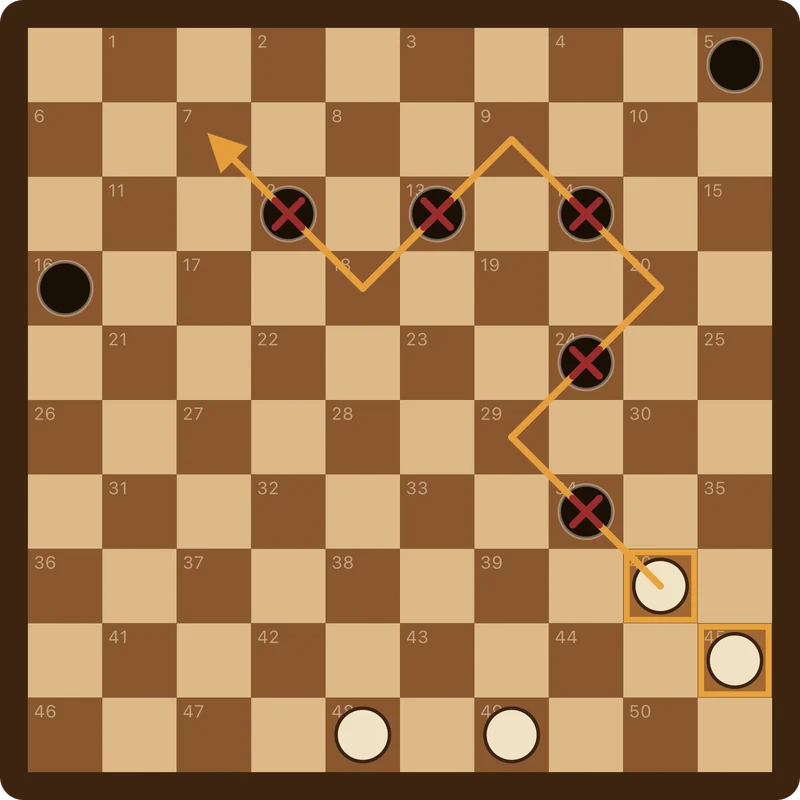
Trace 40x29x20x9x18x7 hop by hop on the diagram[2][6]:
40x29: White’s man on40jumps forward-left over34onto29.29x20: Turning forward-right, it jumps over24onto20on the right flank.20x9: Cutting back forward-left, it jumps over14onto9.9x18: Still an uncrowned man, it jumps backward-left over13from9to18, a pivot impossible in 8×8 checkers.18x7: Pivoting forward-left over12, it lands on7, one rank from crowning, before all five jumped Black pieces come off the board[2].
Trapping a flying king with the Coup Turc
Named by Pierre Manoury in 1770, the Coup Turc (“Turkish stroke”) turns the stopper rule against an enemy flying king[2][5]. By sacrificing pieces in sequence, you compel the opponent’s king under the majority rule to fly around a rectangular loop. On its final leg, the king glides back along the diagonal of its very first victim, which is still sitting on the board as an unjumpable stopper[2]. Blocked by that dead piece, the king must halt on the square directly beside your waiting man, which captures the king on the next move[2].
How does positional strategy work across 50 squares?
When two tournament players spot tactical shots early, 10×10 draughts becomes an architectural struggle across all 40 pieces[2]. While core 8x8 checkers strategy prizes central control and back-row discipline, 100 squares turn individual outposts into whole-board systems:
- The Classical system (Partie Classique): White holds central outposts
27and28against Black’s23and24, backed by diagonal batteries like40–45[2]. Because careless advances trigger combinations, Classical games revolve around tempo counting: rationing quiet reserve moves until the opponent runs out of safe waiting steps. - The Roozenburg system (Partie Roozenburg): Popularized by Dutch world champion Piet Roozenburg, White’s
24,27, and29face Black’s18,23, and25in an asymmetric clash where one side plants bold central and wing outposts while the other yields space to surround and squeeze them[2].
Diagonal 10×10 formations also contrast sharply with orthogonal Turkish dama, played across all 64 squares of an 8×8 board with 16 pieces per side on rows 2 and 3 moving forward and sideways rather than diagonally[2][3].
Why is 8x8 checkers solved while 10x10 draughts remains unsolved?
Since computers solved 8×8 checkers in 2007, newcomers often assume 10×10 draughts is solved too. It is not, and complexity theory shows why those 36 extra squares build an enormous computational wall[1][7].
In 1984, J. M. Robson proved that generalized checkers scaled to an N × N board under mandatory capture is EXPTIME-complete, meaning worst-case decision work grows exponentially with board size[8]. Victor Allis’s 1994 framework distinguishes three levels of solving a game: ultra-weak (knowing the outcome from the start), weak (computing perfect play from the start), and strong (computing perfect play from every legal position)[1]. Applying those tiers in 2002, van den Herik, Uiterwijk, and van Rijswijck mapped how steeply search trees expand from one board size to the next[1].
Connect Four (42 cells, 10^12 positions, 4.00 average legal moves per turn) fell in 1988[9]. Solving 8×8 English checkers, with roughly 5 × 10^20 positions, 70-ply average games, a 2.80 branching factor, and a 10^40 game tree, took Jonathan Schaeffer’s Chinook team 18 years (1989–2007) and a 39-trillion-position 10-piece endgame database to prove a draw[7][9], a campaign we detail in how Chinook solved 8x8 checkers.
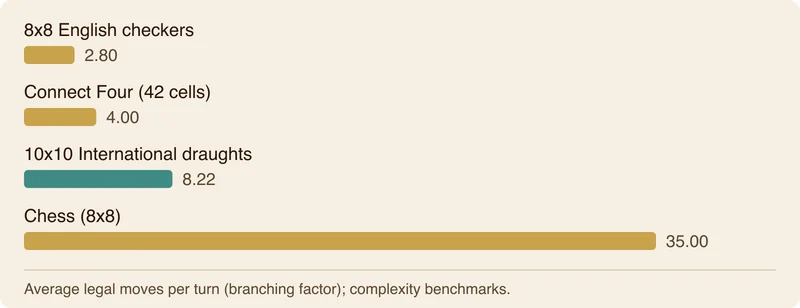
Stepping up to 10×10 International draughts multiplies both dimensions at once:
- State space (~10^30): Moving from 32 dark squares and 24 pieces to 50 dark squares and 40 pieces pushes reachable positions to roughly 10^30 (with upper-bound counts near 5.4 × 10^31), roughly a billion to ten billion times larger than 8×8 checkers[1].
- Branching factor (8.22): Backward captures and flying kings nearly triple average move choices from 2.80 in 8×8 checkers to 8.22 legal moves per turn across roughly 101 plies[9]. Early models estimated a 10^54 game tree[1], while empirical benchmarks using 8.22 across 101 plies reach 10^92: smaller than chess (35.00 branching factor, 10^44 state space, 10^120–10^123 tree), yet far beyond exhaustive proof search[9].
Even with specialized 10×10 endgame databases solving up to nine or ten pieces, 30 pieces still separate the 40-piece opening board from exact tablebase truth[7].
From Dutch boards and Paris cafés to Dakar: why was it called Polish draughts?
For two centuries Europeans called the 100-square game Polish draughts (jeu de dames à la polonoise), even though its roots lie in the Low Countries and Paris[2]. Dutch historian Arie van der Stoep (1984) traced the 10×10 board to the Netherlands around 1550, expanding to 20 pieces per side between 1650 and 1700[2]. Pierre Marin’s 1710 Amsterdam dictionary recorded damer à la polonoise, Parisian coffeehouses popularized the game between 1723 and 1727, and London’s The Craftsman mentioned Polish draughts on September 15, 1733[2].
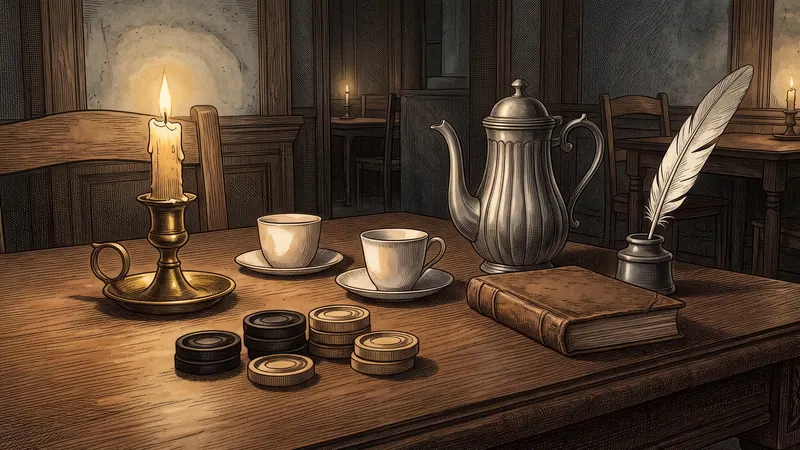
Parisian café owner Pierre Manoury (1728–1814), proprietor on the Quai de l’École from 1766, turned salon play into literature with his 122-page Essai (1770) and 272-page treatise Le Jeu de dames à la polonoise (1787), establishing 1–50 notation[2][5].
Modern championship play brought together France, the Netherlands, the Soviet Union, and West Africa:
- France and the FMJD: After 1885 international tournaments in France, Paris staged the first recognized World Championship in 1894, won by Isidore Weiss, who held the crown across seven championships over 18 years. On September 14, 1947, four federations (France, the Netherlands, Belgium, and Switzerland) founded the FMJD in Paris, growing to 77 member federations by 2021[2].
- Dutch–Soviet rivalry: Following the first Soviet 100-square championship in 1954 and Iser Kuperman’s 1958 world title, Soviet and Russian champions including 10-time winners Alexei Chizhov and Alexander Georgiev traded titles for decades with Dutch greats Piet Roozenburg, Ton Sijbrands, and Harm Wiersma[2].
- Baba Sy and West Africa: Discovered in Dakar in 1959, self-taught Senegalese tactician Baba Sy (1935–1978) took second place at the 1960 World Championship, played a 150-board simultaneous exhibition in 1962, and received the posthumous 1963–1964 world title in 1986, inspiring the African Draughts Championship (founded 1980) and West Africa’s grandmaster tradition[2].
How can you try 10x10 International draughts if you grew up on 8x8?
Three habits ease your first games on 100 squares: check empty squares behind your own piece before stepping into contact so you do not walk into a backward jump; count every mandatory capture sequence to its end before touching a piece, noting where jumped stoppers remain standing; and confirm that a back-rank jump actually stops on 1–5 (or 46–50) rather than bouncing out uncrowned. For a quick bridge from American checkers, try Brazilian draughts, which plays full 10×10 International rules on the familiar 8×8 board with 12 pieces per side[3].
You can play both rulesets in Checkers Crown[10]. When you play checkers online in rated matchmaking, Checkers Crown uses a single unified 8×8 English draughts queue on a 10+5 clock (10 minutes plus a 5-second increment per move) for fast pairing in one shared pool[11][3]. Offline against the computer or in two-player pass-and-play on one device, Checkers Crown runs full 10×10 International draughts, 8×8 Brazilian draughts, and six other regional variants: English, Russian, Italian, Spanish, Turkish, and Pool[3].
Sources
- van den Herik, H. J., Uiterwijk, J. W. H. M., & van Rijswijck, J. (2002). “Games solved: Now and in the future.” Artificial Intelligence, 134(1–2), 277–311.
- Wikipedia contributors. “International draughts.” Wikipedia, The Free Encyclopedia.
- Boardgammon. “Checkers Variants: The Kinds of Draughts Played Around the World.”
- Boardgammon. “Checkers Rules: How to Play, Movement, and Captures.”
- Manoury, P. (1787). Le Jeu de dames à la polonoise, ou Traité historique de ce jeu, sa marche, ses règles, leur explication. Paris.
- de Jongh, H. (1980). Le Coup Royal. Fédération Française du Jeu de Dames.
- Schaeffer, J., Burch, N., Björnsson, Y., Kishimoto, A., Müller, M., Lake, R., Lu, P., & Sutphen, S. (2007). “Checkers Is Solved.” Science, 317(5844), 1518–1522.
- Robson, J. M. (1984). “N by N checkers is Exptime complete.” SIAM Journal on Computing, 13(2), 252–267.
- Wikipedia contributors. “Game complexity.” Wikipedia, The Free Encyclopedia.
- Boardgammon. “Checkers Crown: Play Online Checkers and Regional Draughts Variants.”
- Boardgammon. “Play Checkers Online: Free Browser and Mobile Draughts.”
Found a mistake or an odd phrase? Tell us