Few board games have caused as many passionate family disputes as checkers. Almost everyone learns the game in childhood across a kitchen table, hearing the rules recited from memory by an older relative. Because checkers appears deceptively simple with its uniform round discs and diagonal strides, players assume the laws are elementary. Yet when two players from different households sit down together, conflict is almost inevitable. One player insists that skipping a jump means losing the piece on the spot. Another claims that regular pieces can leap backward to take an opponent. A third insists that two kings must always defeat one lonely king in an endgame.
Most of these heated living-room debates do not come from stubbornness. They happen because checkers has an unusually rich history spanning several distinct national traditions, alongside centuries of evolving tournament standards.
When you play on a modern digital board like Checkers Crown, every rule is enforced with digital consistency. But understanding why those rules exist, which classic customs were replaced, and how world variants differ will settle your table arguments forever. In our official guide to the rules of checkers, competitive integrity begins by separating folklore from codified law.
Is jumping really mandatory in checkers?
The most common question asked by casual players is whether you must capture when a jump is available. The answer across virtually every recognized draughts code in the world is an unequivocal yes.
In standard English draughts (often called American checkers in the United States), played on an 8x8 board [1], jumping is compulsory. If your turn begins and one of your checkers has an opposing piece diagonally adjacent with an empty square immediately beyond it, you cannot choose to make an ordinary quiet move. You are legally required to make the jump.
This principle is the heartbeat of draughts strategy. Without mandatory capture, checkers would lose its tactical depth and collapse into a tedious game of defensive avoidance. The compulsory jump is the exact mechanism that enables sacrificial shots. A skilled player deliberately pushes a piece into harm’s way to force the opponent to leap into an ambush. If jumping were optional, your opponent would simply ignore the bait, retreat into a safe shell, and refuse to engage.
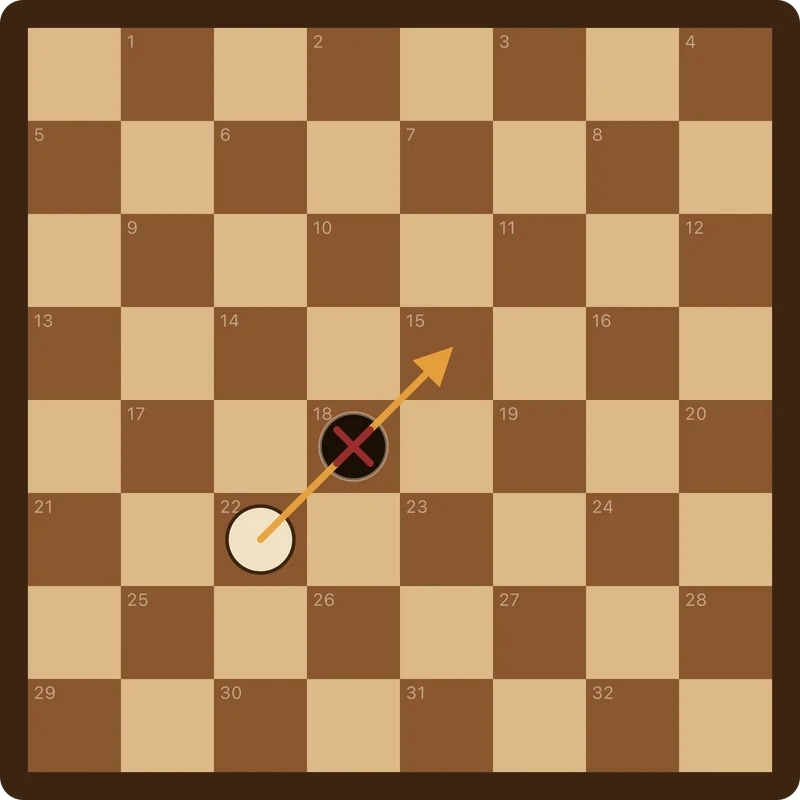
As demonstrated in the diagram above, white’s piece on square 22 has no choice. Even though leaping forward over the black checker on square 18 will land white directly into danger, the laws of the game offer no alternative. In our analysis of checkers strategy, we explore how masters weaponize this forced obedience to construct breathtaking multi-piece combinations.
What was “huffing,” and why was it abolished?
If jumping is mandatory, what happens when a player simply overlooks a capture and makes an ordinary move instead?
This is where the legendary rule of “huffing” (also called “blowing the piece”) enters the discussion. For generations, casual players were taught that if your opponent failed to jump, you could shout “Huff!”, pick up the offending piece, remove it from the board as a penalty, and then take your own turn. In France, the phrase souffler n’est pas jouer (“to blow is not to play”) became an everyday proverb.
Huffing was indeed a legitimate rule during the eighteenth and nineteenth centuries. When William Payne published the first authoritative English treatise on the game in 1756 [2], followed by Joshua Sturges in 1800 [3], the laws permitted a player whose opponent neglected a jump to choose between three remedies:
- Huff the offending checker off the board as a penalty.
- Insist that the opponent retract the illegal move and complete the jump.
- Allow the quiet move to stand and continue play.
The term “huff” came from the charming old custom of blowing a breath of air onto the confiscated piece before tossing it into the box. While colorful, huffing proved disastrous for serious competition. It turned tournaments into games of visual deception. Players would deliberately make distracting gestures, hoping their opponent would miss an obscure jump so they could snatch a free piece.
Consequently, in official tournament codes established during the twentieth century, huffing was completely abolished [4]. Under modern World Draughts Federation standards and national club rules, an illegal quiet move that ignores a capture is simply invalid. If you overlook a jump, your opponent cannot take your piece. Instead, the referee or opponent requires you to take back the illegal move and play the compulsory capture. You are penalized with positional reality, not the arbitrary loss of a checker.
Can an ordinary checker jump backwards?
Another frequent argument arises when a piece leaps in reverse to capture an enemy checker. One player cries foul, insisting that only kings can move backward, while the opponent insists backward leaps are entirely legal.
Who is right? Both, depending on which national game they grew up playing.
In standard English draughts, codified by William Payne in 1756 [2], uncrowned pieces (men) move diagonally forward and can capture forward only. If an enemy checker slips behind your forward line, an ordinary man cannot turn around to jump it. Only a crowned king possesses the power to move or capture in reverse.
However, in many of the world’s most popular regional traditions, ordinary men have always possessed backward capture rights:
- International Draughts (10x10): Played on a 100-square grid across continental Europe, Africa, and parts of the Americas, ordinary pieces move forward only, but they may leap backward to capture opposing pieces [5].
- Russian Shashki: Played widely across Eastern Europe and Central Asia, men step forward only, but jump both forward and backward. If an ordinary piece reaches the back row during a multi-jump sequence, it promotes to a crowned dama immediately and continues jumping as a king in the exact same turn [4].
- Brazilian Checkers: Played on the standard 8x8 board, Brazilian draughts adopts the full rule set of International draughts, meaning men can leap backward to capture.
When players bring their childhood habits from Russian shashki or International draughts to an English draughts board, arguments flare up instantly. This is why exploring checkers variants is so illuminating: clarifying which variant is on the table before the first move prevents endless frustration.
Flying kings versus single-step kings
The powers of a crowned king represent another major divide between kitchen-table play and international practice.
In English draughts, a king is simply an ordinary piece that has earned the right to step and jump backward. Its range remains strictly local: it moves exactly 1 square diagonally and jumps over single adjacent pieces onto the immediate square beyond [5]. It cannot fly across the board or leap over pieces at a distance.
In contrast, most Continental and Mediterranean games feature “flying kings” (known as damas volantes in Spanish or damka in Russian):
- A flying king can slide across any number of unoccupied diagonal squares in a single stride, much like a bishop in chess.
- When capturing, a flying king can leap over an isolated enemy piece located several squares away along an open diagonal, landing on any vacant square beyond it.
There is also a fascinating exception in Italian dama: an ordinary man (pedina) is strictly prohibited from capturing a king (dama) [1]. In Italian rules, a crowned king enjoys complete immunity from capture by uncrowned pieces. If your opponent has a king and you only have men, you cannot jump their king under any circumstances; only another king can capture a king. In almost every other draughts game, including English draughts, any ordinary piece can jump and capture a king as long as the leap geometry is valid.
The majority capture rule: must you take the most pieces?
Imagine a position where you have two different captures available. One path lets your checker jump a single enemy piece. Another path allows your king to leap through a chain of 3 pieces. Do you have the freedom to choose, or are you compelled to take the larger haul?
In English draughts, you are free to choose whichever capture path you prefer. As long as you complete a legal jump, the laws do not dictate which capturing piece or line you select. If taking 1 piece preserves your defensive structure while taking 3 pieces leaves your king stranded, you may happily choose the single capture.
In International draughts, however, Article 3 of the official FMJD rules enforces the strict majority capture rule (loi de la majorité) [5]. A player must always choose the sequence that captures the greatest quantity of pieces. If one path takes two pieces and another takes three, playing the two-piece jump is an illegal move.
Spanish draughts (damas españolas) takes this mathematical precision a step further with its famous dual principles [4]:
- The Law of Quantity (ley de la cantidad): You must capture the largest number of pieces available.
- The Law of Quality (ley de la calidad): If two different paths offer an equal number of captured pieces, you must choose the line that captures the highest number of kings.
Understanding these rules transforms how combinations are calculated. What would be a sound defensive move in an English checkers club is an outright illegal infraction on an International or Spanish board.
Are you trapped or stalemated? Checkers endgames versus chess
In chess, if you have no legal moves on your turn and your king is not in check, the game ends immediately in a stalemate, which counts as a draw. Many casual checkers players assume that the same courtesy applies when their checkers are completely boxed in.
In checkers, running out of moves is never a draw. Under the standard rules established by Joshua Sturges in 1800 [3], a player who has no legal moves remaining on their turn immediately loses the game. Whether your pieces have all been captured or your surviving checkers are completely hemmed in against the board edge, the result is identical: a decisive loss by blockage.
So how does a draw actually happen in checkers?
- Agreed draws: When neither player can force an advantage, both sides can agree to conclude the game as a draw.
- Repetition: When the same board position occurs three times with the same player to move.
- Move limits: When a set number of moves (typically 40 moves) passes without a piece being captured or a man advancing toward the king row.
- Theoretical book draws: Positions where neither side has sufficient material to force a win against accurate defense.
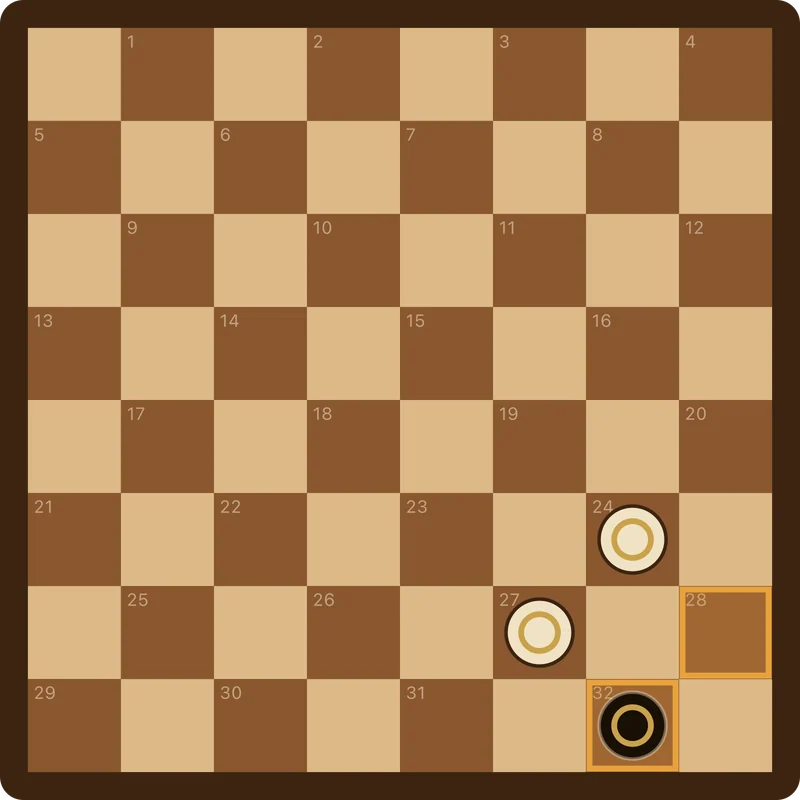
The most famous theoretical draw in draughts is the classic double-corner defense, first analyzed in detail by William Payne in 1756 [2]. As shown in the diagram above, an endgame featuring 2 kings against 1 lone enemy king is a theoretical draw if the defending king reaches the double corner (squares 1 and 5, or squares 28 and 32 in standard notation).
Because the double corner provides two adjacent dark squares along the board edge, the single king can shuttle back and forth between squares 28 and 32 indefinitely. The two attacking kings cannot drive the defender out without offering an exchange or allowing the king to slip away. Unless the lone king blunders into the fatal “single corner” (square 4 or 29), two kings can never force a checkmate against a knowledgeable player.
Is checkers solved? What the mathematics proved
For centuries, checkers players debated whether the player moving first possesses an unstoppable mathematical advantage, or whether the game is fundamentally balanced.
That long-standing dispute was answered once and for all in 2007, when a team of computer scientists led by Jonathan Schaeffer at the University of Alberta published their landmark paper in the journal Science [6]. After an 18-year computational proof involving hundreds of computers calculating over 500 billion billion positions, Schaeffer’s team proved that checkers is a weakly solved game.
With perfect play by both sides from the standard 24-piece starting layout, the outcome is always a draw. Checkers is not a game where White or Black has a hidden forced win. Every game that ends in victory does so because one human player committed an inaccuracy that the other successfully exploited.
Tracing the history of checkers from medieval alquerque boards to supercomputing proofs reveals a game of extraordinary resilience. Whether you are playing casual matches with friends or competing in rated games online, knowing the official rules gives you the confidence to enjoy every tactical clash without argument.
To test your knowledge on a pristine digital board where forced jumps and promotions are handled with absolute accuracy, you can play checkers online today and experience the timeless depth of competitive draughts.
Questions people ask
Is jumping mandatory in checkers?
Yes. In all official competitive rules of checkers (English draughts, American checkers, and International draughts), jumping is compulsory. Whenever a legal capture is available on your turn, you must take it; you cannot choose to make an ordinary non-capturing move.
What is the huffing rule, and is it still used?
Huffing was an old eighteenth- and nineteenth-century rule where a player who caught their opponent overlooking a jump could remove the offending piece from the board as a penalty. Modern tournament rules completely abolished huffing over a century ago. Under modern rules, the illegal move is simply retracted and the forced jump must be played.
Can an ordinary checker piece jump backwards?
In standard English draughts (American checkers), ordinary uncrowned pieces can only move and capture forward. However, in International draughts (10x10), Russian shashki, and Brazilian checkers, ordinary men are allowed to jump backward to capture enemy pieces.
Can a king fly across the board in checkers?
In English draughts, kings move and jump only one diagonal square at a time. In International draughts, Russian shashki, Spanish damas, and Turkish dama, kings are flying kings that can slide across any number of open diagonal or orthogonal squares.
Can two kings beat one king in checkers?
If the lone defending king reaches the double corner (squares 1 and 5, or 28 and 32), two kings cannot force a win against correct defense; the position is a theoretical draw. However, if the lone king is caught away from the double corner or in the single corner, two kings can trap it and win.
Sources
- Encyclopaedia Britannica. “Checkers: Game Rules, Variants, and History.”
- Payne, W. (1756). An Introduction to the Game of Draughts. London: Printed for the Author.
- Sturges, J. (1800). Guide to the Game of Draughts. London: Printed for the Author.
- Murray, H. J. R. (1952). A History of Board-Games Other than Chess. Oxford: Clarendon Press.
- World Draughts Federation (FMJD). “Official Rules of International Draughts and World Draughts Standards.”
- Schaeffer, J., Burch, N., Björnsson, Y., Kishimoto, A., Müller, M., Lake, R., Lu, P., & Sutphen, S. (2007). “Checkers Is Solved.” Science, 317(5844), 1518–1522.
- Boardgammon. “Checkers Rules: How to Play, Movement, and Captures.”
- Boardgammon. “Checkers Variants: The Kinds of Draughts Played Around the World.”
- Boardgammon. “Checkers Crown: Play Online Checkers and Regional Draughts Variants.”
- Boardgammon. “Play Checkers Online: Free Browser and Mobile Draughts.”
Found a mistake or an odd phrase? Tell us