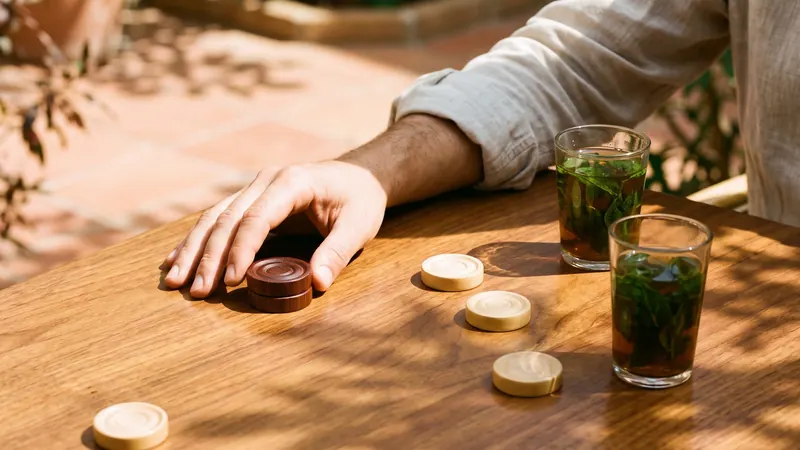
Sit down across from a Russian checkers player, look at the table, and nothing warns you that the game has changed. You see the standard 8×8 checkerboard of 64 squares, 12 round discs per player arranged on the 32 dark squares of the first three rows, and two empty ranks in the center. If you grew up in the United States playing straight checkers (or draughts in Britain), your hand reaches for a dark piece first, your eyes scan only forward for jumps, and you treat the back row as a stop sign where a newly crowned piece ends its turn.
In Russian checkers (russkie shashki, called Russian draughts in Britain and international tournaments), those habits walk straight into traps. Cognitive psychologist Stephen Monsell showed in a 2003 review of laboratory task-switching experiments that applying two rule sets to identical (“bivalent”) visual stimuli creates a measurable switch cost: slower responses and carry-over errors from the old rule set, even when you prepare in advance[1]. Monsell studied simple laboratory tasks rather than board games or medical health, yet anyone switching among the eight checkers variants feels that exact interference[2]. Because the 64-square grid and 24 discs look unchanged, straight-checkers habits make you miss an uncrowned man jumping backward, while Pool-checkers habits make you stop on the eighth rank right when a newborn king must keep capturing.
How do the five rule switches separate Russian checkers from American and Pool checkers?
Russian checkers uses the same board orientation as American straight checkers: dark square a1 (square 29 in 1–32 numbering) sits at White’s bottom-left corner, 12 men per side fill the first three ranks, and eight empty dark squares span the two middle rows[3]. Five switches change how those 24 pieces fight:
- White moves first. Under the rules of English checkers, the darker color starts with one of seven legal openings[4]. In Russian draughts, White moves first with seven symmetrical third-rank advances (
a3-b4,c3-b4,c3-d4,e3-d4,e3-f4,g3-f4, org3-h4), compared with nine White openings on the 100-square, 50-dark-square, 40-piece board of International 10×10 draughts[3]. - Uncrowned men step forward, yet capture forward and backward. On a non-capturing move, a regular man (prostaya) slides one diagonal square forward. Whenever an enemy piece sits diagonally adjacent with an empty square immediately beyond it, however, an uncrowned man captures forward or backward.
- Kings (damki) fly any distance along open diagonals. A crowned piece (damka, plural damki, from French dame) slides and jumps across any number of empty dark squares forward or backward. After jumping an enemy piece, a flying king may land on any vacant square beyond it along the same diagonal, unless one specific square is required to continue a mandatory multi-jump[3].
- Captures are mandatory, choice is free, and jumped pieces act as stoppers. If a jump exists, you must jump and continue with that piece until no jumps remain. Unlike Brazilian 8×8 or International 10×10 draughts, Russian shashki has no majority rule: given a choice between capturing one piece and capturing three, you pick either path freely[3]. Jumped pieces stay on the board until the entire turn ends (the “Turkish strike” rule). You may cross an empty square more than once, never jump the same enemy piece twice in one turn, and never reverse 180 degrees directly back over a piece[5].
- Mid-jump crowning continues the same turn. If an uncrowned man lands on the far rank (
b8,d8,f8, orh8on the eighth rank for White;a1,c1,e1, org1on the first rank for Black) during a capture, it promotes immediately into a flying king and must keep capturing in the same turn if a king jump is open[3].
Comparing the four main 8×8 diagonal games shows where each rulebook splits[2]:
| Rule axis | English / American checkers | American Pool checkers (APCA) | Brazilian draughts | Russian checkers (shashki) |
|---|---|---|---|---|
| Setup | 8×8 (32 dark squares), 12 men | 8×8 (32 dark squares), 12 men | 8×8 (32 dark squares), 12 men | 8×8 (32 dark squares), 12 men |
| First move | Darker color (7 openings) | White (7 openings) | White (7 openings) | White (7 openings) |
| Men capture | Forward only | Forward and backward | Forward and backward | Forward and backward |
| Kings | Short (1 diagonal step) | Flying (any open distance) | Flying (any open distance) | Flying (any open distance) |
| Capture choice | Free choice | Free choice | Majority rule (longest forced) | Free choice |
| Back row mid-jump | Crowns; turn ends | Crowns; turn ends | Stays uncrowned in passing | Crowns and keeps jumping as king |
Notice how close American Pool checkers sits to Russian shashki: governed by the American Pool Checkers Association (APCA), Pool checkers shares White moving first, men jumping backward, flying kings, and free capture choice, diverging only on mid-jump crowning and its 13-move three-kings-versus-one clock[2].
How does mid-jump crowning turn one capture into a three-piece sweep?
That promotion rule looks small on paper until you put five pieces on the board and watch four rulebooks split on move one.
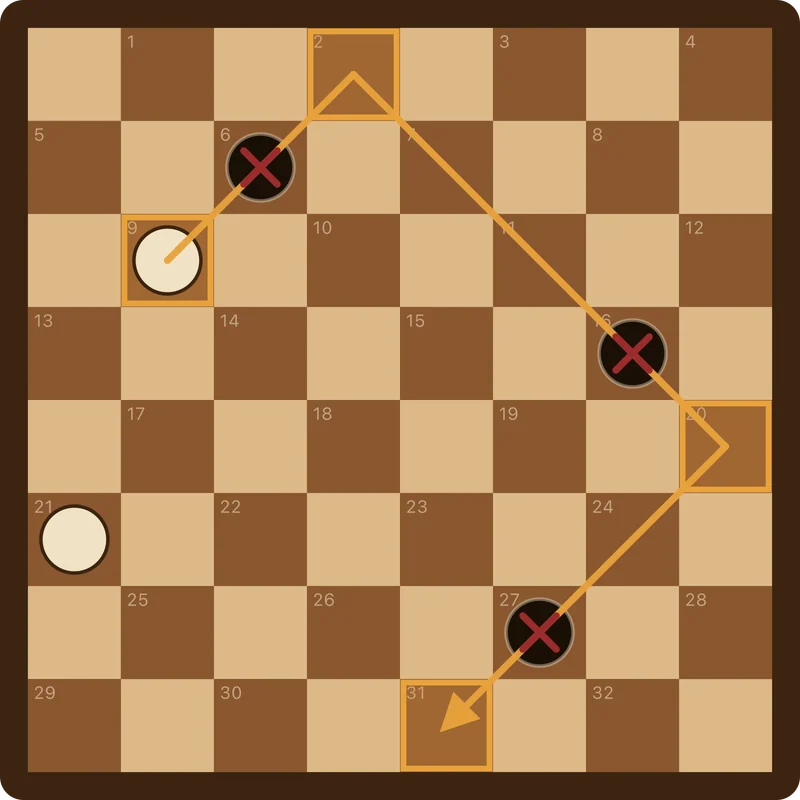
In this verified position with White to move, White holds uncrowned men on b6 (square 9) and a3 (square 21) against Black uncrowned men on c7 (square 6), g5 (square 16), and f2 (square 27)[6]. White’s b6 man must jump c7 onto the back-rank square d8 (square 2).
Here is what happens next across the 8×8 family[6]:
- English checkers and APCA Pool checkers: White plays
b6:d8(9x2), capturesc7, crowns ond8, and stops. Black’s men ong5andf2stay alive, andf2crowns next turn. - Brazilian draughts (and 10×10 International rules): passing through the crown row does not promote a man; it could continue from
d8only if a short one-step man jump existed. Becausee7(square 7) is empty, White’s turn ends atb6:d8(9x2) with one captured piece, crowning only after stopping[6]. - Russian checkers (shashki): White plays
b6:d8:h4:e1(9x2x20x31) and clears the board[6]. Landing ond8(square 2) promotes the man mid-turn into a flying damka. Continuing the same move, the new king flies across two empty squares (e7/ square 7 andf6/ square 11) to jumpg5(square 16) ontoh4(square 20), pivots downh4–e1, and flies across emptyg3(square 24) overf2(square 27) ontoe1(square 31), removing all three Black men in one continuous turn.
That single rule turns the three inner squares just in front of the crown row (c7, e7, and g7 when White attacks; b2, d2, and f2 when Black attacks) into live springboards. Shashki combinations routinely sacrifice two men just to drag an enemy defender onto one of those squares and launch a mid-turn king across the board—a pattern you can practice directly in our four interactive Russian draughts lessons[2].
How did shashki go from a 1551 Moscow ban to a Soviet tournament sport?
Medieval Rus’ players moved wooden and bone discs centuries before printed rulebooks existed, and church authorities long treated board games with suspicion. In 1551, Moscow’s Stoglav Synod under Ivan IV banned both chess and shashki[7]. Tsar Alexis’s 1649 legal code (Sobornoye Ulozheniye) lifted the prohibition, and at the start of the 18th century Peter I built shashki tables into his court assemblies[7].

Russian literature and scholarship embraced the game in the early 19th century. Historian Nikolay Karamzin printed Russia’s first checkers essay in 1803, and in 1827 St. Petersburg master Alexander Dmitrievich Petrov (1794–1867) published the first Russian checkers book[8][7]. Alexander Pushkin wrote the game into poetry, while Nikolai Gogol’s 1842 novel Dead Souls staged a famous scene of Nozdryov trying to cheat Chichikov over a shashki board[7].
Before 1884, local customs still clashed over fuk (“huffing”), one of the classic checkers rules that start arguments, where missing a jump let your opponent remove the offending piece. In 1884, Mikhail Gonyaev (1849–1891) published Russia’s first unified code in Raduga (Nos. 15–16), abolishing fuk and enforcing mandatory capture[7]. Kiev organizer Pavel Bodyansky then ran the first All-Russian Championship in Moscow in 1894: eight players competed over two rounds, Sergey Vorontsov and Fyodor Kaulen shared first place, and subsequent championships drew 14 players in 1895, 12 in 1898, and 15 in 1901[7]. Bodyansky also launched Kiev’s monthly Shashki in 1897, issuing more than 50 numbers across five years[7].
Organized Soviet competition scaled shashki nationwide. Vasily Medkov won the first USSR Men’s Championship in 1924 (20 players), Ekaterina Sushchinskaya won the first Women’s Championship in 1936 (20 players), the Unified Code appeared in 1937, and before World War II more than 100,000 registered players competed in clubs[7]. Riga’s magazine Shashki published 330 issues from 1959 to 1992, Zinovy Tsirik became the first USSR Grandmaster in 1961, the youth circuit Chudo-shashki began in 1966, and from 1924 through 1991 the USSR staged 51 men’s and 35 women’s national championships[7].
To curb memorized draws among masters, Vladimir Gagarin’s two-game micro-matches debuted in 1972 alongside drawn opening ballots and “flying draughts” (letuchie shashki), where one piece per side starts on a balloted square[7]. International Draughts-64 world titles began under Brazilian rules in 1985, the first World Championship in Russian draughts followed in 1993, and Africa hosted its first Draughts-64 Championship in 2016[5]. Two sister games share the exact Russian ruleset: Poddavki (giveaway checkers, won by losing or blocking all your pieces) and Bashni (tower checkers, where jumped pieces tuck underneath the capturer into multi-piece stacks led by the top disc)[5].
How do Russian players map the 32 dark squares, and how does Petrov’s Triangle beat the 15-move clock?
When you study how checkers endgames work in straight English checkers, short kings inch into double corners step by step. With flying kings, control belongs to entire diagonal highways. Russian endgame manuals divide the 32 dark squares into four named systems[9]:
- Bol’shaya doroga (“the Great Road,”
a1–h8): the eight-square corner-to-corner main diagonal. - Dvoyniki (“double diagonals,”
a7–g1andb8–h2): the two seven-square diagonals running perpendicular to the Great Road and crossing it atd4ande5. - Troyniki (“triple diagonals,”
a3–f8andc1–h6): the two six-square diagonals intersecting the dvoyniki at four key squares:c5(square 14),d6(square 10),e3(square 23), andf4(square 19). - Kosyak (“the corner frame,”
a5–d8–h4–e1): the four-corner perimeter linkinga5(square 13),d8(square 2),h4(square 20), ande1(square 31).
Two flying kings cannot defeat one lone king on an open board, making three kings against one the essential winning endgame. Building on Pedro Ruiz Montero’s 1591 Spanish Pé de Galo (“rooster’s foot”) study, Petrov proved in 1827 that three flying kings holding a1–h8 catch a lone king in 12 moves or fewer—and within 15 moves even when seizing the second dvoynik takes until move seven or eight[8][9].
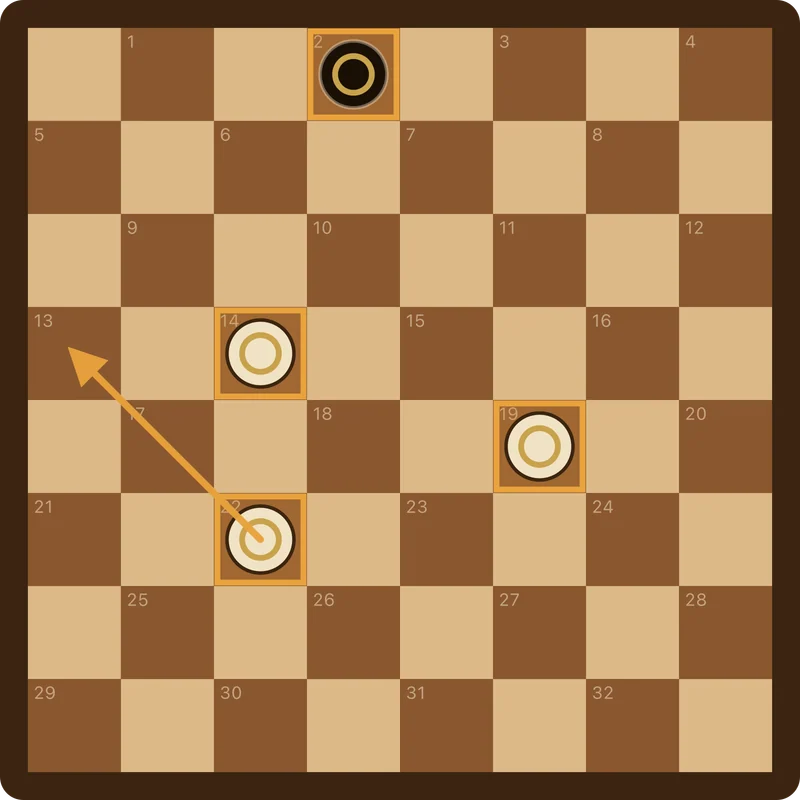
The decisive net is Petrov’s Triangle, shown above with White flying kings on c3 (square 22), c5 (square 14), and f4 (square 19) against Black’s lone king on d8 (square 2)[6]. White forces victory in at most four moves with 1. c3-a5! (22-13; Montero’s 1. f4-d2! / 19-26 also wins in four)[6][9]:
- Immediate traps:
1...d8-c7or1...d8-b6falls to2. a5:d8or2. a5:c7;1...d8-e7loses to2. c5:f8;1...d8-g5loses to2. f4:h6. - If
1...d8-f6(2-11): White pitches two kings to decoy Black ontob6:2. c5-e7!(14-7, forcing2...f6:d8), then3. f4-c7!(19-6, forcing3...d8:b6), and4. a5:d8(13x2) wins[6]. - If
1...d8-h4(2-20): White mirrors the double sacrifice on the opposite wing:2. c5-f2!(14-27, forcing2...h4:e1),3. f4-d2!(19-26, forcing3...e1:c3or3...e1:b4), and4. a5:e1(13x31) finishes[6].
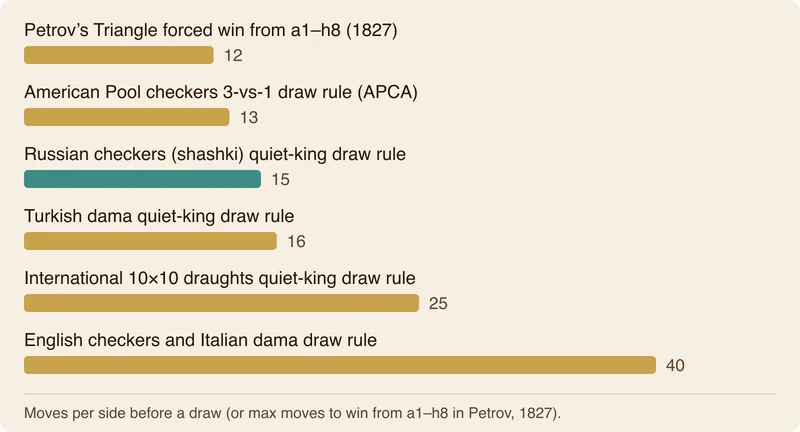
Petrov’s 12-move ceiling explains why tournament draw clocks vary so sharply across traditions[9][2]. APCA Pool checkers gives three kings a razor-thin 13 moves to catch one lone king. Russian shashki declares a draw on threefold repetition or after 15 quiet king moves per side without captures or man moves (also the three-kings-versus-one limit), compared with 16 moves in orthogonal Turkish dama, 25 moves on the 50-square International 10×10 board, and 40 moves in short-king English checkers and Italian dama[2].
Is Russian checkers solved, and what does research show about board games and aging?
Readers familiar with how Jonathan Schaeffer solved English checkers sometimes assume every 8×8 checkers variant is solved too. In 2007, Schaeffer and colleagues weakly solved 8×8 English checkers as a draw after 18 years of computation (1989–2007) across roughly 5 × 10²⁰ positions (500 billion billion, about 1,000,000 times Connect Four, backed by a 39-trillion-position 10-piece endgame database)[10]. Because men jumping backward, flying kings, and mid-jump crowning create a completely different game tree, that proof does not cover Russian checkers, which still has no published starting-position proof[10][7].
What do long-running cohort studies actually measure when they follow board-game players into older age? Two major observational cohorts report real correlations alongside clear limits on cause and effect:
- Jean-François Dartigues and colleagues (2013) tracked 3,675 dementia-free French older adults (32.2% regular board-game players, including checkers) for 20 years, recording 840 dementia cases[11]. Adjusted for age, sex, and education, players showed a 15% lower hazard of dementia (HR 0.85, 95% CI 0.74–0.99, p = 0.04), slower Mini-Mental State Examination decline (β = 0.011, p = 0.03), and lower incident depression (HR 0.84, 95% CI 0.72–0.98)[11]. Once baseline cognitive scores and baseline depression were controlled, however, the dementia hazard ratio became statistically non-significant (HR 0.96, 95% CI 0.82–1.12, p = 0.61): because the study was observational, those figures reflect baseline differences rather than a causal effect on dementia[11].
- Drew Altschul and Ian Deary (2020) followed 1,091 Scottish adults born in 1936 across 14 cognitive tests over 68 years (at age 11 and ages 70, 73, 76, and 79)[12]. After the authors controlled for age-11 scores, education, sex, social class, activity, and health, playing analog games more often at ages 70 and 76 correlated with slightly less relative cognitive decline from age 11 to 70 and slower memory and speed decline from 70 to 79, though an observational design still cannot prove causation[12].
- Meanwhile, Giovanni Sala and Fernand Gobet’s 2017 review of meta-analyses on chess, music, and working-memory training found that “far transfer” drops toward zero against active control groups, showing zero effect on general IQ or classroom grades[13]. Practicing shashki sharpens shashki calculation at the board: spotting pre-crown launching squares, tracking stopper pieces, and closing Petrov’s Triangle inside 15 moves.
On Checkers Crown, you can play checkers in your browser or on iOS and Android across 11 interface languages[14][15]. Rated online matchmaking runs unified on 8×8 English checkers (10+5 clock) so players share one fast pool, while Russian checkers and the other seven variants are ready offline against the computer, in two-player pass-and-play, and in the four-lesson interactive course[2].
Questions people ask
Who moves first in Russian checkers, and how is the board set up?
White moves first in Russian checkers, choosing among seven diagonal third-rank advances, whereas the darker color moves first in American straight checkers[3]. Orient the 8×8 board with a dark square (a1, square 29) at White’s bottom-left corner, placing 12 men per player on the dark squares of the first three ranks[3].
Do you have to jump the most pieces in Russian checkers?
No. Capturing is mandatory whenever a jump is available, and the jumping piece must continue until no further jumps remain, but Russian checkers has no majority rule[3]. Unlike Brazilian 8×8 and International 10×10 draughts, you choose freely between a shorter capture and a longer one[2].
How does American Pool checkers differ from Russian shashki?
Both games use the 8×8 dark-square setup with White moving first, men capturing backward, flying kings, and free capture choice[2]. In APCA Pool checkers, landing on the back row mid-jump crowns the man and immediately ends the turn, and three kings get 13 moves to beat a lone king; in Russian shashki, a man crowning mid-jump continues capturing as a flying king in the same turn, with a 15-move quiet-king and three-kings-versus-one draw limit[2].
Can a flying king jump the same piece twice during one turn?
Never. Jumped enemy pieces remain on their squares as wooden stoppers until the full multi-jump turn finishes[5]. A flying king may cross an empty square more than once while changing diagonals, yet it can never jump the same piece twice or reverse 180 degrees directly back over a piece[5].
What are Poddavki and Bashni?
Both are Russian sister variants using identical movement, flying-king, and mid-jump crowning rules[5]. Poddavki is giveaway checkers, where losing all your pieces or having no legal move wins the game; Bashni (tower checkers) tucks each jumped piece underneath the capturer to form multi-piece stacks controlled by whichever color sits on top[5].
Sources
- Monsell, S. (2003). “Task switching.” Trends in Cognitive Sciences, 7(3), 134–140.
- Boardgammon. “Checkers Variants Around the World.”
- Boardgammon. “Russian Draughts Rules — Шашки (Shashki).”
- Boardgammon. “Checkers Rules: Board Setup, Forced Captures, Kings, and Draws.”
- Wikipedia contributors. “Russian draughts.” Wikipedia, The Free Encyclopedia.
- Boardgammon. “Exact 8×8 Russian draughts move-tree verification for mid-jump crowning (9x2x20x31) and Petrov’s Triangle ([c3, c5, f4] vs. d8).”
- Авторы Википедии. «Русские шашки». Википедия, свободная энциклопедия.
- Petrov, A. D. (1827). Rukovodstvo k osnovatel’nomu poznaniyu shashechnoy igry, ili Iskusstvo obygryvat’ vsekh v prostye shashki [Guide to a Thorough Knowledge of the Game of Draughts]. St. Petersburg: Tipografiya Smirdina.
- Авторы Википедии. «Треугольник Петрова». Википедия, свободная энциклопедия.
- Schaeffer, J., Burch, N., Björnsson, Y., Kishimoto, A., Müller, M., Lake, R., Lu, P., & Sutphen, S. (2007). “Checkers Is Solved.” Science, 317(5844), 1518–1522.
- Dartigues, J.-F., Foubert-Samier, A., Le Goff, M., Viltard, M., Amieva, H., Orgogozo, J.-M., Barberger-Gateau, P., & Helmer, C. (2013). “Playing board games, cognitive decline and dementia: a French population-based cohort study.” BMJ Open, 3(8), e002998.
- Altschul, D. M., & Deary, I. J. (2020). “Playing Analog Games Is Associated With Reduced Declines in Cognitive Function: A 68-Year Longitudinal Cohort Study.” The Journals of Gerontology: Series B, 75(3), 474–482.
- Sala, G., & Gobet, F. (2017). “Does Far Transfer Exist? Negative Evidence From Chess, Music, and Working Memory Training.” Current Directions in Psychological Science, 26(6), 515–520.
- Boardgammon. “Checkers Crown: Play Checkers Online.”
- Boardgammon. “Checkers Crown: Play Checkers in Your Browser.”
Found a mistake or an odd phrase? Tell us