Every game of chess played across the world begins from an arrangement of thirty-two pieces on sixty-four squares that feels timeless. White faces Black across a checkered battlefield, pawns shield noble officers, knights leap over ranks, and rooks command open files. Yet this familiar battle order is neither ancient immutability nor sudden invention. It is the living culmination of fifteen centuries of cultural migration, strategic debate, and radical reinvention.
To understand why a knight leaps while a bishop sweeps across diagonals, or why the king requires checkmate rather than physical capture, you must trace a journey that crossed three continents. The ancestors of modern chess traveled from the royal courts of northwest India into Sasanian Persia, flourished across the golden age of the Islamic world, traveled through Moorish Spain into medieval Europe, and underwent an explosive rebirth in Renaissance Italy and Iberia. On Chess Moment, players continue a grand intellectual tradition whose origins stretch back to antiquity.
Where did chess begin?
The earliest ancestral game unequivocally recognized by historians as the forebear of chess arose in northwest India during the Gupta Empire around the 6th century CE [1]. In Sanskrit, this strategic contest was named chaturanga, a compound word meaning “four limbs” or “four divisions.”
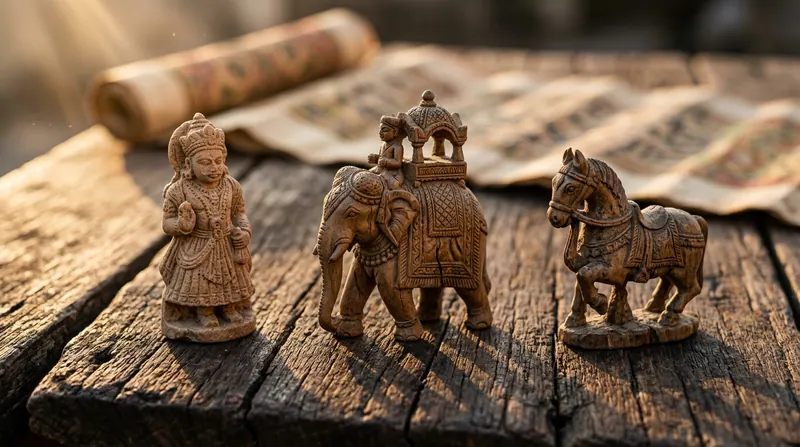
Chaturanga was not merely an abstract board game; it was an artistic military simulation of the classical Indian army described in ancient epics like the Mahabharata. The four military branches represented on the board corresponded to the core divisions of ancient Indian warfare:
- Padati (Infantry): The humble foot soldiers, marching forward one step at a time to clash with the enemy vanguard, represented by modern pawns.
- Ashva (Cavalry): The mounted horsemen, moving with agile leaps to bypass front lines, known today as knights.
- Hasti (War Elephants): Mighty armored pachyderms breaking through fortifications, the direct ancestors of modern bishops.
- Ratha (Chariots): Swift two-wheeled war chariots patrolling broad flanks with unstoppable speed, which became modern rooks.
At the head of this four-fold army stood the Raja (king) alongside his chief counselor or general (Mantri). Unlike earlier race games with dice, such as those found in the ancient Near East and detailed in our exploration of the history of backgammon, chaturanga was a battle of pure tactical positioning played on an uncheckered 8x8 grid called an Ashtapada.
The Ashtapada board was originally used for older Indian games, but the inventors of chaturanga seized upon its sixty-four squares as the ideal arena for military maneuvers. Although some regional variants employed four separate armies controlled by four players, standard Indian chaturanga soon crystallized into a two-sided contest of skill. There were no dice to govern fortune; victory belonged entirely to the commander who could outwit their counterpart.
How did Persia adopt the game as chatrang?
During the late 6th century, chaturanga crossed the Hindu Kush along bustling commercial caravan routes into the Sasanian Empire of Persia [1]. Middle Persian texts preserve vivid accounts of this cultural exchange. The historical treatise Wizārishn ī Chatrang ud Nēw-Ardashīr (“The Explanation of Chess and the Invention of Backgammon”) recounts that an Indian embassy sent by King Dewasarm arrived at the court of Persian King Khosrow I (who reigned from 531 to 579 CE).
The Indian emissaries presented an ebony and ivory game board, challenging the wise viziers of the Persian court to decipher the hidden logic of the pieces without instructions. According to legend, the brilliant Persian chancellor Buzurgmihr solved the game’s movement rules and triumphed over the visiting masters. In return, Buzurgmihr invented the Persian game of Nard (an ancestor of modern backgammon) to demonstrate the philosophical balance between divine destiny and human calculation.
In Persia, the Sanskrit term chaturanga adapted into the Middle Persian chatrang. More importantly, the Persian language bestowed upon chess the vocabulary that defines victory to this day. When a player attacked the enemy sovereign, they declared shah (“king”). When the opposing monarch had no lawful escape from attack, the victor announced shah mat—a Persian phrase translating literally to “the king is helpless” or “the king is paralyzed.” Over centuries of linguistic trade, shah mat entered French as échec et mat, Spanish as jaque mate, and English as checkmate.
What was the golden age of Islamic shatranj?
Following the 7th-century Arab conquest of Persia, the Islamic world embraced the game with extraordinary enthusiasm [2]. In Arabic, the letter combinations of chatrang shifted to shatranj. Across the sprawling Abbasid Caliphate, centered in eighth- and ninth-century Baghdad, shatranj evolved into a celebrated science, high intellectual pursuit, and literary passion.
Islamic scholars regarded shatranj as an instrument for training the intellect in logic, patience, and foresight. Great caliphs hosted international tournaments in their palaces, patronizing grandmasters known as Aliyat (players of the highest rank). The 9th and 10th centuries produced the world’s first systematic chess literature, authored by towering masters such as al-Adli, ar-Razi, and Abu Bakr Muhammad ibn Yahya as-Suli [2].
These classical Arab theorists recognized that the pieces moved quite differently from their modern descendants:
- Shah (King): Moved one square in any direction, identical to modern play, but castling did not yet exist.
- Firzan (Counselor): The piece occupying the modern queen’s square was a male vizier, capable of stepping only 1 square diagonally. It was the weakest officer on the board, suited only for close defense.
- Fil (Elephant): The ancestor of the bishop leaped diagonally over exactly 2 squares. Because it leaped, it could jump over intervening pieces, but it was restricted to only 8 specific squares across the entire sixty-four squares of the board. An opposing piece standing three squares away on a diagonal was completely immune to attack.
- Faras (Horse): Possessed the identical L-shaped jump of the modern knight.
- Rukh (Chariot): Moved along unobstructed ranks and files, exactly like the modern rook.
- Baidaq (Foot Soldier): Marched 1 square forward and captured 1 square diagonally forward. Unlike modern chess, a pawn had no two-square initial leap and could promote only to a modest firzan.
Because the firzan and fil were severely restricted in range, shatranj was a much slower game than modern chess. Pieces took many moves to clash across the center. As a result, early Arab masters bypassed the slow opening phase by developing standardized setup maneuvers known as tabiyat. Players memorized established configurations—such as the Mujannah (flank opening) or Sayyaf (swordsman opening)—before engaging in close-quarters tactical combat.
Arab masters also pioneered the art of the endgame puzzle, known as mansubat (singular mansuba). Masters like as-Suli composed brilliant endgame studies where material was sacrificed to force checkmate. The most famous composition in shatranj history, known as the Mansuba of Dilaram, required White to sacrifice two rooks to deliver a decisive discovered mate with a knight and counselor.
How did chess reach medieval Europe?
By the 10th century, shatranj had traveled across the Mediterranean into Christian Europe along two primary conduits: through Moorish Spain (Al-Andalus) and Norman Sicily [3].
In Moorish Spain, the court of Córdoba became a renowned center of chess learning. Christian, Jewish, and Muslim scholars played together, translating Arabic manuals into Latin and Romance languages. In 1283, King Alfonso X of Castile commissioned his magnificent illustrated manuscript, the Libro de acedrex, dados e tablas (Book of Chess, Dice, and Tables), which documented over one hundred shatranj problems alongside European rules.
As the game swept northward into France, Germany, England, and Scandinavia, European society reshaped the pieces to reflect their own feudal hierarchy:
- The Persian shah remained the King.
- The Arabian firzan (vizier) was reimagined as the Queen, sitting beside the King in royal majesty.
- The Islamic fil (elephant)—an animal unfamiliar to northern Europe—was reinterpreted in England as the Bishop, in France as the Jester (Fou), and in Germany as the Runner (Läufer).
- The faras became the armored Knight (Chevalier or Ritter).
- The rukh was interpreted as a fortified Castle or Rook.
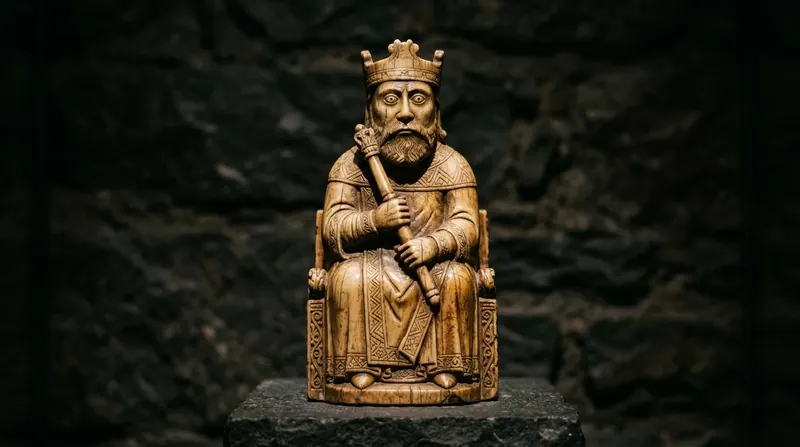
The most famous archaeological testament to this medieval Europeanization is the hoard of Lewis Chessmen, discovered in 1831 on the Isle of Lewis in Scotland [3]. Carved circa 1150–1200 from walrus ivory and whales’ teeth, probably in Trondheim, Norway, these seventy-eight intricately sculpted figures showcase stern kings with broadswords, worried queens resting their chins on their hands, solemn bishops with pastoral staffs, and fierce wild-eyed berserkers biting their shields as rooks.
How did the Renaissance create the modern game?
Despite its immense popularity, medieval European chess remained slow. Games frequently stretched across hours, often concluding in bare-king draws because the weakened counselor and elephant lacked the firepower to finish off an evasive sovereign.
Around the year 1475, a structural change took hold in the intellectual centers of Valencia, Spain, and northern Italy [1]. Humanist scholars and Renaissance court players revised the traditional rules to create a faster, more dynamic contest.
In an overhaul known in Spanish as ajedrez de la dama (“queen’s chess”) or colloquially as scacchi della donna (“mad queen chess”), players altered the geometry of the board:
- The Queen’s Extended Range: The frail, one-step firzan was replaced by the modern Queen, combining the linear power of the rook with the diagonal sweep of the bishop. Over a single move, the queen could now strike across twenty-seven different squares from a central post.
- The Bishop Extended: The two-square leaping elephant was replaced by the modern Bishop, possessing unlimited diagonal range across its color complex.
- The Pawn Advance: To accelerate the opening clash, pawns were granted the option of leaping 2 squares forward on their first move. To prevent pawns from bypassing enemy guards, the en passant capture rule was devised.
- Castling Created: The king, now imperiled by sudden long-range attacks, was granted a defensive sanctuary maneuver: castling, which allowed the monarch and rook to coordinate in a single turn.
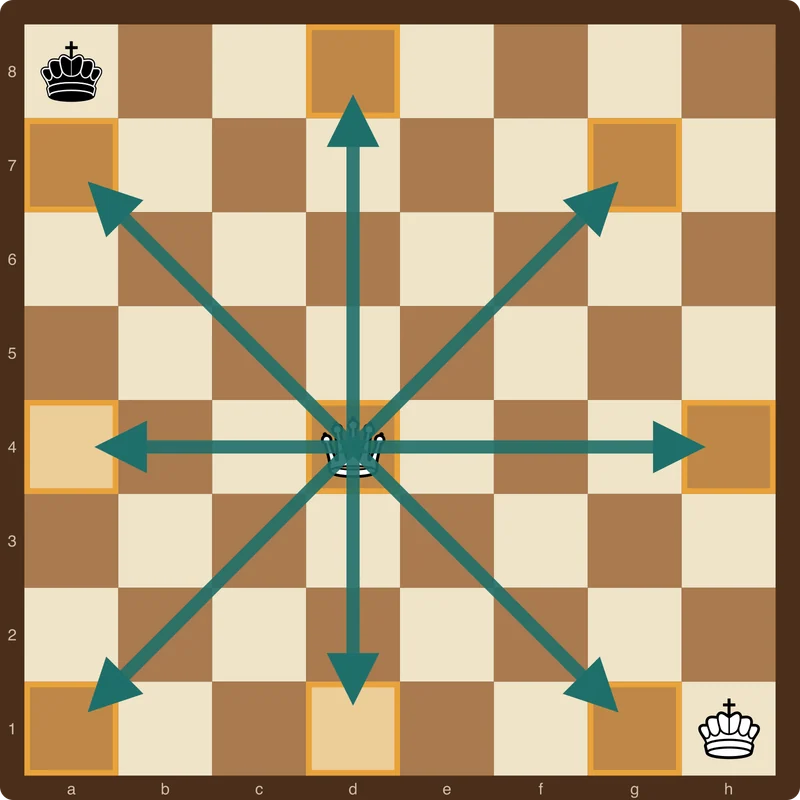
This sudden explosion of tactical violence transformed the game overnight. Openings that took twenty moves in shatranj could now produce a devastating miniature in six turns. Checkmates could strike from across the entire board.
The earliest surviving printed chess book, Luis Ramírez de Lucena’s Repetición de Amores y Arte de Axedres, published in Salamanca in 1497, documented this seismic transition [4]. Lucena explicitly contrasted the juego viejo (the old medieval game) with the juego de la dama (the new queen’s game), analyzing 150 tactical positions that established the foundation of modern endgame theory, including the immortal Lucena position in rook endings.
When did competitive international chess begin?
With rules standardized across Western Europe by the late sixteenth century, chess entered a golden age of international competition. Italian masters like Gioachino Greco in the early seventeenth century and French champion François-André Danican Philidor in the eighteenth century authored influential treatises, famously declaring that “pawns are the soul of chess.”
By the mid-nineteenth century, steamships and telegraphs enabled the first true international tournaments. The landmark London 1851 tournament, organized by English master Howard Staunton, crowned German schoolteacher Adolf Anderssen as the world’s preeminent master [1].
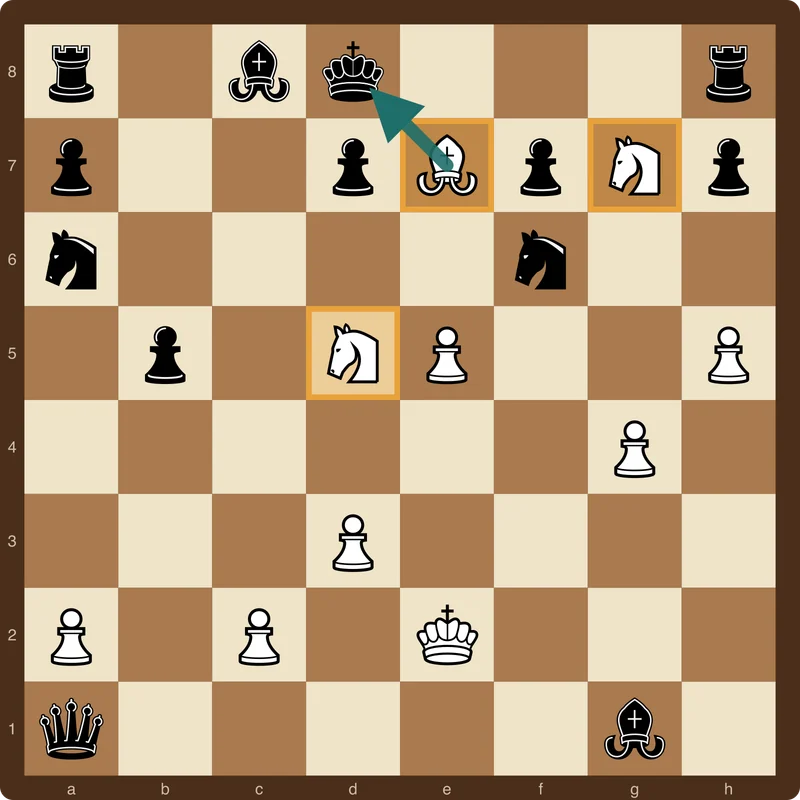
During that 1851 tournament, Anderssen contested an informal match against Lionel Kieseritzky that became known throughout history as the “Immortal Game.” In a breathtaking display of romantic tactics, Anderssen sacrificed both rooks, a bishop, and his queen, ultimately delivering checkmate with his three remaining minor pieces.
The desire for official world recognition culminated in 1886, when Wilhelm Steinitz defeated Johannes Zukertort in the first official World Chess Championship match [1]. Steinitz introduced modern positional theory, proving that tactical brilliance must be grounded in sound pawn structure, king safety, and incremental positional advantages.
In 1924, delegates gathered in Paris to establish the Fédération Internationale des Échecs (FIDE), uniting chess players under the universal Latin motto Gens una sumus (“We are one people”).
How has chess transitioned to the digital age?
Over the past century, chess continued its relentless evolution. The Soviet chess school dominated the twentieth century through rigorous scientific study, producing legends from Mikhail Botvinnik to Garry Kasparov. In 1997, the historic match between Kasparov and IBM’s Deep Blue signaled the dawn of artificial intelligence at the board.
Yet rather than diminishing human enthusiasm, the rise of powerful digital engines catalyzed a worldwide renaissance. Today, millions of players across every continent study master games, solve interactive puzzles, and play rated matches online. Platforms like Chess Moment offer seamless, server-authoritative matchmaking directly in the browser, allowing beginners and seasoned competitors to enjoy chess lessons, study classical opening principles, and play chess online with instant analysis.
From ancient Indian infantry marching on the Ashtapada to modern grandmasters calculating twenty-move combinations on screen, chess remains humanity’s most enduring intellectual dialogue.
Questions people ask about the history of chess
Who invented chess, and is there a single known inventor?
There is no single historical individual credited with inventing chess. The game evolved organically in northwest India around the 6th century CE from earlier military simulations and board games under the Gupta Empire [1]. Persian legends attributed the introduction of the game to King Dewasarm and its analysis to vizier Buzurgmihr, but modern historians recognize that chaturanga developed through centuries of cultural synthesis.
What was the original name of chess?
The original Sanskrit name was chaturanga, referring to the four branches of the ancient Indian army (infantry, cavalry, elephants, and chariots). In Sasanian Persia, the name became chatrang. Following the Arab conquest of Persia, it was adopted into Arabic as shatranj, which eventually evolved into the Spanish ajedrez, the Greek zatrikion, and the Old French esches, from which the English word chess derives.
Why is the queen so powerful compared to other pieces?
In medieval shatranj, the queen was the firzan (counselor), moving only 1 square diagonally. In the late fifteenth century (between 1475 and 1495) in Spain and Italy, players redesigned the game to accelerate play. They granted the queen the combined powers of the rook and bishop, creating a dynamic attacking piece that transformed chess into a faster, more dramatic tactical contest [4].
How old is the standard 8x8 chessboard?
The 8x8 sixty-four-square grid predates chess itself. In ancient India, it was known as the Ashtapada and was used for older board contests before chaturanga was invented in the 6th century CE [1]. Checkering the squares with alternating light and dark colors was introduced in Europe during the tenth and eleventh centuries to make diagonal lines and piece trajectories easier to calculate.
Sources
- Encyclopædia Britannica. “Chess: History, Rules, and Origins.”
- Murray, H. J. R. (1913). A History of Chess. Oxford: Clarendon Press.
- British Museum. “The Lewis Chessmen Collection.” Department of Britain, Europe and Prehistory.
- Lucena, Luis Ramírez de. (1497). Repetición de Amores y Arte de Axedres. Salamanca.
- Boardgammon. “Chess Moment: Play Rated Chess Online.”
- Boardgammon. “Chess Lessons: Master Tactics, Strategy, and Openings.”
- Boardgammon. “Chess Moment: Play Online Chess.”
Found a mistake or an odd phrase? Tell us