When facing White’s classical opening push with 1.e4, many players feel trapped between two extremes. Answering symmetrically with 1...e5 leads into aggressive gambits and sharp tactical battles where a single slip can spell disaster. Choosing the Sicilian Defense with 1...c5 creates dynamic counterplay, but it also invites complicated theoretical warfare that demands constant tactical vigilance.
There is a calmer, deeply resilient alternative that has frustrated attacking players for over a century: the Caro-Kann Defense.
Beginning with the quiet preparatory move 1.e4 c6 [1], Black signals a clear strategic objective. Black does not contest the central e4 square immediately with a piece or create early tactical chaos. Instead, Black uses the c-pawn to support a firm central stake on the very next turn with 2.d4 d5. In our comprehensive survey of chess openings, this strategy stands out as one of the purest demonstrations of classical pawn play.
Understanding the Caro-Kann allows you to establish a rock-solid position, eliminate early tactical vulnerabilities, and guide the game toward a favorable endgame where superior pawn structure decides the outcome.
Why play 1...c6 instead of the French Defense?
The first question new players ask is why Black chooses 1...c6 rather than pushing the e-pawn with 1...e6, the French Defense. Both openings prepare the same central counter-strike with 2...d5, and both build a sturdy pawn barrier in the center.
The decisive difference lies in the fate of Black’s light-squared bishop [1].
In the French Defense, Black plays 1.e4 e6 2.d4 d5. While this structure is resilient, the pawn on e6 creates a permanent traffic jam on the c8–h3 diagonal. Black’s light-squared bishop on c8 becomes a notorious problem piece, often trapped behind its own wall of pawns for twenty or thirty moves. Untangling that bishop requires elaborate maneuvers, and until Black solves the problem, White enjoys greater piece mobility.
The Caro-Kann neatly solves this dilemma on move 1. By advancing the c-pawn to c6 instead of the e-pawn, Black leaves the entire c8–h3 diagonal completely open. After White responds with 2.d4 d5, Black can freely develop the light-squared bishop to active outposts such as f5 or g4 before locking the center with ...e6.
This single geometric advantage defines the personality of the opening. Black secures the central stability of the French Defense without inheriting its most frustrating strategic weakness.
The Classical Variation: harmonious piece development
When White accepts the challenge in the center and develops naturally with 3.Nc3 (or 3.Nd2), the game enters the Classical Variation. After the central exchange 3...dxe4 4.Nxe4, Black arrives at the defining crossroads of the opening.
Here, Black plays the defining move of the system, 4...Bf5 [1].
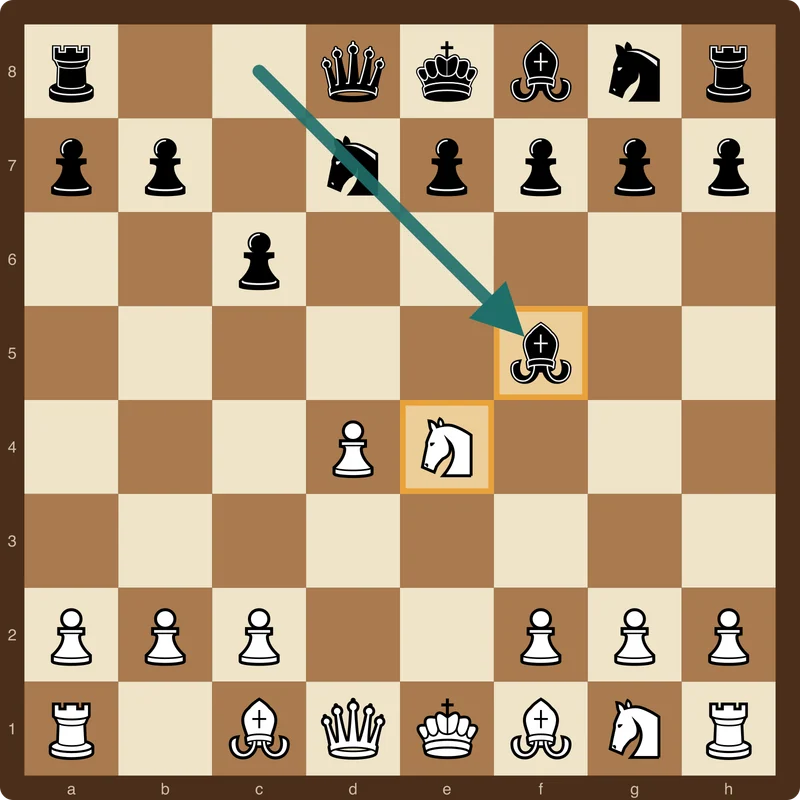
Notice how Black’s bishop immediately challenges White’s centralized knight on e4 while enjoying an unobstructed diagonal. White usually retreats the knight with 5.Ng3, attacking the bishop and gaining a tempo. Black simply drops the bishop back to g6, where it remains safe and actively eyeing the h7–b1 diagonal.
From this solid base, Black’s development proceeds with effortless harmony:
- Black plays e6, cementing control over d5 and creating a solid pawn barrier.
- Black develops the dark-squared bishop to d6 or e7, preparing kingside castling.
- Black develops the king’s knight to f6 or e7.
- Black develops the queen’s knight to d7, reinforcing the center and preventing White from establishing annoying outposts.
White often attempts aggressive pawn storms on the kingside with h4 and h5, but Black meets this calmly with ...h6, securing a safe retreat square on h7 for the bishop. In our structured chess lessons, we emphasize that compactness is not passivity. The Classical Caro-Kann resembles a coiled spring: Black absorbs White’s early pressure with minimal effort, keeps pieces coordinated, and prepares to strike back once White’s initial attack runs out of steam.
The Advance Variation: dismantling White’s center
The most popular weapon against the Caro-Kann at all levels today is the Advance Variation: 1.e4 c6 2.d4 d5 3.e5 [1].
By pushing the pawn to e5, White stakes a claim to space, prevents Black’s knight from settling on f6, and attempts to cramp Black’s position.
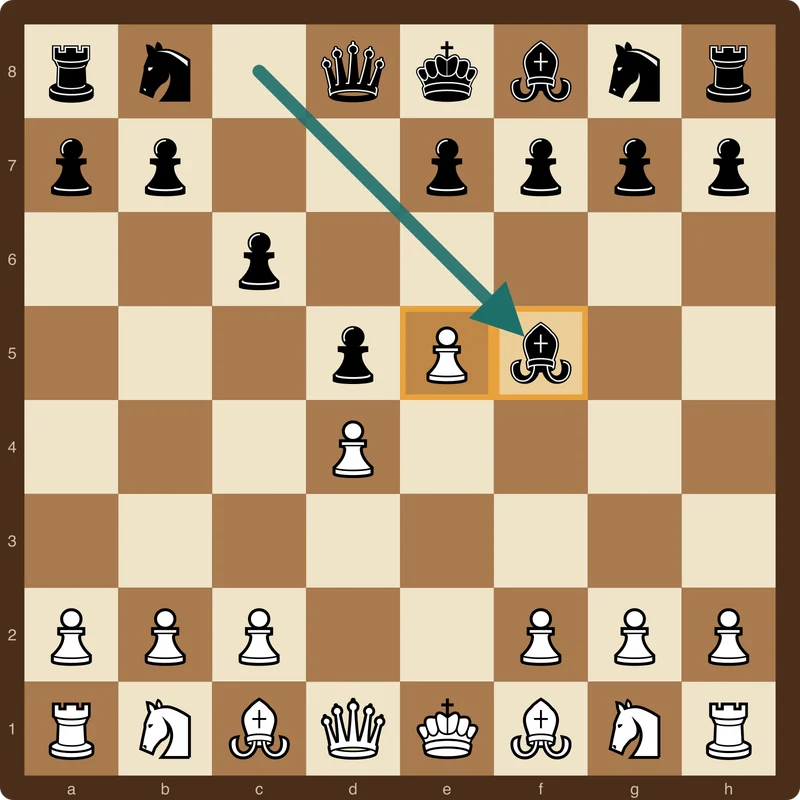
Against this space grab, Black’s first move is automatic: 3...Bf5! Because Black has not played ...e6 yet, the light-squared bishop escapes outside the pawn chain before the door closes. Only after the bishop stands securely on f5 does Black play ...e6, anchoring the center.
Once the bishop is developed and the king’s flank secured, Black immediately launches a counter-offensive against the foundation of White’s pawn chain: the d4 pawn. Black plays ...c5, striking directly at the base of White’s center.
If White attempts to hold d4 with c3, Black follows up with ...Nc6 and ...Qb6, piling irresistible pressure onto the d4 square. In many variations, Black trades pawns on d4 to open the c-file for active rook play, or advances ...c4 to clamp down on the queenside. Far from being a passive defense, the Advance Variation offers Black dynamic, concrete counterplay against an overextended opponent.
Other White setups: Exchange and Fantasy variations
Beyond the Classical and Advance variations, White players will occasionally test you with different setups:
The Exchange Variation (3.exd5 cxd5)
If White prefers to avoid complex maneuvering, trading pawns with 3.exd5 cxd5 relieves all central tension immediately. After the exchange, Black recaptures with the c-pawn, establishing a symmetrical pawn structure. Black develops the knights to c6 and f6, places the bishop on f5 or g4, and plays with complete ease.
White may attempt the sharp Panov-Botvinnik Attack by following up with 4.c4. Here, White accepts an isolated queen’s pawn in exchange for active piece play. Black answers calmly with 4...Nf6 and 5...e6 (or 5...Nc6), establishing firm blockade control over the d5 square. Once Black blockades the isolated d4 pawn, White’s attacking chances evaporate, leaving Black with a decisive structural advantage in the endgame.
The Fantasy Variation (3.f3)
Aggressive attacking players sometimes try 3.f3, hoping to maintain pawns on both e4 and d4 at all costs. While this looks imposing, moving the f-pawn weakens White’s kingside diagonals. Black can strike back boldly in the center with 3...dxe4 4.fxe4 e5!, immediately exploiting the open a7–g1 and h4–e1 lines against White’s exposed king.
The 1880s origins: Caro, Kann, and the Brüderschaft analysis
The opening takes its name from two nineteenth-century chess figures: Horatio Caro, an English-born player who spent much of his life in Berlin, and Marcus Kann, an Austrian master from Vienna [1].
In 1885, at the 4th German Chess Congress in Hamburg, Marcus Kann demonstrated the practical strength of 1...c6 on the international stage by defeating the famous attacking master Jacques Mieses in just 24 moves.
One year later, in 1886, Horatio Caro published the first comprehensive theoretical analysis of the defense in the Berlin weekly chess periodical Brüderschaft. Caro demonstrated that 1...c6 offered Black an exceptionally reliable answer to 1.e4, debunking the contemporary prejudice that only 1...e5 was worthy of serious tournament play. The hyphenated name “Caro-Kann” gained permanent currency in 1890, when German chess master Curt von Bardeleben featured the opening in the Deutsche Schachzeitung.
Why World Champions trusted the rock
Throughout the twentieth century, the Caro-Kann earned a reputation as the ultimate fortress at the highest level of chess. When world championship titles were on the line, the greatest positional minds in the history of the game turned to 1...c6 [1]:
- José Raúl Capablanca, the third World Champion, praised the Caro-Kann for its strategic logic and uncompromised pawn structure. In his 1921 treatise Chess Fundamentals, Capablanca emphasized that maintaining an intact pawn structure without artificial weaknesses allows Black to withstand premature attacks and outplay opponents in simplified positions [2].
- Mikhail Botvinnik, the patriarch of the Soviet chess school, employed the Caro-Kann extensively in his world championship matches, refining the central pawn structures that remain standard theory today.
- Tigran Petrosian, renowned for his iron-clad defensive mastery, used the opening to defuse the most dangerous attackers of his era.
- Anatoly Karpov, whose legendary positional squeeze dominated world chess for a generation, made the Caro-Kann his primary weapon against 1.e4, defeating the world’s elite with patient, microscopic maneuvers.
These champions recognized a fundamental truth: attacking play in chess requires targets. By eliminating structural weaknesses on the first move, the Caro-Kann deprives White of natural attacking targets, forcing opponents to take uncalculated risks to create complications.
Practical guidance for players under 1500
For club players and beginners rated under 1500, opening preparation is frequently misunderstood [3]. Newer players often spend hours memorizing 30 moves of opening lines, only to find that their opponents play an unexpected move on turn 4, rendering their preparation useless.
Games below 1500 are rarely decided by esoteric opening novelties. They are decided by tactical oversight, king safety, and basic piece coordination:
- Avoid unnecessary pawn moves: In the Caro-Kann, your pawn structure is naturally compact. Once your pawns stand on c6, d5, and e6, stop pushing pawns on the flanks until your minor pieces are fully developed.
- Develop your light-squared bishop early: In both the Classical and Advance variations, your top priority is getting the bishop to f5 before playing ...e6. If White plays an early move that threatens to trap the bishop, create a retreat square with ...h6.
- Castle early: Complete your kingside development with ...Nf6 and ...Be7, and castle your king to safety within the first ten moves.
- Target the endgame: When pieces are traded, do not rush to avoid simplification. In a simplified endgame, your compact pawn chain will almost always prove sturdier than White’s overextended pawns. You can sharpen your technique by studying two rook endgames to understand how active rooks convert structural advantages into full points.
If you are just beginning to build an opening repertoire, comparing the Caro-Kann with the solid setups described in our guide to your first chess opening will help you discover whether positional solidity or piece play best matches your natural style. When you are ready to test your skills against players worldwide, you can play chess online and put these classical principles into practice at your own pace.
Questions players ask
Is the Caro-Kann Defense boring?
Not at all. While the Caro-Kann is exceptionally solid, modern variations—particularly against the Advance Variation or the Panov-Botvinnik Attack—lead to sharp, fighting contests where Black actively attacks White’s central pawns. The difference is that Black attacks from a secure, well-defended fortress rather than gambling on speculative tactical sacrifices.
What should Black do if White does not play 2.d4?
If White chooses a flank setup such as 2.Nf3 or 2.Nc3, Black continues with the primary plan: 2...d5! No matter how White begins, Black’s goal remains staking an immediate claim in the center with pawns on c6 and d5.
How does Black handle the Two Knights Variation (2.Nc3 d5 3.Nf3)?
Against the Two Knights setup, Black’s most principled and effective response is 3...Bg4, pinning the knight on f3 and relieving central pressure before playing ...e6. This once again highlights the core virtue of the Caro-Kann: the light-squared bishop develops freely to an active post before the pawn structure is locked.
Can beginners play the Caro-Kann successfully?
Yes. The Caro-Kann is one of the most instructive openings a developing player can learn. Because the pawn structure remains consistent across many different lines, you do not need to memorize hundreds of distinct tactical variations. Mastering two basic ideas—developing the light-squared bishop outside the pawn chain and striking back at White’s center—gives you a dependable, lifelong weapon against 1.e4.
Sources
- Wikipedia. “Caro–Kann Defence.” Comprehensive overview of 1.e4 c6, Classical and Advance variations, and historical development.
- Capablanca, J. R. (1921). Chess Fundamentals. London: G. Bell and Sons.
- Boardgammon. “Chess lessons: Learn to play chess from the first move.”
- Nimzowitsch, A. (1925). My System. Berlin: B. Kagan.
- Boardgammon. “The Caro-Kann Defence: Pawn structures and essential lines.”
- Boardgammon. “Chess openings: Principles and essential lines.”
- Boardgammon. “Chess Moment: Play rated chess online.”
Found a mistake or an odd phrase? Tell us