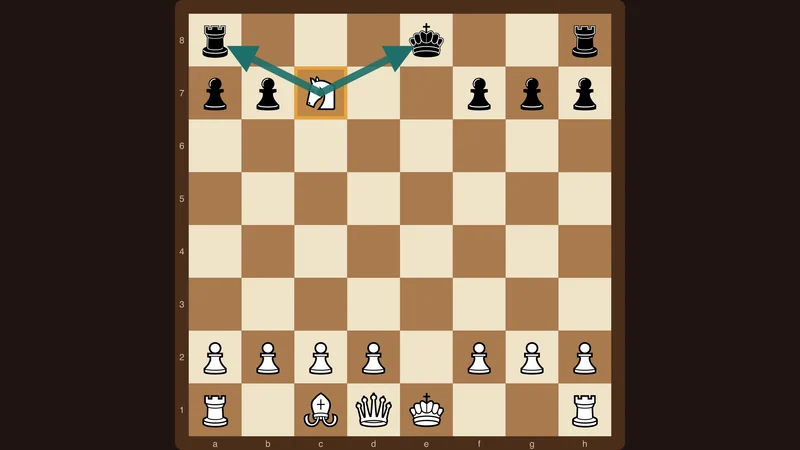
Few openings in chess carry a reputation as fearsome as the Sicilian Defense. When White advances the king’s pawn two squares with 1.e4, the classical instinct taught to school pupils is to match White symmetrically with 1...e5. Symmetrical play creates familiar battles: both players contest the center, develop minor pieces, and aim for an early castled king. Yet generations of grandmasters and world champions have turned instead to an asymmetrical response: 1...c5.
By advancing the c-pawn two squares on move 1, Black immediately challenges the central d4 square from the wing [1]. This move creates an unbalanced board from the very first turn. Black refuses to mirror White, signalling an immediate intention to fight for the full point rather than settle for a quiet draw.
For beginners and club players rated under 1500, however, the Sicilian is often surrounded by intimidating folklore. Chess coaches frequently caution newer players against 1...c5, warning that the opening requires memorizing 30 moves of razor-sharp engine lines in variations such as the Najdorf or the Dragon. In those ultra-sharp grandmaster lines, a single misplaced pawn can lead to a quick tactical defeat.
Yet this warning mistakes master-level preparation for practical chess reality. At club level, games are not decided by computer-crafted novelties on move 25. They are decided by basic tactical awareness, piece coordination, and an understanding of pawn structures. You do not need encyclopedic memorization to enjoy the Sicilian. By grasping the structural ideas behind the pawn trade on d4, the power of the half-open c-file, and how to neutralize common club-level sidelines, any improving player can adopt the Sicilian Defense as a trusted, lifelong weapon.
If you are exploring chess openings to build a dependable repertoire against 1.e4, learning the mechanics of the Sicilian will fundamentally improve how you think about space, counterplay, and imbalances over the board. You can also explore our dedicated Sicilian Defense course to see interactive master games that illustrate these core concepts in action.
The core philosophy: why fight for the center from the wing?
To understand why 1...c5 is so resilient, you must first look at what happens in the center of the chessboard. When White opens with 1.e4, White stakes a claim on the central d5 and f5 squares and frees paths for both the queen and the light-squared bishop. White’s natural strategic dream is to follow up with 2.d4, establishing two classical central pawns side by side and controlling c5, d5, e5, and f5.
When Black responds with 1...e5, Black prevents 2.d4 by directly opposing pawns. But when Black plays 1...c5, Black controls the d4 square without placing a target in White’s direct line of sight. If White pushes 2.d4 immediately, Black simply captures 2...cxd4, trading a wing pawn (the c-pawn) for White’s central d-pawn.
This exchange is the bedrock of the entire opening. In chess, central pawns (on the d-file and e-file) are intrinsically more valuable than flank pawns because they control vital squares in the heart of the board. By giving up the c-pawn to eliminate White’s d-pawn, Black secures an enduring structural advantage: Black retains two central pawns (on d and e) against White’s single central pawn (on e4).
This asymmetrical trade gives the game its distinctive character:
- White’s advantage: White gains an immediate lead in piece development and more space on the kingside. White’s knights and bishops can spring rapidly into aggressive forward outposts, creating dangerous attacking chances against Black’s king.
- Black’s advantage: Black secures a superior long-term pawn structure. In any eventual endgame, Black’s two central pawns give Black greater control over key breakthrough squares. Furthermore, the capture on d4 opens the c-file for Black’s rooks and queen.
As Aaron Nimzowitsch demonstrated in his 1925 treatise My System, a half-open file created by exchanging a wing pawn for a center pawn provides an organic highway of attack and natural outposts for heavy pieces [2]. While White attacks on the kingside, Black builds relentless counterplay down the half-open c-file against White’s queenside.
The Open Sicilian: what happens after 2.Nf3 and 3.d4
In serious competitive chess, about 80 percent of master-level games that begin with 1.e4 c5 continue with 2.Nf3 [1]. This move prepares to open the center cleanly with 3.d4.
After 2.Nf3, Black typically selects one of three natural moves:
- 2...d6: The most flexible choice, guarding e5, preparing ...Nf6, and opening a diagonal for the light-squared bishop.
- 2...Nc6: Developing a knight toward the center, fighting directly for the d4 square.
- 2...e6: Preparing to contest d5, blunting White’s bishop diagonals, and keeping options open for the dark-squared bishop.
When White pushes 3.d4, Black happily captures 3...cxd4, and White recaptures with 4.Nxd4. Black then usually develops the king’s knight with 4...Nf6, attacking the e4 pawn and forcing White to defend it with 5.Nc3.
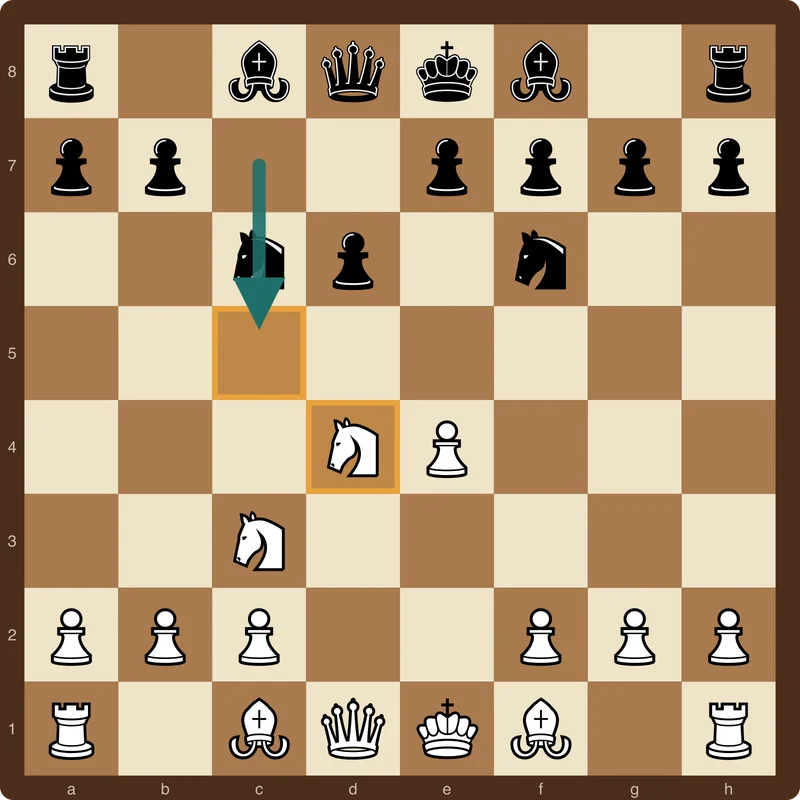
This position marks the classical crossroads of the Open Sicilian. From this tabiya, grandmasters branch into famous named variations:
- The Najdorf Variation (5...a6): Famously championed by Bobby Fischer and Garry Kasparov, 5...a6 prevents White’s knights or light-squared bishop from hopping into b5, while preparing a queenside pawn expansion with ...b5.
- The Classical Sicilian (5...Nc6): Black develops both knights naturally toward the center, challenging White’s centralized knight on d4 immediately.
- The Dragon Variation (5...g6): Black fianchettoes the dark-squared bishop to g7, aiming a laser beam down the long diagonal across the entire board toward White’s queenside rook.
- The Scheveningen Variation (5...e6): Black sets up a compact pawn wall on d6 and e6, known as the “small center,” providing extraordinary flexibility and defense against kingside sacrifices.
While each variation has its own rich literature, club players do not need to master all four. What matters is understanding the shared strategic plans that unite all Sicilian positions.
The three strategic goals every Sicilian player must master
Regardless of which specific move order you choose, successful play with Black in the Sicilian boils down to three fundamental concepts:
1. Activating the half-open c-file
The moment Black trades on d4, the c-file becomes Black’s natural operational base. Black will place the queen’s rook on c8, often supported by the queen on c7 or a5. This puts direct pressure on White’s c2 pawn and any knight that White stations on c3. If White castles queenside (a common attacking plan in sharp lines), White’s king walks right into the line of fire of Black’s heavy pieces.
2. The liberating ...d5 pawn break
In almost every Sicilian structure, Black’s primary strategic milestone is achieving the central pawn push ...d5. Because Black has pawns on both d6 and e6 (or e7), pushing ...d5 strikes directly at White’s e4 pawn.
When Black succeeds in playing ...d5 safely without losing material, Black neutralizes White’s spatial advantage, opens active diagonals for both bishops, and frequently seizes the initiative. If White plays too passively, Black prepares ...d5 with moves like ...a6, ...b5, ...Bb7, and ...Rfd8, blowing open the center at the ideal psychological moment.
3. Guarding the d5 outpost
Before Black can play ...d5, the d5 square itself is a potential outpost for White’s pieces. In many Sicilian lines (such as the Najdorf or the Classical), Black pushes ...e5 to kick White’s knight away from d4. While this gains space and time, it leaves a “hole” on d5 that no black pawn can ever defend again. A skilled Sicilian player knows when to tolerate this backward d6 pawn in exchange for dynamic piece activity, and when to keep the pawn on e6 to firmly control d5.
Avoiding the classic beginner pitfalls in the Sicilian
Why do beginners sometimes struggle when they first play 1...c5? The answer rarely lies in opening theory. It lies in neglecting foundational opening rules.
As José Raúl Capablanca emphasized in his 1921 classic Chess Fundamentals, opening principles require players to develop minor pieces rapidly, secure king safety, and avoid moving pawns unnecessarily [3]. In the Sicilian, novice players often fall into two distinct traps:
- Pawn-pushing fever: Seeing grandmasters play moves like ...a6 and ...b5, beginners often make five or six pawn moves in the first eight turns while their knights and bishops remain asleep on the back rank. Against an active opponent, neglecting development allows White to sacrifice a piece on d5, e6, or f7 and rip open the uncastled black king before move 12.
- Greedy pawn grabbing: White often offers gambit pawns (such as the Wing Gambit with b4 or the Smith-Morra Gambit with 2.d4 cxd4 3.c3). Novices often consume every offered pawn, spending valuable tempi while White rapidly activates every piece and launches an overwhelming assault down the central files.
The golden rule for players under 1500 is straightforward: develop your minor pieces before launching flank attacks. Play ...Nc6 and ...Nf6, castle your king to safety, and only then begin your queenside expansion. To strengthen your foundational piece development, review our guide to your first chess opening for a helpful refresher on classical opening principles.
Taming the Anti-Sicilians at club level
If you play 1...c5 in online games or at your local chess club, you will quickly discover that your opponents rarely play the Open Sicilian. Facing the theoretical labyrinth of 2.Nf3 and 3.d4 can be as daunting for White as it is for Black. Instead, club players frequently deploy “Anti-Sicilians”—sidesteps designed to steer the game into quieter, less theoretical channels.
Here is how you can handle the most common Anti-Sicilians with calm, principled moves:
The Alapin Variation (2.c3)
White’s idea is simple: White wants to play 3.d4 and, when Black captures ...cxd4, recapture with the c-pawn (cxd4) to establish a full pawn center on e4 and d4.
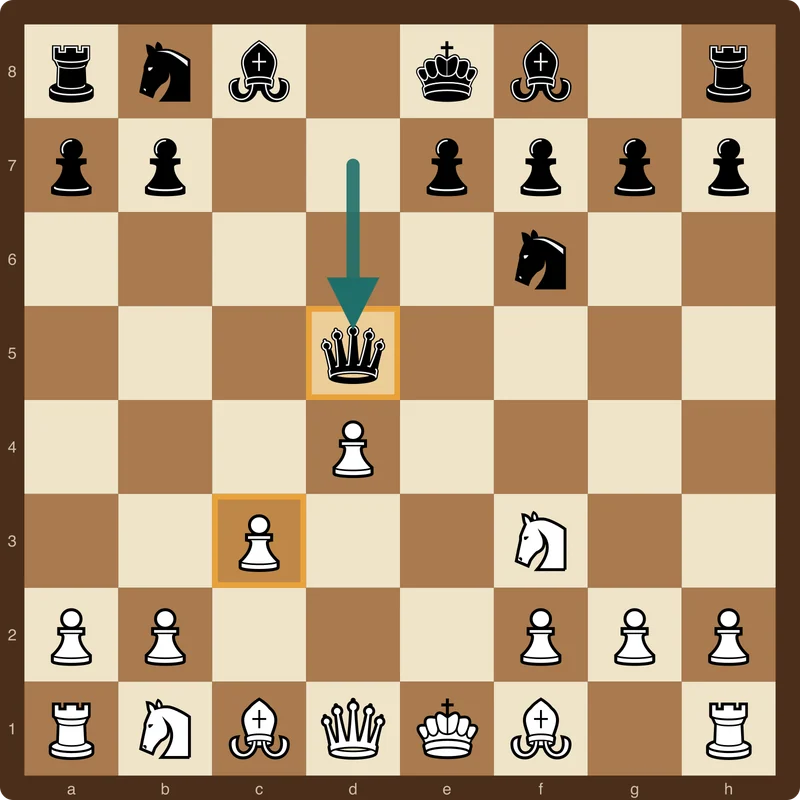
The most principled and effective antidote is to strike directly at the center with 2...d5!
Because White has placed a pawn on c3, White’s queen’s knight cannot develop to its natural c3 square to harass Black’s queen. After 3.exd5 Qxd5 4.d4 Nf6 5.Nf3, Black develops smoothly with ...e6, ...Be7, ...Nc6, and castles early. Black achieves an easy, comfortable position where White’s dream of an imposing pawn center is completely defused.
The Closed Sicilian (2.Nc3)
White chooses not to push an early d4, opting instead for slow, positional pressure. White typically follows with g3, Bg2, d3, and f4, aiming for a kingside storm later in the game.
Against the Closed Sicilian, Black should mirror White’s fianchetto scheme:
- Play 2...Nc6 and 3...g6.
- Develop the bishop to g7, place the d-pawn on d6, and develop the knight to e7 (or f6).
- Expand on the queenside with ...Rb8, ...a6, and ...b5.
The resulting clash is strategic and rich: White probes on the kingside, while Black relentlessly gains queenside territory. Because the center remains closed, neither side is in immediate danger of a sudden tactical knockout, allowing you to play by plans rather than rote memory.
The Bowdler Attack (2.Bc4)
A huge favorite among rapid and blitz players at club level, 2.Bc4 attempts to target Black’s f7 square in the style of the Italian Game. In the Sicilian, however, this move is a positional mistake.
Black simply plays 2...e6! followed by an early ...d5. The pawn on e6 blunts the bishop’s diagonal completely, and the subsequent ...d5 advance attacks the bishop while seizing the center with tempo. White is forced to retreat the bishop, handing Black an immediate positional initiative.
A brief history: from Polerio to modern world championships
The history of the Sicilian spans more than four centuries. The earliest recorded analysis of 1.e4 c5 appears in Giulio Cesare Polerio’s 1594 chess manuscript [1]. Early seventeenth-century masters, including Don Pietro Carrera in 1617 and Gioachino Greco in 1623, noted the opening as a combative alternative to classical king’s pawn games. Carrera christened the opening il gioco siciliano (“the Sicilian game”), giving the defense its enduring regional name.
During the nineteenth century, classical masters initially viewed the opening with suspicion. The legendary American master Paul Morphy and the first official World Champion Wilhelm Steinitz favored open, symmetrical games with 1...e5, viewing flank play as unprincipled. It was not until the mid-twentieth century, through the deep pioneering work of Soviet masters and later world champions like Bobby Fischer and Garry Kasparov, that the Sicilian gained recognition as Black’s sharpest weapon against 1.e4.
Today, the Sicilian is played at every level of the game, from school tournaments to world championship matches. Its appeal lies in its honesty: it does not seek an easy, sterile peace, but invites an authentic contest of tactical vision and strategic courage.
Practical training advice for club players
If you want to add the Sicilian Defense to your opening repertoire, here is a practical roadmap to get started:
- Pick one Open Sicilian structure: Do not try to learn the Dragon, the Najdorf, and the Taimanov all at once. Choose one setup that matches your natural playing style. If you love direct piece play and open diagonals, try the Classical Sicilian (5...Nc6). If you prefer solid pawn walls, explore the Scheveningen (5...e6) or the Kan.
- Master your responses to Anti-Sicilians: At club level, you will face 2.c3, 2.Nc3, and 2.Bc4 in more than half of your games. Spend twenty minutes learning your setups against those three systems; it will save you countless headaches over the board.
- Practice tactical calculation daily: Because the Sicilian leads to asymmetrical positions with kings castled on opposite wings, tactical alertness is essential. Sharpen your tactical radar with daily puzzle training, focusing on pins, forks, and back-rank vulnerabilities. Explore our guide on chess lessons to reinforce your fundamental attacking patterns.
- Learn the rook endgame transitions: When the middle-game storm clears, Sicilian games frequently transition into rook and pawn endgames where Black’s queenside majority plays a decisive role. Understanding foundational defensive structures, such as the techniques explored in our guide to the two rook endgames, ensures that you can convert your structural advantages into clean victories.
- Test your setups in real games: Theory only becomes second nature when tested against real opponents. Jump into a rated game of chess to try 1...c5 in live action, notice where your pieces feel cramped or active, and review your moves after the game.
The Sicilian Defense is not a set of rigid moves to be recited from memory. It is a philosophy of dynamic counter-attack, structural patience, and tactical bravery. By focusing on pawn structures, central breaks, and piece coordination, you can play 1...c5 with confidence at any rating level.
Questions people ask
Is the Sicilian Defense too difficult for beginners?
Not if you focus on ideas rather than move memorization. While grandmasters memorize deeply for world-class preparation, club players under 1500 can play the Sicilian successfully by understanding basic concepts: trading the c-pawn for the d-pawn, utilizing the half-open c-file, and looking for the liberating ...d5 pawn break.
What is the easiest variation of the Sicilian to learn?
For club players seeking a manageable theoretical load, the Classical Sicilian (1.e4 c5 2.Nf3 d6 3.d4 cxd4 4.Nxd4 Nf6 5.Nc3 Nc6) or the Kan Variation (4...a6 followed by ...e6 and ...Qc7) offer harmonious, intuitive piece placement without requiring the memorization demanded by the Najdorf or the Dragon.
How should Black respond to 2.c3 (the Alapin)?
The most reliable and active response to 2.c3 is 2...d5! By striking at the center immediately, Black forces 3.exd5 Qxd5, bringing the queen to a dominant central post where it cannot be easily chased away by White’s queen’s knight.
Why do masters consider 1...c5 Black’s best-scoring defense?
Statistically, 1...c5 yields the highest win percentage for Black against 1.e4 because it immediately creates an asymmetrical board with dynamic winning chances, avoiding the symmetrical, drawish tendencies common in 1...e5 lines.
Sources
- Wikipedia. “Sicilian Defence.” Comprehensive overview of 1.e4 c5, Open Sicilian lines, and Anti-Sicilian variations.
- Nimzowitsch, A. (1925). My System. Berlin: B. Kagan.
- Capablanca, J. R. (1921). Chess Fundamentals. London: G. Bell and Sons.
- Boardgammon. “The Sicilian Defence: Exchanges, pawn structures, and open files.”
- Boardgammon. “Chess openings: Principles and essential lines.”
- Boardgammon. “Chess lessons: Learn to play chess from the first move.”
- Boardgammon. “Chess Moment: Play rated chess online.”
Found a mistake or an odd phrase? Tell us