Sit down for a traditional Greek tavli match and the same wooden board changes laws every game. First comes Portes, the familiar head-on race with hitting and the bar; second comes Plakoto, where a lone checker is pinned in place; and third comes Fevga (Φεύγα, Greek for “run” or “get away”), played across Turkey under virtually identical rules as Moultezim (Mültezim). Suddenly every single opposing checker acts as a locked gate, forcing you to search around blocked corridors much like travelers confronting sudden street closures in human detour-navigation experiments[1].
Among games in the backgammon family, Fevga replaces contact combat with pure positional blockade[2]. You still use the 24-point board (four quadrants of six points), 15 checkers per side (30 total), and two six-sided dice (36 ordered outcomes), yet nothing about the opening setup looks like Western match play.
How does Fevga set up on the 24-point board?
Both players stack all 15 checkers on diagonally opposite corners (the far-right corner from each player’s seat), 12 steps apart, as outlined in our Fevga rules overview[3]. Each starting stack is called the player’s “head.” Instead of marching head-on from opposite directions, both armies travel counter-clockwise around the entire 24-point track, chasing the opponent’s tail:
- White’s track: All 15 White checkers start on point 13 (top-left, step 0), cross points 13–8, continue down through points 7 to 1 (Black’s head at step 12), enter point 24 (step 13) through point 20, and bear off from points 19–14.
- Black’s track: All 15 Black checkers start on point 1 (bottom-right, step 0), cross into point 24 through point 20, continue across points 19 to 13 (White’s head at step 12), drop into point 12 (step 13) through point 8, and bear off from points 7–2.
Because every checker travels all 24 points before bearing off, the race is more than twice as long as standard backgammon. Players who know how to count pips in backgammon can verify the arithmetic right away: each side begins at 360 pips (15 times 24, or 720 combined pips), compared with 167 starting pips in standard backgammon (two on point 24, five on 13, three on 8, and five on 6). That adds 193 extra pips per player, 2.16 times the standard race[4]. At an unobstructed mean of 8.17 pips per roll (294 divided by 36), a pure Fevga sprint averages 44.08 rolls per side versus 20.45 rolls in standard backgammon[4].
Why single-checker blocks change everything when there is no hitting
In Fevga there is zero hitting, zero pinning, and zero play from the bar[3]. A lone checker sitting on a point is never a vulnerable blot. One checker owns and closes its point outright, barring your opponent from landing on that point or touching down on it mid-roll.
Compared with priming games in backgammon, single-checker ownership cuts the cost of a wall by 50%. In standard backgammon, sealing six consecutive points takes two checkers per point: 12 of your 15 checkers (80% of your force), leaving only three checkers (20%) to anchor or advance. In Fevga, an impassable six-consecutive-point prime (exaporto) takes as few as six checkers, just 40% of your 15-checker army[4]. That leaves nine checkers (60%) free to race ahead, slot a second barrier downboard, or stack spare moves behind your wall so an awkward roll does not crack it.
Once all 15 checkers enter your six-point home quadrant (points 19–14 for White; points 7–2 for Black), bearing off follows standard rules: bear off from the home point whose pip distance (6 down to 1) matches the die, or bear off from your farthest occupied home point when a die rolls higher than every occupied point. Scoring is binary and cube-free:
- Single win (1 point): Bearing off all 15 checkers first after your opponent has borne off at least one checker.
- Double win (2 points, diplo or mars): Bearing off all 15 before your opponent bears off any checker (finishing with zero checkers off), even if all 15 opposing checkers sit inside their home quadrant.
- No backgammons and no cube: Traditional tavli matches to 3, 5, or 7 points (occasionally 11) award zero 3-point backgammons and use zero doubling cube[3][5].
Without a cube to end lopsided games early, every blockade plays out to the final bear-off, turning each trapped enemy straggler into a live bid for a 2-point diplo.
Why double sixes fails on Turn 1: the head-pass rule and dice order
Without an opening throttle, whoever rolled first in Fevga would spread four or five single checkers across their starting quadrant and choke the board immediately. The head-pass rule prevents that gridlock: your first pioneer checker must travel at least 13 pips from your starting head to pass strictly beyond the opponent’s starting corner, reaching step 13 or farther (point 24 onward for White; point 12 onward for Black), before any second checker may leave your head[4].
On Turn 1, that gate stands everything you know about backgammon opening rolls on its head. Because your opponent’s 15-checker stack sits 12 steps ahead and blocks step 12, check what happens across all 36 dice outcomes[4]:
- All 30 non-double rolls (83.33%): Advance your pioneer 3 pips (2-1) to 11 pips (6-5), using 100% of both dice; none of the 30 passes step 12 on Turn 1.
- Double fives (5-5, 1 in 36 or 2.78%): Among all six doubles (16.67%), only 5-5 clears step 12 on Turn 1, stepping 0 to 5, 10, and 15 for all four dice and 20 pips (reaching step 20 or releasing a second checker from 0 to 5).
- Double sixes (6-6, 1 in 36 or 2.78%): Worth 24 pips in standard backgammon, 6-6 stops at step 6 after one die because the second 6 hits blocked step 12. With your other 14 checkers still locked, you play one of four dice for 6 pips and forfeit 18 pips (75%).
- Remaining doubles (4-4, 3-3, 2-2, 1-1): Rolling 4-4 (16 pips) hits step 12 on the third die for 8 pips, forfeiting 8 pips (50%). Rolling 3-3 (12 pips) hits step 12 on the fourth die for 9 pips, forfeiting 3 pips (25%). Rolling 2-2 plays all four dice for 8 pips, 2 pips farther than 6-6, and 1-1 plays all four dice for 4 pips.
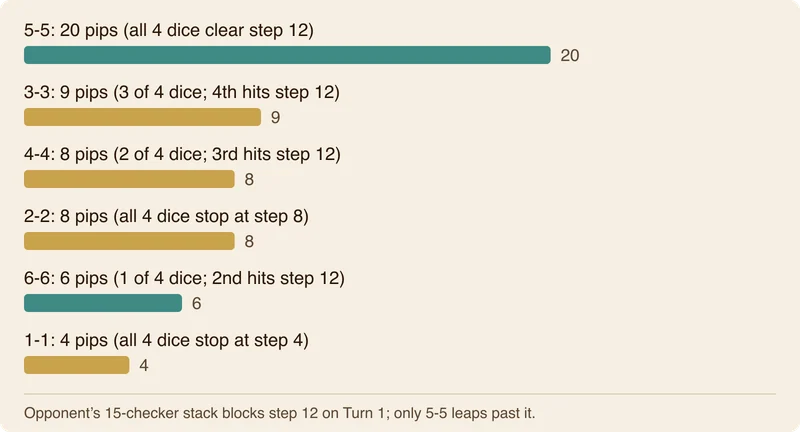
Those 29 forfeited pips (18 plus 8 plus 3) pull Fevga’s exact Turn-1 mean advance down to 7.36 pips (265 divided by 36), compared with 8.17 pips (294 divided by 36) in standard backgammon[4]. Landing back on step 6 after 6-6, 5-1, or 4-2 also hurts your Turn-2 tempo. With step 12 still occupied and steps 13–17 open, a pioneer at step 11 (after 6-5, 1 pip short) clears step 12 on 35 of 36 rolls (97.22%, failing only on 1-1 at 2.78%), and from step 10 (after 6-4) on 34 of 36 (94.44%, failing on 2 of 36 at 5.56%). Step 9 clears on 32 of 36 (88.89%), step 8 on 29 of 36 (80.56%), and step 7 on 26 of 36 (72.22%). From step 6, Turn-2 pass odds drop to 20 of 36 (55.56%, failing on 16 of 36 at 44.44%), then 17 of 36 (47.22%) from step 5, 11 of 36 (30.56%) from step 4, and 7 of 36 (19.44%) from step 3[4].
Because the head unlocks the instant your pioneer clears step 12, even between two dice of the same turn, dice order can decide whether a roll is legal. In the verified 15-checker position below, White holds 14 checkers on point 13 and one pioneer on point 4 (step 9, 3 pips before Black’s head on point 1). Black holds 13 checkers on point 1, one blocker on point 21 (White’s step 16), and one pioneer on point 10 (Black’s step 15). White rolls 5-2[4].
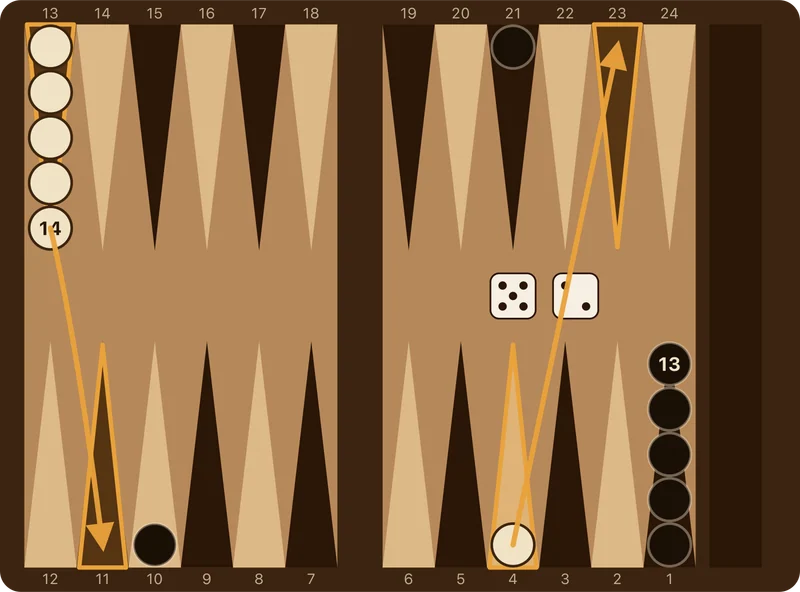
Playing the 2 first (4/2) stops at point 2 (step 11), short of Black’s head at step 12: White’s head stays locked while 2/21 with the 5 is blocked by Black on point 21, illegally forfeiting a playable die. Playing the 5 first (4/23) leaps 2 pips past Black’s head onto point 23 (step 14), unlocking point 13 immediately so 13/11 brings out a second checker with the 2, the sole legal sequence on the board[4].
What are the two fair-play blocking limits, and how do you build a legal six-prime?
Once your head unlocks, Fevga enforces two mandatory fair-play blocking limits so neither player freezes all 15 enemy checkers from move 1[3][4]:
- Never close all six points of your own starting quadrant. White may never occupy all six points of points 13–8 at once, and Black may never occupy all six points of points 1, 24, 23, 22, 21, and 20 at once. At least one of those six points must remain open (at most five occupied).
- Never hold a six-prime directly in front of all 15 opposing checkers. You may never build or maintain six consecutive blocked points immediately ahead of a single point holding all 15 opposing checkers. Two coffeehouse conventions are worth settling before play: in Greek kafeneio rules, if all 15 enemy checkers later pile onto the single point directly behind an existing six-prime elsewhere, the blocker must open one point; in Turkish Moultezim coffeehouse play, players also occupy at most four points in the opponent’s starting quadrant[4].
Experienced players build around both limits by leaving one point open inside their starting table, typically point 12 next to White’s head, and shifting a six-prime across the quadrant boundary once at least one enemy checker has separated. On the walnut Fevga board below, White holds four checkers on point 13, one on 11, two on 10, one on 9, one on 7, one on 6, two on 22, and three on 18. Black holds four on point 1, three on 23, three on 20, two on 16, two on 15, and one pioneer on point 12 (Black’s step 13). White rolls 6-2[4].
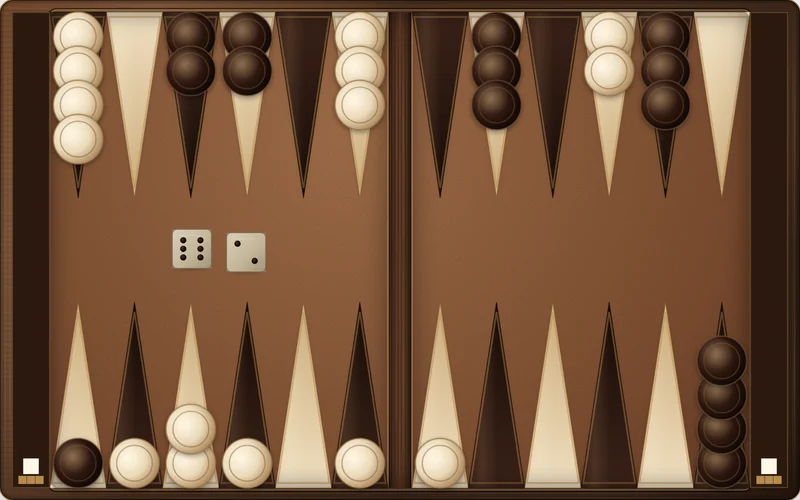
White plays 10/8 (2) and 13/7 (6), completing a 100% legal shifted six-prime across points 11, 10, 9, 8, 7, and 6. Because point 12 stays open inside White’s starting quadrant (points 13–8), White occupies only five of its six starting-table points. Because only one Black checker sits trapped on point 12 (with 0 of 36 rolls, or 0%, able to advance) while Black’s other 14 checkers remain free to move behind point 13, the second rule is satisfied too[4]. Black must burn every roll marching those 14 rear checkers forward and compressing its own spares while White brings points 22 and 18 home.
Comparing Fevga alongside its closest relatives clarifies how each tradition handles starting stacks and blockades[5][6][4]:
| Game | Starting setup | Direction & hitting | Point block | Opening head rule | Prime & table limits |
|---|---|---|---|---|---|
| Fevga (Greek tavli game 3) | 15 on point 13 vs 15 on point 1 (diagonal, 12 steps apart; 360 pips) | Counter-clockwise; 0 hitting, 0 bar | 1 checker | Pioneer must pass enemy head (step 13+) | Never close all 6 starting-table points; no 6-prime ahead of all 15 on 1 point |
| Moultezim (Turkish Mültezim) | Diagonally opposite corners, far right from each seat (360 pips) | Counter-clockwise; 0 hitting | 1 checker | Pioneer must pass enemy head (step 13+) | Same 2 limits; coffeehouse play caps occupation of enemy starting table at 4 points |
| Gülbahar / Gioul (Bulgarian Gul Bara) | Opposite 24-point corners | Parallel track; 0 hitting | 1 checker | No head-pass lock | Rolled doubles climb sequentially through 6-6 |
| Long Nardy (Russian dlinnye nardy) | Opposite 24-point corners (360 pips) | Counter-clockwise; 0 hitting | 1 checker | Max 1 off head per turn (2 on Turn-1 6-6, 4-4, or 3-3) | No 6-prime trapping all 15 enemy checkers |
| Jacquet (French, 1818 rules) | 15 on single talon corner | Parallel race | 1 or 2 by era | 1 postillon courier must reach home quadrant (19th point+) first | Regulated by postillon bottleneck |
| Standard Backgammon (Portes) | Split across 4 points (167 pips) | Opposite directions; hitting & bar | 2 checkers | None | 6-prime legal anywhere; doubling cube in matches |
What detour neuroscience and rule-switching studies explain, and where they stop
Why does Fevga trip up seasoned players in game 3 of a tavli match? Laboratory neuroscience on detour planning and rule-switching explains the cognitive bottlenecks at the board, provided we keep strict boundaries around what those experiments tested.
In a 2017 functional MRI study in Nature Communications, Amir-Homayoun Javadi, Hugo Spiers, and colleagues scanned 24 healthy right-handed adults (11 female and 13 male, ages 20–35, mean age 26.25 years, standard deviation 3.52) navigating a film simulation of London’s Soho streets one day after on-site training[1]. Entering a new street engaged the right posterior hippocampus to track shifts in local connections and the right anterior hippocampus to encode global street topology; when forced detours blocked a planned route, bilateral inferior lateral prefrontal cortex activity scaled with a breadth-first search across alternative future paths[1]. In a 2015 review in Frontiers in Human Neuroscience, Hugo Spiers and Sam Gilbert showed across neuroimaging, single-unit, and lesion studies that lateral prefrontal cortex signals prediction error when an expected route closes, frontopolar and superior prefrontal cortex set a new subgoal, and the hippocampus simulates path distances along candidate detours[7]. Both papers studied spatial street navigation rather than Fevga or board games, and neither shows that playing Fevga improves real-world navigation or clinical neurological outcomes[1][7].
Rotating on the same 24 points from Portes (hitting) and Plakoto (pinning) into Fevga (single-checker walls) adds rule interference. In a 2009 functional MRI study in The Journal of Neuroscience, Alexandre Hyafil, Christopher Summerfield, and Etienne Koechlin tested 24 healthy adults (ages 18–30) across six runs of 128 trials (about 7 minutes per run, 1,000-millisecond stimulus display) in a spatial-Stroop joystick task-switching experiment[8]. Rule switches prolonged reaction times by roughly 20 milliseconds overall (15 milliseconds on congruent-to-congruent and congruent-to-incongruent switches, 18 milliseconds on incongruent-to-congruent switches; F(1,23) = 27.5, p < 0.005) and roughly 40 milliseconds across consecutive incongruent trials. The anterior cingulate cortex activated on every switch to reset task priorities, whereas the caudal dorsolateral prefrontal cortex resolved proactive interference from the recently active rival rule set[8]. That laboratory joystick task did not test tavli, yet proactive interference captures the exact habit slip when a Portes player needlessly stacks a second checker onto a point one Fevga checker already locks.
As examined in our review of what cognitive research finds on backgammon, mastering those switches stays game-specific. Giovanni Sala and Fernand Gobet (2017, Current Directions in Psychological Science) synthesized three meta-analyses across chess instruction, music training, and working-memory training, finding that apparent far-transfer gains shrink toward zero against active control groups[9]. Practicing Fevga builds Fevga-specific route-planning and blocking skill; playing Fevga does not raise general IQ, improve school grades, or prevent dementia or cognitive decline[9].
From Ottoman Mültezim and French Jacquet to playing Fevga today
Parallel-race tables games trace back to late antiquity: Byzantine Emperor Zeno’s tabula game of 480 CE already moved checkers in one direction around 24 points with three dice, alongside 6th-century Persian Nard, whose 12 points per half represented 24 hours across 30 checkers[5]. Across the Mediterranean traditions explored in our guide to tavla, tavli, nardy, and shesh-besh and backgammon culture around the world, same-direction blockades endured right beside hitting games[10].
In Greece and Cyprus, Fevga (still called Moultezim by some older café regulars) closes the three-game tavli rotation (Portes, Plakoto, Fevga) without the doubling cube introduced in New York clubs in the 1920s, around 1926[11]. Its Turkish name Mültezim comes from Ottoman Turkish mültezim (Arabic iltizām), the holder of an imperial tax-farming contract introduced in the 15th century (the 1400s) under Sultan Mehmed II and abolished in the Tanzimat reforms of 1856[12]: a dry coffeehouse nod to how one lone checker plants itself on a point and collects a toll on the road.
Neighboring tables cultures kept close cousins alive: Turkish Gülbahar (Greek Gioul, Bulgarian Gul Bara, game 3 after Tabla and Tapa) with climbing doubles up to 6-6, Levantine Arabic Tawlet 31 (played to 31 points) and Moultezim, and Russian Long Nardy (dlinnye nardy)[5]. Western Europe played single-corner parallel races for centuries too: Catalan jaquet (attested in 1638, defined in Barcelona in 1696) and Spanish chaquete (widespread in the 17th and 18th centuries and paired with French jacquet in a Lyon dictionary of 1800)[6]. In France, Lepeintre’s 1818 rule sheet for jacquet contrasted sharply with 120-page trictrac manuals of 1773, and the game stayed popular into the 1960s, requiring one postillon (“courier”) to reach the final home quadrant (the 19th point onward) before other checkers left the talon[6].
To try Fevga’s head-pass timing and shifted primes yourself on Boardgammon[13]:
- Practice in your browser: Work through four interactive Fevga modules in our backgammon lessons, covering head movement, single-checker blocks, fair blocking limits, and the race bear-off.
- Play full games in the app: Open the Boardgammon app (available across 11 interface languages) to play Fevga against the computer or in local two-player pass-and-play on one device.
- Play standard matches online: Live browser matchmaking when you play backgammon online focuses on standard backgammon to keep one unified player queue, and our backgammon strategy guide shows how prime timing shifts once two-checker points and the cube return[14].
Sources
- Javadi, Amir-Homayoun, Beatrix Emo, Lorelei R. Howard, Fiona E. Zisch, Yichao Yu, Rebecca Knight, Joao Pinelo Silva, and Hugo J. Spiers. “Hippocampal and prefrontal processing of network topology to simulate the future.” Nature Communications 8 (2017): 14652.
- Boardgammon. “Backgammon Variants: Games in the Tables Family.”
- Boardgammon. “Fevga Rules — Greek & Turkish Backgammon, No Hitting.”
- Boardgammon exact 36-roll Fevga combinatorics and verified 15-checker positions under FevgaRules.
- Murray, H. J. R. A History of Board-Games Other than Chess. Oxford: Clarendon Press, 1952, ch. 6 (“Tables”).
- Wikipedia contributors. “Jacquet (game).” Wikipedia, The Free Encyclopedia.
- Spiers, Hugo J., and Sam J. Gilbert. “Solving the detour problem in navigation: a model of prefrontal and hippocampal interactions.” Frontiers in Human Neuroscience 9 (2015): 125.
- Hyafil, Alexandre, Christopher Summerfield, and Etienne Koechlin. “Two mechanisms for task switching in the prefrontal cortex.” The Journal of Neuroscience 29, no. 16 (2009): 5135–5142.
- Sala, Giovanni, and Fernand Gobet. “Does Far Transfer Exist? Negative Evidence From Chess, Music, and Working Memory Training.” Current Directions in Psychological Science 26, no. 6 (2017): 515–520.
- Boardgammon. “Backgammon Culture Around the World.”
- Jacoby, Oswald, and John R. Crawford. The Backgammon Book. New York: Viking Press, 1970, p. 210.
- Wikipedia contributors. “Iltizam.” Wikipedia, The Free Encyclopedia.
- Boardgammon. “Interactive Backgammon Lessons.”
- Boardgammon. “Backgammon Strategy Guide.”
Found a mistake or an odd phrase? Tell us