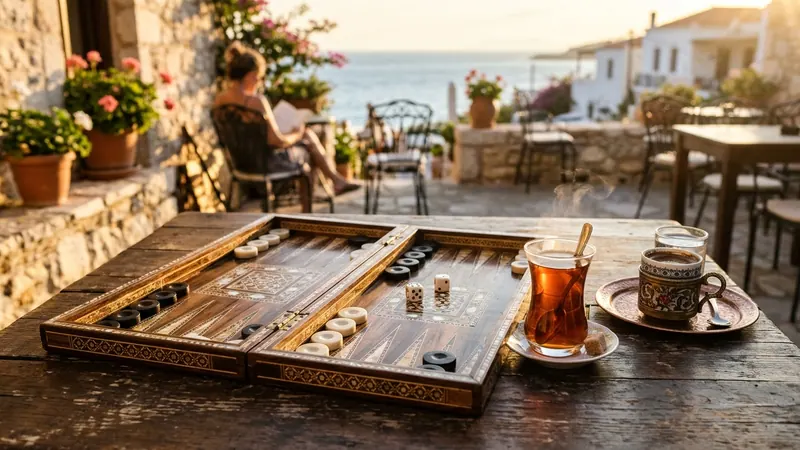
Sit down for a match of tavli at a café table in Athens or Thessaloniki and the first game feels familiar. Portes uses the standard backgammon layout, minus the doubling cube. Then your opponent sweeps all 15 checkers onto a single corner point for the second game: Plakoto.
In Plakoto, landing on an unpinned enemy blot does not send it to the bar[1]. You place your checker on top of it and pin it in place. That single pinning checker owns and blocks the point[1]. The pinned checker cannot move until every enemy checker above it leaves, and neither side can bear off while any of its checkers remains pinned[1]. Leave your last starting checker alone to get pinned while your opponent’s starting checker is unpinned, and you lose a 2-point double game on the spot[1].
Among traditional backgammon variants, Plakoto sets a subtle trap for Western players[2]. Because the 24 points and dice look identical to standard backgammon, your practiced reflexes fire automatically: you fret over harmless early blots in your outer board, or you slot a loose home-board point that stays buried for half the game. Psychologists call that habit carryover the Einstellung effect, quantified by Merim Bilalić, Peter McLeod, and Fernand Gobet in a 2008 laboratory study of chess checkmate problems (not Plakoto), where a familiar pattern blinded masters to a faster win[3]. In Plakoto, hitting instincts misfire because blots never leave the board.
How do you set up and move in Plakoto?
Plakoto uses a 24-point board split into four quadrants of six points, 15 checkers per side (30 total), and two six-sided dice with 36 ordered outcomes[1]. In standard notation from White’s seat, White stacks all 15 checkers on the 24-point and moves from 24 down to 1; Black stacks all 15 checkers on White’s 1-point (Black’s 24-point) and moves in the contrary direction, from 1 up to 24[1].
Starting every checker 24 pips from home creates a 360-pip race per player (720 combined pips), compared with 167 pips in standard backgammon’s split layout (2 on 24, 5 on 13, 3 on 8, and 5 on 6)[1]. That adds 193 pips per side, or 2.16 times the race length[1]. Counting doubles four times gives 294 pips across 36 outcomes, or 8.17 pips per average roll, stretching an unobstructed race from 20.45 rolls in standard backgammon to 44.08 rolls in Plakoto[1].
Two freedoms separate Plakoto from other single-stack games such as Greek Fevga and Russian Long Nardy[2]:
- No head restriction. Long Nardy limits you to one checker off your 24-point head per turn (except two checkers on opening doubles 6-6, 4-4, or 3-3)[2]. Plakoto puts no limit on the starting point: you may move one, two, or four checkers off point 24 on any roll[2].
- Full six-point primes are legal. Fevga and Long Nardy let one checker block a point and forbid closing a six-point prime ahead of all 15 enemy checkers[2]. Plakoto allows closing six consecutive points at any stage[2].
| Rule | Plakoto | Standard backgammon (Portes) | Fevga / Long Nardy |
|---|---|---|---|
| Starting setup | All 15 on the 24-point | 2 on 24, 5 on 13, 3 on 8, 5 on 6 | All 15 on one starting point |
| Direction | Contrary (opposite) | Contrary (opposite) | Parallel (same direction) |
| Starting pips | 360 pips | 167 pips | 360 pips |
| Point block | 2 checkers, or 1 pinning a blot | 2 checkers | 1 checker |
| Lone blot | Pinned on the point (no bar) | Sent to the bar | Cannot be hit or pinned |
| Off point 24 | 1, 2, or 4 checkers freely | Starts with only 2 checkers there | 1 per turn in Long Nardy (2 on first 6-6, 4-4, 3-3) |
| Six-point prime | Always legal | Always legal | Forbidden ahead of all 15 enemy checkers |
How does pinning work when nobody goes to the bar?
No checker ever goes to the bar in Plakoto[1]. Four rules govern every pin[1]:
- Landing on a blot traps it. You may land on any empty point, any point with your own checker on top, or any point holding one unpinned enemy blot[1]. Your checker sits on top of that blot and pins it.
- One pinning checker closes the point. Unlike a loose hit in standard backgammon, one checker sitting on a pinned blot immediately owns and blocks that point[1]. Your opponent cannot land there or re-pin, while you may stack a second or third friendly checker—or more—on top[1].
- Total release is required. The trapped checker cannot move until every enemy checker above it moves off[1].
- Any pin locks your bear-off. Even with 14 checkers home on points 1–6, you cannot bear off any of your 15 checkers while even one remains pinned anywhere on points 1–24, including inside your own home board[1].
That single-checker block reshapes the choice between hitting or building in backgammon. In standard backgammon strategy, hitting loose risks a blot to gain tempo[4]. In Plakoto, pinning a blot makes the point with a single checker[1].
What is the mother rule, and how does Plakoto scoring work?
Greek players name the three deepest points of your journey[5]. Your last starting checkers on the 24-point, down to the final one, are called the mother (mana). One pip ahead on the 23-point (your opponent’s 2-point) sits paramana, and two pips ahead on the 22-point (their 3-point) sits proparamana[5].
While two or more checkers hold your 24-point, the mother is safe. Once you drop to a lone mother on point 24, sudden death comes into play: if your opponent pins your lone mother while their own mother is safe, they win a 2-point double game (diplo) on the spot[5]. Once your mother leaves point 24, pinning it later on point 23 or beyond carries no instant loss[1].
Otherwise, games finish by bearing off[5]:
- 1 point (single win): You bear off all 15 checkers after your opponent bears off at least one[5].
- 2 points (double win, diplo): You bear off all 15 while your opponent has borne off no checkers, including when a late pin prevented them from starting[5].
Unlike Western match play, where gammons and backgammons combine 2- and 3-point finishes with a doubling cube, traditional tavli uses no doubling cube and awards no 3-point backgammon[6].
One edge case divides café custom from digital play: the mutual mother pin. In traditional Greek kafeneio rules, if White pins Black’s lone mother while White’s own lone mother still sits on point 24, play continues; if Black then pins White’s mother too, both mothers are locked forever for a 0-point draw and replay[5]. On Boardgammon (detailed in our Plakoto rules guide), pinning a lone mother wins 2 points immediately whenever your own mother is not pinned; if both mothers ever sit pinned, neither side wins on the spot and remaining unpinned checkers play on[1].
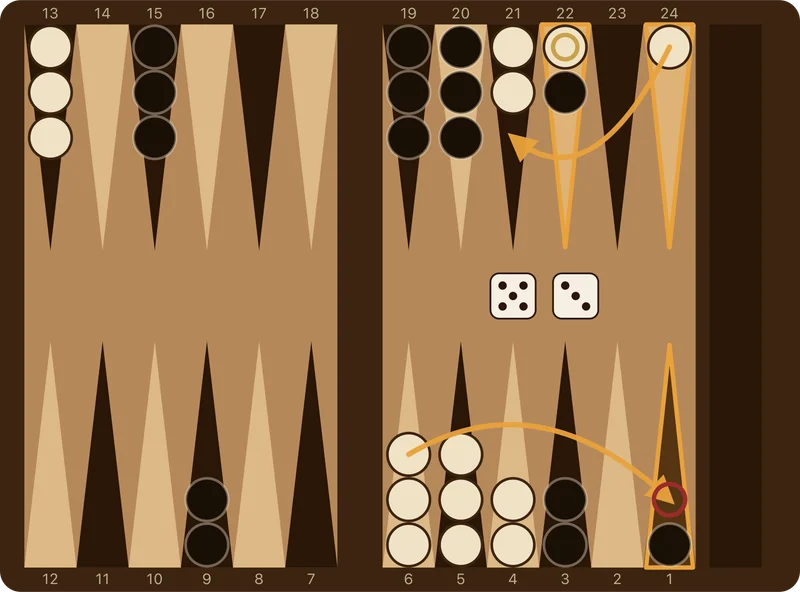
In the diagram above, White holds 1 mother on 24, 1 checker pinned under Black on 22, 2 on 21, 3 on 13, 3 on 6, 3 on 5, and 2 on 4 (15 checkers), while Black holds 1 pinning guard on 22, 3 on 20, 3 on 19, 3 on 15, 2 on 9, 2 on 3, and 1 lone mother on 1 (15 checkers)[1]. Rolling 5-3, White plays 6/1 (5) to pin Black’s mother on point 1 and 24/21 (3) to clear White’s own mother onto the made 21-point[1]. With point 24 empty, White clinches an immediate 2-point win under both café and Boardgammon rules, even with a White checker still pinned on point 22[1].
How should you play opening rolls and midgame mother sieges?
On the first turn, avoiding blots without rolling doubles is impossible[4]. Out of 36 ordered dice outcomes, only the six doubles (1-1 through 6-6, or 16.67%, 1 in 6) move four checkers in pairs and leave no blots[4]. All 30 non-doubles (83.33%, or 5 in 6, across 15 pairs in two orders) force either one blot (up to 11 pips out on 6-5) or two separate blots[4]. Because an opposing stack of 15 checkers reaches at most 11 pips on non-doubles and only multiples of a single die on doubles, an early blot 13 or 19 pips from your opponent’s starting point faces 0 out of 36 single-turn pinning rolls (0%)[4].
Blots turn dangerous in the midgame, especially near an exposed mother or on central points that anchor priming games in backgammon.
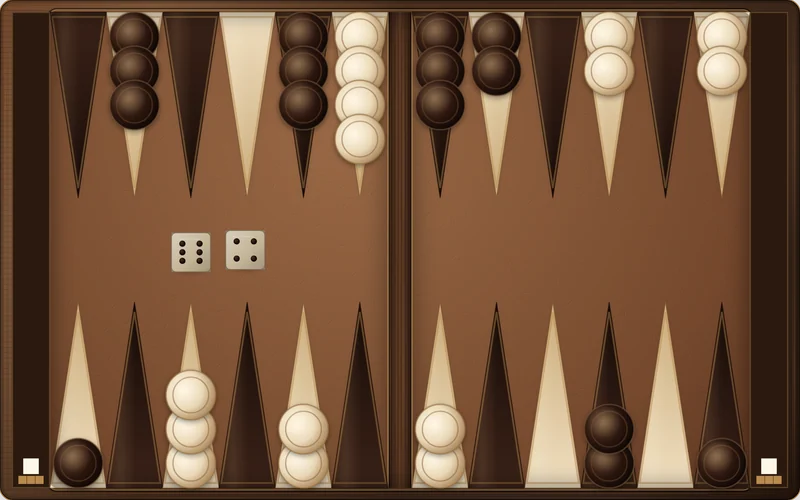
On the walnut board above, White rolls 6-4, holding 2 checkers on 24, 2 on 22, 4 on 18, 3 on 10, 2 on 8, and 2 on 6 (15 total)[1]. Black holds 1 lone mother on 1, 2 on 3 (proparamana), 1 blot on 12, 3 on 14, 3 on 17, 3 on 19, and 2 on 20 (15 total)[1]. Slotting 10/4 would leave an exposed White blot 3 pips from Black’s mother[1]. Instead, White plays 18/12, 10/6[1]. Moving 18/12 (6) pins Black’s blot and closes the 12-point with one checker (keeping 3 on 18), while 10/6 (4) places a third checker on the 6-point, 5 pips from Black’s mother, leaving no White blots and threatening a mother pin from that point alone on 15 of 36 rolls (41.67%) next turn[1].
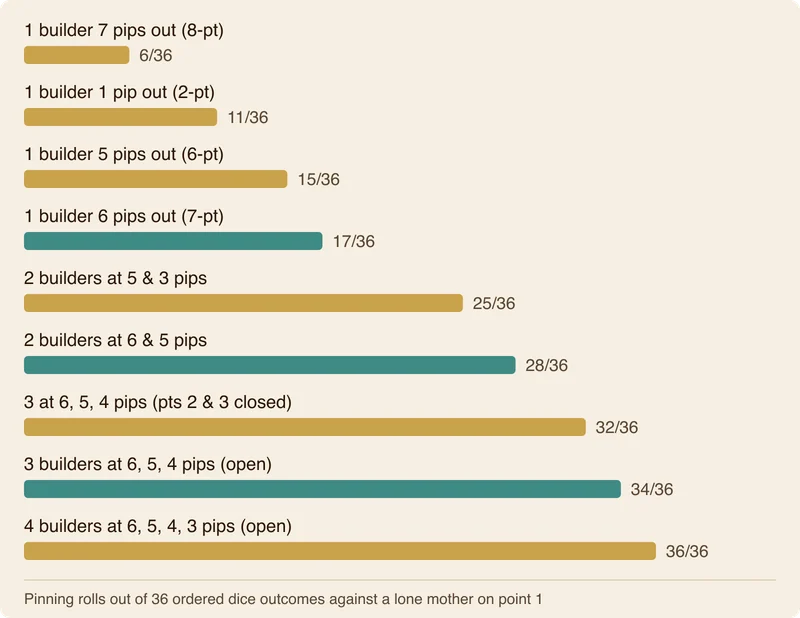
Against a lone mother on point 1 with open intermediate points, pinning shots out of 36 escalate rapidly as builders gather[4]:
- 1 builder 7 pips out (8-point): 6/36 (16.67%)[4].
- 1 builder 1 pip out (2-point): 11/36 (30.56%)[4].
- 1 builder 5 pips out (6-point): 15/36 (41.67%) (11 direct fives plus
4-1,1-4,3-2,2-3)[4]. - 1 builder 6 pips out (7-point): 17/36 (47.22%) (11 direct sixes plus
5-1,1-5,4-2,2-4,3-3,2-2)[4]. - 2 builders at 5 and 3 pips (points 6 and 4): 25/36 (69.44%)[4].
- 2 builders at 6 and 5 pips (points 7 and 6): 28/36 (77.78%)[4].
- 3 builders at 6, 5, and 4 pips (points 7, 6, and 5): 34/36 (94.44%), missing only
1-2and2-1(2/36, or 5.56%)[4]. - 4 builders at 6, 5, 4, and 3 pips (points 7, 6, 5, and 4): 36/36 (100%)[4].
Even if the defender closes both paramana (point 2, 1 pip ahead) and proparamana (point 3, 2 pips ahead), three attackers at 6, 5, and 4 pips still pin the lone mother on 32 of 36 rolls (88.89%): 27 direct rolls with a 4, 5, or 6, plus 3-3, 2-3, 3-2, 1-3, and 3-1 stepping through the open 4-point[4]. Keep two checkers on point 24 until both can clear safely or enemy builders are gone.
Why do experienced backgammon players misplay pins?
Strong Western players rarely miss pip counts; they lose by slotting or splitting by reflex early, then holding old pins too long late.
Habit carryover on a familiar board
In their 2008 Cognition study, Bilalić, McLeod, and Gobet tested 16 master chess players across two experiments (eight per experiment, mean Elo 2262, SD 165, more than two standard deviations above the 1500 club average, plus 24 players across three tiers from 2126 to 2520 Elo in Experiment 3)[3]. When a familiar five-move smothered mate sat beside a shorter three-move mate, habit pulled performance down by roughly three standard deviations (about 300 Elo points), and eye-tracking showed over 50% of gaze fixations staying on the familiar routine’s squares[3]. With the five-move line removed in a control position, all eight masters tested (100%) solved the three-move mate[3]. The experiments studied chess checkmate problems in a lab rather than Plakoto or cognitive training, yet the mechanism fits the tavli table: practiced Portes habits pull your eyes toward loose home-board slots and early splits off point 24[3].
Status quo bias and holding pins too long
Later in the game, players cling to mid-board pins even when keeping a lone guard wrecks their home prime. Two economics papers—studying financial choices and consumer trades, not board games—describe that reluctance by analogy[7][8]. William Samuelson and Richard Zeckhauser’s 1988 Journal of Risk and Uncertainty study analyzed 486 students across 66 choice proportions and 9,185 Harvard University health-plan enrollees from 1980 to 1986 across eight plans, where only about 3% switched yearly and existing enrollees kept incumbent plans at two to four times the rate of new hires[7]. Across 850,000 TIAA-CREF retirement participants in the same paper, 72% made no allocation changes over their careers and only 28% ever changed[7]. In a 1991 Journal of Economic Perspectives paper, Daniel Kahneman, Jack Knetsch, and Richard Thaler gave 22 coffee mugs retailing at $6.00 to half of 44 Cornell students: where standard theory predicted 11 trades (50%), four markets produced only 4, 1, 2, and 2 trades because sellers asked a median $5.25 while buyers offered $2.25–$2.75, roughly a 2:1 gap[8]. Among 77 Simon Fraser students, median mug valuations reached $7.12 for sellers, $3.12 for choosers, and $2.87 for buyers[8]. Surrendering a held pin feels twice as painful as missing a better point ahead, yet releasing an outer-board prisoner while your home prime stands closed in front of it is often the winning tempo play.
What a 21-year aging cohort observed, and why it is not proof
In a 2003 New England Journal of Medicine prospective cohort from the Bronx Aging Study, Joe Verghese and colleagues followed 469 community-dwelling adults older than 75 without baseline dementia for a median of 5.1 years (up to 21 years, recording 124 dementia cases)[9]. Frequent board-game players (checkers, chess, backgammon, or cards) showed an adjusted hazard ratio of 0.26 (74% lower observed hazard than rare players), with each 1-point step on the cognitive-activity scale carrying a hazard ratio of 0.93 (7% lower observed hazard)[9]. Because this was an observational cohort rather than a randomized trial, reverse causation and confounding cannot be excluded, and board games are not proven to prevent dementia or raise IQ[9]. Practice at Plakoto makes you better at Plakoto, which is reason enough to set up the board.
How does Plakoto connect to Mahbousa, Hapis, and Tapa?

In Greece and Cyprus, Plakoto is the second game of the tavli rotation—Portes, Plakoto, and Fevga—played to 3, 5, or 7 points without the doubling cube that entered New York clubs around 1926[6]. Across backgammon culture around the world, sister pinning games share its core rules[10]:
- Mahbousa across Arabic-speaking cafés in the Levant and Egypt, distinct from the 31-point running game Tawlet 31[6].
- Hapis tavla in Turkey, Mahbusa in Israel, and Mahbouseh in Iran[5].
- Tapa in Bulgaria and North Macedonia, played between Tabla and Gulbara in a three-game match[6].
As our guide to tavla, tavli, nardy, and shesh besh explains, H. J. R. Murray traced all of these cousins to Roman and Byzantine tabula (recorded in 480 CE with three dice) and sixth-century Persian Nard, whose 12 points per half, 24 points in all, and 30 checkers mirrored the 12 months, 24 hours, and 30 days[5].
Where can you learn and play Plakoto today?
When you play backgammon online in your browser on Boardgammon, live matchmaking focuses on standard backgammon to keep one fast player pool[11]. To play and study Plakoto itself[11]:
- Play in the app: Open the Boardgammon app (in 11 interface languages) for offline Plakoto against the computer or pass-and-play with a friend[11].
- Practice step by step: Work through four Plakoto modules in our interactive backgammon lessons[11].
- Check rules fast: Keep our Plakoto rules and strategy reference bookmarked for mother-pin and bear-off rules[1].
Keep two checkers guarding point 24 until an escape landing point is open, treat every midfield pin as an instant made point, and lift your pins on your own terms, right when your home-board wall is ready to trap the runner again.
Sources
- Boardgammon. “Plakoto: Greek Pinning Backgammon Rules and Strategy.”
- Boardgammon. “Backgammon Variants: Games in the Tables Family.”
- Bilalić, M., McLeod, P., & Gobet, F. (2008). “Inflexibility of experts—Reality or myth? Quantifying the Einstellung effect in chess masters.” Cognition, 108(3), 652–661.
- Boardgammon. “Backgammon Strategy Guide.”
- Murray, H. J. R. (1952). A History of Board-Games Other than Chess. Oxford: Clarendon Press.
- Jacoby, O., & Crawford, J. R. (1970). The Backgammon Book. New York: Viking Press.
- Samuelson, W., & Zeckhauser, R. (1988). “Status Quo Bias in Decision Making.” Journal of Risk and Uncertainty, 1(1), 7–59.
- Kahneman, D., Knetsch, J. L., & Thaler, R. H. (1991). “Anomalies: The Endowment Effect, Loss Aversion, and Status Quo Bias.” Journal of Economic Perspectives, 5(1), 193–206.
- Verghese, J., Lipton, R. B., Katz, M. J., Hall, C. B., Derby, C. A., Kuslansky, G., Ambrose, A. F., Sliwinski, M., & Buschke, H. (2003). “Leisure Activities and the Risk of Dementia in the Elderly.” New England Journal of Medicine, 348(25), 2508–2516.
- Boardgammon. “Backgammon Culture Around the World.”
- Boardgammon. “Interactive Backgammon Lessons.”
Found a mistake or an odd phrase? Tell us