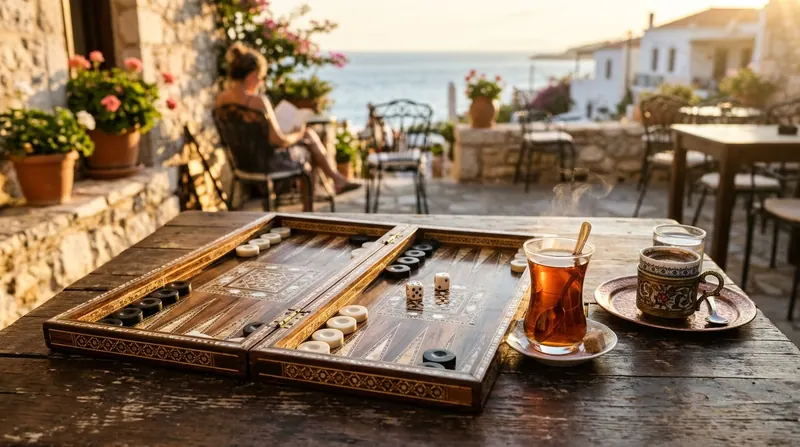
Walk into an open-air kafeneio in Athens, a shaded tea garden along the Bosphorus in Istanbul, a lively courtyard in Tbilisi, or a bustling street café in Jerusalem, and you will hear a rhythm as familiar as the clinking of glasses. The sharp snap of wooden checkers striking polished timber and the rolling rattle of dice against oak echo from morning to midnight.
To an English-speaking visitor, the wooden board with its twelve alternating triangular points on each side looks immediately recognizable. Most travelers assume the locals are simply playing backgammon. But sit down across the table, roll the dice, and you will quickly realize that you have entered an entirely different tactical universe.
Backgammon is not a single, isolated game. It is the modern Western tournament branch of an ancient Mediterranean and Middle Eastern family of games known to historians as the “tables” group [1]. Across the Mediterranean basin, the Caucasus, Central Asia, and the Middle East, this lineage thrives under a kaleidoscope of local names: tavla in Turkey, tavli in Greece and Cyprus, nardy in Russia, takhteh nard in Iran, and shesh besh across the Levant. In our exploration of backgammon culture around the world, each community brings its own cadence, table manners, and oral traditions to the wooden points.
Every member of this family shares the same physical canvas: a folding wooden board divided into four quadrants of 6 points each, totaling 24 points, played with 30 checkers split evenly into 15 light and 15 dark pieces, propelled by 2 dice. Yet the rules of engagement, the opening positions, the handling of captured pieces, and the absence of Western scoring gadgets transform each game into a distinct test of mind and nerve.
If you want to explore the full spectrum of games in the backgammon family, you must first understand why the games split, how their regional rules work, and why traditional players never touched the doubling cube.
One board, two dice, many names
The unity of the tables family is rooted in deep antiquity. Archaeological excavations across the Fertile Crescent demonstrate that track games played with lots and counters have engaged humanity for over five thousand years. The Royal Game of Ur and ancient Egyptian senet laid the foundation for linear racing.
By the time of the Roman Empire, the game had evolved into Ludus Duodecim Scriptorum (the game of twelve lines) and later Tabula, meaning table or board. In the Greek world, tabula became tavli (τάβλι). In the Ottoman Empire and modern Turkey, it became tavla. In Arabic and Persian, the ancient root was nard, derived from the Middle Persian nardshir. Across Russia and Eastern Europe, the Persian name traveled along trade routes to become nardy (нарды).
In the Middle East, players affectionately call the game shesh besh (شيش بيش in Arabic, שש בש in Hebrew). The name itself is a living testament to regional cultural synthesis [1]: shesh is the Persian word for the number 6, while besh is the Turkish word for the number 5. For centuries, merchants and coffee-house patrons called out dice rolls using a shared bilingual vocabulary, immortalizing the roll of 6 and 5 as the very name of the pastime.
In the history of backgammon, this shared ancestry explains why a player from Cairo can sit opposite a player from Athens or Baku and immediately recognize the terrain. Yet beneath this shared visual identity lie fundamental strategic divides.
The Western invention: where is the doubling cube?
If you hand a doubling cube to an old-timer in an Istanbul café or a Greek village square, they will likely set it aside or look at it with polite amusement.
The single biggest difference between Western tournament backgammon and the traditional games of the Eastern Mediterranean is the doubling cube. Modern Western players consider the cube the intellectual core of the game. It transforms backgammon from a simple race into a market of equity, risk calculation, and psychological leverage.
Yet as we explored in our investigation of who invented the doubling cube, the six-sided cube marked with powers of two was introduced around 1926 in the private athletic clubs of New York City [2]. It was an American addition from the 1920s designed to accelerate high-stakes club play and penalize runaway games.
In traditional café play across Turkey, Greece, Iran, and Russia, the 20th-century American cube never gained a foothold. Traditional players view backgammon not as an exercise in financial equity management, but as a test of endurance, flow, and competitive spirit contested across multi-game sets. A game is played to the final checker. A player who falls behind does not surrender with a cube drop; they fight through every pip, looking for a desperate hit or a miraculous series of doubles to turn disaster into triumph.
Turkish tavla: speed, rhythm, and table etiquette
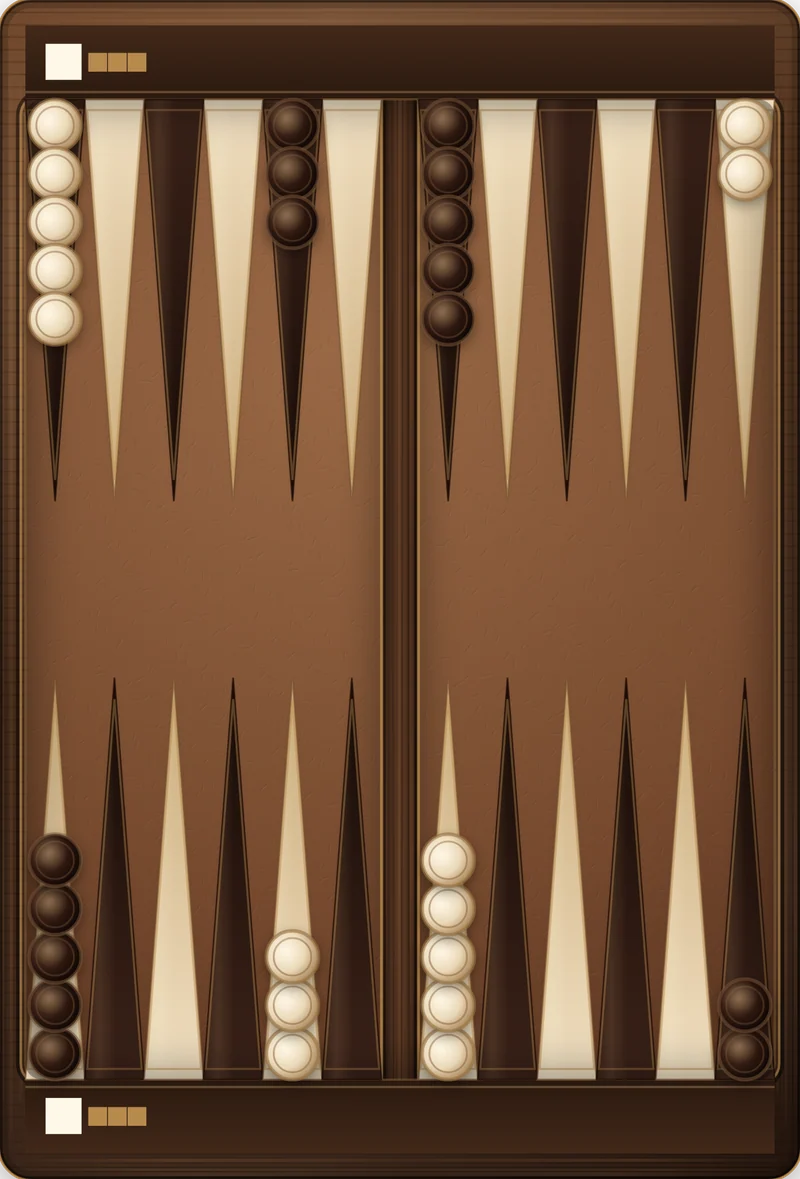
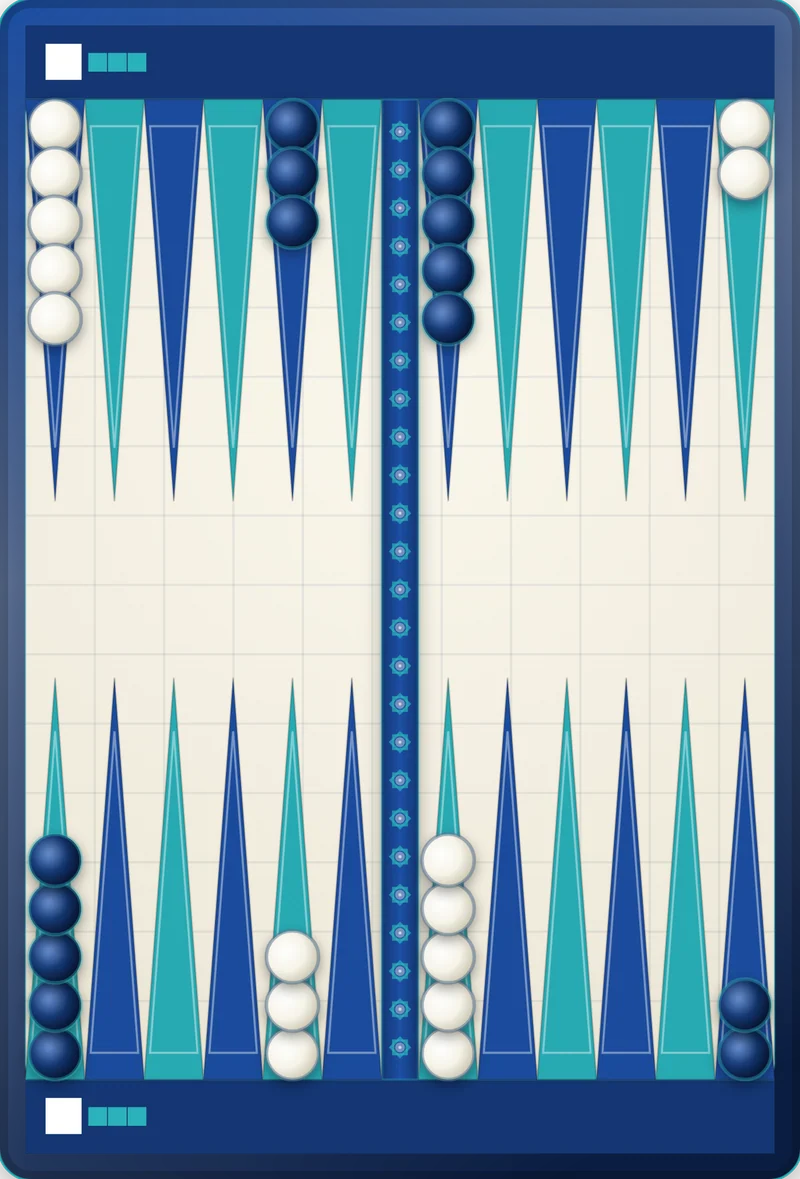
In Turkey, tavla is not merely a pastime; it is the heartbeat of urban life. Turkish tavla, often called erkek tavlası (traditional tavla), uses the standard starting layout that Western players know: 15 checkers per side distributed across four points, with 2 checkers on point 24, 5 checkers on point 13, 3 checkers on point 8, and 5 checkers on point 6 [1].
The movement rules follow the rules of backgammon: players move in opposing directions, single checkers left exposed on a point are blots that can be hit and sent to the central bar, and hitting checkers must re-enter through the opponent’s home table.
However, the flavor and scoring of Turkish tavla are distinct [3]:
- No doubling cube: Games are played one at a time for 1 point, or 2 points for a mars (gammon), where the losing player fails to bear off a single checker.
- No backgammon: The Western concept of a triple loss (backgammon, where the loser still has a checker in the winner’s home board or on the bar) does not exist in standard Turkish tavla. Whether your opponent bore off nothing or still has checkers trapped on your 1-point, the penalty is simply a mars worth 2 points.
- Strict table etiquette: Tavla is played at breakneck speed. Seasoned players roll and move in a single fluid gesture taking no more than two seconds per turn. Checkers must be moved with one hand only. Dice must be rolled cleanly onto the right-hand board; if a die rests cocked against the rim or lands on a checker, both dice must be cast again.
- The linguistic poetry of the roll: Players rarely announce numbers in Turkish alone. Instead, they recite the traditional Ottoman-Persian rhyming calls: yek-ü se for 3 and 1, dü-yek for 2 and 1, cehar-ü se for 4 and 3, and the jubilant şeş-beş for 6 and 5.
In our dedicated guide to Turkish tavla, we examine how this rapid-fire pacing rewards intuition and instant board vision over agonizing calculation.
Greek tavli: the art of the tri-match
In Greece and Cyprus, tavli represents something even richer: an entire triathlon of board strategy [1].
If you challenge someone to tavli in Greece, you do not sit down to play a single game. You play a match, typically contested to 3, 5, or 7 points. Crucially, the match rotates through three completely different games played in sequence on the same board: Portes, Plakoto, and Fevga. Each victory awards 1 point, or 2 points for a gammon.
To win a tavli match, a player cannot rely on one specialized skillset. You must master hitting and bearing off in Portes, positional strangulation in Plakoto, and obstacle navigation in Fevga.
1. Portes (Πόρτες)
Portes means “doors” or “gates,” referring to the secure points a player constructs along the board. Portes is essentially standard backgammon played without a doubling cube. The pieces start in the classic 15-checker array, blots are hit to the bar, and bearing off follows the traditional rules. It serves as the opening act of every Greek contest.
2. Plakoto (Πλακωτό)
Plakoto changes the foundational physics of checker interaction [3].
All 15 of your checkers start stacked on the opponent’s 1-point (point 24 from your perspective), moving in opposing directions toward your home board. But in Plakoto, there is no hitting to the bar.
When an opposing checker sits alone on a point, you do not knock it off. Instead, your checker lands directly on top of it, pinning it to the board. The pinned checker is completely trapped: it cannot move, jump, or be borne off as long as your enemy checker rests on its head. Furthermore, the point now belongs entirely to the pinning player. You can pile additional friendly checkers onto the pinned stack, solidifying your outpost. Only when you decide to lift your pinning checker does the enemy piece regain its freedom.
Plakoto contains a dramatic sudden-death rule: the mother checker (the very first checker at the bottom of your starting stack on point 24). If your opponent manages to pin your mother checker in your starting table before you have moved it away, the game ends immediately as a 2-point loss. In our breakdown of Plakoto rules, we explore why defensive vigilance on the opening moves determines the entire outcome.
3. Fevga (Φεύγα)
Fevga, meaning “run” or “escape,” is the third leg of the Greek triathlon [3]. It is a game of pure positioning and evasion, allied to the Turkish game Moultezim.
In Fevga, all 15 checkers begin on the extreme corner of the board (point 24), but both players move in the same counter-clockwise direction around the entire circuit.
There is no hitting and no pinning whatsoever. A single checker parked on a point completely owns that point. Your opponent cannot land on it, touch it, or pass through it if it forms an impassable barrier.
Because a single checker exerts absolute control, the game revolves around constructing running walls. However, the rules contain a vital safeguard: you are strictly forbidden from building a full 6-prime (a barrier of 6 consecutive closed points) that traps an opponent without escape, unless the opponent has already advanced at least 1 checker past your prime [3]. This prevents a player from building an unbreakable blockade early and freezing the game into paralysis. As we detail in our analysis of priming games in backgammon, constructing a prime requires meticulous timing.
Russian nardy: short versus long
Across Russia, Ukraine, the Caucasus, and Central Asia, the word nardy encompasses two distinct games: korotkie nardy (short nardy) and dlinnye nardy (long nardy).
Short nardy is simply international backgammon played under standard rules, often contested with the doubling cube in competitive clubs. But the true cultural favorite of Eastern European parks and train journeys is Long Nardy [3].
Long Nardy differs from Western backgammon in almost every structural rule:
- The head starting array: Instead of distributing checkers across four points, all 15 checkers of each player start stacked in a tall tower on a single point called the “head” (голова, point 24).
- Unidirectional movement: Both players move in the exact same counter-clockwise direction around the board, racing into their respective home boards.
- No hitting: Like Fevga, a single checker commands a point. There is no bar, no hitting, and no re-entry.
- The one-checker-from-the-head rule: A player is legally permitted to take only 1 checker off the head per turn. This fundamental law prevents players from rapidly unpacking their starting tower. There is only one historic exception: on a player’s very first roll of the game, rolling doubles of 6-6, 4-4, or 3-3 allows taking 2 checkers off the head, because without this exception, certain early rolls would leave the player with zero legal moves [3].
- The prime restriction: Just as in Greek Fevga, a player cannot construct a solid 6-prime that traps opposing checkers behind it unless the opponent has already escorted at least 1 checker into the forward territory.
Long Nardy is a game of exquisite patience. Because single checkers form unbreakable blockades, players maneuver like generals contesting mountain passes, holding back key checkers to deny the opponent safe landing squares while steadily advancing their own convoy. In our specialized guide to Long Nardy rules, we demonstrate how managing the bottleneck at the head decides the race.
Persian takhteh nard: poetry and cosmological design
In Iran, takhteh nard (the wooden board) is treated with reverent affection. Persian literature celebrates nard in the epic verses of Ferdowsi’s Shahnameh, which recounts the legendary diplomatic exchange between the courts of India and Sasanian Persia.
According to the 6th-century Middle Persian text Wizārishn ī Chatrang ud Nihišn ī Nēw-Ardaxšīr (The Explanation of Chess and the Invention of Nard), the great Sasanian vizier Bozorgmehr created nard to mirror the immutable laws of cosmic order and human fate [3]:
- The board represents the terrestrial world.
- The 24 points symbolize the 24 hours of the day and night.
- The 12 points on each side mirror the 12 months of the year and the 12 signs of the zodiac.
- The 30 checkers represent the 30 days of the lunar month (15 light days and 15 dark nights).
- The 2 dice embody the revolution of the celestial spheres and the interplay of destiny with human agency.
This philosophical heritage lives on in modern Iranian play. While standard Iranian takhteh nard utilizes the familiar 15-checker starting array and allows hitting to the bar, it is played without a doubling cube. It retains traditional table customs where rolling doubles is greeted with celebratory toasts and every game is pursued to its natural conclusion.
The ancient record: Emperor Zeno’s catastrophic roll
The structural lineage connecting modern backgammon, tavla, and tavli back to Roman Tabula is confirmed by one of the most remarkable historical records in board gaming: the epigram of Byzantine Emperor Zeno, composed in 480 CE by the poet Agathias [4].
Agathias recorded an actual game of tabula played by Emperor Zeno on a 24-point board. In tabula, players rolled 3 dice instead of 2, moving their pieces around the board while hitting isolated blots.
In the recorded position from 480 CE, Zeno had built strong multi-checker points across his board. But on his turn, the three dice produced an excruciating roll of 2, 5, and 6. Because the movement rules strictly compelled him to play all three numbers if legally possible, Zeno was forced to break up his secure outposts, scattering seven separate isolated blots across the 24 points. His opponent immediately pounced on the exposed checkers, crushing the Emperor’s position.
This ancient account proves that the fundamental tactical dynamics of backgammon—the agony of forced moves, the vulnerability of blots, and the terror of awkward rolls—have tested human patience unchanged since the fall of the Western Roman Empire.
Which variant should you play?
For players accustomed only to Western backgammon, exploring traditional Mediterranean and Middle Eastern variants opens an exhilarating new dimension of board play.
| Variant | Country / Culture | Cube Used? | Hitting Style | Starting Array |
|---|---|---|---|---|
| Western Backgammon | International / US / UK | Yes (since 1920s) | Blots hit to central bar | 15 checkers split on 4 points |
| Turkish Tavla | Turkey | No | Blots hit to bar; no backgammon score | 15 checkers split on 4 points |
| Greek Portes | Greece & Cyprus | No | Blots hit to bar; played in tri-match | 15 checkers split on 4 points |
| Greek Plakoto | Greece & Cyprus | No | Blots pinned; mother checker loss | 15 checkers stacked on point 24 |
| Greek Fevga | Greece & Cyprus | No | No hitting or pinning; pure blocking | 15 checkers on point 24; same direction |
| Russian Long Nardy | Russia & Caucasus | No | No hitting; 1 checker from head rule | 15 checkers on head (point 24) |
| Levantine Shesh Besh | Middle East | No | Traditional café play; bilingual calls | 15 checkers split on 4 points |
If you enjoy tactical sharp play, sacrificial combinations, and high-stakes cube pressure, Western backgammon remains the premier competitive arena.
If you enjoy lightning-fast tempo, rapid board assessment, and vibrant table banter, Turkish tavla will test your instincts.
If you want a complete strategic test that forces you to pivot from attacking to pinning and blocking, nothing surpasses the Greek tavli tri-match.
And if you appreciate deep positional maneuvering where every checker is an immovable fortification, Russian Long Nardy offers a deeply satisfying strategic puzzle.
When you sit down to play backgammon online, remembering this rich heritage enriches every roll. The wooden board before you is not merely an entertainment of our modern digital age; it is a living bridge across five thousand years of human culture, connecting ancient Roman emperors, Ottoman tea masters, Persian poets, and modern enthusiasts across the globe.
Sources
- Encyclopædia Britannica. “Backgammon: Board Game.”
- Jacoby, O., & Crawford, J. R. (1970). The Backgammon Book. Viking Press, New York.
- Murray, H. J. R. (1952). A History of Board-Games Other than Chess. Oxford: Clarendon Press.
- Agathias. (c. 530–582 CE). Anthologia Graeca, Book IX, Epigram 482 (Recording Emperor Zeno's Game of Tabula, 480 CE).
- Boardgammon. “Backgammon Variants: Games in the Tables Family.”
- Boardgammon. “Tavla: Turkish Backgammon Rules and Culture.”
- Boardgammon. “Plakoto: The Greek Pinning Variant.”
- Boardgammon. “Fevga: Greek Running and Blocking Game.”
- Boardgammon. “Long Nardy: Russian Dlinnye Nardy Rules.”
- Boardgammon. “The History of Backgammon: From Nard to the Modern Board.”
- Boardgammon. “Play Backgammon Online Free.”
Found a mistake or an odd phrase? Tell us