Walk into any traditional coffee house from Athens and Istanbul to Manhattan and London, and you will find players deep in thought over backgammon boards. Checkers clack against wood, dice tumble across felt, and opponents weigh risk and reward on every single turn. Whether someone is first discovering the board through backgammon lessons or has played for half a century, enthusiasts have long maintained that the game challenges the intellect, requires active calculation, and tests emotional composure.
In recent years, health magazines and lifestyle websites have amplified these claims, asserting that playing board games can prevent Alzheimer’s disease, boost general intelligence, or act as a digital detox that repairs modern attention spans. But how much of this enthusiastic praise holds up when examined under the lens of rigorous cognitive science?
The honest answer requires separating scientific evidence from romantic folklore. Clinical trials have never shown that playing backgammon cures or prevents dementia, and cognitive psychology demonstrates that tabletop skills do not magically transfer to unrelated everyday tasks. Yet when epidemiologists follow thousands of people across decades of life, a distinct and consistent pattern emerges: regular participation in complex, non-digital games like backgammon correlates with slower cognitive decline in late adulthood. Much like avoiding the ten mistakes beginners make, understanding your mind at the board requires replacing assumptions with evidence.
Examining what the research really shows requires exploring the largest longitudinal cohorts ever assembled, the neurological concept of cognitive reserve, and the unique mental demands of backgammon’s 36 dice outcomes.
What do the largest 20-year cohort studies show?
When investigating cognitive aging, short-term laboratory studies cannot capture how human brains change over decades. The most reliable insights come from prospective longitudinal cohort studies that track thousands of individuals across their senior years.
The most widely cited investigation into board games and long-term brain health is the French PAQUID study, published in BMJ Open in 2013 [1]. Led by Professor Jean-François Dartigues, the prospective cohort monitored 3,675 community-dwelling older adults aged 65 and older in southwestern France across a 20-year follow-up period [2]. At the beginning of the study, none of the participants had a diagnosis of dementia. Researchers documented their regular leisure activities, including board games, physical exercise, reading, and social outings.
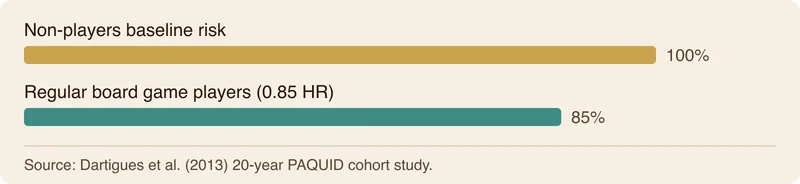
Over the subsequent 20 years, researchers repeatedly administered the Mini-Mental State Examination (MMSE) to evaluate global cognitive functioning. In their initial statistical analysis, regular board game players had a 15% lower risk of developing incident dementia compared to non-players, represented by a hazard ratio of 0.85 with a 95% confidence interval of 0.74 to 0.99 [2]. Furthermore, regular players experienced significantly less global cognitive decline on their MMSE trajectories over time.
However, the authors did not stop at this headline number. When researchers adjusted their models to account for baseline depressive symptoms and initial cognitive performance, the statistical association between board game playing and dementia risk was attenuated [2]. This finding is critical: it demonstrated that playing board games does not act like a medical vaccine against neuropathology. Rather, game playing served as a reliable marker of broader intellectual engagement, social integration, and cognitive health.
A second landmark dataset reinforces these findings: the Lothian Birth Cohort 1936 study conducted at the University of Edinburgh [1]. Published in 2020 by Dr Drew Altschul and Professor Ian Deary in The Journals of Gerontology: Series B, the study examined 1,091 participants who had taken the Scottish Mental Survey 1947 at age 11 [1]. Because researchers possessed verified childhood intelligence scores from 1947, they could test an essential question: do board games protect the brain, or do people who already have higher intelligence simply play more games?
Researchers evaluated the cohort at four distinct waves across the eighth decade of life: at ages 70, 73, 76, and 79, administering 14 standardized cognitive tests measuring memory, processing speed, and visuospatial ability [1]. The findings were striking: participants who increased their analog game playing between age 70 and age 79 experienced less cognitive decline in processing speed and memory, even after rigorously controlling for age 11 intelligence, education, social class, and gender [1].
The Edinburgh authors were careful to emphasize the study’s limitations [1]. As an observational cohort study rather than a controlled randomized drug trial, it showed a clear statistical association rather than absolute experimental causality. Reverse causation—where individuals whose brains remain healthier are naturally more inclined to continue playing games—cannot be entirely ruled out.
What is cognitive reserve, and why does it matter?
To make sense of both the PAQUID and Lothian cohort findings, neuroscientists rely on the concept of cognitive reserve, pioneered by Dr Yaakov Stern at Columbia University [3].
For decades, pathologists observed a baffling clinical phenomenon: during post-mortem autopsies, some elderly individuals were found to have extensive neurodegenerative plaques and tangles characteristic of advanced Alzheimer’s disease, yet while alive, they had displayed no noticeable memory loss or clinical symptoms of dementia. How could a brain suffer physical damage without manifesting functional impairment?
Stern’s theory of cognitive reserve explains that the brain is not a static machine that breaks down at a fixed rate [3]. Instead, lifelong intellectual engagement, education, complex hobbies, and social interaction build resilient, adaptable neural networks. When age-related changes or neuropathology affect one neural pathway, a brain with high cognitive reserve can recruit alternative networks to complete the same cognitive task.
Crucially, cognitive reserve does not halt biological degeneration in brain tissue [3]. Plaque accumulation and biological aging continue. What cognitive reserve does is provide a buffer: it allows an individual to maintain functional independence, problem-solving ability, and memory for years longer before clinical symptoms cross the diagnostic threshold.
Playing complex strategy games like backgammon fits the cognitive reserve model precisely. Unlike passive entertainment, such as watching television, backgammon demands continuous active calculation, evaluation of changing board geometries, and real-time responses to unpredictable opponent choices.
The three mental challenges unique to backgammon
Many people group all tabletop games together, comparing backgammon casually to chess or checkers. But from a cognitive perspective, backgammon exercises distinct neural processes because it is a game of imperfect information driven by stochastic dice rolls.
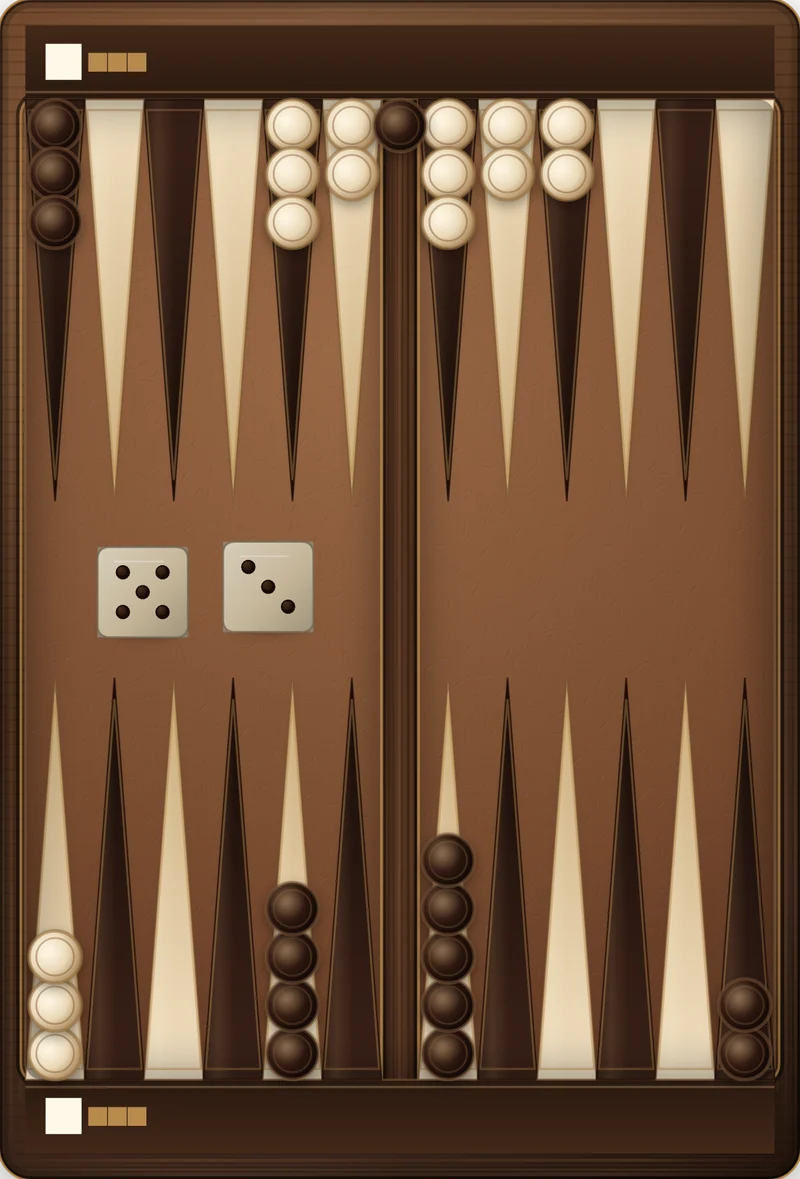
Standard backgammon is played on a board of 24 points with 15 checkers per side moving in opposing directions according to the roll of two dice [4]. The race requires players to navigate three demanding cognitive challenges on every turn.
1. Probabilistic calculation under uncertainty
In chess or checkers, both players see all information at all times; there are no hidden variables and no randomized dice. Backgammon, by contrast, introduces 36 distinct outcomes on two 6-sided dice on every single turn [5].
A player cannot simply look for one ideal move in a vacuum. Instead, you must assess risk dynamically:
- What are the odds of your opponent rolling a direct shot (any single die roll from 1 to 6) to hit a vulnerable blot?
- If you leave a blot eight pips away, what fraction of the 36 combinations can hit it (for example, rolls like 6-2, 5-3, 4-4, 2-2)?
- Does the offensive gain of slotting a key home-board point outweigh the mathematical risk of being sent to the bar?
This stochastic structure forces the prefrontal cortex to perform continuous expected-value calculations. Players learn not to judge a decision solely by its immediate result, but by the soundness of the probabilities behind it. If you make a mathematically sound move and your opponent rolls an unlikely roll to hit you, you must maintain cognitive flexibility and adapt your strategy rather than succumbing to emotional frustration.
2. Rapid mental arithmetic: the pip count
Every backgammon position is fundamentally a race to bring 15 checkers home and bear them off the board [4]. To determine who is ahead in that race, players must calculate the pip count: the total number of points their remaining checkers must travel to clear the board.
Performing rapid mental arithmetic without touching the checkers exercises working memory and mental chunking. Experienced players do not count checkers one by one; they group checkers into symmetrical geometric clusters (such as three checkers on the 8-point representing 24 pips) and adjust for crossover differences. In practice, learning to track the pip count across changing board states exercises spatial and numerical calculation at the board.
3. Emotional regulation and the doubling cube
The third distinct cognitive demand of backgammon is the doubling cube. As explored in our inquiry into who invented the doubling cube, the device appeared in the 1920s to allow a player who believes they hold an advantage to propose doubling the stakes of the match [5]. The opponent must either accept the double and play on at twice the stakes, or immediately concede the game at the current value.
Basic game theory establishes that in money play without gammon threats, the mathematical threshold for accepting a double is exactly 25% winning chances [5]. If your estimated probability of winning is 25% or higher, taking the double offers an expected value equal to or better than dropping (surrendering 1 point). If your winning chances fall below 25%, taking is mathematically detrimental.
Making these decisions under time pressure requires emotional discipline and metacognition. Human beings are naturally vulnerable to loss aversion and cognitive biases: players either stubbornly cling to losing positions out of pride, or panic and drop winnable games out of fear. Managing the doubling cube demands objective self-assessment, forcing players to override emotional impulses with disciplined probabilistic reasoning.
Does backgammon make you smarter in everyday life?
Given these intense mental exercises, it is tempting to conclude that hours spent playing backgammon will make you better at business, enhance your performance on math exams, or improve your memory for everyday tasks.
Unfortunately, cognitive science soundly refutes the idea of broad cognitive transfer. In a comprehensive 2019 review published in BioPsychoSocial Medicine, Dr Mutsuhiro Nakao evaluated board game interventions across psychological and clinical literature [6]. The review concluded that while traditional board games stimulate prefrontal cortical networks, working memory, and social communication, empirical evidence that these skills carry over to unrelated everyday tasks remains unproven [6].
This finding matches what decades of research on chess have revealed. Grandmasters possess extraordinary recall for complex chess positions, but when tested on random board arrangements or non-chess memory tasks, their performance drops to that of average novices. Expertise is domain-specific. Practicing backgammon strategy makes you exceptionally skilled at evaluating backgammon positions, calculating dice combinations, and managing the cube. It does not automatically turn you into a financial wizard or a mathematical genius.
Recognizing the limits of cognitive transfer is liberating. It allows players to appreciate the game for what it genuinely provides: an engaging, low-cost, mentally stimulating social activity that exercises working memory and spatial reasoning within its own rich domain.
Integrating backgammon into a healthy mental routine
If your goal is to support healthy cognitive aging and enjoy the game for decades to come, evidence suggests treating backgammon as one component of a balanced lifestyle:
- Play for the challenge, not for a medical promise. Do not approach backgammon as clinical medicine. Play because you enjoy the tactical richness, the interplay of skill and luck, and the social interaction across the table.
- Combine mental play with physical exercise. Epidemiological research consistently shows that aerobic physical fitness, cardiovascular health, and quality sleep have far greater proven effects on brain health and dementia risk reduction than any sedentary puzzle or board game alone.
- Embrace deliberate practice. Playing mindless games against the clock does little to challenge your brain. To maximize cognitive engagement, study difficult checker plays, calculate the pip count by hand, and review your blunders after completing a match.
- Value the social connection. Board games provide structured social engagement, connecting generations across families and clubs. Social contact is itself one of the strongest protective factors documented in cognitive aging literature.
Whether you enjoy playing on a classic walnut board with friends or prefer to play backgammon online free in your browser, the ancient game offers a timeless blend of calculation, psychology, and chance. While it cannot guarantee immunity from aging, it provides an intellectually stimulating pastime that has tested human decision-making for thousands of years.
Questions people ask
Can playing backgammon prevent dementia or Alzheimer’s disease?
No scientific trial has ever shown that playing backgammon, chess, or any other game prevents, cures, or reverses dementia or Alzheimer’s disease. However, large 20-year epidemiological studies like the PAQUID cohort demonstrate that regular participation in non-digital board games is associated with slower rates of global cognitive decline in older adults, likely by helping build cognitive reserve.
Does backgammon improve math skills in children and adults?
Practicing backgammon requires frequent mental addition, multiplication, and probability calculations across 36 dice combinations. While this provides active arithmetic practice at the board, cognitive research indicates that these skills remain largely domain-specific, meaning they do not automatically transfer to unrelated academic subjects.
How does backgammon differ cognitively from chess?
Chess is a game of deterministic calculation and complete information with zero random elements, heavily taxing visualization and deep calculation trees. Backgammon is a game of stochastic decision-making under uncertainty, forcing the brain to weigh probabilities, manage variance across two dice, and evaluate risk dynamically using the doubling cube.
Sources
- Altschul, D. M., & Deary, I. J. (2020). “Playing Analog Games Is Associated With Less Cognitive Decline: A 68-Year Longitudinal Study.” The Journals of Gerontology: Series B, 75(3), 474–482.
- Dartigues, J. F., et al. (2013). “Boardgame playing, cognitive decline and risk of dementia in elderly subjects: a 20-year population-based study of the PAQUID cohort.” BMJ Open, 3(8), e002998.
- Stern, Y. (2012). “Cognitive reserve in ageing and Alzheimer's disease.” The Lancet Neurology, 11(11), 1006–1012.
- Boardgammon. “Backgammon lessons: Learn to play step by step.”
- Boardgammon. “Backgammon strategy: Core concepts and game plans.”
- Nakao, M. (2019). “Special series on 'effects of board games on health education and promotion' board games as a promising tool for health promotion: a review of recent literature.” BioPsychoSocial Medicine, 13(1), 5.
- Boardgammon. “Play backgammon online free in your browser.”
Found a mistake or an odd phrase? Tell us