How does en passant work in chess?
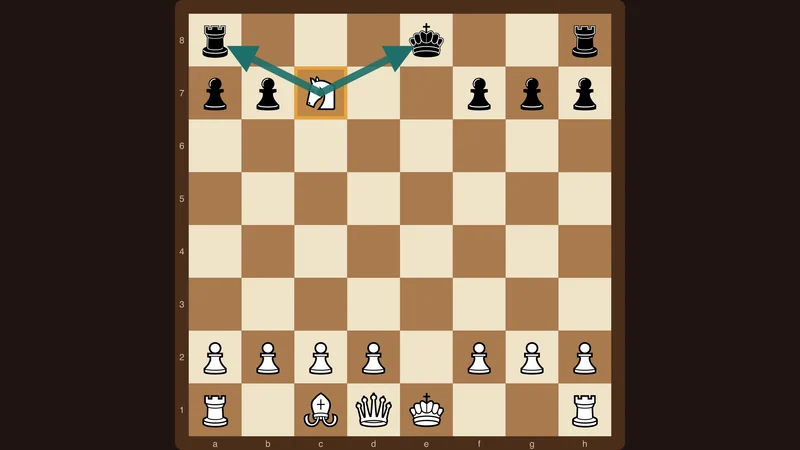
En passant is French for “in passing.” When an opponent’s pawn jumps two squares in a single move from its starting rank and lands directly beside your pawn on an adjacent file, your pawn may capture it diagonally onto the empty square that pawn just crossed, removing the enemy pawn as if it had stepped forward only one square. Because the opportunity arises so rarely, it runs into a well-known blind spot in human visual search: in laboratory studies, observers missed 46% of targets that appeared on only 2% of trials[1].
Under Article 3 of the FIDE Laws of Chess (in both the 2018 and 2023 rulebooks), four conditions must hold on the same turn[2]:
- Your capturing pawn already stands on its fifth rank. Counting from White’s side of the board, the fifth rank is rank 5 (
a5throughh5); counting from Black’s side, the fifth rank is rank 4 (a4throughh4). A pawn on any other rank can never capture en passant. - An enemy pawn on a neighboring file advances two squares in one move. Suppose your White pawn sits on
e5. If Black pushes a pawn fromd7tod5(or fromf7tof5) in a single turn, that pawn has crossed an attacked square (d6orf6) to land beside yours. If Black’s pawn reachedd5in two separate turns instead (d7–d6earlier, andd6–d5now), en passant is illegal. - You capture diagonally onto the skipped square on your immediate next turn. White’s pawn on
e5moves diagonally forward tod6(rank 6) and lifts Black’s pawn offd5. From Black’s side, a pawn onb4meeting White’sa2–a4moves diagonally toa3(rank 3) and lifts White’s pawn offa4. Wait even one turn—for instance, to play an in-between check elsewhere—and the right to take that pawn en passant vanishes for the rest of the game. - Both the attacker and the target must be pawns. Out of the 32 pieces on the 64-square board (eight pawns per player, 16 pawns in total), only a pawn can capture or be captured en passant, as Kenneth Whyld noted in Learn Chess in a Weekend in 1993[2]. A bishop, knight, rook, queen, or king can never capture “in passing,” and a pawn can never invoke the rule against a piece.
As Graham Burgess observed in the 2000 second edition of The Mammoth Book of Chess, en passant is the sole capture in chess where the capturing unit finishes its move on a square the captured unit did not occupy[2]. If you want to practice the motion yourself before reading the tournament edge cases, our step-by-step chess lessons cover the fundamentals across 12 interactive modules, and Lesson 1 introduces en passant on step 9 from the position 4k3/8/8/3pP3/8/8/8/4K3 w - d6 0 2[3][4].
Scoresheet notation follows the landing square, not the square where the captured pawn stood. In standard algebraic notation, you write your pawn’s starting file, an x, and the empty destination square: exd6 or bxa3, never exd5 or bxa4[2]. Adding e.p. (exd6 e.p.) is optional, while checks (+) and checkmates (#) attach at the end as usual (hxg6#). Chess software tracks that fleeting permission in Forsyth–Edwards Notation (FEN), which encodes any position in six space-separated fields[2]. After any two-square pawn advance, the fourth FEN field records the skipped square (such as d6 in the Lesson 1 FEN above) for one half-move, then clears to - on the very next ply (unless the reply is another two-square pawn push), whether a capture was possible or played.
Is en passant forced, and how does it affect draws?
Spend five minutes in online chess forums and you will meet the running joke that en passant is mandatory every time it appears. Over a tournament board, that folklore is false: en passant is optional whenever you have at least one other legal move[5].
There is, however, one genuine case where en passant becomes compulsory, and it sparked a decade-long debate across 19th-century Europe[6]. Suppose it is your turn, your king is not in check, every other unit on your side is immobilized, and your sole legal move on the board is an en passant capture. Because en passant began as an optional right, can you decline that right, declare yourself out of moves, and claim a 0.5–0.5 draw by stalemate? For how true stalemates work when zero legal moves exist, see our guide to why stalemate is a draw in chess.
Leading masters split over that puzzle starting in 1846[6]. On January 31, 1846, Adolf Anderssen published a three-move problem in Leipzig’s Illustrirte Zeitung turning on whether Black could refuse en passant to claim stalemate[6]. In April 1846, Pierre-Charles Fournier de Saint-Amant argued in Le Palamède that en passant was a privilege a player could waive[6]. Tassilo von der Lasa weighed both sides in Deutsche Schachzeitung in 1848 and 1855[6]. Howard Staunton settled the question in London in 1860: following a committee submission by Charles Tomlinson, Staunton wrote on page 5 of Chess Praxis that taking a pawn in passing is a forced move when the player has no other[5]. Alain Campbell White in 1911 and Kenneth Harkness in 1967 recorded the same ruling, and FIDE law today is unequivocal: when en passant is your sole legal move, you must play it[6].
That one-turn lifespan also shapes draw rules and tournament arbitration:
- Threefold and fivefold repetition. Under FIDE Article 9.2, a player may claim a draw on three occurrences of the same position, while five occurrences end the game automatically under FIDE’s mandatory-draw rules[7]. Two identical piece layouts do not count as the same position if a legal en passant capture existed on the first occurrence and none remained on the later ones[7]. FIDE’s early 1928 rule omitted en passant rights, an oversight later repaired so the first layout is excluded from the repetition count.
- The 50-move and 75-move counters. Every pawn move and every capture resets both the 50-move claimable draw counter and the 75-move mandatory draw counter to zero[7].
- The 1976 Haifa Olympiad slip. As Edward R. Brace recorded in An Illustrated Dictionary of Chess in 1977, a game at the 1976 Haifa Chess Olympiad featured an illegal “deferred en passant” played two moves after the enemy pawn’s advance, and neither player nor the arbiters caught the error until the game was over[8].
Why was en passant invented, and why did Italy reject it until 1880?
For centuries of early chess, en passant had no reason to exist. In Persian and Arabic shatranj and in medieval European chess, pawns stepped only one square at a time from start to finish, as we trace in how chess evolved from ancient chaturanga and shatranj. Opposing pawns on adjacent files could never pass each other without stepping onto an attacked square[9].
Between the 13th and 16th centuries—alongside the late-15th-century European reforms of the queen and bishop around 1475–1497 and Luis Ramírez de Lucena’s book of circa 1497—players added the initial two-square pawn advance to speed up openings[9]. That change created a tactical loophole: a home-rank pawn could now bound two squares straight past an enemy pawn posted on its fifth rank (rank 5 for White, rank 4 for Black), manufacturing a passed pawn without risking combat.
En passant closed that loophole by treating a two-square sprint past a fifth-rank guard as if the pawn had paused one square out. Spanish priest and master Ruy López de Segura recorded the rule in his 1561 treatise Libro de la invención liberal y arte del juego del axedrez, cited in H. J. R. Murray’s 1913 A History of Chess as well as later histories by Henry Davidson in 1949 and Harry Golombek in 1977[9]. English chess writers adopted the French phrase directly, with early definitions printed in The Popular Educator, published in Oxford in 1767, and in W. S. Kenny’s Practical Chess Exercises in London in 1818[6].
Italian masters rejected the rule for more than 300 years. Under Italian chess rules, a pawn jumping two squares from its starting rank enjoyed passar battaglia (“passing battle”), the right to march past an enemy fifth-rank pawn unharmed. London master Jacob Sarratt described passar battaglia for English readers in 1808 in A Treatise on the Game of Chess, warning that Italian pawn play differed sharply from French and English practice[6]. Over three centuries after Ruy López’s 1561 book, Italy finally abandoned passar battaglia and adopted international en passant rules in 1880 ahead of the 1881 Milan tournament, as David Hooper and Kenneth Whyld note in The Oxford Companion to Chess (1996)[10].
Even after 1880 unified European play, skeptics remained. In the October 1924 British Chess Magazine, John Keeble recalled 19th-century English master Joseph Henry Blackburne predicting that if an international chess federation were ever formed, its first act would be to abolish en passant[6]. FIDE was founded in that very year, 1924, and kept the rule untouched.
Why do human eyes miss en passant so often?
Online chess moderators regularly hear from newer players convinced that a bug or cheat code just deleted their pawn from the fifth or fourth rank (a complaint online chess administrators noted regularly by 2018)[2]. Club players know the rule well, yet they still overlook en passant in three-move calculations far more often than standard captures. Vision science and chess psychology point to three mechanisms behind that blind spot.
First is the low-prevalence effect in visual search. In a 2005 Nature paper, Jeremy M. Wolfe, Todd S. Horowitz, and Naomi M. Kenner showed that when observers searched displays for a target appearing on 1% of trials rather than 50%, they missed roughly 30% (0.30) of those rare targets[11]. In 2007, Wolfe, Horowitz, Michael J. Van Wert, Kenner, Skyler S. Place, and Nour Kibbi ran seven experiments in the Journal of Experimental Psychology: General (volume 136, issue 4) to isolate the cause[1].
In Experiment 1a, 24 observers aged 19–53 (mean age 28.5) completed 99 practice trials, 200 trials at 50% prevalence, and 1,000 trials at 2% prevalence, resting every 50 trials[1]. Dropping prevalence from 50% to 2% more than doubled the miss rate, from 20% (0.20, standard deviation 0.06; false alarms 19%) to 46% (0.46, standard deviation 0.15; false alarms 1%)[1]. Observers’ perceptual sensitivity did not fall (the sensitivity index d′ rose from 1.97 at 50% prevalence to 2.55 at 2% prevalence), and paired observers missed the same targets[1]. Forcing slower responses in Experiment 6 still left 41% low-prevalence misses versus 18% at high prevalence[1]. Repeated “absent” trials shift the visual system’s decision threshold to quit searching early.
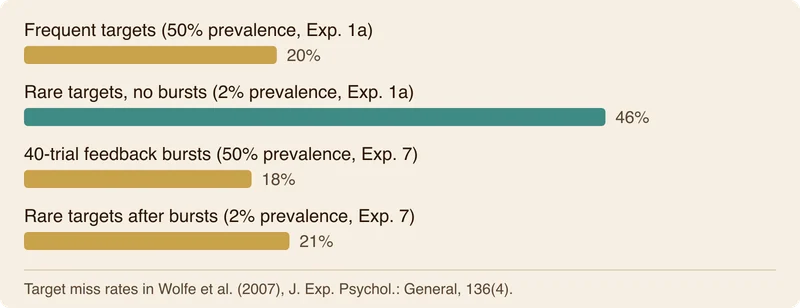
Experiment 7 tested a fix with 14 observers aged 21–47 (mean age 32.6) across 1,700 trials: 300 training trials, then five blocks of 200 no-feedback trials at 2% prevalence alternating with 40-trial full-feedback bursts at 50% prevalence (8.9% overall prevalence)[1]. Those 40-trial feedback bursts recalibrated the search criterion and cut rare-target misses at 2% prevalence from 46% down to 21% (0.21), close to the 18% (0.18) miss rate inside the 50% bursts[1].
Two chess-specific perceptual hurdles compound that rarity effect:
- Empty-square targeting vs. static chunks. In 1973, William G. Chase and Herbert A. Simon estimated in Cognitive Psychology that skilled chess perception draws on 50,000 to 100,000 stored spatial piece patterns, which researchers call “chunks” in memory[12]. Ordinary captures place an enemy piece visibly on the destination square. En passant targets an empty square (
d6,f6,g6,d3) and requires working-memory tracking of the prior two-square move. - The Einstellung tunnel-vision trap. Using eye tracking in Cognition in 2008, Merim Bilalić, Peter McLeod, and Fernand Gobet showed that familiar patterns pull gaze back to expected squares and lower problem-solving performance by roughly three standard deviations in skill level[13]. That pull blinds experienced players to quiet en passant resources while tempting newer players into the opposite reflex of snapping off en passant automatically.
Keep the scope of those findings exact. As Giovanni Sala and Fernand Gobet showed across meta-analyses in Current Directions in Psychological Science in 2017, practicing tactical patterns and feedback bursts sharpens domain-specific board recognition in chess only, with zero transfer to general intelligence (IQ), school grades, everyday memory, or dementia outcomes[14]. We look closer at those trials in what the largest trial found about chess and intelligence.
When does en passant win on the spot, and when should you decline it?
Irish chess writer James J. Walsh observed (quoted by historian Edward Winter) that players show growing maturity when they stop capturing en passant automatically[6]. Two verified board positions—one from an Australian tournament in 1928 and one composed in 1902—illustrate both sides of that rule of thumb.
How can one en passant capture deliver double checkmate?
At the 1928 Pietzcker Christmas Tournament in Melbourne, Gunnar Gundersen played White against Albert H. Faul in an Advance Variation of the French Defense[4]:
1. e4 e6 2. d4 d5 3. e5 c5 4. c3 cxd4 5. cxd4 Bb4+ 6. Nc3 Nc6 7. Nf3 Nge7 8. Bd3 O-O 9. Bxh7+ Kxh7 10. Ng5+ Kg6 11. h4 Nxd4 12. Qg4 f5
Look at move 13 before the diagram. Black’s 12...f5 has just landed beside White’s e5 pawn, inviting 13. exf6. Gundersen declined it[4]. Leaving Black’s pawn on f5 kept defensive lines jammed around Black’s king. Gundersen played 13. h5+ Kh6 14. Nxe6+, uncovering a discovered check from Bc1 (14...Kh7 loses to 15. Qxg7#). Faul blocked the diagonal with 14...g5, reaching r1bq1r2/pp2n3/4N2k/3pPppP/1b1n2Q1/2N5/PP3PP1/R1B1K2R w KQ g6 0 15[4].
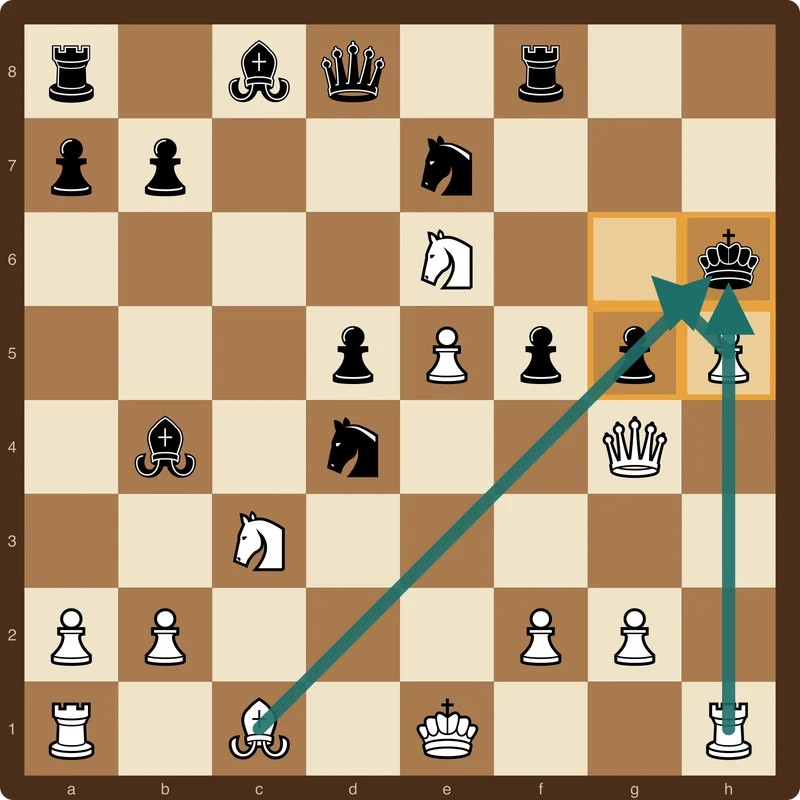
Now White plays 15. hxg6# (15. hxg6 e.p.#)[4]. Vacating h5 opens White’s rook on h1 up the h-file at the exact moment removing g5 re-opens White’s bishop on c1 along c1–h6. Neither checking piece moved, yet Black’s king on h6 faces double check and checkmate with zero legal replies (Qg4 guards g6 and h5, Ne6 covers g7 and g5, and the pawn on g6 covers h7)[4].
Three verified records frame Gundersen’s finish[4][6]:
- Earliest possible en passant: Move 3 (
1. e4 e6 2. e5 d5 3. exd6), played twice in 1882 by Wilhelm Steinitz: against Bernhard Fleissig in Vienna, and against Jacob Elson in Philadelphia on December 12, 1882. - Most en passant captures in one competitive game: Three, verified in at least eight tournament games starting with Alexandru Segal vs. Karl-Heinz Podzielny in Dortmund in 1980, and never all three by one player. (Irving Chernev’s 1952 and 1968 story claiming four en passant captures within six consecutive half-moves in an 1870 Paulsen–Anderssen game was an unverified spoof.)
- Shortest composed en passant checkmate: Six moves, composed independently by C. D. Locock (1922), Pal Benko (1975:
1. e4 e5 2. Qh5 Nc6 3. g4 d6 4. Bh3 Kd7 5. g5+ f5 6. gxf6#), and Michael McDowell.
Why can two pawns on one rank still be horizontally pinned?
Normally, two pawns standing between an enemy rook and your king on the same rank mean neither pawn is pinned: if one moves, the other still shields the king. For standard single-piece pins, see how pins, forks, and skewers work in chess. En passant is the lone exception where two pawns leave the rank in one move.
In 1902, composer O. Sommerfeldt published a mate-in-two problem (8/1b3q2/B7/6p1/1R2pkPp/1p5P/1Q1P2K1/8 w - - 0 1) built around that geometry[4]. White plays the key move 1. d4!, reaching 8/1b3q2/B7/6p1/1R1PpkPp/1p5P/1Q4K1/8 b - d3 0 1 and threatening 2. Qf2#[4].
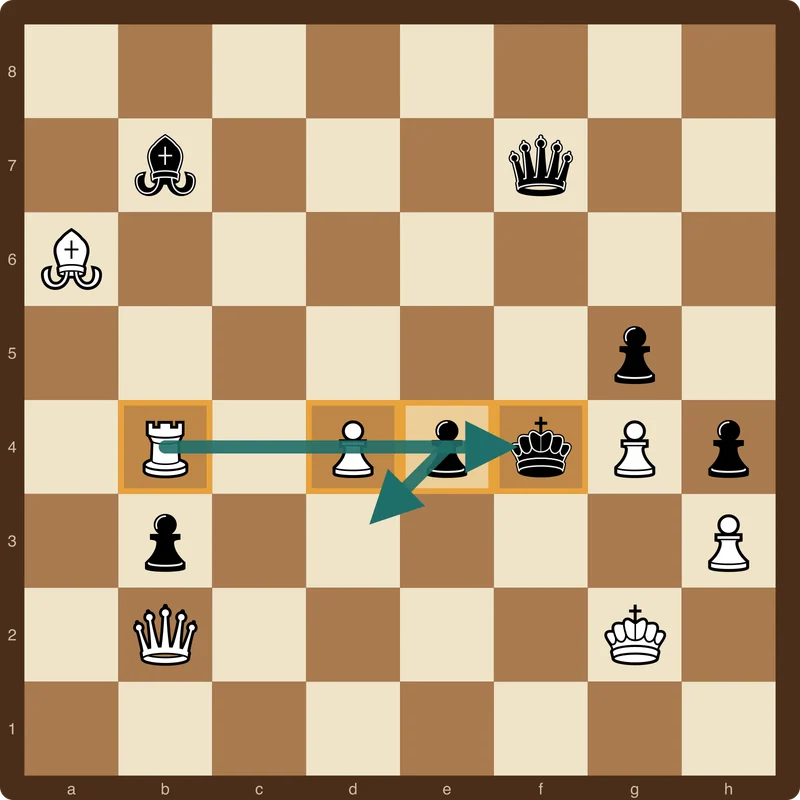
Along the fourth rank stand Rb4, Pd4, pe4, and kf4. Black wants to play 1...exd3 e.p.+, giving discovered check from Bb7 while stopping the threat. Yet 1...exd3 e.p. is illegal: taking moves Black’s pawn off e4 and lifts White’s pawn off d4, clearing the fourth rank and exposing Black’s king on f4 to horizontal check from Rb4[4].
By contrast, 1...e3+ is legal because d4 remains on the fourth rank as a shield. Out of Black’s 22 legal moves, 1...e3+ self-blocks e3 and loses to 2. d5#, 1...Ke3 loses to 2. Qc1#, and all 20 legal moves by Black’s queen and bishop allow 2. Qf2#[4].
Run three quick checks before taking or declining en passant in your own games:
- Inspect all opened lines. Check both vacated files, both diagonals, and whether clearing two pawns from the fifth or fourth rank exposes your king horizontally.
- Weigh central pawn tension in openings. In Petrov’s Defense (
1. e4 e5 2. Nf3 Nf6 3. d4 exd4 4. e5 Ne4 5. Qxd4 d5), White often plays6. exd6to open central lines[10]. In the French Defense Advance (1. e4 e6 2. d4 d5 3. e5) and the Caro-Kann Advance (1. e4 c6 2. d4 d5 3. e5, covered in our guide to the Caro-Kann Defense and our seven core chess opening guides), trading off youre5spearhead by reflex if Black later pushes...f5surrenders central space[15][4]. - Practice rare motifs in short bursts. Following Wolfe’s Experiment 7, short sets with immediate feedback recalibrate visual search[1]. Browse 144 sample positions across 12 tactical themes (12 static diagrams per theme, including pins, discovered attacks, and mates in two) on our chess tactics puzzles page, visit the Chess Moment hub, or play chess online in your browser in 10+5 Quick Match games, solo practice, or friend challenges at 3+2, 5+3, 10+5, 15+10, and untimed controls[16][17][18].
What else do players ask about en passant?
What does en passant mean in English? It is a French phrase that translates literally as “in passing” in English[2]. English-speaking players kept the French term from 18th- and 19th-century manuals because the capture intercepts an enemy pawn mid-stride as it crosses an attacked square.
Can you capture en passant on the turn after you get out of check? No. FIDE rules allow one half-move: your immediate turn and no later one[2]. If the opponent’s two-square pawn push gives check (directly or by discovery) and capturing that pawn en passant immediately does not legally end the check, the right expires as soon as you play another reply.
What if two of my pawns sit beside the pawn that just jumped two squares?
Either pawn may capture en passant, though only one can make the move. If White has pawns on d5 and f5 when Black plays e7–e5, both dxe6 and fxe6 are legal on White’s next turn, landing on e6 and removing Black’s e5 pawn[2].
Can an en passant capture promote a pawn? Never. White always captures en passant from rank 5 onto rank 6, and Black always captures from rank 4 onto rank 3[2].
Do you have to write “e.p.” on a tournament scoresheet?
No. Writing the capturing pawn’s file, x, and the destination square, such as exd6 or hxg6#, records the move completely under FIDE rules[2]. Adding e.p. is optional.
Why did the app block en passant when the pawns were side by side?
One of three rules stopped it: the enemy pawn arrived by a single-square push (d6–d5) rather than a two-square jump (d7–d5), a turn already elapsed since the jump, or taking en passant would expose your own king to diagonal, vertical, or two-pawn horizontal check[2][4].
Sources
- Wolfe, J. M., Horowitz, T. S., Van Wert, M. J., Kenner, N. M., Place, S. S., & Kibbi, N. (2007). “Low target prevalence is a stubborn source of errors in visual search tasks.” Journal of Experimental Psychology: General, 136(4), 623–638.
- Wikipedia contributors. “En passant.” Wikipedia, The Free Encyclopedia.
- Boardgammon. “Chess Lessons: Step-by-Step Curriculum.”
- Boardgammon. “Move-by-move and legal-move verification of Gundersen vs. Faul (Melbourne, 1928) and O. Sommerfeldt (1902).”
- Staunton, H. (1860). Chess Praxis: A Supplement to The Chess Player’s Handbook, p. 5. London: Henry G. Bohn.
- Winter, E. (2006). Chess Facts and Fables, pp. 98–99 (with Chess Notes historical feature “En passant (Chess)”).
- Wikipedia contributors. “Threefold repetition.” Wikipedia, The Free Encyclopedia.
- Brace, E. R. (1977). An Illustrated Dictionary of Chess, “double check” and “en passant,” pp. 83, 93. Secaucus, NJ: Craftwell.
- Murray, H. J. R. (2012 [1913]). A History of Chess, p. 815. New York: Skyhorse Publishing (orig. Oxford University Press).
- Hooper, D., & Whyld, K. (1996). The Oxford Companion to Chess (2nd ed.), “en passant,” pp. 124–125. Oxford University Press.
- Wolfe, J. M., Horowitz, T. S., & Kenner, N. M. (2005). “Cognitive psychology: rare items often missed in visual searches.” Nature, 435(7041), 439–440.
- Chase, W. G., & Simon, H. A. (1973). “Perception in chess.” Cognitive Psychology, 4(1), 55–81.
- Bilalić, M., McLeod, P., & Gobet, F. (2008). “Why good thoughts block better ones: The mechanism of the pernicious Einstellung (set) effect.” Cognition, 108(3), 652–661.
- Sala, G., & Gobet, F. (2017). “Does far transfer exist? Negative evidence from chess, music, and working memory training.” Current Directions in Psychological Science, 26(6), 515–520.
- Boardgammon. “Chess Openings: Core Principles and Repertoire Guides.”
- Boardgammon. “Chess Puzzles: 12 Tactical Themes and Sample Positions.”
- Boardgammon. “Chess Moment: Play Rated Chess Online.”
- Boardgammon. “Chess Moment: Play Online Chess in Your Browser.”
Found a mistake or an odd phrase? Tell us