What is stalemate in chess, and how does it differ from checkmate?
Stalemate happens the instant the player whose turn it is to move is not in check and has zero legal moves anywhere on the board. Play ends immediately as an automatic 0.5–0.5 draw, awarding half a point to each side.
Checkmate and stalemate look nearly identical from across the table, yet one detail separates them. In checkmate, the defending king is under direct attack and has no legal escape: it cannot step to a safe square, block the attack, or capture the checking piece, so the attacker wins 1–0 or 0–1. In stalemate, the defending king stands on an unattacked square, every other friendly piece or pawn is gone, blocked, or pinned, and every square around the king is either occupied by a friendly unit or guarded by the opponent. Because chess forbids moving your king into check and offers no “pass” move, the turn cannot be completed.
Why do strong players walk into so obvious a deadlock? Eye-tracking experiments point to visual tunnel vision. In a 2013 study of 34 chess players, psychologists Heather Sheridan and Eyal M. Reingold found that a familiar corner mating pattern pulls an expert’s eyes to that corner within 407 milliseconds on average and holds 62% of total looking time; when that corner move was playable but suboptimal, 47.1% of players missed a stronger move elsewhere on the board[1]. Once your gaze locks onto the corner where you expect to finish the game, you stop checking whether the enemy king still has a legal square before the final check lands.
Even the 0.5–0.5 tournament score took decades of experiment to stick: the 1867 Paris tournament ignored draws as double losses, the 1867 Dundee tournament introduced the half-point split, London 1883 required replays, and Monte Carlo in 1901 and 1902 split a first-replay win 0.75 to 0.25[2]. Among grandmasters above 2750 Elo, over 70% of games finish drawn overall, though stalemate itself rarely reaches the final board because masters foresee it and agree to a draw early[2]. If you are building endgame habits from the ground up, our step-by-step chess lessons walk through the exact boundary on the board, starting with Lesson 2 (four steps) on check, checkmate, and stalemate[3].
Why is stalemate a draw instead of a win?
Nearly every newcomer who stalemates a lone king with two queens asks the same question: if I stripped my opponent of every move, why didn’t I win?
Two reasons hold the rule together. First, the goal of chess is checkmate—putting the enemy king under inescapable threat of capture—not freezing the board. Closing every exit without attacking the king misses the target and creates a turn that cannot legally happen.
Second, making stalemate a draw is what gives endgames their strategic life. If stalemate counted as a 1–0 win, almost every extra-pawn ending would collapse into a mechanical march: you could trade every piece, push even a rook pawn down the edge, and win simply by crowding the defending king out of squares. Because stalemate rescues the defender for 0.5 points, winning king and pawn endgames demands real craft: opposition, key squares, and accurate timing ahead of your pawn. Stalemate does not reward mistakes by the defender; it requires precision from the attacker and keeps worse positions worth defending.
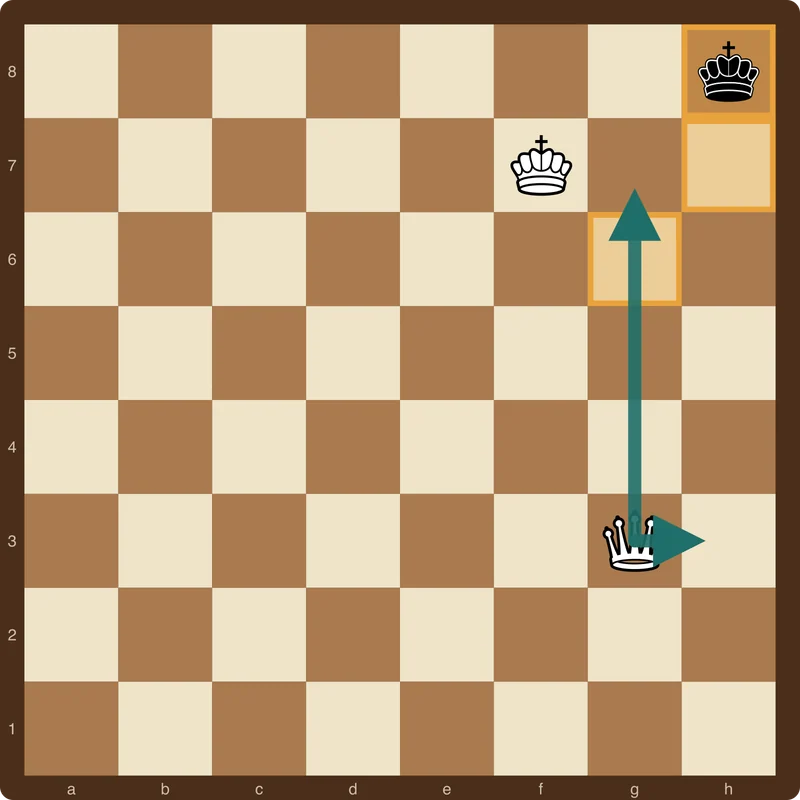
The diagram above (7k/5K2/8/8/8/6Q1/8/8) shows how narrow that margin is in a basic queen ending. White’s king stands on f7, White’s queen is on g3, and Black’s lone king sits in the h8 corner. Because f7 and g3 already cover g8 and g7, Black has only one legal flight square left: h7.
Beginners often learn a handy rule (keep the queen a knight’s jump from the enemy king to shrink its box) and play 1. Qg6?? on autopilot. Once the king is already in the corner, that habit backfires. Playing 1. Qg6?? reaches 7k/5K2/6Q1/8/8/8/8/8, the exact stalemate from Lesson 2, Step 4 of our curriculum: g6 covers h7 without attacking h8, leaving Black zero legal moves for an instant 0.5–0.5 draw[3]. One square away, 1. Qg7# (guarded by Kf7) or 1. Qh3# attacks h8 directly and checkmates in one move. Lesson 10 of our curriculum, queen mate, walks through that king-and-queen finish across three steps[4].
Does stalemate take a set number of moves?
A stubborn playground and kitchen-table myth claims that once you are down to a lone king, the game becomes a stalemate if your opponent fails to mate you within 10, 12, 16, 20, or 21 moves[5]. None of those counts exists in official chess rules.
Stalemate uses no move counter: zero extra moves are played once a legal stalemate position appears on the board[5]. Players who remember a move limit are blending stalemate together with four separate FIDE draw rules[5]:
| Rule | Condition on the board | How the draw takes effect |
|---|---|---|
| Stalemate | Side to move is not in check and has 0 legal moves | Automatic and immediate (0 extra moves) |
| Threefold repetition | Same position, turn, and legal rights occur 3 times | Claimed by the player |
| Fivefold repetition | Same position occurs 5 times | Mandatory arbiter (or server) draw |
| 50-move rule (FIDE Article 9.3) | 50 full moves by both sides (100 half-moves) with 0 pawn moves and 0 captures | Claimed by the player |
| 75-move rule (FIDE Article 9.6) | 75 full moves (150 half-moves) with 0 pawn moves and 0 captures, unless move 75 mates | Mandatory arbiter (or server) draw |
FIDE once granted 100-move exceptions for specific material combinations that needed more than 50 moves to win, before abolishing those 100-move extensions in 1992 (while International Correspondence Chess Federation events adjudicate endings with seven pieces or fewer using tablebases)[5]. At the board or online, a lone king never wins a free draw after 10 or 20 moves of running.
When stalemating lost you the game: a thousand years of disputed rules
Modern players treat the half-point stalemate as self-evident, yet chess spent more than a thousand years testing nearly every possible outcome. Across the history of chess from chaturanga to the modern board, stalemate has been scored as a loss for the attacker, a win for the attacker, half the wager, a skipped turn, and an illegal move[6].
In ninth-century Indian chaturanga, leaving an unattacked king without a move faulted the player who caused the deadlock: delivering stalemate lost you the game[6]. Tenth-century Arab shatranj flipped that ruling and counted stalemate as a full win for the attacker, a verdict carried into early 15th-century Spain[6]. Around 1497, Spanish author Luis Ramírez de Lucena described a monetary middle ground that lasted through 1600 and 18th-century Spain: checkmate collected the full stake, while stalemate won half the wager[6].
Other traditions banned the move outright. As historian H. J. R. Murray documented in 1913, chess variants in Burma, India, Japan, and Siam into the early 20th century treated any stalemating move as illegal, forcing the offender to retract it and play something else[6]. Medieval French circles sometimes made the stalemated player forfeit a turn, while 13th-century Italy and the 1422 German Cracow Poem already scored stalemate as a draw[6].
English chess took the sharpest detour of all. English first recorded the word stalemate in 1765, compounding Middle English stale (from Anglo-French estale, a standstill) with mate, more than a century before its figurative everyday use appeared in 1885[6]. Yet in England from about 1600 to 1800, just as in 17th-century Russia, stalemating your opponent penalized you with a loss[6]. A player down heavy material could deliberately wedge their own king into a corner to steal a win from a careless favorite.
Before 1820, London master Jacob Sarratt persuaded leading British clubs to adopt the Franco-Italian draw rule, bringing 19th-century European practice under one roof[6]. Printed handbooks lagged for decades: Hoyle’s Games Improved still published the old stalemate-loses rule as late as 1866[6]. Later critics still grumbled: British master T. H. Tylor attacked the draw rule in 1940, and Władysław Gliński’s hexagonal chess splits stalemate 0.75 points to the attacker and 0.25 to the defender[6].
Under modern rules, composers and world champions found startling extremes. American problemist Sam Loyd composed a legal game from the 32-piece starting array that reaches stalemate in 10 moves (later matched in 10 moves by Frederick Rhine), plus a 12-move game reaching stalemate with all 32 pieces still on the board[6]. Enzo Minerva published the fastest known double-stalemate game in l’Unità on August 14, 2007[6]. In World Chess Championship match play, Game 5 between Viktor Korchnoi and Anatoly Karpov in 1978 ended in stalemate on move 124 (124. Bg7), the longest championship game until the 136-move Game 6 in 2021 and the sole championship stalemate until Viswanathan Anand and Vladimir Kramnik drew by stalemate on move 65 (65...Kxf5) in 2007[6].
Why do focused players still blunder into stalemate?
Knowing the definition never stops tired club players or grandmasters from walking into a stalemate trap. Cognitive psychologists trace these blind spots to the Einstellung (mental set) effect: once a familiar pattern triggers a plausible move in memory, that first idea physically pulls your eyes back to the same squares.
In 2008, Merim Bilalić, Peter McLeod, and Fernand Gobet tested chess masters on positions offering both a familiar routine continuation and a quieter, stronger move, and tracked where masters looked on the board[7]. Even while masters reported searching for better options, their gaze stayed anchored to the squares of their first idea, and the familiar pattern knocked their problem-solving down by roughly three standard deviations in skill[8].
In 2013, Heather Sheridan and Eyal M. Reingold measured how a corner mating motif captures attention using a 1,000 Hz eye tracker[1]. Thirty-four players participated: 17 experts (mean age 30, ages 15 to 56, mean Canadian Chess Federation rating 2223, range 1876 to 2580) and 17 active club novices (mean age 26, ages 17 to 47)[1]. Each player tackled 12 positions—four Einstellung positions resembling a familiar corner checkmate plus eight fillers, up to 3 minutes each—graded on a 1–10 scale by five titled players (three International Masters above 2300 FIDE and two Grandmasters above 2500 FIDE) and two chess programs rated around 3000 Elo[1].
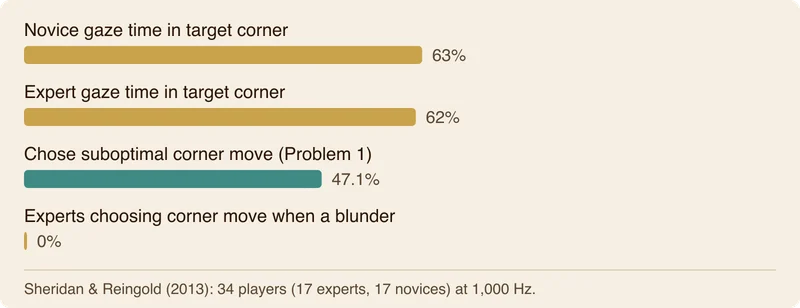
Four numbers from the eye tracker explain why corner stalemates happen so fast[1]:
- Immediate corner lock-on: Experts fixated on the familiar corner within 407 milliseconds on average, and novices within 719 milliseconds (averaging 2,395 milliseconds across 27 dwells for experts vs. 3,440 milliseconds across 18 dwells for novices)[1].
- Two-thirds of gaze trapped in one zone: Experts spent 62% of total looking time inside the target corner, and novices spent 63%[1].
- Equal trap rate when the routine move is playable: On Problem 1, where the familiar corner check remained advantageous for White despite a stronger move elsewhere on the board, eight of 17 experts (47.1%) and eight of 17 novices (47.1%) settled for the familiar corner move[1].
- Disengaging saves the blunder: When a subtle change turned the familiar corner sequence into an outright blunder on Problems 2, 3, and 4, 0% of experts played it because they gradually disengaged their gaze from the corner to verify the rest of the board[1].
That gaze pattern maps straight onto endgame blunders. Closing in on a bare king triggers the familiar “tighten the box” habit, holding 62%–63% of your attention in the corner while you skip checking whether a distant enemy pawn can still move.
This research has a strict boundary: both Bilalić, McLeod, and Gobet (2008) and Sheridan and Reingold (2013) measured domain-specific chess perception, namely board gaze allocation and move selection[7]. Neither study tested general IQ, school grades, or neurological conditions such as dementia, and breaking visual fixation on a chessboard shows up only in fewer blunders over the board[1].
How a stalemate swindle works: Evans vs. Reshevsky, 1963
Stalemate is not confined to bare-king accidents. When a defender’s pawns are jammed in place, sacrificing remaining pieces with check—turning a rook or queen into a desperado—can force a draw from a hopeless deficit.
The classic American example came in New York on December 29, 1963, in Round 9 of the 1963–1964 U.S. Championship between Larry Evans and Samuel Reshevsky[9]. Writing in American Chess Quarterly in 1964 (Volume 3, Number 3, page 171), Evans named the finish “The Swindle of the Century.”[9]
At move 47 (2Q5/5Rpk/8/1p2p1qp/1P2Pn2/4rPPP/7K/8), Evans (White) was a knight down with Black’s rook on e3, queen on g5, and knight on f4 converging on h2[9]. Noticing that his pawns on b4, e4, and f3 stood blocked behind Black’s b5 pawn, e5 pawn, and f4 knight, Evans played 47. h4!, jamming his h-pawn against h5[9]. Reshevsky answered 47...Re2+ 48. Kh1 and snatched the g3 pawn with 48...Qxg3?? to threaten mate on g2 and h2, overlooking 48...Qg6!, which still won[9].
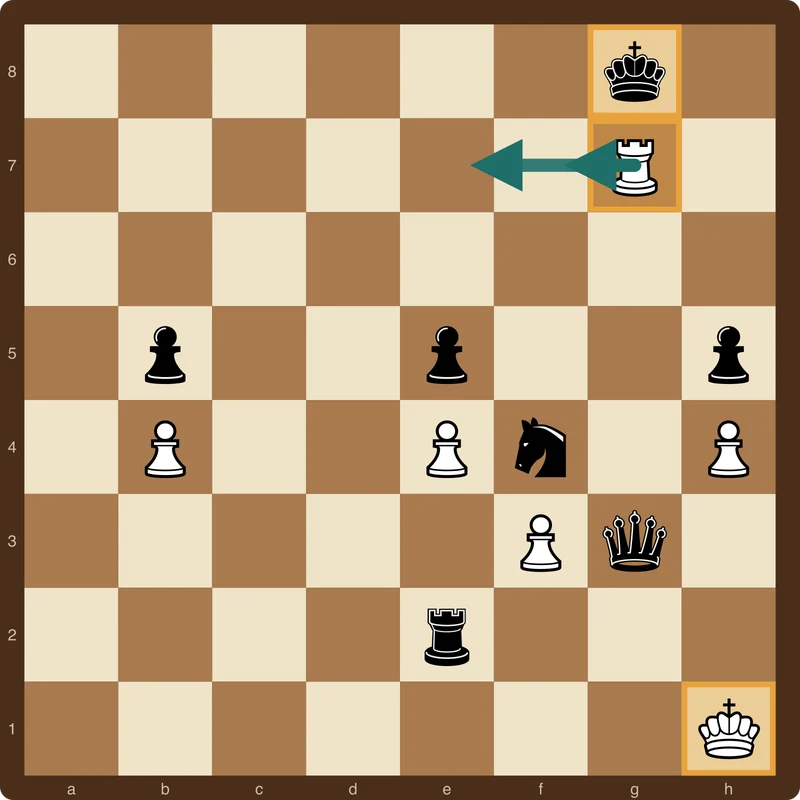
With g3 gone, his king boxed into h1, and all four remaining pawns frozen, Evans played 49. Qg8+! Kxg8 50. Rxg7+!, reaching the diagrammed position (6k1/6R1/8/1p2p2p/1P2Pn1P/5Pq1/4r3/7K)[9]. Black had no way out:
- Capturing on g7 with either
50...Kxg7or50...Qxg7leaves White out of check with zero legal moves: g1, g2, and h2 are guarded, and pawns b4, e4, f3, and h4 are all blocked[9]. - Fleeing along the eighth rank lets White’s “eternal rook” check along the seventh rank (
Rf7+,Re7+) forever[9].
That saved 0.5–0.5 draw helped Evans finish clear second on 7.5 out of 11 behind Bobby Fischer’s 11–0 sweep, while Reshevsky tied for fourth and fifth on 6.5 out of 11[9]. Similar stalemate saves run through classic games and compositions, including Troitsky–Vogt (1896), Burn–Pillsbury (1898), Tartakower–Réti (1925), Bernstein–Smyslov (1946), and A. J. Roycroft’s 1957 eternal-rook study[6]. In modern elite play, Vladimir Kramnik found a desperado-queen resource against Boris Gelfand in Game 6 (moves 67–70) of their 1994 Candidates match, and Gata Kamsky saved a 2009 endgame against Kramnik by stalemate[6].
How to avoid accidental stalemate when winning and hunt for one when losing
Two short board routines turn those mechanics into saved points.
When you are winning
- Give check on every move, or name one flight square before you let go. Against a lone king, pause two seconds and identify one safe square the enemy king can still step onto after your move. Every checking move automatically rules stalemate out.
- Stop promoting extra queens. One queen and king mate cleanly; a second queen slices ranks and diagonals across the corner’s last air square.
- Pull your gaze out of the corner to inspect distant pawns and pins. Do not trust spare enemy pawns on the other wing unless at least one has an empty square ahead and is not frozen by an absolute pin to its king, a pattern covered in our guide to forks, pins, and skewers in chess.
When you are defending a lost position
- Jam your remaining pawns. Keep pawns locked head-to-head against enemy pawns rather than opening files, building the frozen pawn shell Evans set up with
47. h4!against Reshevsky. - Step your king toward cut-off pockets. Edge squares bordered by enemy heavy pieces often strip your king of legal steps without putting it in check.
- Launch desperado checks. Once your king and pawns cannot move, a remaining rook or queen that checks relentlessly along open lines can force your opponent either to capture into stalemate or accept perpetual check.
You can work on both sides on Chess Moment[4]: study the 12 core step-by-step lessons, solve positions across 12 tactical and endgame themes in chess puzzles[10], and test your endgame conversion when you play chess online in rated 10+5 Quick Match games, friend challenges (3+2, 5+3, 10+5, 15+10, or untimed), or solo practice[11].
Questions players ask
How many moves is a stalemate in chess?
Zero extra moves: the instant a player’s turn arrives with their king out of check and no legal moves anywhere on the board, the game ends immediately as a draw[5]. Playground rules counting 10, 12, 16, 20, or 21 moves against a lone king are myths; official move-count draws belong to threefold or fivefold repetition (three or five identical positions) and FIDE’s 50-move and 75-move rules without a pawn move or capture[5].
Who wins in a stalemate in chess?
Nobody wins. Under FIDE rules, stalemate always ends as a 0.5–0.5 draw, awarding half a point to each player regardless of material[2].
Can stalemate happen with pieces and pawns still on the board?
Yes. Stalemate depends on legal moves, not an empty board. Sam Loyd’s 12-move composition finishes in stalemate with all 32 pieces still standing[6], and Larry Evans’s 1963 save against Reshevsky worked with four white pawns on the board because every remaining unit was blocked[9].
Is stalemate the same as repetition or insufficient material?
No. Everyday English uses “stalemate” for any standoff (a figurative meaning recorded since 1885), whereas chess rules separate them strictly[6]. Stalemate means zero legal moves while not in check; repetition means the same position recurred three or five times; and dead position (insufficient material) means neither side can possibly checkmate by any legal sequence[2].
Sources
- Sheridan, H., & Reingold, E. M. (2013). “The mechanisms and boundary conditions of the Einstellung effect in chess: evidence from eye movements.” PLOS ONE, 8(10), e75796.
- Wikipedia contributors. “Draw (chess).” Wikipedia, The Free Encyclopedia.
- Boardgammon. “Chess Lessons: Interactive Step-by-Step Curriculum.”
- Boardgammon. “Chess Moment: Play Rated Chess Online.”
- Wikipedia contributors. “Fifty-move rule.” Wikipedia, The Free Encyclopedia.
- Wikipedia contributors. “Stalemate.” Wikipedia, The Free Encyclopedia.
- Bilalić, M., McLeod, P., & Gobet, F. (2008). “Why good thoughts block better ones: the mechanism of the pernicious Einstellung (set) effect.” Cognition, 108(3), 652–661.
- Bilalić, M., McLeod, P., & Gobet, F. (2008). “Inflexibility of experts—reality or myth? Quantifying the Einstellung effect in chess masters.” Cognitive Psychology, 56(1), 73–102.
- Wikipedia contributors. “Swindle (chess).” Wikipedia, The Free Encyclopedia.
- Boardgammon. “Chess Puzzles: Tactical Themes and Positions.”
- Boardgammon. “Chess Moment: Play Online Chess in Your Browser.”
Found a mistake or an odd phrase? Tell us