How do bullet, blitz, rapid, and classical chess differ?
Blitz chess gives each player 10 minutes or less for a 60-move game; rapid chess gives more than 10 and less than 60 minutes. That extra margin shapes every decision on the board because tight clocks steadily drive up mistakes: when neuroscientist Mariano Sigman and his colleagues recorded more than 2.8 million online games with time budgets from 1 to 15 minutes (over 200 million moves in all), they found that 8.3% of moves dropped the position evaluation by more than 1.56 pawns, rising to 10% outside endgames, and that blunder rates climbed steadily as remaining clock time shrank[1]. Your chess understanding does not vanish below one minute. What vanishes is the time needed to check whether your first plausible move walks into a tactical refutation.
Whether you sit down at a club board or open Chess Moment for an evening game, modern time controls are written as two numbers separated by a plus sign, such as 3+2 or 10+5[2][3]. The first number is your starting bank of minutes; the second is the increment in seconds added back to your clock after every completed move[2]. Under 10+5, each player starts with 10 minutes and gains 5 seconds per move from move 1 onward[3].
To compare sudden-death clocks and increment clocks on one scale, FIDE (the World Chess Federation) projects each player’s total budget across a 60-move game: starting minutes plus 60 times the per-move increment in seconds[2]. That 60-move formula defines the four speed tiers players meet everywhere:
- Bullet (under 3 minutes per player): An informal category born on online chess servers, typically projected over a 40-move game[2]. Common settings are
1+0(1 minute with no increment) and2+1, while clocks of 30 seconds or less (0.5+0or 15-second games) are called hyperbullet or ultrabullet[2]. - Blitz (10 minutes or less across 60 moves): Any FIDE control whose 60-move budget totals 10 minutes or under[2]. In
3+2, the FIDE World Blitz Championship format since 2009, 3 base minutes plus 120 seconds (2 minutes) of increment equal 5 minutes[2]. Sudden-death5+0also equals 5 minutes, and5+3totals 8 minutes[2]. One threshold surprises many online players:10+0equals 10 minutes across 60 moves, making it blitz under over-the-board FIDE rules even though several online servers group10+0under rapid[2]. - Rapid (more than 10 and less than 60 minutes across 60 moves): Clear the 10-minute mark on a 60-move projection and the game is rapid[2]. A
10+5game gives each player 15 minutes across 60 moves (10 base minutes plus 5 minutes of increment), while15+10, used in the FIDE World Rapid Championship, provides 25 minutes per player[2]. - Classical (at least 60 minutes across 60 moves): Full-length tournament play starts at 60 minutes per side, and since January 2022 FIDE has required at least 120 minutes per player in events for players rated 2400 and above[2]. A tournament schedule like
90+30supplies 90 base minutes plus 30 minutes of increment over 60 moves, reaching 120 minutes[2].
| Tier | 60-move budget per player | Common examples | What decides most games |
|---|---|---|---|
| Bullet | Under 3 minutes (40-move online norm) | 1+0, 2+1, 0.5+0 |
Hand speed, instant board sight, clock management |
| Blitz | 10 minutes or less | 3+2 (5 min), 5+0 (5 min), 5+3 (8 min), 10+0 (10 min) |
Stored opening and tactical patterns, intuitive candidate moves |
| Rapid | Above 10 and under 60 minutes | 10+5 (15 min), 15+10 (25 min) |
Pattern recognition verified by two- and three-move calculation |
| Classical | 60 minutes or more (120+ min at 2400+) | 90+30 (120 min) |
Deep concrete search, strategic planning, endgame technique |
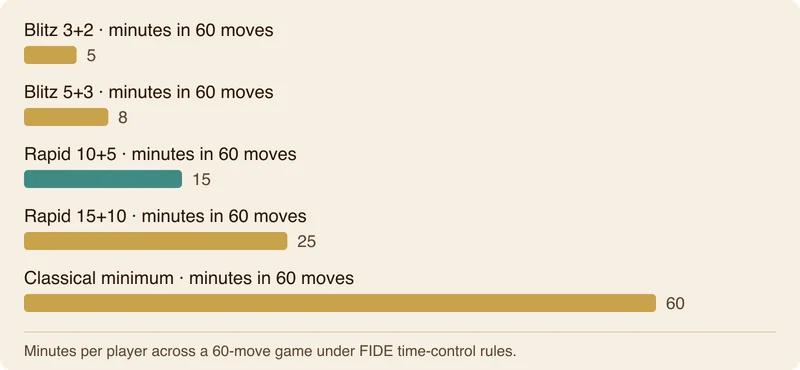
Notice the step from 3+2 to 10+5 in that chart. Both fit into a short break, yet 10+5 triples each player’s 60-move budget from 5 minutes to 15[2]. Those extra 10 minutes decide whether you play the first move that looks tempting or pause long enough to test it.
How does clock pressure change the way you choose moves?
Coaches have debated for decades whether speed chess sharpens instincts or cements careless habits. Cognitive scientists have answered that question by separating two processes at the board: fast recognition of stored patterns and slower, step-by-step lookahead.
In 2004, psychologist Bruce D. Burns studied archival tournament results from 5-minute blitz events, where players had less than 5% of typical classical tournament thinking time[4]. Burns found that 5-minute blitz performance accounted for up to 81% of the variance in players’ classical ratings[4]. At first glance, 81% looks like an endorsement of non-stop blitz: if a 5-minute game ranks players in almost the same order as a multi-hour game, why play slower formats?
Burns’s mechanism points the other way for anyone trying to improve[4]. Blitz tracks classical rating because experienced players draw on thousands of familiar pawn structures, piece placements, and tactical motifs already stored in memory for chess positions[4]. Within a second or two, a master spots the right square without searching a wide tree[4]. Blitz expresses the pattern library you already own; it does very little to build new patterns from scratch.
Six years later, in 2010, Sigman, Pablo Etchemendy, Diego Fernández Slezak, and Guillermo A. Cecchi tracked how players spend a tight clock move by move[1]. Examining response times in 91,340 three-minute games (10 to 100 moves long) and move-choice entropy across 650,000 games, they found an inverted-U thinking curve over a 40-move game: moves came fast in openings and simplified endgames, and slowed sharply in the middlegame where branching choices peaked[1].
Splitting players by rating showed where strong players find that middlegame time. Players rated above 1900 played their first 10 opening moves faster than players below 1400, then invested the saved seconds in critical middlegame positions, spending 77.9% of their clock budget by move 40 versus 74.7% for players below 1400[1].
What does that extra middlegame pause buy? In 2012, Jerad Moxley, K. Anders Ericsson, Neil Charness, and Ralf T. Krampe tested tournament experts and less-skilled club players on tactical problems, comparing the first move favored on intuition against the final move chosen after extended deliberation[5]. Experts began with stronger initial candidates than weaker players, yet extra deliberation significantly improved final move strength for both experts and club players on easy and hard positions alike[5]. Intuition nominates a move; calculation catches the refutation intuition missed.
What these studies measured, and what they did not
Online marketing often stretches chess research far past the chessboard, so the boundary here matters. Burns, Sigman, and Moxley measured chess performance on the board: move quality, recognition of chess patterns, and clock allocation under time pressure[1][5][4]. None of these papers measured general IQ scores, school grades, job output, or cognitive decline; we examine that separate body of transfer research in our article on chess and general intelligence. Slowing down from blitz to rapid improves your chess moves, not a medical chart.
One position, two clocks: what 20–30 extra seconds change on the board
To see the split between a blitz reflex and a rapid calculation on an actual board, take White’s seat on move 22 below[6].
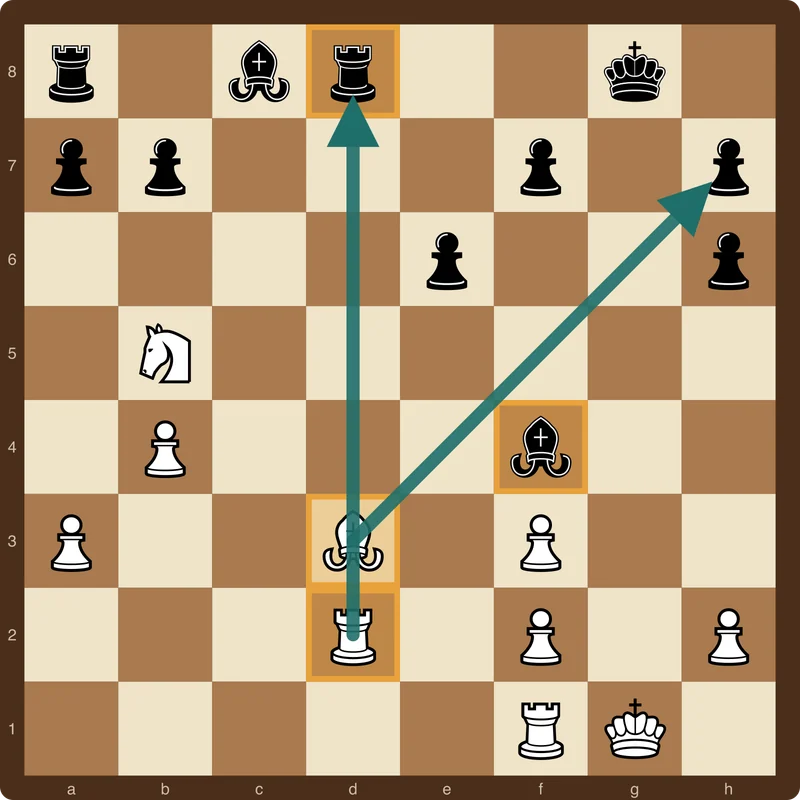
Black’s bishop has just landed on f4, attacking White’s rook on d2[6]. Pieces are even: White has a knight on b5 and a bishop on d3 against Black’s bishops on c8 and f4 (with Black holding a doubled extra h-pawn), an open-file structure where understanding when a knight outperforms a bishop normally shapes long-term trades. First, however, White must deal with the attack on d2.
Compare how two time budgets steer the decision:
- The blitz reflex (
3+2under clock pressure): Seeing the rook ond2attacked, your hand flicks it off thed-file toc2ore2in two seconds. Only when Black replies1...Rxd3do you realize that yourd2rook was the sole defender of your bishop ond3[6]. An automatic retreat drops a piece. - The rapid check (
10+5or15+10with 20–30 seconds): Instead of retreating on sight, you spend 20–30 seconds scanning forcing moves — checks, captures, and threats — just as Moxley’s deliberative step describes[5][6]. Along thed-file, Black’s rook ond8sits undefended, shielded only by your own bishop ond3[6]. Vacatingd3with check solves everything:1. Bxh7+!forces Black’s king to respond, after which1...Kxh7 2. Rxd8wins Black’s undefended rook and a pawn for the bishop, while declining with1...Kh8or1...Kf8runs into2. Rxd8+, winning a full rook with check[6].
Those 20–30 seconds turn a blundered bishop into a winning discovered attack. Once you have drilled discovered attacks and the intermediate check (zwischenzug) in untimed chess tactics puzzles, grouped into 12 tactical themes so you can repeat specific motifs until they stick, 1. Bxh7+! eventually becomes fast enough for blitz too[6][3]. Before a pattern lives in memory, only rapid or untimed calculation can find it.
Why did chess move from sandglasses to Fischer’s increment?
Across nearly all of the history of chess, players competed without clocks. When international tournaments began in the mid-19th century, untimed games stretched for up to 14 hours, and trailing players sometimes stared at a lost board for hours hoping fatigue would induce a blunder[7].
London tournament organizers stepped in during the early 1860s, including at the 1862 London tournament, by introducing paired sandglasses often set to 2 hours for 24 moves, with each player’s glass running only during that player’s turn[7].
In 1883, Thomas Bright Wilson of the Manchester Chess Club invented the tumbling double mechanical chess clock, first used at the 1883 London tournament: tilting its balance beam stopped one pendulum and started the other in a single motion[7].
Digital electronics arrived 90 years later when Cornell student Bruce Cheney built the first digital chess clock in 1973, followed in 1975 by Joseph Meshi and Jeffrey R. Ponsor’s patent for the Micromate-80[7]. Yet traditional classical schedules of 40 moves in 2 hours plus 20 moves per extra hour still produced two headaches: players spent almost their whole 2 hours on the first 30 moves and blundered in a scramble between moves 30 and 40, or adjourned after 4, 5, or 6 hours so teams of analysts could dissect the sealed position overnight[8].
On August 5, 1988, former world champion Bobby Fischer filed United States Patent 4,884,255 (granted November 28, 1989) for a digital clock that added a fixed increment after every move[8]. Introduced in Fischer’s 1992 match against Boris Spassky and adopted at the 1998 FIDE World Chess Championship, per-move increment ended both overnight adjournments and pure flag scrambles[8]. Its impact shows clearest in technical king and pawn endgames: whereas sudden-death 5+0 or 10+0 turns a dead-won extra-pawn endgame into a frantic race against zero, a 2-second increment in 3+2 or a 5-second increment in 10+5 gives accurate technique the seconds needed to convert[2][8].
Which time control helps you improve fastest?
Choosing the right clock comes down to pairing engagement with enough time to calculate. In 2012, psychologists Sami Abuhamdeh and Mihaly Csikszentmihalyi studied intrinsically motivated online chess games and found that perceived challenge and objective game closeness strongly predicted enjoyment: close, contested games against matched or slightly stronger opponents were enjoyed far more than easy one-sided wins[9]. Fast chess hooks us because tense finishes arrive every few minutes; rapid chess keeps that tension while leaving room to understand why a close game turned.
Match the clock to your stage
- New players and returning learners (
15+10or untimed): While you are still learning to scan the whole board for undefended pieces and long-range bishop lines, bullet and3+2blitz rush you into guesswork. Start untimed or in15+10rapid alongside structured chess lessons until basic blunder checks become automatic[10][3]. - Busy club and adult improvers (
10+5or15+10as your staple): You do not need 120-minute classical nights to make steady gains. Spending 70–80% of your chess week on10+5or15+10rapid games, brief post-game review of your sharpest turning point, and a consistent habit for how to practice chess with puzzles builds both pattern recognition and calculation, leaving 20–30% for relaxed blitz[3]. - Experienced players testing openings (
3+2or5+3in capped sets): Blitz works well in short blocks when you want to rehearse the first 10 moves of an opening repertoire, echoing Sigman’s finding that players above 1900 bank time early[1]. Stop or switch back to rapid the moment you catch yourself playing superficial one-move threats.
Three clock habits worth stealing from stronger players
- Play known opening moves briskly, then brake at the first unfamiliar crossroads. Avoid burning minutes on move 4 choosing between two sound developing moves; save that bank for moves 12 to 30, where Sigman’s inverted-U curve shows complexity and blunder risk peak[1].
- Pause 20–30 seconds before every irreversible trade or tactical clash. When a piece is attacked or the center opens, check all checks, captures, and intermediate moves for both sides: the pause that spots
1. Bxh7+!instead of a passive retreat[5][6]. - Choose increment over sudden death. Playing
10+5over10+0, or3+2over3+0, rewards sound chess through checkmate rather than random piece-shuffling to run down a clock[2][8].
You can put every one of these paces to work when you play chess online on Chess Moment: rated Quick Match games use 10+5 rapid, direct friend challenges let you pick 3+2, 5+3, 10+5, 15+10, or an untimed board, and solo play supports 10+5 or untimed practice[3][11]. Choose 10+5 when you want to sharpen your calculation, save 3+2 for testing openings you already know, and always keep 20 seconds in reserve to question your first impulse.
Questions players ask about chess time controls
Is a 10-minute game (10+0) blitz or rapid?
Under over-the-board FIDE rules, 10+0 is blitz: 10 base minutes plus 60 times a 0-second increment equals 10 minutes, hitting FIDE’s upper ceiling of 10 minutes or less for blitz[2]. Several online platforms group 10+0 under rapid instead, whereas adding even a small increment such as 10+5 (15 minutes across 60 moves) makes the game rapid under every rulebook[2][3].
Does playing blitz permanently ruin your chess?
No study shows permanent harm from blitz. Burns’s 2004 tournament study showed that 5-minute blitz largely expresses the pattern store a player already holds, accounting for up to 81% of classical rating variance[4]. The catch for learners is opportunity cost: if blitz crowds out slower games and untimed puzzles, you spend every session replaying old patterns rather than calculating new ones[4][5].
Why do classical games still produce time-pressure blunders?
Even in 120-minute tournament schedules, long calculation stretches and sustained physiological strain — examined separately in our look at how much energy tournament chess burns — drain both the clock and the player before move 40[8]. Once a classical player drops into the final minutes before move 40, sudden time pressure triggers the same rush of unverified moves that Sigman measured in speed chess, which is why Fischer’s per-move increment became standard across championship play[1][8].
Sources
- Sigman, M., Etchemendy, P., Fernández Slezak, D., & Cecchi, G. A. (2010). “Response time distributions in rapid chess: a large-scale decision making experiment.” Frontiers in Neuroscience, 4, 60.
- Wikipedia contributors. “Fast chess.” Wikipedia, The Free Encyclopedia.
- Boardgammon. “Chess Moment: Play Rated Chess Online.”
- Burns, B. D. (2004). “The effects of speed on skilled chess performance.” Psychological Science, 15(7), 442–447.
- Moxley, J. H., Ericsson, K. A., Charness, N., & Krampe, R. T. (2012). “The role of intuition and deliberative thinking in experts’ superior tactical decision-making.” Cognition, 124(1), 72–78.
- Boardgammon. “Chess Puzzles: Tactical Themes and Positions.”
- Wikipedia contributors. “Chess clock.” Wikipedia, The Free Encyclopedia.
- Fischer, R. J. (1989). Digital Chess Clock. United States Patent 4,884,255, filed August 5, 1988, granted November 28, 1989.
- Abuhamdeh, S., & Csikszentmihalyi, M. (2012). “The importance of challenge for the enjoyment of intrinsically motivated, goal-directed activities.” Personality and Social Psychology Bulletin, 38(3), 317–330.
- Boardgammon. “Chess Lessons: Interactive Step-by-Step Curriculum.”
- Boardgammon. “Chess Moment: Play Online Chess in Your Browser.”
Found a mistake or an odd phrase? Tell us