How does Scholar’s Mate work in four moves?
Scholar’s Mate finishes a game of chess on White’s fourth move by aiming the queen and the light-squared bishop at f7: 1. e4 e5 2. Bc4 Nc6 3. Qh5 Nf6?? 4. Qxf7#. Almost everyone who learns the rules meets this sequence within the first week, usually from the losing side. It works because chess’s starting setup hides a structural weak spot beside each king. Every other pawn on the second and seventh ranks begins guarded by at least one rook, bishop, knight, or queen, whereas f2 and f7 are defended by the king alone (Ke1 for White, Ke8 for Black).
After 1. e4 e5 2. Bc4 Nc6 3. Qh5, White’s bishop on c4 and queen on h5 both target f7, while Qh5 also eyes the e5 pawn protected by Nc6. To an unpracticed eye, Black’s reply 3...Nf6?? looks natural: it develops a knight toward the center, attacks the white queen on h5, and pressures e4. Yet 3...Nf6?? is an intuitive lure. In a 2025 Journal of Intelligence study comparing 25 internationally rated Argentine chess players (mean Elo 2405) with 25 matched university students, Guillermo Campitelli, Milagros Labollita, and Merim Bilalić found that experienced players solved 69.4% of Cognitive Reflection Test items designed to bait an impulsive wrong answer, versus 25.2% for non-players[1]. Although that cross-sectional comparison cannot establish causality, 3...Nf6?? is the over-the-board twin of grabbing a plausible first thought without checking the opponent’s threat.
Once White plays 4. Qxf7#, Black has zero legal moves[2]. The king on e8 cannot capture the queen because Bc4 protects her, no piece can step between two adjacent squares (f7 and e8), and Black’s own queen, bishop, and pawns plug every flight square on d8, f8, d7, and e7[2]. Black can mirror the exact same four-move geometry against f2 in eight plies if White drifts passively after 1. e4 e5, pairing a dark-squared bishop on c5 with ...Qh4 or ...Qf6 against White’s king[2]. You can step through how piece coordination governs these opening turns in our interactive chess opening guides, which span seven opening courses and 16 interactive sessions[3].
How do you stop and punish Scholar’s Mate step by step?
You refute Scholar’s Mate not just by surviving move four, but by turning White’s exposed queen into a target that hands you free developing moves[2]. Everything hinges on one question: did White bring out the bishop first (2. Bc4) or the queen first (2. Qh5)?
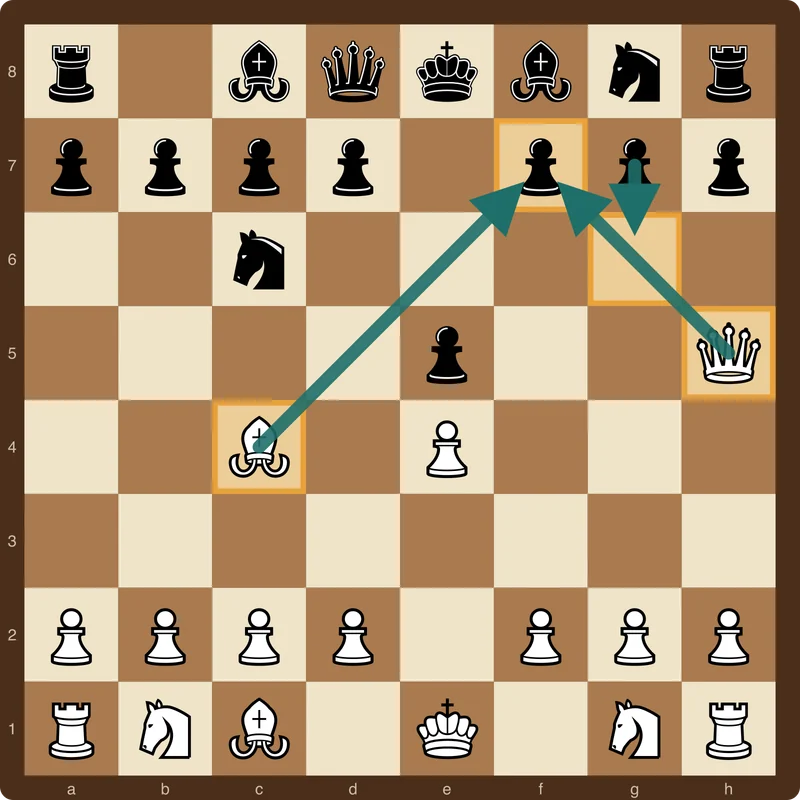
In the Bishop’s Opening order (1. e4 e5 2. Bc4), Black can stop Qh5 before it happens with the Berlin Defense, 2...Nf6!, developing a knight to attack e4 while covering h5[2]. After 2...Bc5 3. Qh5, the calm 3...Qe7! defends both f7 and e5 at once[2]. And at the diagrammed crossroads 1. e4 e5 2. Bc4 Nc6 3. Qh5, your cleanest answer is 3...g6!, blocking the diagonal and kicking the queen[2]. When White retreats 4. Qf3 to renew the threat along the f-file, 4...Nf6! shuts down f7 again while developing your second knight[2].
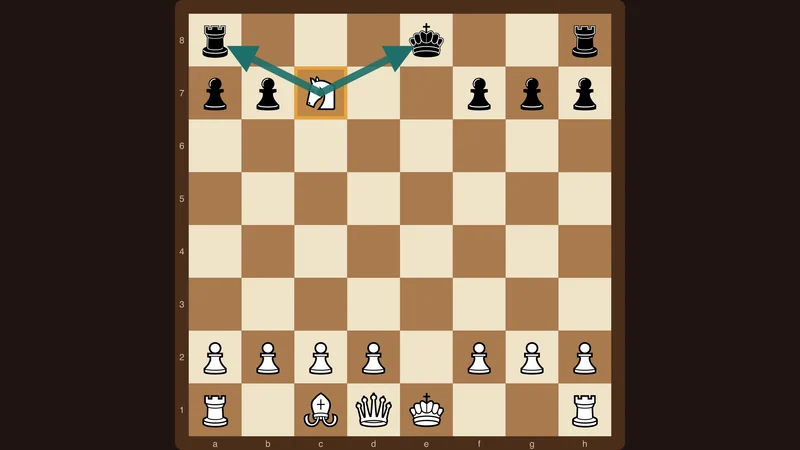
The trap inside the trap hides in the Wayward Queen Attack (1. e4 e5 2. Qh5, ECO code C20, also called the Danvers Opening)[2][4]. Because White’s bishop is still on f1, 2. Qh5 threatens 3. Qxe5+, not checkmate[2]. Players who play 2...g6?? on autopilot walk straight into 3. Qxe5+!, a double attack checking Ke8 and winning the h8 rook[2] (see our guide to forks, pins, and skewers in chess). Worse still is 2...Ke7??, which allows 3. Qxe5#, checkmate in three moves[2].
Against 1. e4 e5 2. Qh5, use the three-step defense taught in the eight-step development session of Chess Moment’s Opening Principles course[3]:
- Defend
e5first with2...Nc6!. Your knight develops cleanly and removes every profitable check[2]. - Meet
3. Bc4with3...g6!. Withe5secure,...g6kicks the queen and prepares...Bg7[2]. - Answer
4. Qf3with4...Nf6!. You blockf7, prepare castling, and threaten...Nd4hittingQf3andc2[2].
Count the position after 4...Nf6!: Black has two knights developed and kingside readiness, whereas White’s queen has moved twice (d1–h5–f3), clogs f3, and leaves zero white knights out[2]. White’s Napoleon Opening (1. e4 e5 2. Qf3, ECO C20) is tamer still, blocking g1’s knight without even attacking e5[2]. You can also sidestep 1...e5 on move one with the Sicilian Defense (1...c5, where 2. Bc4? e6 prepares ...d5 with tempo), the Caro-Kann Defense (1...c6), the French Defense (1...e6), or the Scandinavian Defense (1...d5)[2].
Scholar’s Mate vs. Fool’s Mate: what are the fastest checkmates in chess?
Scholar’s Mate is often mistaken for the shortest game in chess, yet Fool’s Mate finishes three half-moves faster on Black’s second turn (1. f3 e5 2. g4?? Qh4#)[5]. Mathematicians measure game trees in plies (single half-moves). Building on Claude Shannon’s 1950 paper in The Philosophical Magazine, which estimated at least 10^120 games across 40 move pairs (80 plies)[6], exact enumerations in the On-Line Encyclopedia of Integer Sequences (A048987 for legal games, A083276 for distinct positions, and A079485 for checkmates) pinpoint where each mate appears[5].
| Ply | Turn completed | Legal games (A048987) |
Checkmates (A079485) |
Milestone checkmate |
|---|---|---|---|---|
| 1 | White’s 1st | 20 | 0 | None |
| 2 | Black’s 1st | 400 | 0 | None |
| 3 | White’s 2nd | 8,902 (5,362 positions) | 0 | None |
| 4 | Black’s 2nd | 197,281 (72,078 positions) | 8 | Fool’s Mate (2...Qh4#) |
| 5 | White’s 3rd | 4,865,609 | 347 | White’s fastest (3. Qh5# or 3. Qxe5#) |
| 6 | Black’s 3rd | 119,060,324 | 10,828 (computed 1897) | Early diagonal and smothered mates |
| 7 | White’s 4th | 3,195,901,860 | 435,767 | Scholar’s Mate (4. Qxf7#) |
| 8 | Black’s 4th | 84,998,978,956 | 9,852,036 | Black’s Scholar’s Mate on f2 |
At ply 4, only eight of the 197,281 legal games end in checkmate, and every one is Fool’s Mate[5]. White must advance f3 or f4 alongside g4 in either order, stripping the e1–h4 diagonal so Black can answer 1...e5 or 1...e6 with 2...Qh4#[5]. White’s own earliest checkmate arrives at ply 5 (347 mates out of 4,865,609 games), such as 1. e4 g5 2. d4 f6?? 3. Qh5#—Problem No. 73 in Bobby Fischer Teaches Chess (1972, pages 95–96) and Problem No. 14 in László Polgár’s 1994 book of 5,334 problems (page 57)—or 1. e4 e5 2. Qh5 Ke7?? 3. Qxe5#[5].
By ply 7, where Scholar’s Mate lands, the tree holds 3,195,901,860 games and 435,767 checkmates; at ply 8 it reaches 84,998,978,956 games and 9,852,036 mates[5]. Fool’s Mate stays a curiosity because nobody pushes f3 and g4 to develop pieces, whereas 1. e4 e5 2. Bc4 Nc6 is normal chess right until 3. Qh5 tests Black’s alertness.
Why is it called Scholar’s Mate, Shepherd’s Mate, and Napoleon’s Plan?
Both English names, Scholar’s Mate and Fool’s Mate, entered print in London in 1656 in Francis Beale’s The Royall Game of Chesse-Play (printed for Henry Herringman, pages 10 and 17), adapting early-17th-century manuscripts by Italian master Gioachino Greco[7][8]. In 17th-century English, a scholar meant a student or novice rather than a professor, which is why British clubs also called it Schoolboy’s Mate[8]. Beale’s 1656 book preserves two period quirks: it printed “one house” for the opening king’s-pawn advance—a typesetting slip beside the errata sheet, since 1...e6 blocks Bc4’s diagonal to f7—and gave “The Fooles Mate” with Black moving first, nearly two centuries before the White-first rule standardized in the mid-19th century[8].
Across other languages, the same four-move checkmate wears vivid folk names[4]:
- Shepherd’s Mate: French (coup du berger / mat du berger), Spanish (mate del pastor), German (Schäfermatt), and Turkish (çoban matı)[4].
- Shoemaker’s or Cobbler’s Mate: German (Schustermatt) and Hebrew (מט סנדלרים)[4].
- Children’s, School, and Barber’s Mate: Russian (детский мат), Scandinavian and South Slavic languages (School Mate), and Italian (matto del barbiere)[4].
- Napoleon’s Plan or Mate: Arabic (خطة نابليون), Persian (مات ناپلئونی, alongside مات چوپان), and Greek (ματ του Ναπολέοντα / βαριάντα του Ναπολέοντα), echoing mid-19th-century stories noted by H. J. R. Murray (1913, page 877; 1963, page 79) of Napoleon Bonaparte’s 1809 game at Schönbrunn Palace in Vienna against Johann Allgaier operating The Turk[9][4].
The 2. Qh5 sortie kept resurfacing in tournament and exhibition lore[8][4]. In July 1879, Richard A. Proctor reported in Belgravia (Vol. 39, pages 71–90) that the automaton Mephisto delivered a six- or seven-move Scholar’s Mate[8]. American journals named 1. e4 e5 2. Qh5 the “Kentucky Opening” in the May 1875 Dubuque Chess Journal (page 250) and the “Danvers Opening” via psychiatrist E. E. Southard in the 1905 American Chess Bulletin[4]. Against Garry Kasparov, Woody Harrelson held a grandmaster-assisted consultation draw with 2. Qh5 in 1999, whereas Boris Becker lost in 17 moves in 2000[4]. U.S. Champion Hikaru Nakamura even played 2. Qh5 twice in April–May 2005, drawing Grandmaster Nikola Mitkov in 55 moves before losing to Grandmaster Krishnan Sasikiran[4]. And on December 27, 2023, in Round 8 of the World Rapid Chess Championship, Grandmaster Surya Shekhar Ganguly missed a disguised Qh5 and Bc4 battery against Mukhiddin Madaminov and lost in eight moves[4].
How Légal’s Mate attacks f7 the right way, without a queen
Targeting f7 is sound strategy; sending the queen out alone on move two is the flaw. Classical openings such as the Italian Game (1. e4 e5 2. Nf3 Nc6 3. Bc4) and Two Knights Defense (3...Nf6 4. Ng5) develop knights and bishops toward the four central squares (d4, d5, e4, e5) first so attacks on f7 carry real force[3]. Légal’s Mate proves the point by sacrificing White’s queen on d1.
Named after Sire de Légal (Kermur de Legal), whose Paris Café de la Régence game against Saint Brie (1. e4 e5 2. Nf3 d6 3. Bc4 Bg4 4. Nc3 g6? 5. Nxe5! Bxd1?? 6. Bxf7+ Ke7 7. Nd5#)—traditionally dated 1750 at rook odds, or 1787 by later historians—was popularized in the late 19th century by Joseph Henry Blackburne[4], the trap reaches a completely sound form in André Chéron’s Paris win over Jeanlose: 1. e4 e5 2. Nf3 Nc6 3. Bc4 d6 4. Nc3 Bg4?! 5. h3 Bh5? 6. Nxe5![2][3].
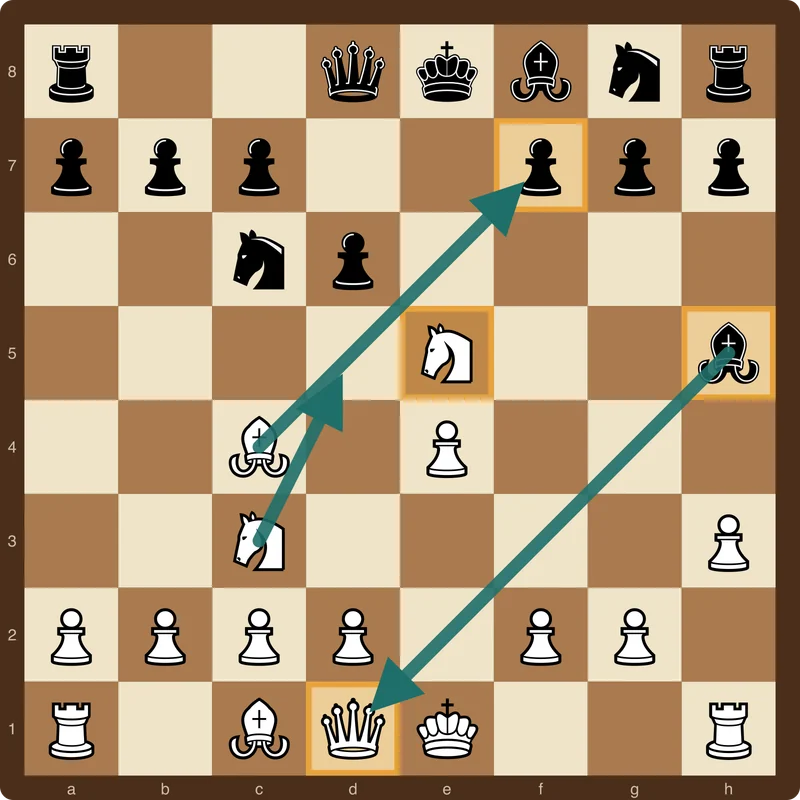
Unlike 2. Qh5, 6. Nxe5! is no gamble[2]. If Black declines the queen with 6...Nxe5, White plays 7. Qxh5 Nxc4 8. Qb5+ and 9. Qxc4, emerging one clean pawn ahead[2] (spotting exposed pieces on h5 and c4 is the heart of why undefended loose pieces drop off).
If Black grabs the queen with 6...Bxd1??, three minor pieces force mate in two moves: 7. Bxf7+ Ke7 (sole legal move) 8. Nd5#[2]. The finish is a pure mate: every one of the nine squares in Black’s king zone around e7 has a single blocker or attacker[2]. Nd5 alone checks e7 and guards f6; Bf7 alone guards e8 and e6; Ne5 alone guards d7 and f7; and Black’s own Qd8, Bf8, and d6 pawn block d8, f8, and d6[2]. For sound openings built on that piece harmony, see choosing your first chess opening.
Why quick traps tempt us: what cognitive science and heart-rate labs measure
Both halves of Scholar’s Mate—gambling on a four-move knockout and blundering into 4. Qxf7#—reflect a contest between fast intuition and deliberate verification. Laboratory studies have measured that contest across planning tasks, eye movements, and millisecond heartbeats.
In their 2025 Journal of Intelligence study (N = 50), Campitelli, Labollita, and Bilalić compared 25 Argentine chess players (21 men; mean age 27.8, SD 9.7, range 15–55; mean Elo 2405, SD 122, range 2159–2607, including seven Grandmasters, nine International Masters, five FIDE Masters, and four rated players; mean education 14 years, SD 2.36) against 25 age- and gender-matched psychology students (mean age 27.0, SD 6.1, range 17–41)[1]. On five Tower of London multi-step planning problems, chess players solved 97.6% versus 72.0% for non-players (BF10 = 96.47, Cohen’s d = 1.23)[1]. On the three-item Cognitive Reflection Test, chess players inhibited the intuitive wrong lure on 69.4% of items versus 25.2% (BF10 = 1,114.7, d = 1.54)[1]. Across three Intertemporal Choice decisions between a smaller immediate sum and a larger future sum, chess players chose the delayed reward 49.3% of the time versus 23.8% (BF10 = 901.1), whereas risky-choice gaps were weak (59.0% vs. 40.0% in high-EV gains, BF10 = 4.54; 18.0% vs. 22.0% in low-EV gains, BF10 = 0.449; 28.0% vs. 44.1% in low-EV losses, BF10 = 1.52)[1].
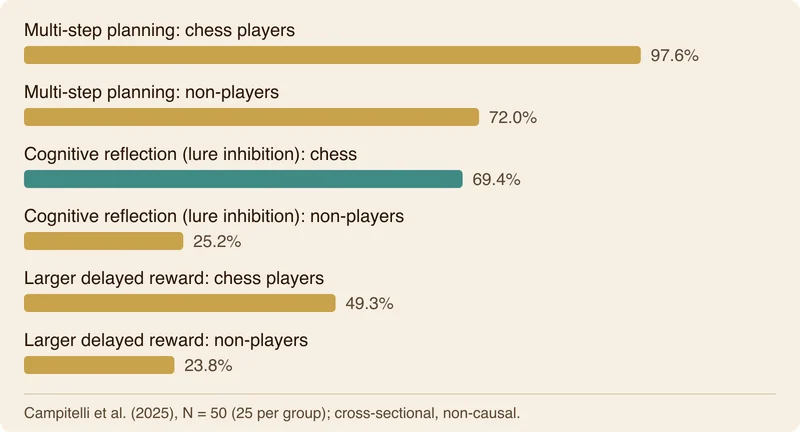
Two caveats are essential. First, the authors stress that their cross-sectional observational design cannot establish causality: it cannot tell whether chess builds patience and reflection or whether reflective, patient people gravitate toward chess[1]. Earlier Tower of London work by Unterrainer and colleagues (2006, mean Elo 1683, d = 0.72; 2011, mean Elo 1808.6, d = 0.25) also showed the planning edge shrinking to non-significance when pre-move planning time was restricted[1]. Second, meta-analyses by Giovanni Sala and Fernand Gobet (2017, Current Directions in Psychological Science, 26(6), 515–520; Gobet & Sala, 2023, Perspectives on Psychological Science, 18(1), 125–141) found null far transfer[10][1]: chess training builds domain-specific chess skill, with zero transfer to general IQ, school grades, or medical conditions such as dementia and cognitive decline[10] (see what the largest school trial of chess found).
Within chess itself, eye-tracking and cardiac data show why players miss two-piece threats. Using gaze-contingent windows and 3×3 check boards, Eyal Reingold, Neil Charness, Marc Pomplun, and Dave Stampe (2001) found that novices fixate directly on individual pieces, such as staring straight at Qh5 with a narrow visual span, whereas experienced players fixate between squares to read multi-piece lines like Bc4 plus Qh5 at once[11]. Pausing helps at every level: Jerwen Moxley, K. Anders Ericsson, Neil Charness, and Ralf Krampe (2012) showed that extra deliberation significantly improves initial intuitive move choices for experts and less-skilled players on easy and hard tactical problems alike[12].
Your heart tracks that pause too. Nicolas Troubat and colleagues (2009) recorded 20 male players whose mean heart rate climbed from 75 to 86 beats per minute during play while their sympathetic-to-parasympathetic LF/HF ratio rose from 1.3 to 3.0 and respiratory exchange ratio shifted from above 0.89 to 0.75[13]. Recording 256-Hz electrocardiograms across 25 rapid games (15 minutes, or 900 seconds, per player) by nine experienced players (mean Elo 2111 ± 60.4, range 2021–2216; mean age 35.6 ± 11.7, range 21–58), María J. Leone, Agustín Petroni, Diego Fernandez Slezak, and Mariano Sigman (2012) analyzed 2,086 moves (565 opening, 1,007 middlegame, 514 endgame) and 153 blunders losing one pawn unit or more (68 player, 85 opponent)[14]. Heart rate rose steadily as clock time fell across all 25 games (r = −0.6347) and as positions grew unbalanced[14]. In matched subsets separated by at least 5 seconds (24 player blunders, 34 opponent blunders, 15 planning moves, 17 calculation moves), avoiding a blunder in a tense spot was preceded by a transient heart-rate dip 2.5 to 1.0 seconds before moving, a physiological signature of motor action inhibition, whereas blunders lacked that dip[14]. Opponent blunders triggered a heart-rate jump from 0.25 seconds before to 2.0 seconds after the move (62.46% decoding vs. 50% chance), and concrete calculation raised heart rate 2.5 to 0.5 seconds before moving (78.18% decoding)[14].
How do you build the habit of spotting early traps at the board?
Shutting down early queen raids takes one repeatable habit rather than memorizing trap lines by rote: pause for two full seconds whenever an opponent’s queen crosses the center and ask what checks, what captures, and what threats just appeared on f7, f2, and undefended central pawns like e5. That brief stop gives your eyes time to look past the queen to any bishop waiting on c4 or c5 before your hand reaches for an automatic knight move.
You can build that scan in our step-by-step chess lessons, a 12-lesson path where Lesson 4 covers Checks, Captures, and Threats in four steps and Lesson 9 practices central development (1. e4, Nf3, Bc4 eyeing f7, and castling O-O) in eight steps[15]. To train your eyes to spot multi-piece batteries rather than fixating on a lone queen, solve tactical chess puzzles across 12 themes and 144 browser sample diagrams (12 per theme from a 4,096-puzzle corpus, including mate-in-one, mate-in-two, and sacrifice)[16].
Then put those reflexes to work on Chess Moment or start playing chess in your browser[17][18]. Practicing in 15+10, 10+5, or untimed games gives that pre-move brake room to fire until answering 2. Qh5 with 2...Nc6! and 3. Bc4 with 3...g6! feels effortless even in 5+3 or 3+2 (for how clock pressure changes error rates, see blitz vs. rapid chess time controls)[18].
Sources
- Campitelli, G., Labollita, M., & Bilalić, M. (2025). “Planning, Cognitive Reflection, Inter-Temporal Choice, and Risky Choice in Chess Players: An Expertise Approach.” Journal of Intelligence, 13(3), 40.
- Boardgammon. “Move-by-move, perft, and pure-mate verification of Scholar’s Mate (1. e4 e5 2. Bc4 Nc6 3. Qh5), Fool’s Mate (2...Qh4#), and Légal’s Mate (8. Nd5#).”
- Boardgammon. “Chess Openings: Principles and Repertoire Guides.”
- Wikipedia contributors. “Scholar’s mate,” “Fool’s mate,” “Legal Trap,” “Danvers Opening,” and “Napoleon Opening.” Wikipedia, The Free Encyclopedia.
- OEIS Foundation Inc. “Sequence A079485: Number of chess games that end in checkmate after exactly n plies (with Sequence A048987: Number of possible chess games at the end of the n-th ply).” The On-Line Encyclopedia of Integer Sequences.
- Shannon, C. E. (1950). “Programming a computer for playing chess.” The Philosophical Magazine, Series 7, 41(314), 256–275.
- Beale, F. (1656). The Royall Game of Chesse-Play (adapting Gioachino Greco), pp. 10, 17. London: Henry Herringman.
- Hooper, D., & Whyld, K. (1996 [1992]). The Oxford Companion to Chess (2nd ed.), “fool’s mate” and “scholar’s mate,” pp. 143, 358–359. Oxford University Press.
- Murray, H. J. R. (1913). A History of Chess, p. 877. Oxford University Press.
- Sala, G., & Gobet, F. (2017). “Does far transfer exist? Negative evidence from chess, music, and working memory training.” Current Directions in Psychological Science, 26(6), 515–520.
- Reingold, E. M., Charness, N., Pomplun, M., & Stampe, D. M. (2001). “Visual span in expert chess players: Evidence from eye movements.” Psychological Science, 12(1), 48–55.
- Moxley, J. H., Ericsson, K. A., Charness, N., & Krampe, R. T. (2012). “The role of intuition and deliberative thinking in experts’ superior tactical decision-making.” Cognition, 124(1), 72–78.
- Troubat, N., Fargeas-Gluck, M.-A., Tulppo, M., & Dugué, B. (2009). “The stress of chess players as a model to study the effects of psychological stimuli on physiological responses: an example of substrate oxidation and heart rate variability in man.” European Journal of Applied Physiology, 105(3), 343–349.
- Leone, M. J., Petroni, A., Fernandez Slezak, D., & Sigman, M. (2012). “The tell-tale heart: heart rate fluctuations index objective and subjective events during a game of chess.” Frontiers in Human Neuroscience, 6, 273.
- Boardgammon. “Chess Lessons: Step-by-Step Curriculum.”
- Boardgammon. “Chess Puzzles: 12 Tactical Themes and Sample Positions.”
- Boardgammon. “Chess Moment: Play Rated Chess Online.”
- Boardgammon. “Chess Moment: Play Online Chess in Your Browser.”
Found a mistake or an odd phrase? Tell us