How does blindfold chess actually work at the table?
Watch a simultaneous blindfold exhibition for the first time and the setup looks like a stage illusion. One player sits in a chair facing away from the room, playing without sight of the chessboard or pieces by calling out moves in standard chess notation[1]. Across the hall sit sighted opponents behind wooden sets, while an intermediary relays moves between each table and the blindfold player, who neither sees the positions nor touches the pieces[2].
Older chess literature calls the format sans voir, French for “without seeing.”[2] That phrase describes the rules better than “blindfold” does, because a physical cloth mask is optional as long as the player has no visual or tactile contact with a set[2]. An average chess position offers roughly 37 legal choices, and the player must track every open file, pinned defender, pawn break, and castling right inside an internal model that updates after each half-move[1].
Two other forms of chess often get mixed up with sans voir play, though they test very different rules:
- Tactile board play by visually impaired competitors. Visually impaired tournament players read the position legally by touching a specialized tactile chessboard and pieces, whereas blindfold chess forbids touching the pieces as well as seeing them[2].
- Hidden-opponent variants such as Kriegspiel. In Kriegspiel, you see your own pieces on a board in front of you while your opponent’s pieces remain hidden from view[2]. Blindfold chess hides no moves at all: every move by both sides is communicated openly, and only the physical board is absent.
Do blindfold masters have a photographic memory?
No, and psychologists have tested that assumption since the 19th century. Psychological research on blindfold chess began with Alfred Binet in 1893 and continued with grandmaster and psychoanalyst Reuben Fine in 1965[2]. Eliot Hearst and John Knott brought that historical and experimental record together across 444 blindfold games in their 2009 book, winner of the 2009 Fred Cramer Award and reviewed in 2010 by cognitive researcher Francis Mechner[2][1].
Two findings recur throughout that research. First, outside chess, the general memory of chess masters is no better than average[1]. After setting a world blindfold record of 29 simultaneous games in São Paulo in 1925, Richard Réti left his briefcase behind after the event and joked about his poor memory[2]. Second, inside chess, roughly 14 blindfold champions quoted by Hearst and Knott consistently stated that they form no photographic (“eidetic”) pictures of pieces at all[1].
Instead, masters describe perceiving abstract “lines of force,” piece relationships, and active plans, backed by fluent geometric knowledge of the names, colors, and intersecting diagonals of all 64 squares[1]. They know automatically that a1–h8 is dark, that c4 and f7 share a light diagonal, and that a knight on e6 controls g5 and g7. They hold what a piece does, not what its carved wood looks like.
Controlled experiments show how the brain manages that load without superhuman memory:
- Stored pattern chunks replace square-by-square memorization. Iconic afterimages on the retina fade in about 0.25 seconds, whereas Neil Charness showed in 1976 that experienced players encode real positions into long-term memory within seconds despite distracting tasks[1][3]. In 1973, William G. Chase and Herbert A. Simon estimated that a chess master relies on 50,000 to 100,000 stored patterns, or “chunks.”[3] A beginner remembers a king on g1, a rook on f1, and pawns on f2, g2, and h2 as five separate items; a master stores “castled kingside” (or a fianchetto setup) as one unit. Scatter those pieces randomly on the board so the chunks vanish, and masters recall only four to seven items, just like beginners[3].
- Active zones stay clearer than quiet ones. Across seven experiments in 1991, Pertti Saariluoma showed that blindfold imagery pairs visuospatial working memory with those long-term chunks[4]. In five experiments in 1998, Saariluoma and Virpi Kalakoski demonstrated that blindfold players recall functionally significant board zones far more accurately than quiet sectors[5].
- The mind’s eye tracks what changes. Across two experiments in 2005, Guillermo Campitelli and Fernand Gobet placed irrelevant pieces on a visible board while masters followed an unseen game[6]. Static clutter scarcely bothered them; disruption appeared only when those irrelevant pieces changed dynamically from move to move[6].
That chunking mechanism is also why regular players build calculation fastest on chess tactics puzzles when they solve each static diagram in their head before unfolding the solution[7].
Why do sighted grandmasters look away from the board when calculating?
Watch two grandmasters during a critical classical game. Even with a wooden board sitting right under their eyes, neither stares at it for long once deep calculation begins. One looks up at the ceiling; the other stares past the table. If seeing the board helps, why look away?
Francis Mechner’s 2010 review points to perceptual interference[1]. When you calculate two or three moves ahead, the piece you plan to move first is still sitting physically on its old square. Staring at the board sends a live retinal signal that the old square is full and the new square is empty, colliding with the imagined position you are trying to hold in working memory[1]. Looking at a blank wall shuts off that competing signal.
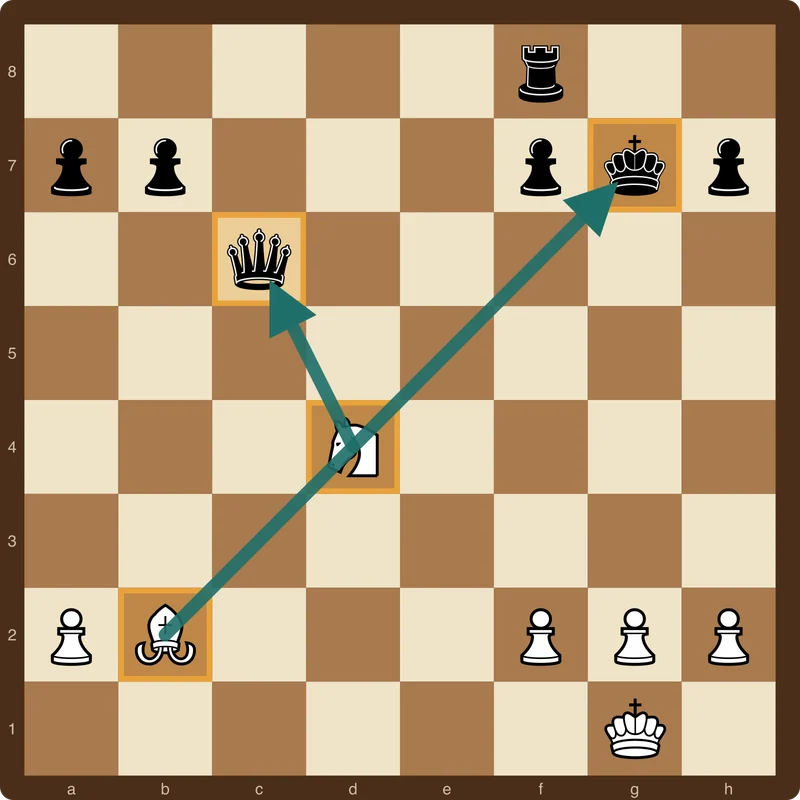
The position above comes from Lesson 7 on discovered attacks in our 12-lesson curriculum, with White to move[8]. See what happens when you stare straight at d4 versus updating the board in your head:
- White’s bishop on b2 aims along the dark-square b2–g7 diagonal at Black’s king on g7, while Black’s queen stands on c6, guarded by the pawn on b7[8].
- White’s own knight on d4 physically blocks that diagonal. Stare directly at d4 and your eyes tell you the diagonal is closed, tempting you to reject
1. Nxc6because1...bxc6looks ready to recapture your knight. - Update only the squares that change[8]. Lift the knight off d4 and set it on c6. Black’s queen vanishes, and vacating d4 opens the b2 bishop’s line straight onto Black’s king on g7.
- The move
1. Nxc6+!therefore wins the queen with discovered check[8]. Black must answer the check first (say,1...Kg8), giving White move two to retreat the knight safely from b7’s attack to e5, e7, d4, b4, a5, or a7[8].
Sighted calculation is already short-range blindfold chess. Looking away clears the old position from your eyes so the future position can hold steady.
What happens in the brain during blindfold play, and why did the USSR ban it?
In 1930, the USSR officially banned simultaneous blindfold chess exhibitions as an alleged health hazard, and Mikhail Botvinnik also discouraged them because of the fatigue they caused[2].
Modern tournament records and scalp recordings let us test what blindfold play actually costs. From 1992 until 2011, Monte Carlo’s annual Melody Amber tournament paired the world’s top grandmasters in both rapid sighted games and rapid blindfold games[9][2]. Vladimir Kramnik, Viswanathan Anand, Alexei Shirov, and Alexander Morozevich traded titles from 1996 to 2007, and Levon Aronian won three times before also taking the 2012 SportAccord blindfold event[2].
In 2003, Christopher F. Chabris and Eliot S. Hearst studied classical, rapid, and rapid blindfold games played by the same 23 grandmasters at Monaco from 1993 to 1998, defining mistakes at a 1.5-pawn shortfall (and blunders as larger drops)[9]. Faster clocks multiplied errors compared with classical chess (a pattern familiar from blitz vs. rapid chess time controls), yet rapid and blindfold error rates did not differ significantly[9]. In 2010, Veljko Jeremić, Dragan Vukmirović, and Zoran Radojičić confirmed that 1993–1998 result, then examined the Monaco 2002–2007 games and found a measurable quality drop in blindfold play relative to rapid sighted chess[10]. Holding an unseen board intact takes real working-memory effort even at elite level.
Electroencephalography (EEG) shows that effort directly. In 2022, Juan Pedro Fuentes-García, José Luis Leon-Llamas, Narcís Gusi, and Santos Villafaina measured EEG and heart-rate variability in a 33-year-old grandmaster rated 2562 Elo, with over 26 years of play and 3–4 hours of daily training[11]. Across a 15+10 sighted game, a 15+10 blindfold game, four 1-minute lightning games (0 wins, 1 draw, 3 losses), and six tactical problems (two low, two medium, and two high difficulty, solving five of six), he won both 15+10 games, though with lower average move quality blindfolded[11]. Cortical theta and alpha power rose in the hardest tasks, and alpha wave power peaked during blindfold play, reflecting intense internal focus and sensory gating that blocks out external distraction[11].
Those results draw two firm scientific lines. First, blindfold play produces temporary exhaustion, similar to the physical strain we cover in whether playing chess burns calories, not brain damage. Second, the skill stays strictly inside chess. In a 2017 review of chess, music, and working-memory studies, Giovanni Sala and Fernand Gobet found no far transfer: visualization drills build chess calculation, while general IQ, school grades, everyday recall, and medical risk of dementia remain unchanged[12] (see what the largest school trial of chess found).
From desert horsemen and 1783 affidavits to 48 boards on an exercise bike
Unseen chess predates modern tournaments by more than a millennium. The earliest recorded blindfold player was Sa’id bin Jubair (665–714) in the Middle East[2]. In 1913, chess historian H. J. R. Murray documented Central Asian horsemen who rode side by side calling out moves aloud without a board, while Europe’s first recorded blindfold event took place in Florence in 1266, staged by Buzecca[2].
On May 9, 1783, French composer and chess master François-André Danican Philidor (1726–1795), author of a famous 1749 treatise on chess, turned sans voir play into a modern spectacle[13]. Having discovered in bed during sleepless nights that he could picture the whole board in the dark, Philidor played three simultaneous blindfold games at Parsloe’s Chess Club on St James’s Street in London, giving all three opponents White and pawn odds on the third board[13][2]. Witnesses signed formal affidavits so posterity would believe three unseen games had been played at once, and at age 67 in 1793 Philidor still won two simultaneous blindfold games in London[2][13].
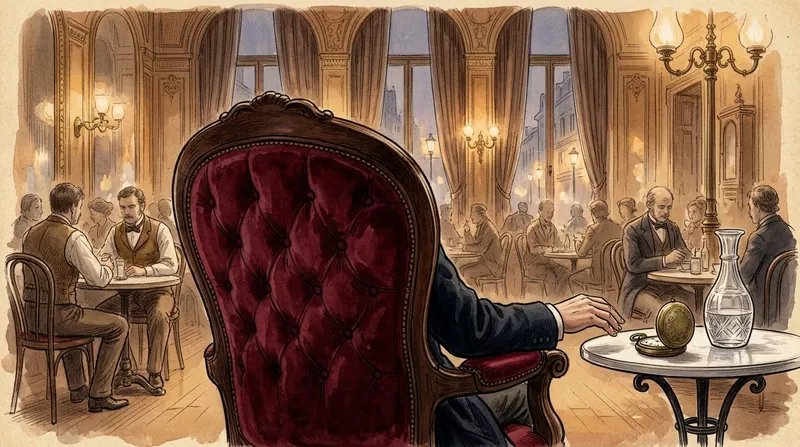
Nineteenth-century masters expanded the art. Louis Paulsen, Joseph Henry Blackburne (up to 16 boards), Wilhelm Steinitz (six boards in Dundee in 1867: 3 wins, 3 draws), and Ellen Gilbert (one of the first women recorded playing blindfold, in the 1870s) all gave noted blindfold displays[2]. Yet the defining 19th-century performance belonged to Paul Morphy (1837–1884), who faced eight strong Parisian players simultaneously at the Café de la Régence in late September 1858, scoring 6 wins, 2 draws, and 0 losses (7 out of 8)[2].
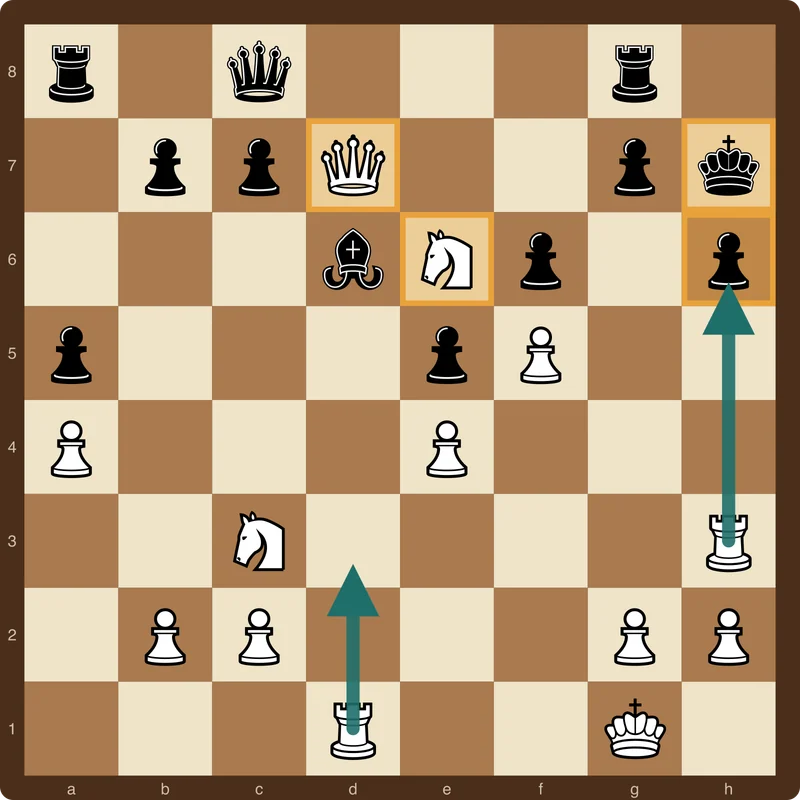
Table 1 against Henri Baucher, recorded by Johann Löwenthal in his 1860 collection (1898 edition, Book II, pages 184–187), shows Morphy’s board vision at full strength[14]. After 24. Qxd7 Bd6, White’s queen on d7 looks trapped by Black’s queen on c8 and bishop on d6.
Juggling seven other games without a board, Morphy spotted a hidden seventh-rank pin (see our guide to forks, pins, and skewers): Qd7 pins Black’s g7 pawn to the king on h7[14].
25. Rxh6+!!Taking with25...gxh6is illegal because g7 is pinned by Qd7, forcing25...Kxh6[14].26. Rd3!Morphy leaves his queen on d7 completely unguarded[14]. Capturing26...Qxd7allows27. Rh3#checkmate in one move, since Ne6 covers g5 and g7 while f5 covers g6 (26...Kh7also loses to27. Rh3#)[14].26...Kh5 27. Qf7+!Baucher played26...Kh5and resigned upon27. Qf7+!, facing forced mate in two (27...Kh4 28. Rh3+ Kg4 29. Qh5#,27...Kg4 28. Qg6+ Kh4 29. Rh3#, or27...g6 28. Qh7+ Kg4 29. Qh3#)[14].
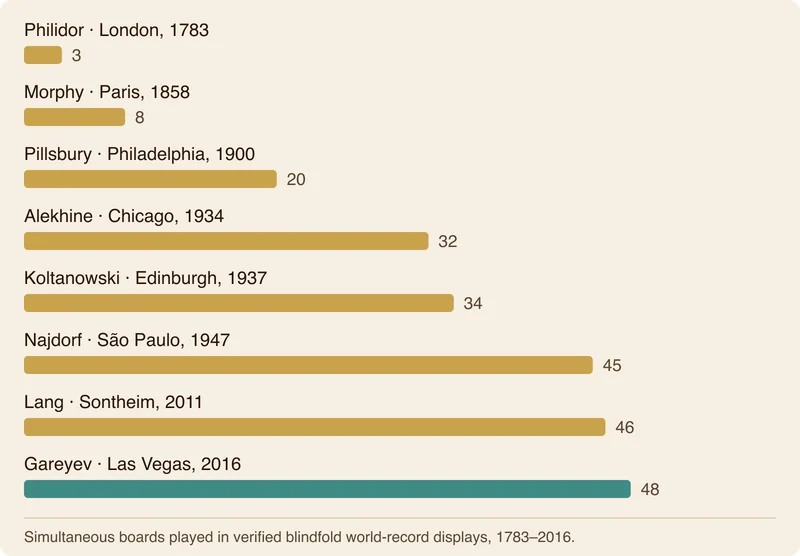
Across the 20th and 21st centuries, verified simultaneous blindfold records climbed from 20 boards to 48:
- 1900: Harry Nelson Pillsbury (20 boards). Pillsbury played 20 blindfold chess boards in Philadelphia in 1900, and once played 15 chess and 15 checkers games blindfolded together (the blindfold checkers record stood at 28)[2].
- 1924–1934: Alexander Alekhine and Richard Réti (26 to 32 boards). Alekhine played 26 boards at New York’s Alamac Hotel in 1924 (16 wins, 5 losses, 5 draws) and 28 against four-player teams in Paris in February 1925 (22 wins, 3 losses, 3 draws); Réti reached 29 in São Paulo later in 1925 (20 wins, 2 losses, 7 draws); and Alekhine reclaimed the record with 32 boards in Chicago on July 16, 1934 (19 wins, 4 losses, 9 draws), refereed by Edward Lasker[2].
- 1937: George Koltanowski (34 boards). On September 20, 1937, Koltanowski played 34 simultaneous blindfold games over 13 hours in Edinburgh, winning 24 of them[2]. In San Francisco in 1960, he also played 56 consecutive blindfold games at 10 seconds per move over nine hours (50 wins, 6 losses), plus blindfold Knight’s Tours up to 192 squares[2].
- 1943 and 1947: Miguel Najdorf (40 and 45 boards). Stranded in Argentina when World War II began during the 1939 Buenos Aires Olympiad, Najdorf staged huge exhibitions hoping news dispatches would reach his family in occupied Poland[2]. He played 40 boards in Rosario in 1943 (36 wins, 1 draw, 3 losses) and 45 boards in São Paulo in 1947 (39 wins, 4 draws, 2 losses)[2]. Koltanowski later claimed he could manage 100 games under multiple-opponent and scoresheet conditions, though historians recognize Najdorf’s 45-board mark as the verified record of that era[2]. János Flesch’s 52-board claim over about five hours in Budapest in 1960 (31 wins, 3 draws, 18 losses) was likewise disputed because he was allowed to recount move scores aloud during play[2].
- 2011 and 2016: Marc Lang (46 boards) and Timur Gareyev (48 boards). After a 23-hour, 35-board European record in November 2010 (19 wins, 13 draws, 3 losses), Marc Lang broke Najdorf’s 64-year-old record with 46 boards in Sontheim in November 2011 (25 wins, 19 draws, 2 losses)[2]. Across December 3–4, 2016, in Las Vegas, Timur Gareyev pedaled an exercise bike in a mask across 48 boards, scoring 35 wins, 7 draws, and 6 losses (38.5 points, or 80.2%)[2].
How can you train board visualization in four steps?
You do not need an eye mask to benefit from blindfold habits. For club and online players, the practical goal is calculating two or three moves ahead in normal sighted games without dropping a piece or missing an open line.
Step 1: Split the 64 squares into four 4×4 quadrants
Holding all 64 squares (eight files a–h by eight ranks 1–8, with 32 light squares, 32 dark squares, and 26 diagonals of two squares or longer) as a single block overwhelms beginners[15]. Cut the board into four symmetric 4×4 quadrants of 16 squares each[15]:
- White’s queenside (
a1–d4): dark cornera1. - White’s kingside (
e1–h4): light cornerh1. - Black’s queenside (
a5–d8): light cornera8. - Black’s kingside (
e5–h8): dark cornerh8[15].
Practice calling out random coordinates (c3, f6, b7, g2) away from the board, naming each square’s quadrant and color until you never have to count up from a1.
Step 2: Use square-color parity for bishops and knights
Square colors work as a fast legality filter. A bishop remains on one square color for the entire game, while every knight jump switches square color from dark to light or light to dark[15]. Before spending a minute calculating a knight fork two moves ahead, check the colors of the two target squares: if one sits on light and the other sits on dark, no single knight move can fork them.
Step 3: Track only the squares that change
Follow the lesson of Campitelli and Gobet’s experiments: track dynamic changes instead of redrawing all 32 starting pieces[6]. After each imagined ply, check three things: which square just emptied (and what line opened behind it), what happened on the arrival square, and which new lines the moved piece now attacks. You can drill those patterns across our 12 step-by-step chess lessons[8] and static discovered-attack diagrams[7].
Step 4: Solve static two-move diagrams before touching a piece
Moving pieces around to “see how it looks” short-circuits calculation, as we explain in how to practice chess with puzzles. On our Chess Moment puzzle pages, 12 tactical themes offer 12 static diagrams per theme, 144 sample positions in all, with hidden solution lines[7][16]. Pick a set of mate-in-two positions, look away from the screen if a piece causes interference, and speak the full forcing line and the opponent’s best defense in notation before unfolding the answer[7]. Once the line is clear, you can test the habit over a clock when you play chess online in your browser in a 10+5 Quick Match, a 3+2, 5+3, or 15+10 friend challenge, or solo practice[17].
Questions people ask
Is blindfold chess legal, and why was it once banned?
Blindfold chess is completely legal and has featured at elite events such as Monte Carlo’s Melody Amber tournament (1992–2011) and the 2012 SportAccord blindfold event[2]. In 1930, however, the USSR officially banned simultaneous blindfold exhibitions as an alleged health hazard, and Mikhail Botvinnik also discouraged them due to fatigue[2].
Who holds the world record for simultaneous blindfold chess?
Grandmaster Timur Gareyev set the verified record of 48 simultaneous blindfold games in Las Vegas across December 3–4, 2016, pedaling an exercise bike in a mask and scoring 35 wins, 7 draws, and 6 losses (80.2%)[2]. He surpassed Marc Lang’s 46 boards (2011) and Miguel Najdorf’s 45 boards (1947)[2].
Do you have to be a master to play a blindfold game?
Not on a single board. Simultaneous exhibitions draw on 50,000 to 100,000 stored chunks[3], whereas one blindfold game requires fluent 4×4 quadrant coordinates, square-color parity, and steady move-by-move updating[1][15]. Most club players who drill square colors and solve static two-move puzzles in their head can finish a full game once piece movement feels automatic.
Does blindfold chess change general memory scores or IQ?
Controlled studies show that the gains remain specific to chess. Blindfold champions score no better than average on everyday memory tests[1], and Giovanni Sala and Fernand Gobet’s 2017 review found that chess visualization training improves chess calculation while leaving general IQ, school grades, and neurological disease risk unchanged[12].
Sources
- Mechner, F. (2010). “Chess as a behavioral model for cognitive skill research: Review of Blindfold Chess by Eliot Hearst and John Knott.” Journal of the Experimental Analysis of Behavior, 94(3), 373–386.
- Wikipedia contributors. “Blindfold chess.” Wikipedia, The Free Encyclopedia.
- Chase, W. G., & Simon, H. A. (1973). “Perception in chess.” Cognitive Psychology, 4(1), 55–81.
- Saariluoma, P. (1991). “Aspects of skilled imagery in blindfold chess.” Acta Psychologica, 77(1), 65–89.
- Saariluoma, P., & Kalakoski, V. (1998). “Apperception and imagery in blindfold chess.” Memory, 6(1), 67–90.
- Campitelli, G., & Gobet, F. (2005). “The mind’s eye in blindfold chess.” European Journal of Cognitive Psychology, 17(1), 23–45.
- Boardgammon. “Chess Puzzles: 12 Tactical Themes and Sample Positions.”
- Boardgammon. “Chess Lessons: Step-by-Step Curriculum.”
- Chabris, C. F., & Hearst, E. S. (2003). “Visualization, pattern recognition, and forward search: effects of playing speed and sight of the position on grandmaster chess errors.” Cognitive Science, 27(4), 637–648.
- Jeremić, V., Vukmirović, D., & Radojičić, Z. (2010). “Does playing blindfold chess reduce the quality of game: comments on Chabris and Hearst (2003).” Cognitive Science, 34(1), 1–9.
- Fuentes-García, J. P., Leon-Llamas, J. L., Gusi, N., & Villafaina, S. (2022). “Are there neurophysiological differences behind the play of different chess modalities?: An international grandmaster case study.” Physiology & Behavior, 255, 113918.
- Sala, G., & Gobet, F. (2017). “Does far transfer exist? Negative evidence from chess, music, and working memory training.” Current Directions in Psychological Science, 26(6), 515–520.
- Wikipedia contributors. “François-André Danican Philidor.” Wikipedia, The Free Encyclopedia.
- Löwenthal, J. (1898 [1860]). Morphy’s Games of Chess: Being the Best Games Played by the Distinguished Champion in Europe and America, Book II, “Blindfold Games Played in Paris, Table No. 1 (Mr. Morphy and M. Baucher),” pp. 184–187. London: George Bell and Sons.
- Boardgammon. “Standard 8×8 chessboard quadrant, diagonal, and square-color parity arithmetic.”
- Boardgammon. “Chess Moment: Play Rated Chess Online.”
- Boardgammon. “Chess Moment: Play Online Chess in Your Browser.”
Found a mistake or an odd phrase? Tell us